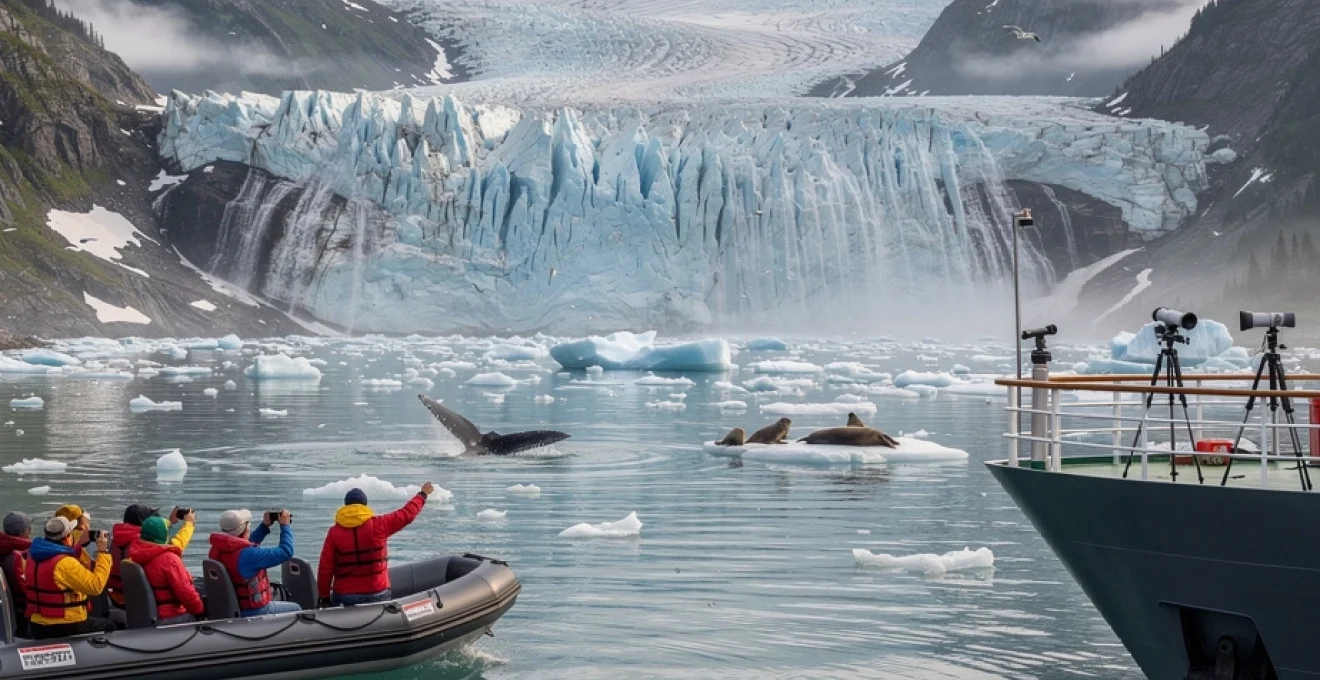
Alaska’s pristine glacial landscapes represent one of Earth’s most spectacular natural phenomena, where ancient ice formations meet the sea in dramatic displays of calving icebergs and thunderous rumbles. Small-ship glacier expeditions offer unparalleled access to these frozen giants, allowing travellers to witness the raw power of nature up close while navigating waters that larger vessels simply cannot reach. The intimate scale of expedition vessels, typically carrying between 60-100 passengers, creates opportunities for spontaneous wildlife encounters and glacier viewing that transform a simple cruise into an extraordinary Arctic adventure.
The logistical advantages of smaller expedition ships become immediately apparent when approaching Alaska’s most remote glacial systems. These vessels possess the manoeuvrability and shallow draft necessary to penetrate deep into protected fjords, positioning passengers within safe yet thrilling proximity to active glacier faces. The experience of hearing glacier ice crack and witnessing massive chunks calve into the sea creates memories that last a lifetime, particularly when viewed from the comfort of a well-appointed expedition ship equipped with specialised glacier-viewing amenities.
Alaska’s premier glacier regions for Small-Ship navigation
Alaska’s coastal geography encompasses over 100,000 glaciers, yet only a select few remain accessible to maritime vessels throughout the cruise season. The convergence of tectonic activity, precipitation patterns, and coastal topography has created distinct glacial regions, each offering unique characteristics for small-ship exploration. Understanding these regional differences enables expedition planners to craft itineraries that maximise glacier diversity while accounting for seasonal accessibility and weather patterns.
The Inside Passage region alone contains more than 3,000 named glaciers, ranging from massive tidewater systems that calve directly into the ocean to hanging glaciers perched on fjord walls. Small expedition vessels excel in these protected waters, where calm conditions and strategic positioning allow for extended glacier observation periods. The protected nature of Southeast Alaska’s waterways means that weather-related itinerary changes occur less frequently than in more exposed coastal areas.
Prince william sound’s columbia and meares glaciers
Columbia Glacier stands as one of Alaska’s most dynamic tidewater glaciers, retreating rapidly and producing spectacular iceberg displays throughout the summer months. This 41-mile-long glacier system creates an ever-changing landscape of ice formations, where small ships can navigate through dense iceberg fields while maintaining safe distances from the active terminus. The glacier’s retreat rate of approximately 115 feet per year ensures that each visit reveals new configurations of ice architecture.
Meares Glacier, located in nearby Unakwik Inlet, offers a more stable viewing experience with consistent access throughout the cruise season. The protected nature of this fjord system allows expedition vessels to approach within 400-500 metres of the glacier face, providing exceptional photographic opportunities. The acoustic properties of Unakwik Inlet amplify the sounds of glacial movement, creating an immersive sensory experience as ice shifts and settles within the glacier structure.
Glacier bay national park’s margerie and grand pacific glaciers
Margerie Glacier represents the crown jewel of Glacier Bay’s tidewater glacier collection, advancing at a rate of several feet per year while maintaining a dramatic 250-foot-high ice face. Small expedition ships benefit from National Park Service regulations that limit vessel numbers and establish specific approach protocols, ensuring a pristine viewing environment. The glacier’s stability and accessibility make it an ideal location for extended observation periods, allowing passengers to witness multiple calving events during a single visit.
Grand Pacific Glacier, positioned at the head of Tarr Inlet, showcases the international nature of glacial systems as it extends across the Alaska-Canada border. The retreat and advance cycles of this glacier have been documented for over a century, providing expedition naturalists with compelling historical context during presentations.
The juxtaposition of Margerie and Grand Pacific glaciers within the same inlet demonstrates the varied responses of ice systems to climate fluctuations
, offering passengers a natural laboratory for understanding glacial dynamics.
Tracy arm fjord’s sawyer glacier terminus
Tracy Arm’s narrow configuration creates unique challenges and opportunities for small-ship navigation, with towering fjord walls rising over 3,000 feet above sea level. The dramatic approach to Sawyer
Glacier culminates in a tight amphitheatre where the North and South Sawyer Glacier faces frequently calve into a maze of brash ice and growlers. Small-ship captains time their arrivals to coincide with optimal light and tidal conditions, often spending several hours slowly repositioning the vessel for different viewing angles. The restricted width of the fjord naturally limits larger ships, but expedition vessels can nose closer to the ice, sometimes deploying Zodiacs when conditions permit. For travellers, this means lingering long enough to notice subtle changes in the glacier surface, from new crevasses opening to seracs toppling into the sea. The sense of scale becomes striking when harbour seals, resting on ice floes, appear as tiny dark specks against the vast blue-white walls.
College fjord’s harvard and yale tidewater systems
College Fjord, in northern Prince William Sound, hosts an extraordinary concentration of glaciers, many named after Ivy League universities by early 20th-century explorers. Harvard Glacier, one of the largest tidewater glaciers in the fjord, presents an impressive, widely splayed face that can stretch more than a mile across. Its relatively consistent calving activity and broad terminus offer exceptional opportunities for panoramic photography from the open decks of a small-ship cruise. The fjord’s protected waters typically remain calm, making it a reliable highlight on multi-day glacier itineraries.
Yale Glacier, tucked into a neighbouring arm of College Fjord, offers a contrasting perspective on Alaska glacier exploration. While smaller than Harvard, it is often framed by steep, forested slopes and cascading waterfalls that soften the starkness of the ice. Expedition leaders may alternate between the two glacier systems depending on ice density and weather, optimising your chances of clear views and safe approaches. Because of the fjord’s geography, you can often observe multiple valley glaciers descending from the surrounding mountains in a single slow turn of the ship. For those interested in comparing glacier behaviour, College Fjord functions like an open-air classroom where different stages of glacial advance and retreat are displayed side by side.
Small-ship design features for glacier observation
The design of a modern expedition vessel directly shapes your experience of Alaska’s glaciers on a small-ship cruise. Unlike large cruise liners built primarily for point-to-point travel, small ships are engineered to linger, pivot and hold position in tight fjords while passengers watch calving events or photograph wildlife. Naval architects balance hull strength, manoeuvrability and comfort so that the ship can safely navigate iceberg-dense waters without sacrificing onboard amenities. When you understand these design features, you can better appreciate why certain itineraries access remote glacier regions that conventional cruises must bypass. You also gain insight into how safety is preserved even when the ship appears to be operating at the very edge of the ice.
Ice-class hull reinforcement and displacement ratios
Operating close to tidewater glaciers requires more than just skilled captains; it depends on hulls designed to withstand contact with floating ice. Many expedition vessels carry an ice-strengthened or ice-class rating, indicating that critical parts of the hull have been reinforced with thicker steel and additional framing. While these ships are not icebreakers, the added strength allows them to safely push through brash ice and small bergy bits at reduced speeds. This capability significantly expands the envelope of safe navigation within Alaska’s glacier fjords.
Displacement ratios play a quieter but equally important role in glacier cruising. Ships with higher displacement sit deeper and may ride more smoothly in open water, but they lose some flexibility in shallow approaches. Smaller expedition vessels typically optimise for a balance between displacement and draft, enabling them to enter narrower channels while still remaining stable when drifting among ice. Think of it as the difference between steering a compact SUV and a long-haul truck down a winding mountain road—both can travel, but only one can comfortably negotiate tight curves. When choosing a small-ship cruise, looking at a vessel’s ice-class rating and overall size can help you gauge how close you are likely to get to active glacier fronts.
Bow thruster systems for precise glacier face positioning
Bow thrusters—lateral propulsion units near the front of the ship—are crucial for fine-tuning a vessel’s position in front of a glacier. In the confined spaces of a fjord, traditional rudder steering alone may not provide enough control for the captain to maintain a safe but satisfying observation distance. Bow thrusters allow the ship to sidestep into the optimal viewing line or gently counter the effects of wind and currents without constant forward motion. This is particularly useful when captains want to remain largely stationary while passengers photograph a glacier face over an extended period.
On an Alaska small-ship cruise, you may notice the vessel slowly rotating so that different decks and lounges gain a front-row view of the glacier. This controlled “pirouette” is largely made possible by bow thrusters working in concert with the main propulsion system. It also enhances safety: if new icebergs calve and drift toward the ship, the captain can rapidly adjust position laterally to increase distance. From a passenger perspective, this translates into more time spent actually looking at glaciers and less time in transit, making each glacier stop feel like a dedicated event rather than a brief passing moment.
Stabiliser technology for calving event photography
Stabilisers, whether traditional fin-based systems or more modern gyroscopic units, are primarily associated with reducing roll in open seas. Yet they also contribute significantly to the quality of your glacier-viewing experience. Even in protected fjords, wind gusts and swell reflected from steep rock walls can cause a vessel to rock unexpectedly. Stabilisers dampen this motion, making it easier for passengers to stand at railings, frame shots, and track fast-moving wildlife or falling ice with cameras and binoculars.
If you have ever tried to photograph a calving event while the deck moves beneath your feet, you know how valuable a stable platform can be. Stabilisers effectively turn the ship into a floating observation deck, improving both comfort and safety for guests moving between indoor and outdoor spaces. For keen photographers, this is the difference between capturing a sharp sequence of ice crashing into the sea and returning home with a series of blurred images. While no technology can remove all motion, modern stabilisation significantly enhances the practicality of glacier face photography, especially when extended telephoto lenses are involved.
Shallow draft capabilities for fjord navigation
A shallow draft—the vertical distance between the waterline and the bottom of the hull—is one of the hallmarks of a true expedition vessel in Alaska. Many glacier fjords feature uneven bottoms, submerged moraines and silty shallows created by glacial meltwater. Ships with deep drafts must remain farther from the glacier terminus and may be forced to turn back if soundings indicate reduced depth. By contrast, a shallow-draft small ship can safely explore further into narrow inlets and approach closer to ice fronts, provided that other safety criteria, such as ice density and calving risk, are met.
From a traveller’s point of view, shallow draft translates into more time surrounded by dramatic scenery and less time looking at it from a distance. It also enables captains to respond flexibly to changing conditions. If one arm of a fjord becomes choked with ice, they may be able to divert into a secondary channel that would be inaccessible to larger vessels. This “go where the conditions are best today” approach is a defining characteristic of Alaska’s small-ship glacier expeditions and a key reason they can deliver such intimate encounters with both ice and wildlife.
Glacial dynamics and formation processes in southeast alaska
Understanding how Alaska’s glaciers form, flow and change over time adds depth to the visual spectacle of a small-ship cruise. Glaciers begin as layers of compacted snow accumulating over centuries in high-altitude basins where yearly snowfall exceeds summer melt. As the snow compresses into dense glacial ice, gravity slowly pulls the mass downslope, carving valleys and fjords as it moves. In Southeast Alaska, heavy coastal precipitation and rugged topography create ideal conditions for this process, resulting in some of the fastest-moving and most responsive glaciers on the planet.
Once a glacier reaches tidewater, it transitions into what scientists call a tidewater glacier system, interacting directly with the ocean. Here, glacial dynamics resemble a slow-motion conveyor belt: ice flows seaward while calving, melting and submarine erosion remove mass at the terminus. When the rate of ice delivery from upstream roughly matches losses at the front, the glacier appears stable. If melt and calving outpace supply, the glacier retreats; if supply exceeds loss, it may advance. You can often see these changes from year to year on an Alaska cruise, especially in dynamic systems like Columbia or Sawyer Glacier.
Climate trends introduce another layer of complexity. Warmer air and ocean temperatures increase surface melt and undercutting at the glacier front, accelerating retreat in many Southeast Alaska glacier systems. At the same time, snowfall patterns at high elevations remain variable, meaning some interior or high-altitude glaciers can still advance or thicken. This is why you might see one glacier in rapid retreat while another nearby appears relatively stable. For travellers, a small-ship cruise through multiple fjords offers a rare chance to compare these different responses to climate within a single journey, almost like flipping through a live atlas of glacial change.
Glacial features visible from the deck—such as crevasses, seracs, moraines and trimlines—provide visual clues to these underlying processes. Crevasses indicate areas of faster flow or stretching; towering seracs reveal zones of intense internal deformation. Moraines, the rocky ridges along valley sides or floors, mark former ice boundaries and transport pathways for debris. Trimlines, where vegetation abruptly changes height or colour on the fjord walls, trace past maximum glacier extents. Once you learn to “read” these signs, each glacier encounter becomes more than a photo opportunity; it becomes a story of ice, time and landscape evolution unfolding in front of you.
Wildlife encounter protocols around tidewater glaciers
Approaching tidewater glaciers by small ship often brings you into some of Alaska’s richest wildlife habitats. Harbour seals haul out on ice floes to rest and nurse pups, bald eagles perch on bergs scanning for fish, and humpback whales sometimes feed in the nutrient-rich waters near glacier outflows. With such abundance comes responsibility. Ethical wildlife viewing in Alaska’s glacier fjords depends on strict encounter protocols designed to minimise disturbance while still allowing unforgettable sightings. Small-ship operators work within both regulatory frameworks and voluntary guidelines to strike this balance.
Most reputable expedition companies follow approach distances set or recommended by agencies such as the National Park Service and NOAA Fisheries. For example, vessels typically maintain at least 100 yards from seals on ice and greater distances from whales, especially when calves are present. Captains adjust speed and course to avoid cutting off animals’ movement paths, and engines may be placed in neutral when whales surface nearby. These practices reduce stress on wildlife and prevent the kind of repeated disturbance that can alter feeding or resting behaviour over time.
Onboard naturalists play a crucial role in reinforcing wildlife protocols with guests. Before entering high-density habitat near a glacier, they will brief you on quiet zones, appropriate viewing angles and the importance of avoiding sudden movements along railings. Why does this matter? Many animals, particularly seals with young pups, are highly sensitive to noise and visual disruption. A single mass flush from an ice floe can waste valuable energy at a time when survival margins are already thin. By staying calm and following crew instructions, you help ensure that your presence leaves as light a footprint as possible.
Responsible operators also limit the number and duration of close wildlife encounters in a single area, even when regulations would technically allow more intensive viewing. The aim is to collect moments, not disturb ecosystems. Over the course of an Alaska glacier cruise, this can mean fewer but higher-quality sightings, where animals behave naturally and you have time to observe subtle behaviours such as cooperative feeding or playful seal pups. In this way, tidewater glacier regions become living classrooms where conservation is practised, not just discussed.
Zodiac deployment strategies for glacier terminus exploration
One of the defining advantages of a small-ship glacier cruise is the ability to leave the mother ship and explore by Zodiac. These rigid-hull inflatable boats provide unmatched manoeuvrability in iceberg-dense waters, allowing you to weave among floes, approach waterfalls cascading off fjord walls and gain new perspectives on massive glacier faces. Effective Zodiac operations, however, require careful planning and strict adherence to safety standards. Expedition teams coordinate launch timing, passenger loading and route selection to align with both environmental conditions and wildlife protocols.
Typically, Zodiac excursions near glacier termini are staggered so that groups can spread out across the fjord, reducing congestion and wake interference. Guides communicate via radio about shifting ice fields, wildlife locations and any emerging hazards. You might notice a specific choreography: as one boat moves closer to the terminus (within safe limits), another hangs back to give a broader, more panoramic vantage. This choreography is no accident; it is designed to maximise varied experiences while ensuring that rescue support is always within rapid reach should conditions change.
Safety protocols for iceberg-dense waters
Navigating Zodiac boats through iceberg-dense waters demands a conservative, safety-first mindset. Guides are trained to read ice patterns, spotting stable floes suitable for closer viewing and avoiding areas where tightly packed brash ice could trap or damage the boat. They also maintain significant stand-off distances from larger bergs, which can roll or fracture without warning, sending waves and fragments in all directions. Even seemingly small chunks of ice can cause serious harm when struck at speed, so Zodiacs travel slowly and deliberately in glacier zones.
Each outing begins with a safety briefing that covers life jacket use, handholds, seating positions and emergency signals. You will be reminded to keep cameras and bags secured so that your hands remain free to brace or hold on if the boat meets unexpected chop. In many operations, a dedicated safety Zodiac accompanies the group, carrying extra gear and remaining slightly detached so it can respond quickly to any issue. These layers of precaution may feel extensive, but they allow you to focus on the scenery knowing that robust systems are in place.
Engine positioning techniques near calving zones
Engine management is one of the most subtle yet important skills in Zodiac-based glacier exploration. Guides learn to position their boats so that the engine and propeller remain oriented away from the direction of potential calving waves and icefall. This usually means facing the bow toward the glacier while maintaining enough lateral distance to sidestep incoming ice. Think of it as parallel parking in a river that can change course at any moment; you want both power and escape routes available at all times.
Speed is kept low near calving zones to preserve manoeuvrability and minimise collision risk with floating debris. When a calving event occurs, guides may briefly turn the boat to meet the wave head-on, reducing roll, then quickly adjust position to maintain safe separation from newly released ice. Radio communication with other Zodiacs and the main ship ensures that all craft respond coherently to any large event. For passengers, these techniques may go unnoticed when executed well, but they underpin the sense of calm and control you feel even when the environment appears dramatic and unpredictable.
Passenger briefing systems for cold-water environments
Cold-water operations demand a higher level of preparedness, and passenger briefings are structured accordingly. Before the first Zodiac excursion, crew members typically walk you through immersion risks, appropriate clothing layers and what to do if a fall into the water occurs. While accidental immersion is rare thanks to strict boarding procedures and stable boats, the consequences in near-freezing water are serious enough that no shortcuts are taken. You may be outfitted with additional gear, such as waterproof overpants or insulated life vests, depending on the operator and the day’s conditions.
Briefings also address comfort and endurance. Guides will advise you to protect exposed skin, keep spare gloves dry and avoid sitting directly on cold, wet surfaces for extended periods. Many travellers underestimate how quickly body heat is lost when stationary in a light breeze surrounded by ice. By following recommended clothing strategies—base layers, insulating mid-layers and windproof outer shells—you can remain warm enough to focus on the experience rather than the temperature. Clear, repeated communication ensures that even first-time expedition cruisers feel confident stepping into a Zodiac beside an active glacier.
Seasonal timing for optimal glacier visibility and accessibility
Choosing when to cruise Alaska’s glacier regions is nearly as important as choosing which small ship to sail on. The primary expedition season for Southeast Alaska and Prince William Sound runs from late April through September, but conditions shift markedly within that window. In spring and early summer, snow still clings to the mountain tops, waterfalls run strong with meltwater, and many glaciers are framed by fresh snowfields that enhance contrast for photography. By mid-summer, longer days and warmer temperatures bring increased wildlife activity and often more comfortable deck time, though fog can be more common in some fjords.
From late May through July, tidewater glaciers such as Margerie, Columbia and Sawyer tend to exhibit frequent calving as seasonal melt accelerates. This period is ideal if witnessing dramatic glacier calving is at the top of your wish list. Harbour seal pupping near ice floes also peaks in early summer, adding another layer of interest to glacier-front visits. However, operators must be especially mindful of wildlife protection protocols during this time, sometimes increasing stand-off distances to avoid disturbing nurseries. For travellers, this may mean slightly more distant but ethically sound viewing of seal colonies.
By August and early September, many fjords experience reduced floating ice density, which can improve access for both ships and Zodiacs. This can be an excellent time for kayakers and photographers who value clear water and reflective surfaces for mirror-like glacier shots. Autumn colours begin to appear in some lower-elevation forests, providing a striking contrast against lingering snow and ice higher up. On the other hand, daylight hours start to shorten, and the first major storms of the season may occasionally disrupt itineraries in more exposed areas.
When weighing the best time to take an Alaska small-ship glacier cruise, consider your priorities: do you prefer peak wildlife and energetic calving, or quieter fjords with fewer boats and softer light? Shoulder-season departures in late April, early May or mid-September often offer competitive pricing and fewer crowds, though some glacier regions may still be locked in by winter ice or already shifting toward winter conditions. Consulting with an experienced expedition planner who knows the nuances of each itinerary and vessel can help you align your travel dates with your expectations. With the right timing, ship and route, exploring Alaska’s glaciers by small ship becomes not just a journey through extraordinary scenery, but a deeply informed encounter with one of Earth’s most powerful natural forces.