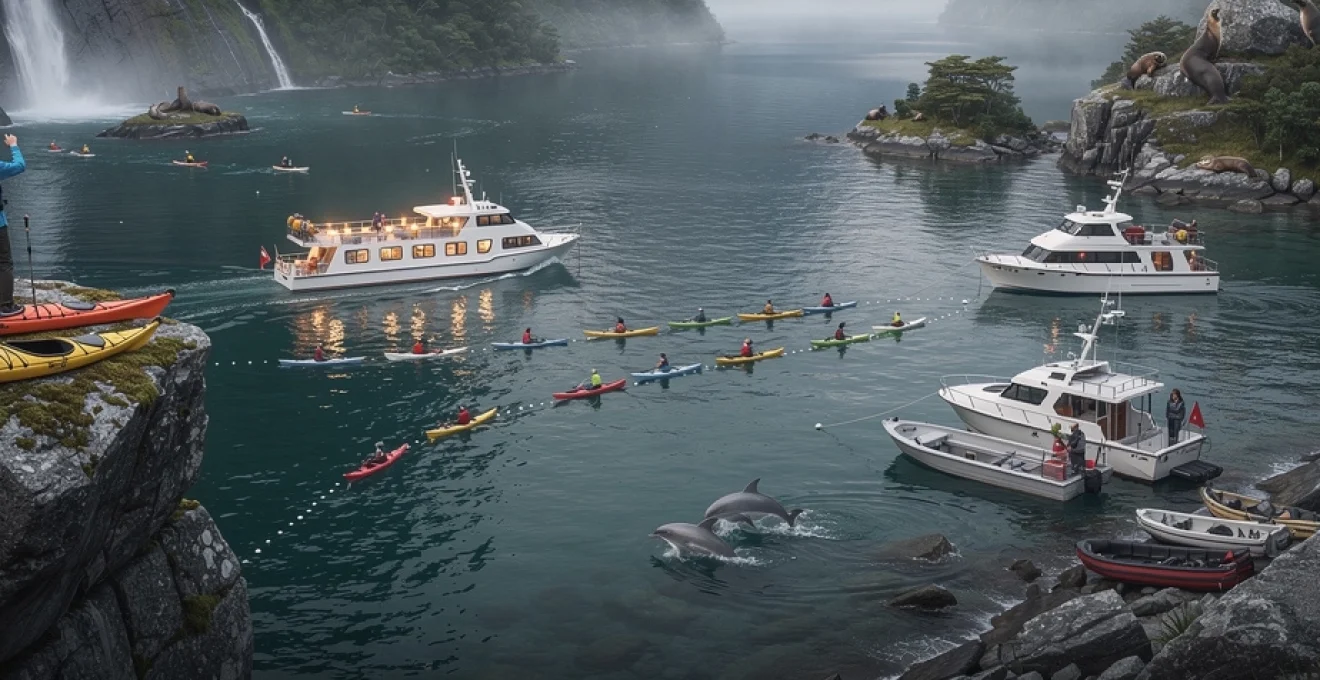
New Zealand’s fjordland region represents one of the world’s most dramatic natural landscapes, where ancient glaciers carved deep valleys into the mountainous terrain, creating spectacular waterways that penetrate kilometres inland from the Tasman Sea. These geological masterpieces, protected within Fiordland National Park, offer visitors an extraordinary opportunity to witness pristine wilderness, towering waterfalls cascading hundreds of metres down sheer rock faces, and diverse marine ecosystems thriving in dark, tannin-stained waters. The remote nature of these fjords has preserved their untouched character, making each excursion feel like a journey back through geological time. Whether you’re seeking adrenaline-fuelled kayaking adventures, luxurious overnight cruises, or aerial perspectives from helicopter tours, the fjords of New Zealand deliver experiences that rank among the planet’s most memorable natural encounters.
Milford sound: navigating new zealand’s most iconic fiordland wilderness
Milford Sound stands as New Zealand’s most accessible and visited fjord, yet its grandeur remains undiminished by popularity. The 15-kilometre-long waterway extends from the Tasman Sea inland to Harrison Cove, flanked by near-vertical cliffs rising up to 1,200 metres above the water’s surface. Mitre Peak, the fjord’s most recognisable landmark, soars 1,692 metres directly from sea level, creating one of the world’s most photographed natural formations. The journey to Milford Sound along the 119-kilometre Milford Road from Te Anau constitutes an attraction in itself, winding through Homer Tunnel and past numerous viewpoints showcasing alpine lakes, avalanche-prone mountain passes, and native beech forests.
Day cruises represent the most popular method of exploring Milford Sound, with vessels departing regularly throughout the day from the terminal at Deepwater Basin. These 1.5 to 2-hour excursions navigate the full length of the fjord, passing beneath Stirling Falls and Bowen Falls, where water plummets 155 metres and 162 metres respectively into the sound below. On rainy days—which occur approximately 200 days annually in this region—hundreds of temporary waterfalls appear on the cliffsides, creating an even more spectacular experience. The unique U-shaped profile of the fjord, carved by glacial ice over successive ice ages, becomes particularly evident when viewing the steep walls from water level, demonstrating the immense erosive power that shaped this landscape.
Overnight cruising aboard real journeys and mitre peak expeditions
For those seeking a more immersive Milford Sound experience, overnight cruises provide opportunities to witness the fjord’s changing moods as daylight fades and dawn breaks over the mountains. Real Journeys operates the Milford Wanderer and Milford Mariner vessels, purpose-built for overnight expeditions with comfortable cabins and dining facilities. These cruises typically depart in the late afternoon, allowing guests to explore the fjord during the quieter evening hours when day-trippers have departed. The stillness after sunset creates ideal conditions for observing the fjord’s reflective qualities, with mountain peaks mirroring perfectly in the calm waters when wind conditions permit.
Mitre Peak Cruises offers a more intimate experience aboard smaller vessels, with passenger numbers limited to ensure personalised service and access to remote anchorage points. These overnight excursions include opportunities for kayak exploration, nature walks to isolated beaches, and the chance to observe nocturnal wildlife activity around the vessel. Spending the night anchored in Harrison Cove or Milford Sound’s inner reaches provides a profound sense of connection to this wilderness environment, particularly when heavy rain generates the roar of waterfalls echoing off rock walls throughout the night. The experience differs markedly from day visits, offering insights into how weather patterns shift rapidly in this high-rainfall region.
Kayaking through stirling falls and seal colonies at harrison cove
Sea kayaking in Milford Sound delivers an intimate perspective unmatched by larger vessels, bringing paddlers directly alongside towering cliffs, into hidden coves, and beneath thundering waterfalls. Guided kayak tours typically launch from Deep Water Basin or join overnight cruises as add
on experiences, giving you the flexibility to paddle for a few hours or commit to a full-day adventure reaching the outer reaches of the fiord. As you glide beneath Stirling Falls, expect to feel the cooling mist and hear the thunder of 155 metres of water crashing into the dark fjord below, a visceral reminder of Milford Sound’s immense power. Harrison Cove, sheltered from the strongest winds, often offers calmer conditions ideal for beginners, and it is here that New Zealand fur seals frequently haul out on rocks, dozing between fishing forays. Encountering these curious animals at water level, with Mitre Peak looming in the distance, is an experience that feels almost cinematic. For safety and to minimise environmental impact, guided tours provide all necessary gear, including spray skirts, buoyancy aids, and sometimes dry bags, ensuring you can focus on scenery rather than logistics.
Scenic flights from queenstown: helicopter and fixed-wing access routes
While travelling to Milford Sound by road is iconic, scenic flights from Queenstown offer a completely different perspective on Fiordland’s fjords. Helicopter and fixed-wing aeroplane tours trace routes over Lake Wakatipu, the rugged Humboldt and Darren Mountains, and glacial valleys that are inaccessible by foot or boat. From the air, the fjords resemble giant stone fingers reaching into the Tasman Sea, their sheer walls scarred by ancient ice flows, an aerial view that makes the region’s glacial origins instantly clear. On clear days, you can see as far as the snow-capped peaks of Mount Aspiring National Park, while in more dramatic weather, cloud layers create shifting patterns of light and shadow across the landscape.
Helicopter flights often include alpine landings on remote ridgelines or glacier fields, allowing you to step out into silence broken only by the wind, a contrast to the bustle at Milford’s wharf. Fixed-wing flights, typically using small aircraft seating between 7 and 14 passengers, generally follow established flight paths along valleys and over passes such as the famous Milford Sound flight route via the Milford Track region. Many operators offer “fly-cruise-fly” or “coach-cruise-fly” packages, combining a Milford Sound cruise with one-way or return scenic flights to reduce travel time significantly. If you’re looking to maximise fjord time and minimise hours on the road, these flight options can turn a 12–14 hour day tour into a 5–7 hour premium experience.
Weather plays a crucial role in the operation of scenic flights to New Zealand’s fjords, and safety regulations are strict. Low cloud ceilings, high winds, or heavy rain can cause flight cancellations or last-minute itinerary changes, so it is wise to schedule flights early in your trip to allow flexibility for rebooking. Most operators provide full refunds or alternative transport if weather prevents flying, and you can usually confirm conditions a few hours before departure. When flights do operate, you’ll want to sit by a window and keep your camera at the ready, as the ever-changing play of light on glaciers, lakes, and fjords makes each journey unique. Think of it as watching a live nature documentary where you control the view with a simple turn of your head.
Underwater observatory at harrison cove: marine biodiversity encounters
One of Milford Sound’s most distinctive excursions is a visit to the underwater observatory at Harrison Cove, where you can explore the fjord’s secret world beneath the surface without getting wet. The observatory, reached by boat as part of selected cruise itineraries, descends around 10 metres underwater, taking you below the fresh-water layer that sits atop the fiord’s heavier salt water. This unique stratification, created by tannin-stained rainfall running off the surrounding forests, blocks much of the sunlight and allows deep-water species to thrive at shallow depths. As a result, you can see black coral, usually found at depths beyond recreational diving limits, growing just outside the observatory windows.
Inside the observatory, interpretive panels and guides explain the complexities of Fiordland’s marine ecosystems, from tiny plankton to large bottlenose dolphins that occasionally patrol the entrance to the fjord. You’ll likely spot colourful anemones, sponges, and fish species adapted to the dim conditions, creating an underwater scene that feels more like a twilight forest than a typical coastal reef. Because the structure is anchored to the seafloor rather than floating, there is minimal motion, making it comfortable even for those prone to seasickness. For families, this experience is a practical way to introduce children to marine science while still enjoying the broader grandeur of Milford Sound.
The underwater observatory visit is typically an add-on component to a standard Milford Sound cruise, extending your overall excursion by an hour or so. When planning, it is worth checking whether your chosen operator includes this stop, as availability can vary by season and departure time. If you’re deciding between multiple Milford Sound excursions and wondering which offers the greatest variety in a single day, combining a cruise with the Harrison Cove observatory provides perspectives from above and below the waterline. In many ways, it’s like reading both sides of the same story: the towering cliffs and waterfalls tell you how the fjord was carved, while the dark waters reveal how life has adapted to this extraordinary environment.
Doubtful sound expeditions: remote wilderness access via wilmot pass
Doubtful Sound, often called the “Sound of Silence,” offers a more remote and tranquil alternative to Milford Sound, rewarding visitors who are willing to invest extra travel time. Located deeper within Fiordland National Park, it is inaccessible by road, which preserves its wild character and limits visitor numbers compared with more famous fjords. To reach Doubtful Sound, you must first cross Lake Manapouri by boat and then traverse the rugged Wilmot Pass by coach, an expedition-style journey that feels like an adventure before you even see the water. The payoff is a vast, three-armed fiord system more than 40 kilometres long, surrounded by steep forested slopes and peaks that rarely feel crowded, even in peak season.
The atmosphere in Doubtful Sound differs noticeably from Milford Sound; the fiord is broader, the water often glassier, and the sense of isolation more pronounced. On calm days, the reflections of mountains and clouds are so perfect that it can be hard to distinguish where the landscape ends and its mirror image begins. Even when Fiordland’s frequent rain arrives, veils of mist and countless cascading waterfalls give the fiord a mysterious, layered quality. If you’re seeking a New Zealand fjord excursion where stillness and subtlety replace hustle and bustle, Doubtful Sound is an exceptional choice. Many travellers report that while Milford delivers the dramatic postcard views, Doubtful offers the deeper emotional connection.
Manapouri power station underground tour and lake crossing logistics
Your Doubtful Sound adventure typically begins at the small township of Manapouri, located on the shores of Lake Manapouri, about a 20-minute drive from Te Anau. After checking in with your tour operator, you board a boat for a 30–45 minute cruise across the lake, passing forested islands and mountain backdrops that set the tone for the remote wilderness ahead. Some excursions include a visit to the Manapouri Power Station, one of New Zealand’s most ambitious engineering projects, built deep underground in the 1960s. Here, a network of tunnels channels water from Lake Manapouri through massive turbines before discharging into Doubtful Sound, harnessing the immense energy of Fiordland’s natural hydrology.
The optional underground power station tour adds a fascinating cultural and technical layer to your fjord journey, illustrating how human ingenuity can coexist with, and sometimes challenge, wild landscapes. You travel via coach down a spiral access tunnel to reach the machine hall, an enormous underground cavern housing generators and control systems. Interpretive displays explain how the station operates, its environmental impact, and the history of New Zealand’s “Save Manapouri” conservation campaign, which fundamentally shaped the nation’s environmental policy. If you’re interested in the intersection of nature and engineering, this behind-the-scenes experience turns your fjord excursion into a rare combination of eco-tourism and industrial heritage.
After crossing Lake Manapouri, all visitors to Doubtful Sound transfer to a coach for the journey over Wilmot Pass, often cited as one of New Zealand’s most remote roads. Built to support the Manapouri Power Station project, this gravel route climbs through dense rainforest and offers spectacular viewpoints over Doubtful Sound’s inner reaches. Weather can vary dramatically along the pass, from clear vistas to misty, rain-drenched scenes where waterfalls appear from every ridge. As with all Fiordland excursions, layering your clothing and carrying a waterproof jacket is essential, as conditions can change as quickly as turning a page in a book.
Multi-day kayaking circuits through deep cove and crooked arm
For those seeking a more immersive and self-propelled way to discover Doubtful Sound, multi-day kayaking expeditions offer a chance to explore its branching waterways at a human pace. Most trips begin at Deep Cove, the main access point where coaches from Wilmot Pass arrive, and then fan out into side arms such as Crooked Arm, Hall Arm, and First Arm. Over two to four days, you paddle past sheer cliffs, forested slopes, and secluded beaches, camping at designated sites or using basic huts where available. Because there are no permanent settlements along the fiord, nights are genuinely dark and quiet, with only the sound of rainfall, distant waterfalls, and the occasional call of a morepork owl for company.
Multi-day kayaking in Doubtful Sound requires a higher level of fitness and outdoor experience than short guided outings in Milford Sound, particularly when it comes to handling changeable weather and open-water conditions. Many travellers choose guided circuits with experienced local outfitters who provide sea kayaks, safety gear, and detailed route planning, leaving you free to focus on paddling and photography. Distances between campsites can vary, but typical itineraries cover 10–20 kilometres per day, manageable for active paddlers who are comfortable spending several hours on the water. If you’ve ever dreamed of feeling like a tiny speck moving through a vast, cathedral-like space of water and stone, few experiences rival gliding beneath towering ridgelines in a small kayak.
Because Doubtful Sound is both remote and ecologically sensitive, strict guidelines govern camping locations, waste disposal, and wildlife interactions. Before booking, it’s worth asking operators about their environmental policies, group sizes, and contingency plans for storms or strong winds. You should also be prepared for sandflies at campsites, particularly during calm, damp conditions, by packing effective repellent and lightweight long sleeves. While this level of preparation might seem daunting at first, the reward is an intimate encounter with one of New Zealand’s most pristine fjord systems, where you may paddle for hours without seeing another vessel.
Wildlife observation: bottlenose dolphins, fiordland crested penguins, and fur seals
Doubtful Sound is renowned for its rich wildlife, and many visitors consider animal encounters to be the highlight of their New Zealand fjord excursions. The resident bottlenose dolphin population, one of the southernmost such groups in the world, is frequently seen surfing the bow waves of boats or travelling in family pods along the fiord. These dolphins are larger and more robust than their tropical counterparts, adaptations to the cold, tannin-darkened waters of Fiordland. While responsible operators maintain respectful distances, the dolphins’ natural curiosity often brings them close enough for you to see individual markings and playful behaviour.
Fiordland crested penguins, or tawaki, are another iconic species occasionally sighted along the rocky shorelines and forested slopes of Doubtful Sound, particularly during their breeding season from July to December. Recognisable by their yellow eyebrow crests and shy demeanour, these rare birds are among the world’s least-studied penguins, making any sighting feel special. New Zealand fur seals are more commonly observed, lounging on exposed rocks or diving gracefully for fish in the fiord’s deeper channels. Birdwatchers may also spot shags, petrels, and even the occasional albatross near the fiord’s outer reaches.
Because wildlife movements are unpredictable, you should treat sightings as a bonus rather than a guarantee, even in habitats as rich as Doubtful Sound. To increase your chances, consider choosing longer excursions, such as overnight cruises or multi-day kayaking trips, which allow more time on the water and at different times of day. Guides with long experience in the region can often interpret subtle signs, such as ripples or bird activity, that reveal where animals are feeding or travelling. Remember that observing from a respectful distance not only protects wildlife but also results in more natural behaviour, giving you a more authentic sense of life in this remote fjord ecosystem.
Overnight accommodation options: fiordland navigator vessel experiences
Overnight cruises on vessels such as the Fiordland Navigator offer one of the most comfortable and atmospheric ways to experience Doubtful Sound. These purpose-built ships are designed for small-group expeditions, typically accommodating around 70 passengers in a mix of private cabins and shared bunk-style rooms. Onboard facilities often include a dining saloon, observation lounges, and expansive outdoor decks, giving you multiple vantage points as the vessel glides quietly through the fiord. Plated dinners and hearty breakfasts prepared by the onboard chef ensure you remain well-fuelled, allowing you to concentrate on photography, wildlife spotting, or simply absorbing the stillness.
A typical Fiordland Navigator itinerary begins with the Lake Manapouri crossing and Wilmot Pass coach journey, followed by an afternoon of cruising Doubtful Sound’s inner arms. Weather and sea conditions dictate the exact route, but common highlights include rolling out towards the Tasman Sea, exploring sheltered coves, and shutting down engines in selected spots to appreciate the near-total silence. In the early evening, guests often have the option to explore by kayak or tender boat, giving you the chance to get closer to waterfalls, forested shorelines, and secluded inlets. As night falls, the vessel anchors in a protected bay, and if skies are clear, you can step onto the top deck to admire a starfield largely free from light pollution.
Overnight fjord cruises also provide practical advantages, particularly if you want to avoid the compressed pace of a single-day trip. By spreading the journey over two days, you experience the fiord in a variety of lighting and weather conditions, from soft dawn glow to dramatic afternoon cloudscapes. Onboard naturalist guides typically deliver presentations on Fiordland’s geology, ecology, and history, linking what you see from the deck to the deeper processes that shaped the landscape. If you’ve ever wondered what it would be like to live aboard a small expedition vessel in one of the world’s most remote marine environments, an overnight on the Fiordland Navigator offers a compelling, accessible version of that dream.
Dusky sound and breaksea sound: chartered expedition access points
Beyond Milford and Doubtful Sound lie Dusky Sound and Breaksea Sound, vast and intricate fjord systems that remain among the least-visited corners of Fiordland National Park. Their isolation, challenging weather, and lack of road access mean that most travellers experience these fiords via chartered expedition boats or small-ship cruises departing from Te Anau, Manapouri, or sometimes Bluff and Invercargill. For adventurous travellers, these remote fjords represent the ultimate New Zealand fjord experience, combining maritime exploration, coastal trekking, and a genuine sense of expedition-style discovery. With multiple branches, sheltered anchorages, and a long history of European and Māori presence, Dusky and Breaksea Sound reward those willing to venture beyond the standard tourist routes.
Chartered access to Dusky Sound and Breaksea Sound often takes the form of multi-day voyages, ranging from three to ten nights, allowing ample time to explore side arms, islands, and historical sites. Smaller vessels, often former fishing boats refitted for tourism, provide flexible itineraries that adapt to weather, wildlife sightings, and passenger interests. Because visitor numbers are low compared with Milford or Doubtful, you are unlikely to see other boats for extended periods, enhancing the fiords’ sense of seclusion. If you’ve ever imagined charting your own course through a maze of mist-shrouded inlets, this is where that dream comes closest to reality.
Luncheon cove and supper cove historical significance and anchorages
Luncheon Cove and Supper Cove are two of Dusky Sound’s most notable anchorages, both for their sheltered geography and their place in New Zealand’s early European history. Luncheon Cove, located on the southern side of Anchor Island, was the site of New Zealand’s first European shipbuilding yard and one of the earliest semi-permanent European settlements in the late 18th century. Captain James Cook anchored the Resolution in Dusky Sound during his second Pacific voyage in 1773, describing it as a safe harbour rich in fish, birds, and timber. Today, interpretive materials and knowledgeable guides help visitors imagine life for these early mariners, who relied on the fjord’s resources for survival over long months.
Supper Cove, positioned at the northern end of Dusky Sound, is both a superb anchorage and a key junction between marine and terrestrial exploration. It marks one terminus of the Dusky Track, a challenging multi-day tramping route that links Lake Hauroko to the coast, allowing determined hikers to emerge from the forests directly onto the fjord’s edge. For expedition vessels, Supper Cove provides a scenic, sheltered spot to drop anchor, disembark kayaks, and explore nearby coves and beaches by tender. If you’re intrigued by the idea of stepping ashore where both Māori communities and early European explorers once camped and gathered food, these anchorages offer a tangible connection to the human history of Fiordland’s fjords.
Both Luncheon Cove and Supper Cove also serve as rich wildlife zones, with frequent sightings of fur seals, birdlife, and, on occasion, dolphins moving through the channels. The combination of cultural heritage and ecological richness makes landings here particularly rewarding for photographers, historians, and nature enthusiasts alike. Because access is largely limited to expedition-style charters, visitor impact remains relatively low, supporting ongoing conservation efforts. In this way, each visit functions almost like a carefully managed field trip, where you become part of a long, evolving story of people interacting with a powerful and often unforgiving landscape.
Multi-day yacht charters from te anau and manapouri departure points
For travellers seeking flexibility and privacy in exploring Dusky Sound and Breaksea Sound, multi-day yacht or motor-cruiser charters are an increasingly popular option. These charters, often arranged through specialist operators in Te Anau and Manapouri, allow small groups or families to customise their itineraries based on interests such as photography, fishing, diving, or coastal hiking. Vessels range from rugged working boats with simple, functional accommodation to more luxurious yachts offering private cabins, onboard chefs, and even hot tubs on deck. Regardless of comfort level, the defining feature is control over your schedule: you can linger in a favourite cove, change plans according to weather, or pursue wildlife sightings as opportunities arise.
Charters typically depart from coastal ports such as Bluff or from sheltered anchorages reached by a combination of road and smaller transfer vessels. From Te Anau or Manapouri, operators coordinate logistics to move you efficiently to your departure point, often including scenic drives or short flights that showcase Fiordland’s broader landscape. Once aboard, daily routines might include morning briefings over coffee, followed by several hours of cruising or anchoring in new locations, with optional shore excursions. Imagine waking up to the sound of gentle waves against the hull, drawing back the curtain, and realising your “front yard” is a new fjord each morning.
Because Dusky and Breaksea Sound are remote and can experience fast-changing conditions, reputable charter companies prioritise safety and environmental responsibility. Skippers with decades of local experience read weather patterns, currents, and tides in a way that might seem almost intuitive to newcomers. Before booking, it’s wise to ask about safety certifications, crew-to-guest ratios, and contingency plans, especially if you’re planning activities like diving or extended shore walks. While chartering a vessel requires a higher budget than standard day cruises, the cost often compares favourably with land-based accommodation and activities when you consider that transport, lodging, guiding, and many meals are all included in a single, seamless New Zealand fjord adventure.
Dusky track trekking integration with marine-based exploration
One of the most rewarding ways to connect land and sea in Fiordland is to combine the Dusky Track with a marine-based exploration of Dusky Sound. The Dusky Track itself is a demanding 8–10 day hike, usually graded for experienced trampers only, traversing boggy ground, swing bridges, and steep forested ridges between Lake Hauroko, Lake Manapouri, and the fjord at Supper Cove. For those prepared with good fitness, navigation skills, and the right gear, the track offers a deep immersion in Fiordland’s temperate rainforest environment, with overnight stays in basic Department of Conservation huts. The sense of achievement on emerging from dense forest to glimpse the waters of Dusky Sound for the first time is hard to overstate.
Integrating the track with a fjord charter or water taxi service adds a unique twist: instead of simply turning around and retracing your steps, you can board a boat at Supper Cove and continue your journey along the coast. Some operators offer scheduled or on-demand pickups from the cove, transporting trampers to other parts of Dusky Sound or onward to more accessible harbours. This combination allows you to experience the fjord system both from the perspective of an inland traveller arriving by foot and as a mariner navigating complex waterways. It’s like reading a novel first from the protagonist’s viewpoint, then re-reading it from the landscape’s perspective.
Given the complexity of logistics and the physical demands involved, planning is crucial for anyone considering a Dusky Track and fjord integration. You’ll need to coordinate hut bookings, weather windows, and boat schedules, often months in advance, especially in the more popular late-summer period. Carrying reliable communication devices, such as satellite messengers or personal locator beacons, is recommended, as cellular coverage is virtually non-existent in this part of Fiordland. If all this preparation sounds intense, remember that these very challenges are what keep Dusky Sound and its surrounding tracks wild, ensuring that every step and every nautical mile feels like a genuine expedition rather than a routine day tour.
Te anau and manapouri: strategic base camps for fiordland access
Te Anau and Manapouri function as the primary gateways to Fiordland National Park, making them ideal base camps for travellers planning to discover New Zealand’s fjords. Te Anau, the larger of the two townships, sits on the eastern shore of Lake Te Anau and offers a broad selection of accommodation, from campgrounds and motels to boutique lodges. It is the starting point for the Milford Road, as well as a staging area for many guided walks, flights, and cruise departures to Milford and Doubtful Sound. Manapouri, smaller and quieter, lies a short drive away and serves as the launch point for Lake Manapouri crossings and Doubtful Sound excursions.
By basing yourself in Te Anau or Manapouri for several days, you gain flexibility to adapt your fjord excursions to changing weather conditions, which is essential in Fiordland’s volatile climate. Rather than rushing through on a single fixed itinerary, you can choose the best day for a Milford Sound coach-cruise, reserve a clearer forecast for a scenic flight, and keep a rainy day open for atmospheric Doubtful Sound or a visit to the Te Anau Glowworm Caves. Both towns offer supermarkets, gear shops, and information centres where you can fine-tune plans and pick up last-minute essentials such as rain jackets, insect repellent, or dry bags. For many visitors, this “hub-and-spoke” approach turns a single fjord visit into a rich, multi-day exploration of the wider region.
Transport connections to Te Anau and Manapouri are straightforward, with regular bus services from Queenstown and Invercargill, as well as rental car options for those who prefer to self-drive. Driving times from Queenstown to Te Anau average around two hours, making it realistic to arrive in the afternoon, settle in, and still have time for a lakeside walk or short excursion. If you’re travelling during the peak summer season, booking accommodation and key tours in advance is highly recommended to secure preferred dates and departure times. In shoulder seasons, you may enjoy quieter trails and fewer crowds, but it is still wise to confirm operating schedules, as some excursions run on reduced timetables outside the busiest months.
Fjordland national park geology: glacial formation and u-shaped valley systems
The dramatic scenery that defines New Zealand’s fjords is the product of millions of years of geological and climatic processes, with glaciers playing the starring role. During repeated ice ages, massive tongues of ice flowed from high mountain basins down towards the Tasman Sea, carving deep troughs into the bedrock. As these glaciers advanced, they ground away at the sides and floors of existing river valleys, transforming them from narrow V-shaped river channels into broad U-shaped valleys with steep, often near-vertical walls. When the climate warmed and sea levels rose, these over-deepened valleys flooded, creating the fjords we know today, such as Milford, Doubtful, Dusky, and Breaksea Sound.
The U-shaped profile you see so clearly from a cruise deck or sea kayak is more than just a scenic backdrop; it’s physical evidence of the enormous erosive power of ice. Some fjord floors lie hundreds of metres below sea level, even beyond where the water appears deepest at the surface. In places, terminal sills—raised submarine ridges formed by glacial debris—partially block the entrance to the fjords, influencing tidal patterns and water circulation. This complex underwater topography, combined with the layering of fresh and salt water, creates a mosaic of habitats that support unique marine ecosystems, including deep-water species living at relatively shallow depths.
In Fiordland National Park, you can witness glacial landforms not only in the fjords themselves but also along access routes such as the Milford Road and the Dusky Track. Hanging valleys, where smaller tributary glaciers once joined the main ice flow, now appear as high, side-valleys with waterfalls that drop dramatically into the main fjord or valley below. Striations—parallel grooves cut into exposed rock surfaces—reveal the direction in which glaciers moved, like scratches on a record telling the story of a song long finished. For travellers curious about how landscapes evolve, these features turn Fiordland into an open-air geology classroom, where every viewpoint and waterfall has a deeper story beneath its beauty.
Seasonal considerations: weather patterns, sandfly management, and optimal visitation windows
Planning fjord excursions in New Zealand inevitably means planning around Fiordland’s famously changeable weather, which is both a challenge and a key part of the region’s appeal. The western slopes of the Southern Alps, including Fiordland, receive some of the highest rainfall in the world, with Milford Sound averaging over 6,000 millimetres annually. This constant cycle of cloud, rain, and clear spells fuels the waterfalls, lush forests, and misty atmospheres that make the fjords so photogenic. However, it also means you should be prepared for conditions to shift from blue sky to downpour and back again in the span of a single excursion.
Each season offers distinct advantages for discovering the fjords of New Zealand. Summer (December to February) brings longer days, milder temperatures, and the highest frequency of tour departures, making it easier to piece together complex itineraries that include cruises, flights, and hikes. Autumn (March to May) often features calmer weather, golden foliage around lakes and valleys, and slightly fewer visitors, enhancing a sense of tranquillity on popular routes. Winter (June to August) delivers snow-dusted peaks, crisp air, and atmospheric low-angle light, ideal for photographers willing to embrace colder conditions and occasional road closures. Spring (September to November) combines lingering snow on the mountains with vigorous waterfalls fed by snowmelt and seasonal rains, creating dramatic contrasts between white peaks and dark, churning water.
Regardless of when you visit, managing comfort and insects—particularly sandflies—is essential for an enjoyable fjord experience. Sandflies, small biting midges common in damp, still conditions near the water, are an infamous part of Fiordland travel, but with the right strategies they need not dominate your trip. Wearing lightweight long sleeves and trousers, using effective insect repellent, and avoiding lingering in windless, shaded spots at dawn and dusk can significantly reduce bites. Many locals joke that sandflies are nature’s way of keeping Fiordland from becoming too crowded, a reminder that you’re sharing this environment with resilient native species adapted to its extremes.
When choosing the best time to visit New Zealand’s fjords, it helps to balance weather preferences, crowd levels, and your planned activities. If you’re hoping for scenic flights and clear mountain vistas, targeting more settled periods in late summer or early autumn may improve your odds, though nothing is guaranteed. For waterfall enthusiasts, rainy spells and spring snowmelt can create unforgettable displays, provided you pack waterproof clothing and embrace the conditions. In all cases, building flexibility into your schedule—allowing at least a few days around key excursions—gives you room to adjust for weather and seize unexpected opportunities. In a landscape shaped by ice and rain over eons, a little patience often yields the most memorable moments.