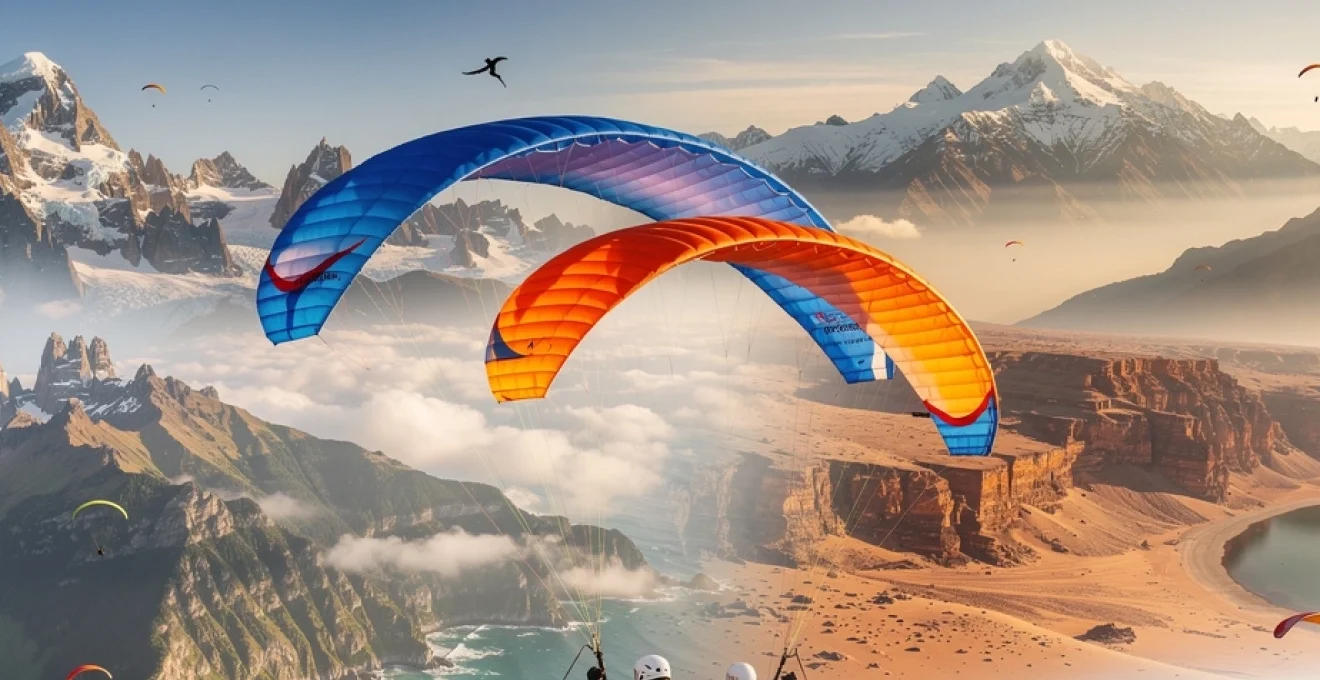
# Best places in the world for paragliding with spectacular views
Paragliding represents one of humanity’s most profound achievements in personal aviation, allowing you to experience the sensation of free flight while suspended beneath a fabric wing. The sport has evolved from experimental beginnings in the 1960s to become a globally recognized adventure activity, with dedicated launch sites spanning every continent. What distinguishes exceptional paragliding destinations from merely adequate ones extends beyond simple accessibility—the combination of reliable meteorological conditions, breathtaking visual landscapes, established safety infrastructure, and vibrant pilot communities creates environments where both novice and experienced flyers can push their boundaries. Whether you’re seeking the adrenaline rush of high-altitude alpine thermals, the serene beauty of coastal ridge soaring, or the technical challenges presented by desert canyons, the world offers remarkable diversity in flying environments.
The past decade has witnessed significant growth in paragliding tourism, with an estimated 500,000 active pilots worldwide and millions more experiencing tandem flights annually. This expansion has driven infrastructure improvements at premier sites, including dedicated transport services to launch points, professional instruction facilities, and comprehensive weather monitoring systems. Understanding what makes a location truly exceptional for paragliding requires consideration of multiple factors: consistent thermal activity during peak seasons, varied terrain offering different flight experiences, spectacular scenery that enhances the sensory experience, and robust safety protocols that minimize risk without compromising adventure.
Alpine paragliding sites: european mountain ranges with thermal conditions
The European Alps have long served as the spiritual heartland of paragliding, where the sport’s modern techniques and safety standards were largely developed. These magnificent mountain ranges offer unparalleled vertical relief, creating powerful thermal currents that can lift experienced pilots to altitudes exceeding 4,000 meters. The combination of glaciated peaks, verdant valleys, and crystalline lakes provides visual splendour that few other regions can match. Alpine sites typically operate from May through October, with July and August offering the most reliable thermal conditions, though also attracting the largest crowds.
What makes alpine paragliding particularly compelling is the diversity of flight experiences available within relatively compact geographical areas. You can experience gentle valley flights in the morning, transition to powerful thermal climbing during midday, and finish with evening glass-off conditions that provide smooth, contemplative soaring. The well-established infrastructure throughout the Alps means you’ll find certified instructors, equipment rental facilities, and specialized accommodation catering specifically to paragliding enthusiasts. However, alpine flying demands respect—rapidly changing weather patterns, complex airspace regulations, and technical terrain require thorough preparation and ideally, guidance from local experts familiar with specific site characteristics.
Chamonix Mont-Blanc, france: High-Altitude launch sites and glacial valley thermals
Chamonix stands as perhaps the most iconic paragliding destination in the world, offering access to launch sites at elevations exceeding 3,800 meters via the Aiguille du Midi cable car. The Chamonix valley itself stretches approximately 16 kilometers, providing extensive flight corridors with landing options throughout. Pilots can experience flights ranging from short valley descents to ambitious cross-country routes that traverse multiple valleys and peaks. The visual spectacle of flying with Mont Blanc—Western Europe’s highest mountain at 4,808 meters—as your backdrop creates genuinely unforgettable moments.
The thermal dynamics in Chamonix are influenced by the valley’s north-south orientation and the massive temperature differentials created by extensive glaciation. Morning anabatic winds typically develop around 10:00-11:00, strengthening throughout the afternoon before transitioning to evening katabatic flows. The presence of multiple launch sites at varying elevations allows you to select appropriate take-off points based on current conditions and your skill level. Planpraz at 2,000 meters offers more forgiving conditions suitable for intermediate pilots, while Brévent at 2,525 meters provides stronger thermal activity for experienced cross-country enthusiasts.
Safety considerations in Chamonix are paramount—the high-altitude environment means reduced air density affecting glider performance, while the complex topography creates turbulent rotors and unexpected wind shear. The local paragliding community recommends acclimatization periods for pilots unaccustomed to high-altitude flying, and weather conditions can deteriorate rapidly with afternoon thunderstorm development during summer months. Despite these challenges, Chamonix’s combination of
strong thermic potential, iconic scenery, and well-developed safety infrastructure continues to make it a benchmark destination for pilots aiming to experience high-altitude paragliding at its most dramatic. If you’re new to the valley, flying with a local guide or school is strongly advised, both to navigate airspace rules and to understand how the glacial valley thermals evolve throughout the day.
Interlaken, switzerland: jungfrau region flight corridors and landing zones
Nestled between Lake Thun and Lake Brienz, Interlaken has become synonymous with adventure sports, and paragliding is among its most renowned attractions. The city serves as the gateway to the Jungfrau region, where well-organized launch sites such as Beatenberg-Niederhorn and Amisbühl provide straightforward access to spectacular alpine views. From the air, you can admire the iconic trio of the Eiger, Mönch and Jungfrau peaks, as well as the deep turquoise lakes that bookend Interlaken itself.
The flight corridors around Interlaken are carefully managed to balance tourism, air traffic, and safety. Most commercial tandem flights follow well-established paths from Beatenberg down to the grassy landing area in Höhematte Park, right in the town center. For licensed pilots, cross-country possibilities extend deeper into the Lauterbrunnen and Grindelwald valleys, but these routes require thorough knowledge of local airspace and valley wind systems. Strong valley winds can develop in the afternoon, so many pilots prefer morning and early afternoon flights for smoother conditions.
Interlaken’s popularity means you benefit from a mature paragliding infrastructure, including multiple schools, daily weather briefings, and shuttle services to launch points. However, the high density of tandem operations also demands disciplined launch and landing behavior, as well as strict adherence to right-of-way rules in the air. If you are just starting your paragliding journey, Interlaken offers an excellent blend of professional instruction, predictable landing zones, and some of the most photogenic alpine vistas on the continent.
Stubai valley, austria: cross-country routes and ridge soaring opportunities
Located just south of Innsbruck, the Stubai Valley (Stubaital) is considered one of Austria’s premier paragliding regions, recognized for its reliable thermals and long cross-country potential. The main hub for pilots is the Elfer lift near Neustift im Stubaital, which provides easy access to several launch sites between 1,800 and 2,000 meters. From here, you can explore flights along the valley’s ridges, linking thermal sources that often allow extended soaring well into the afternoon.
Stubai’s geography encourages a mix of ridge soaring and thermal flying that appeals to both intermediate and advanced pilots. The valley runs roughly north-south, funnelling anabatic winds that can combine with sun-heated slopes to generate consistent lift. On classic days, pilots can follow cross-country routes north toward Innsbruck or deeper into side valleys, always keeping an eye on developing cloud formations that signal stronger thermic activity. As with any alpine route, careful planning around safe landing fields and potential valley wind acceleration points is essential.
The region is also known for its organized paragliding events and safety-focused training, including SIV (Simulation d’Incident en Vol) courses conducted over nearby lakes in season. For pilots aiming to refine their active flying skills and thermal management, Stubai offers a controlled environment with quick cable car access and clear bailout options. If you enjoy the idea of stringing together long ridge lines and building your confidence on cross-country paragliding routes, this Austrian valley deserves a top spot on your list.
Dolomites, italy: technical flying terrain at kronplatz and val gardena
The Dolomites in northern Italy are renowned for their jagged limestone towers and dramatic cliffs, creating some of the most visually striking paragliding terrain in Europe. Sites such as Kronplatz (Plan de Corones) and Val Gardena serve as primary hubs, offering gondola-accessible launch sites that place you directly above sculpted ridges and deep valleys. From the air, the contrast between pale rock faces, dark conifer forests, and alpine meadows creates a landscape that feels almost surreal.
Flying in the Dolomites can be technically demanding due to complex wind patterns and strong valley breezes, especially in midsummer. Thermals often trigger along sharp rock faces and south-facing cliffs, which can generate powerful but narrow columns of lift. Pilots must be comfortable with active flying techniques, as the air can feel “sharp” compared to more rounded thermals found in lower, rolling terrain. The rewards, however, are immense: well-planned flights can link multiple massifs and offer extended views over the entire Dolomite range.
Because the Dolomites are a UNESCO World Heritage Site and a popular hiking and skiing destination, airspace and take-off regulations vary by municipality. Local flying clubs and schools in Kronplatz, Val Gardena, and nearby sites like Col Rodella provide invaluable guidance on restricted areas, seasonal closures, and recommended flight paths. If you’re an intermediate pilot looking to progress into more technical paragliding environments with spectacular rock formations, the Dolomites offer a rich, though challenging, playground.
Coastal paragliding destinations: sea cliff soaring and ocean panoramas
Coastal paragliding offers a markedly different experience from alpine flying, trading towering peaks for sea cliffs, steady laminar winds, and endless horizons. While thermals do exist over land-adjacent coastlines, much of the enjoyment comes from ridge soaring on maritime breezes that are often smoother and more predictable than inland air. Coastal sites also tend to be less affected by rapid temperature swings, giving you longer flying windows and, in many cases, year-round opportunities.
From a technical standpoint, coastal paragliding simplifies some variables while introducing others. You may not need to chase thermals as aggressively, but you must consider sea-breeze fronts, marine layers, and potential rotor behind headlands or buildings. For beginners, well-managed coastal sites can feel forgiving—like practicing balance on a gently moving walkway instead of a roller coaster. For experienced pilots, long coastal ridges are ideal for distance flights and acrobatic practice, all against the backdrop of beaches, cliffs, and turquoise waters.
Ölüdeniz, turkey: babadağ mountain launch point and turquoise coast approaches
Ölüdeniz, located on Turkey’s Turquoise Coast, is consistently ranked among the best places in the world for paragliding with spectacular views. The primary launch site is Babadağ Mountain, which offers multiple take-off points between approximately 1,200 and 1,900 meters. From these lofty perches, pilots glide out over a vivid palette of deep blue sea, white-sand beaches, and the renowned Blue Lagoon, one of Turkey’s most photographed natural landmarks.
The local microclimate around Ölüdeniz supports a long flying season, typically from April through October, with the most stable conditions in late spring and early autumn. Thermic activity over the mountain combines with sea breezes to provide generous lift, allowing extended flights and even modest cross-country ventures for skilled pilots. Standard routes involve a scenic glide out toward the lagoon followed by lazy figure-eights above the bay, before setting up for a beach landing on the designated strip parallel to the shoreline.
Safety regulations in Ölüdeniz are relatively strict due to the site’s popularity and the high volume of commercial tandem flights. All pilots must adhere to clearly defined approach patterns and landing procedures, and tandem operators are licensed under Turkish civil aviation rules. If you’re new to paragliding, Ölüdeniz is an ideal place to book a tandem flight and experience coastal soaring in a controlled environment. For licensed pilots, a thorough briefing from one of the many local schools will help you understand daily wind patterns, inversion layers, and appropriate altitude margins when flying out over water.
Torrey pines gliderport, california: marine layer dynamics and pacific ocean views
Perched on the cliffs north of San Diego, Torrey Pines Gliderport is one of the United States’ most historic free-flight sites, shared by both hang gliders and paragliders. The launch area sits atop 100-meter sandstone bluffs overlooking the Pacific Ocean, with a broad sandy beach stretching below. In ideal conditions, pilots can soar for hours along the cliffs, enjoying uninterrupted views of the coastline, surfers, and migrating marine life such as dolphins and whales.
The key to successful flying at Torrey Pines is understanding the interaction between synoptic winds and the local marine layer. Soaring conditions develop when the onshore breeze hits the cliffs at a sufficient angle and speed—typically 10–18 km/h—creating a lift band along the face. However, a low marine layer or fog bank can rapidly reduce visibility, while stronger winds or crosswinds may generate turbulence and make launches or top-landings hazardous. Because the site is highly regulated, pilots must hold at least a basic paragliding rating and complete a site orientation before flying solo.
If you are looking to practice ridge-soaring skills or simply enjoy relaxed coastal flights, Torrey Pines offers a relatively controlled setting with on-site instructors and safety staff. As with all coastal paragliding locations, you should remain vigilant about changing wind direction and strength—conditions that feel manageable at launch can intensify down the ridge. Still, when everything aligns, Torrey Pines delivers classic postcard views and a flying experience that feels like gently surfing an invisible wave.
Rio de janeiro, brazil: pedra bonita launch site and tandem flight regulations
Rio de Janeiro combines urban energy with lush mountains and sweeping beaches, making its paragliding scene uniquely dramatic. The primary launch site is Pedra Bonita, a granite peak within the Tijuca National Park, situated around 520 meters above sea level. From this take-off, pilots and tandem passengers soar out above the forested slopes, with panoramic views of São Conrado Beach, the iconic Christ the Redeemer statue, and the serrated skyline of Rio’s coastal mountains.
The typical flight path from Pedra Bonita follows the contours of the mountain before transitioning over the cityscape and descending to land on the sands of São Conrado. Thermals are present but often secondary to dynamic lift created by onshore winds interacting with the hills and coastal cliffs. This blend of urban and coastal meteorology means conditions can change quickly; therefore, local expertise is invaluable. Many pilots time their flights to avoid the strongest midday turbulence, opting instead for morning or late-afternoon windows.
Brazilian aviation authorities regulate tandem paragliding in Rio to maintain safety amid high tourist demand. Tandem pilots must be certified and registered, and equipment undergoes periodic inspections. If you’re booking a tandem flight, you should verify your operator’s license and insurance coverage, and follow all pre-flight briefings regarding take-off runs, in-flight posture, and landing procedures. With the right preparation, a flight from Pedra Bonita lets you experience Rio from an angle usually reserved for birds and helicopters—an unforgettable blend of coastal scenery and urban spectacle.
Cape town, south africa: lion’s head and signal hill flight parameters
Cape Town offers some of the most photogenic coastal paragliding in the Southern Hemisphere, with Lion’s Head and Signal Hill serving as the primary launch points. Both sites sit just behind the city, providing a bird’s-eye perspective of Table Mountain, the Atlantic seaboard, and the chic suburbs of Camps Bay and Sea Point. Launch altitudes range from roughly 300 to 600 meters, depending on the site and specific take-off, which is sufficient for extended soaring when the sea breeze cooperates.
Flight parameters in Cape Town are strongly influenced by the South Atlantic high-pressure system and the iconic “Cape Doctor” wind. When conditions are favorable, a steady onshore breeze provides smooth lift along the slopes and cliffs, enabling pilots to cruise above the city and coastline. However, strong south-easterly winds or rapid changes in direction can render flying unsafe, which is why local operators are cautious about go/no-go decisions. During peak summer months, it’s not uncommon to have several flyable days in a row, punctuated by occasional shut-downs due to high winds.
Most paragliding in Cape Town is conducted via tandem operations, though qualified visiting pilots can often fly with local guidance and proper site briefings. Standard flights from Signal Hill usually end with a landing on the grassy fields along Sea Point’s promenade, while Lion’s Head flights sometimes extend toward Camps Bay, depending on conditions. If you’re planning to experience Cape Town from the air, be prepared for flexible scheduling—the city’s capricious winds demand patience, but when everything aligns, the combination of sea, mountain, and cityscape is hard to beat.
Desert and canyon paragliding: thermic activity in arid landscapes
Desert and canyon environments introduce a distinct flavour to paragliding, characterized by strong thermals, expansive visibility, and striking geological formations. In arid regions, the sun heats the ground rapidly, creating powerful columns of rising air that can sometimes feel like elevator shafts. These thermals are a double-edged sword: they enable impressive altitude gains and long cross-country flights, but they can also be sharp and turbulent, requiring confident active piloting.
Because vegetation is sparse and terrain is often rocky, landing options may be more limited than in alpine or pastoral settings. This places greater emphasis on route planning, glide calculations, and the ability to identify potential out-landing fields from the air. Yet for those who relish adventure and wide-open spaces, desert paragliding offers an unmatched sense of scale. Flying over vast canyons or sand-sculpted plateaus can feel like drifting across the surface of another planet.
Valle de bravo, mexico: thermal columns and lake avándaro microclimate
Valle de Bravo, located about two hours from Mexico City, has established itself as one of the world’s premier winter paragliding destinations and a frequent host of international competitions. The main launch site, La Torre, sits at around 2,300 meters above sea level, overlooking the town and Lake Avándaro. From this vantage, pilots can tap into strong thermals that form over the surrounding hills and flatlands, often climbing to cloudbase before embarking on cross-country routes across the plateau.
Lake Avándaro plays a crucial role in shaping the microclimate, moderating temperatures and influencing local wind circulations. On typical days, thermic activity begins late morning, building into consistent columns by early afternoon. Competition pilots use these thermal “highways” to complete large triangular tasks, often flying 50–100 km circuits. For recreational pilots, the standard flight involves thermalling above launch, gliding over the lake, and then setting up for a picturesque landing on the lakeshore or in designated landing zones near town.
Given the site’s popularity and thermal strength, Valle de Bravo is best suited to pilots with solid thermalling skills and comfort with moderately strong conditions. Tandem options do exist for non-pilots, and several reputable schools offer guided flying and coaching. As with many desert-adjacent sites, hydration and sun protection are critical—you may spend hours in strong sun, both in the air and waiting on launch. When managed wisely, Valle de Bravo offers some of the most reliable winter paragliding anywhere in the Americas.
Atacama desert, chile: high-altitude XC flying and andean backdrop
The Atacama Desert, stretching along northern Chile, is one of the driest places on Earth and a rising star for adventure sports, including paragliding. Sites near towns like Iquique have become particularly well-known, where pilots launch from coastal cliffs and inland ridges to soar above dune fields and desert plateaus. With launch altitudes often between 500 and 1,000 meters and benign sea breezes, it’s possible to log exceptionally long ridge-soaring and cross-country flights along the coastline.
Further inland, high-altitude launches in the pre-Andean foothills provide more technical flying, with thermals that can reach impressive climb rates due to intense solar heating. Here, you fly against a backdrop of snow-capped Andean peaks and multicolored mineral hills, a reminder that you are in one of the planet’s most extreme environments. However, altitude and aridity bring specific challenges: air density is lower, affecting your wing’s performance, and dehydration can sneak up quickly if you’re not proactive.
For pilots considering Atacama paragliding, acclimatization and planning are essential. You should arrive a few days early to adjust to elevation if flying from high inland sites and consult local schools regarding preferred routes, rotor zones, and restricted airspace. Cross-country potential is huge—pilots sometimes cover over 100 km in a single flight—but safe retrieval and communication systems must be in place. Treated with respect, the Atacama offers an otherworldly blend of high-altitude XC paragliding and stark desert beauty.
Wadi rum, jordan: desert thermal systems and red sandstone formations
Wadi Rum, often called the Valley of the Moon, is a protected desert wilderness in southern Jordan famous for its towering red sandstone cliffs and expansive sand dunes. For paragliders, the area presents a unique opportunity to soar above landscapes that have doubled as Mars in major films. Launch sites are typically located on elevated plateaus or rocky outcrops, with flights taking you over labyrinthine canyons, narrow gorges, and broad sandy basins.
Thermic systems in Wadi Rum are driven by intense surface heating, with strong but relatively predictable thermals forming from late morning to mid-afternoon. Because the terrain is rugged, pilots must be adept at identifying safe landing zones—usually flat sandy areas clear of rocks and vegetation. Think of it as sailing across a sea of sand, where each thermal is a gust of wind lifting your wing upward, and each dune field is a potential harbor for landing.
Access to Wadi Rum’s flying sites typically requires coordination with local Bedouin guides and paragliding operators, who know not only the terrain but also the logistics of retrieval in a remote desert. Due to the protected nature of the area, pilots should respect environmental regulations and cultural heritage sites. If you are drawn to paragliding adventures that feel truly remote, Wadi Rum combines strong desert thermals with a sense of timeless, cinematic grandeur.
Himalayan and high-altitude paragliding zones: extreme elevation flight dynamics
High-altitude paragliding in regions like the Himalayas and Southern Alps introduces another layer of complexity to the sport. Elevations above 2,500–3,000 meters mean thinner air, which reduces wing lift and alters stall speeds, while cold temperatures and intense UV radiation place extra demands on both pilot and equipment. Yet for many, the chance to soar alongside some of the world’s highest peaks is the pinnacle of free-flight experience.
In these environments, understanding mountain meteorology becomes non-negotiable. Strong valley winds, katabatic flows after sunset, and rapid storm development all pose significant risks if misjudged. Flying here is akin to high-altitude mountaineering in the sky: preparation, acclimatization, and respect for conditions are essential. For newer pilots, tandem flights or guided tours with seasoned local instructors are the safest way to sample these extraordinary landscapes.
Pokhara, nepal: sarangkot launch site and annapurna range visibility
Pokhara is widely regarded as one of the best beginner-friendly high-altitude paragliding destinations in the world. The primary launch site at Sarangkot sits at around 1,600 meters, overlooking Phewa Lake and facing the majestic Annapurna and Machapuchare (Fishtail) peaks. From launch, you glide out over terraced hillsides and traditional villages, with snow-covered giants looming less than 30 km away—a visual combination few places can match.
The thermic environment in Pokhara is generally gentle, especially in the main season from October to April, making it ideal for novice pilots and tandem passengers. Daily cycles see valley winds developing from the south, creating ridge lift along Sarangkot and moderate thermals over sunlit slopes. Typical flights involve a combination of ridge soaring and light thermalling before gliding over Phewa Lake for a landing in the designated lakeside field.
Safety infrastructure has improved in recent years, with licensed tandem operators, local clubs, and air rescue coordination based out of Pokhara. That said, pilots still need to be aware of occasional strong valley winds and cloud build-up during the monsoon fringe seasons. If you’re considering your first taste of Himalayan paragliding, Pokhara offers a relatively low-stress entry point, combining manageable flight dynamics with some of the most photogenic mountain views on Earth.
Bir billing, india: world cup competition venue and dhauladhar range thermals
Bir Billing in the Indian state of Himachal Pradesh has gained global recognition since hosting the Paragliding World Cup, and it remains a magnet for serious cross-country pilots. The take-off site at Billing lies at about 2,400 meters, while the landing zone in Bir sits roughly 1,400 meters below in a broad, grassy valley. Behind launch towers the Dhauladhar Range, an imposing wall of peaks that generate strong, consistent thermals in the main flying season from October to November and again from March to June.
On classic days, thermals over the forested slopes and rocky spurs can take pilots quickly to cloudbase, often between 3,000 and 4,000 meters. From there, experienced XC pilots set off along the Dhauladhar spine, sometimes covering distances of 100 km or more along the range. The sensation of flying parallel to these rugged, snow-streaked ridges is hard to overstate—it’s like tracing the backbone of the Himalayas with your wingtip.
Because conditions in Bir Billing can be strong and complex, it is not an ideal first alpine site for completely new pilots. However, numerous schools in Bir provide instruction, tandem flights, and guided XC tours, making it possible to progress under supervision. Airspace rules, convergence lines, and afternoon valley winds are all important to understand, and many pilots choose to land earlier rather than risk late-day turbulence. For those with sufficient experience, Bir Billing is a world-class arena for testing your thermal flying skills against truly big mountains.
Queenstown, new zealand: southern alps cross-country routes and remarkables range
Although geographically distant from the Himalayas, Queenstown in New Zealand’s South Island provides a comparable sense of soaring among dramatic, snow-tipped peaks. Often called the adventure capital of New Zealand, Queenstown sits on the shores of Lake Wakatipu and is framed by the aptly named Remarkables Range. Primary paragliding launches include Coronet Peak and sites above the town itself, with altitudes around 1,200–1,600 meters.
Here, the Southern Alps create a complex but rewarding flying environment. Thermals form over sun-facing slopes and valley floors, while lake breezes influence low-level wind patterns. On suitable days, pilots can explore cross-country routes along the Remarkables or deeper into the alpine interior, although strong westerlies and rapid weather changes are common. Having reliable weather forecasts and local briefings is crucial, much like reading a nautical chart before venturing into unfamiliar waters.
For visitors without a paragliding license, Queenstown offers highly professional tandem operations that combine the thrill of flight with the region’s iconic scenery. Landing zones are well-managed, and transport back to town is typically included. If you’re a licensed pilot, local clubs and schools can advise you on appropriate tasks for your skill level and current conditions. Whether you’re thermalling above Lake Wakatipu or gliding out toward the Remarkables, Queenstown delivers the quintessential Southern Alps paragliding experience.
Tropical paragliding locations: trade wind systems and volcanic terrain
Tropical paragliding sites introduce warmth, lush vegetation, and often volcanic topography to the flying equation. Many of these destinations lie within the influence of trade wind systems, which can provide reliable onshore breezes and ridge lift but can also strengthen quickly and create challenging conditions if not respected. At the same time, volcanic cones, coastal cliffs, and terraced hillsides generate diverse microclimates and scenic contrasts.
In tropical climates, moisture and convection play a larger role in daily weather cycles. Clouds may build rapidly in the afternoon, sometimes leading to showers or thunderstorms, while mornings often bring lighter winds and clearer skies. This makes timing especially important—you might enjoy smooth, laminar air early in the day and then contend with active thermals or gusty trade winds later on. For many pilots, the reward is worth the extra planning: flights over coral-blue waters, emerald rice fields, and jungle-covered slopes are hard to forget.
Bali, indonesia: timbis beach launch area and rice terrace landscapes
On the island of Bali, the Timbis Beach area on the Bukit Peninsula has become a well-known paragliding hub. Launch sites are positioned atop limestone cliffs ranging from 50 to 150 meters above the Indian Ocean, providing straightforward access to ridge lift generated by the prevailing southeast trade winds. Flights here are typically smooth and scenic, with pilots cruising along the coastline above white-sand beaches, turquoise lagoons, and luxury cliffside resorts.
While Timbis itself focuses on coastal soaring, inland sites on Bali’s volcanic slopes offer a contrasting experience, where you can fly above patchworks of rice terraces and traditional villages. Thermals in these interior regions are more variable, influenced by daily heating and the island’s mountainous terrain. For visiting pilots, it can feel like moving between two worlds—one of gentle, maritime ridge lift and another of more dynamic, thermic inland air.
Local schools and operators manage access to the main cliff launches, often charging a site fee that supports landowners and infrastructure. Because conditions are heavily wind-dependent, you should always check forecasts and current readings before heading to launch; even in paradise, over-strong trade winds can shut flying down. For those wanting to combine relaxed holiday vibes with accessible coastal paragliding, Bali’s Timbis Beach area is a highly attractive option.
Reunion island, france: maïdo cirque flights and indian ocean vistas
Reunion Island, a French territory in the Indian Ocean, is a volcanic jewel renowned for its dramatic topography and microclimates. For paragliders, the island offers a rare mix of high mountain flying and coastal landings within relatively short distances. One of the signature experiences is flying from the Maïdo area, which overlooks the Cirque de Mafate—a massive volcanic caldera carved by erosion—before gliding out toward the ocean.
Launch altitudes around Maïdo can reach 1,800–2,000 meters, giving ample height to explore thermals forming over the cirque’s steep walls and forested ridges. On good days, pilots climb in gentle but persistent lift before setting off on a glide toward the coastal plains and beaches near Saint-Paul. The visual shift from rugged volcanic amphitheatre to palm-fringed shoreline is like watching two different postcards merge into one flight.
Because Reunion lies in the path of trade winds and occasional tropical systems, weather awareness is key. Strong winds aloft, rapid cloud development, and orographic effects around the volcano can create challenging conditions for the unprepared. Local paragliding schools provide detailed briefings on safe launch windows, recommended approaches, and landing options. If you’re looking to experience volcanic paragliding with Indian Ocean views, Reunion offers a compact yet technically rich environment.
Costa rica: arenal volcano thermal activity and rainforest canopy views
Costa Rica’s diverse landscapes—ranging from active volcanoes to Pacific and Caribbean coastlines—make it an intriguing destination for paragliding enthusiasts. One of the standout areas is around Arenal Volcano, near the town of La Fortuna. Launch sites on the surrounding hills and ridges offer views of the conical volcano, Lake Arenal, and vast swaths of tropical rainforest, home to an extraordinary range of wildlife.
Thermals around Arenal are generated by intense solar heating of the dark volcanic soils and the patchwork of cleared pastures and forest. These thermals may be softer than those in arid deserts but can still provide consistent climb rates, especially during the dry season (roughly December to April). Flying over rainforest canopy resembles drifting above a living, breathing carpet, with emergent trees, river valleys, and occasional clearings serving as visual reference points and potential landing options.
Given Costa Rica’s propensity for afternoon showers and cloud build-up, pilots often plan flights for the morning or early afternoon, keeping a close eye on towering cumulus growth. Local operators around Arenal and other sites like Jacó or Miramar offer tandem flights, instruction, and site guidance. If you’ve ever wondered what it’s like to paraglide over a rainforest teeming with life, Costa Rica provides a safe and infrastructure-supported way to find out—just remember that, like the jungle itself, the weather can change quickly.
Technical flight planning considerations: meteorological assessment and safety protocols
Regardless of how stunning a paragliding location may be, your enjoyment and safety ultimately hinge on sound flight planning and decision-making. Meteorological assessment sits at the heart of this process. Before clipping into your harness, you should evaluate wind speed and direction at multiple altitudes, thermal potential, cloud development, and any regional hazards such as föhn winds, sea-breeze fronts, or valley wind accelerations. Think of it as reading a three-dimensional weather map: you’re not just concerned with what’s happening at launch, but with the invisible currents that will shape your flight path from take-off to landing.
Experienced pilots often rely on a combination of national meteorological services, specialized aviation forecasts, and local site briefings. Many premier paragliding sites now feature dedicated weather stations and live wind readings accessible via apps or web dashboards. Cross-checking multiple sources can help you identify inconsistencies and avoid overconfidence in a single forecast. Remember, even the most famous paragliding destinations—Chamonix, Interlaken, Ölüdeniz—can turn hostile when conditions exceed safe limits.
Beyond weather, robust safety protocols are non-negotiable. This includes thorough pre-flight equipment checks—verifying line integrity, riser condition, reserve parachute deployment systems, and helmet fit—along with a clear mental plan for emergencies. Where will you go if your chosen landing field is compromised? How will you respond to unexpected turbulence or a sudden increase in wind strength? Practising these scenarios, much like emergency drills in aviation, reduces reaction time and panic when it matters most.
For newer pilots, flying with more experienced companions, joining local clubs, and undertaking advanced training (such as SIV and cross-country courses) are some of the best ways to accelerate learning while maintaining safety margins. Even for seasoned pilots, humility before the weather and terrain is a hallmark of longevity in the sport. By combining technical knowledge, conservative decision-making, and respect for local guidelines, you can fully enjoy the world’s best paragliding locations while keeping risk at a level you—and your loved ones—are comfortable with.