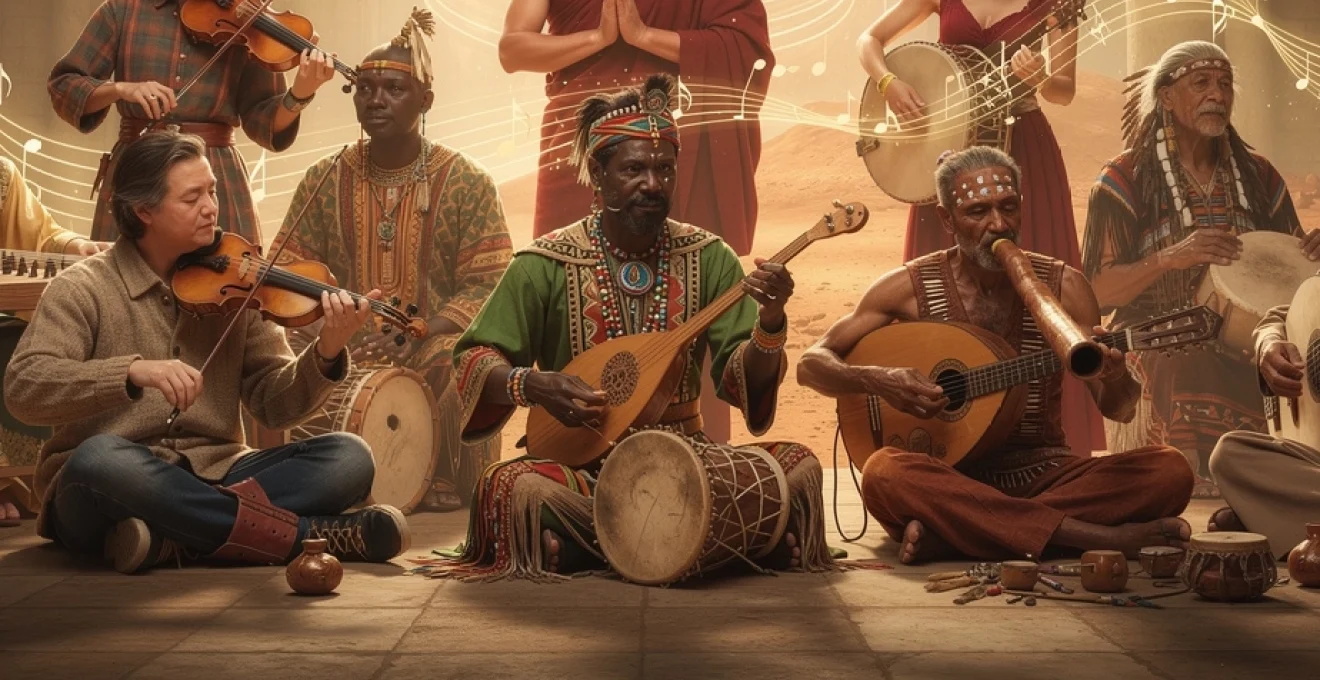
Music serves as humanity’s most profound cultural mirror, reflecting the deepest values, spiritual beliefs, and collective memories of civilisations across the globe. From the haunting pentatonic melodies of ancient China to the complex polyrhythmic structures of West African griots, musical traditions encode the very essence of cultural identity in ways that transcend spoken language. These musical dialects carry forward ancestral wisdom, sacred knowledge, and community bonds that have survived millennia of social transformation and geographical displacement.
The relationship between music and cultural soul extends far beyond mere entertainment or artistic expression. Musical traditions function as living repositories of collective consciousness, preserving historical narratives, spiritual practices, and social structures within their melodic frameworks and rhythmic patterns. Each culture’s unique approach to sound organisation reveals fundamental philosophical perspectives about harmony, time, spirituality, and human relationships that define their worldview.
Understanding how musical traditions embody cultural essence requires examining the intricate connections between sonic structures, ritual practices, and community identity. The study of these connections illuminates not only the diversity of human musical expression but also the universal human need to encode meaning, memory, and cultural continuity through organised sound.
Ethnomusicological foundations of cultural identity expression
Ethnomusicology reveals that musical systems function as sophisticated cultural encoding mechanisms, where specific scales, modes, and rhythmic patterns become vehicles for transmitting cultural DNA across generations. The mathematical relationships between musical intervals, the selection of particular timbres, and the organisational principles governing musical performance all reflect deeper cultural values about harmony, hierarchy, and cosmic order.
The study of musical structures across cultures demonstrates that no musical system develops in isolation. Instead, these systems emerge from complex interactions between environmental factors, social structures, spiritual beliefs, and historical experiences that shape how communities organise sound into meaningful expressions. The resulting musical languages become as distinctive and culturally specific as spoken languages, carrying layers of meaning that extend far beyond their surface aesthetic qualities.
Pentatonic scale systems in east asian musical heritage
The pentatonic scale system that dominates East Asian musical traditions embodies fundamental philosophical principles from Confucian and Daoist thought. The five-note structure corresponds to ancient Chinese cosmological concepts, where each tone represents one of the five elements: wood, fire, earth, metal, and water. This musical framework reflects a worldview that emphasises balance, cyclical patterns, and the interconnectedness of natural forces.
In traditional Chinese music, the pentatonic system creates distinctive melodic contours that avoid the harmonic tensions characteristic of Western diatonic scales. This approach to melody construction reflects cultural values that prioritise harmony over conflict, gradual transformation over sudden change, and collective resonance over individual expression. The resulting musical aesthetic captures the Chinese cultural emphasis on wu wei – effortless action that flows in accordance with natural principles.
Modal structures in celtic and gaelic folk traditions
Celtic musical modes preserve ancient European musical consciousness that predates major-minor tonality by thousands of years. The Dorian, Mixolydian, and other church modes that characterise Irish, Scottish, and Welsh folk traditions create distinctive emotional landscapes that reflect the Celtic relationship with nature, mythology, and ancestral memory. These modal structures generate the haunting, otherworldly qualities that distinguish Celtic music from other European traditions.
The preservation of modal structures in Celtic folk traditions demonstrates remarkable cultural continuity despite centuries of political upheaval and cultural suppression. The survival of these ancient musical patterns within oral traditions reveals their deep integration with cultural identity, where melodic memory functions as a form of cultural resistance and community preservation. The characteristic intervals and melodic contours of Celtic modes continue to evoke landscapes, legends, and emotional states that connect contemporary performers and listeners with their ancestral heritage.
Polyrhythmic patterns in west african griotic lineages
The sophisticated polyrhythmic structures of West African musical traditions reflect complex social organisations and spiritual cosmologies that govern traditional African societies. Griot musicians, who function as hereditary keepers of oral history, employ intricate interlocking rhythmic patterns that mirror the multilayered nature of African social structures, where individual voices contribute to collective rhythmic tapestries without losing their distinct identities.
These polyrhythmic systems embody African philosophical concepts about
these rhythms as interconnected rather than competing forces. Just as village life depends on collaboration between different clans, ages, and professions, West African music aligns multiple rhythmic cycles into a cohesive whole. For listeners, this polyrhythmic density creates an experience of being held within a larger communal pulse, a sonic metaphor for belonging to an extended kinship network. In this way, griotic polyrhythm does more than entertain; it encodes philosophies of solidarity, interdependence, and the shared responsibility of maintaining social harmony.
Microtonal intervals in middle eastern maqam theory
Middle Eastern maqam theory is built on microtonal intervals that sit between the semitones of Western equal temperament, giving Arabic, Persian, and Turkish music its unmistakable expressive colour. These microtones are not arbitrary “bent notes” but carefully codified degrees that shape each maqam’s emotional and spiritual character. For example, Maqam Hijaz is often associated with longing and transcendence, while Maqam Bayati evokes warmth, intimacy, and devotion.
The cultural identity embedded in maqam systems reflects a worldview that is comfortable with ambiguity, nuance, and fluid emotional states. Where Western classical harmony often seeks resolution and closure, microtonal structures embrace suspension, tension, and lingering feeling as meaningful in themselves. This musical approach parallels Middle Eastern poetic traditions, where layered symbolism and multiple interpretations are valued over single, fixed meanings. As a result, maqam performance becomes a vehicle for exploring the subtle shades of human emotion and the ineffable dimensions of spiritual experience.
Crucially, maqam traditions also encode regional, religious, and linguistic identities through specific melodic turns and ornamental practices. A listener raised within this sound world can often recognise not only a maqam but also its regional school, urban centre, or Sufi lineage by the way phrases are shaped and cadences are approached. You might think of maqam as a musical calligraphy: the same letters exist across a region, but every culture – and sometimes every master – develops a recognisable stylistic “handwriting” that signals origin, community, and spiritual orientation.
Sacred and ritualistic musical practices across civilisations
Across civilisations, sacred and ritual music functions as a direct conduit between community and cosmos, giving audible form to prayers, myths, and metaphysical beliefs. While the surface sounds of Tibetan chanting, Aboriginal songlines, or Gregorian chant may differ dramatically, each tradition uses organised sound to mark sacred time, consecrate space, and align human life with perceived higher orders of reality. Understanding how sacred music rituals operate reveals how cultures encode their cosmologies, moral systems, and spiritual aspirations within musical form.
Ritual music often follows strict structural rules, prescribed performance contexts, and lineage-based transmission, reflecting its role as more than personal expression. In many societies, such music may be performed only by designated ritual specialists, monks, shamans, or hereditary musicians, underscoring its perceived power and responsibility. At the same time, congregational participation – through call-and-response, communal chanting, or shared dancing – allows entire communities to embody sacred narratives together. In this sense, ritual music acts as a kind of “sonic architecture” in which people temporarily inhabit a shared spiritual space.
Tibetan buddhist chanting and overtone meditation techniques
Tibetan Buddhist chanting, particularly in the Vajrayana tradition, employs deep vocal drones and overtone techniques designed to transform consciousness. Monastic ensembles often produce a multi-layered sound in which individual voices generate fundamental tones and resonant overtones simultaneously, creating a dense, vibrating sonic field. This overtone chanting is not a display of virtuosity but a disciplined spiritual practice intended to focus the mind, regulate breath, and synchronise the mental states of the monastic community.
The texts set to these chants typically consist of mantras, sutras, and liturgical passages that encapsulate core Buddhist teachings on impermanence, compassion, and emptiness. By repeating them within a stable rhythmic and melodic framework, practitioners inscribe these teachings not only into memory but into the body’s breathing patterns and nervous system. For listeners and participants alike, the experience can feel like entering a sonic mandala – a circular field of sound that mirrors visual mandalas used in meditation. Here, the music tradition is inseparable from the spiritual technology it supports, reflecting a cultural view of sound as a direct vehicle for awakening.
Aboriginal australian dreamtime songlines and didgeridoo ceremonials
In Aboriginal Australian cultures, music is woven into the concept of the Dreamtime – the ancestral epoch in which the land, its creatures, and its laws were sung into existence. Songlines are melodic maps that trace the journeys of ancestral beings across the continent, encoding geographic, ecological, and spiritual knowledge within their contours. To sing a songline correctly is to navigate country, remember sacred sites, and affirm legal and ethical obligations to the land and community.
Instruments like the didgeridoo and clapsticks support these vocal traditions, grounding them in a powerful, droning soundscape that echoes the vastness of the Australian landscape. Didgeridoo ceremonies often accompany initiation rites, funerals, and seasonal gatherings, linking individual life stages to cosmic narratives. The low, resonant timbre of the instrument evokes the earth’s own vibration, reinforcing a worldview in which humans, animals, and landforms are all part of a single, living network. Through these music traditions, Aboriginal communities preserve complex environmental knowledge and kinship systems, ensuring their continuity despite intense historical disruption.
Native american powwow drumming and spiritual invocation
Native American powwow traditions centre on large communal drums, often described as the “heartbeat” of the people. The drum is typically shared by a circle of singers, each contributing vocables and song texts that honour ancestors, warriors, and spiritual beings. The steady, pulsing rhythm acts as a sonic anchor for dancers, whose movements express tribal identities, clan affiliations, and personal stories through highly codified regalia and choreography.
Powwow drumming carries profound spiritual significance: the drum itself is often treated as a living relative, fed with offerings and addressed with respect. Songs may function as prayers, memorials, or honourings, inviting spiritual presence and protection into the gathering. For communities that have endured forced assimilation and cultural suppression, the powwow has become a powerful site of cultural resurgence, where language, dress, and ceremony converge around music. When you hear the shared rhythm ripple across a powwow arena, you are witnessing how indigenous music traditions transform collective memory into embodied, audible resilience.
Gregorian chant influence on european ecclesiastical music
Gregorian chant, developed within the medieval Latin Church, established a foundational musical language for European Christian worship. Its monophonic, unaccompanied melodies follow free rhythms guided by the natural accents of Latin texts, creating a floating, timeless quality. This musical approach reflects a theological aim: to focus attention on sacred scripture and liturgy rather than on individual performers, embodying ideals of humility, devotion, and communal prayer.
Over centuries, Gregorian chant provided the modal and melodic basis for more complex polyphonic forms, from organum to the great Mass settings of Renaissance composers. Even as Western music moved toward harmonic complexity and secular genres, echoes of chant persisted in melodic shapes, cadences, and sacred motifs. Today, the resurgence of interest in chant – both within and beyond religious contexts – speaks to its enduring capacity to evoke contemplative states. For many listeners, its austere beauty offers a sonic link to a shared European spiritual past, reminding us how ecclesiastical music traditions can shape cultural identity long after their original social structures have changed.
Indigenous instrumental craftsmanship and symbolic representation
Indigenous musical instruments are rarely “just tools” for producing sound; they are often sacred objects whose materials, shapes, and decorative motifs encode layers of cultural meaning. The choice of wood, animal skin, metal, or plant fibre reflects local ecology and cosmology, while carvings and paintings inscribe myths, clan symbols, and protective spirits. In many cultures, crafting an instrument is itself a ritual act, guided by taboos, prayers, and lineages of specialised artisans.
Consider the West African kora, whose calabash gourd body, cowhide resonator, and long hardwood neck physically embody the agricultural and pastoral life of Mande societies. Or the Japanese koto, where lacquered wood, silk strings, and minimalist design mirror aesthetic values of refinement, impermanence, and attention to detail. In both cases, the instrument’s form reflects the broader cultural aspiration toward balance between nature, craft, and human emotion. When you hear these instruments played within their traditional contexts, you are not only hearing music; you are encountering portable sculptures of cultural philosophy.
These instruments often act as visual identity markers during ceremonies, festivals, and inter-community gatherings. A Native American flute with specific feather arrangements, beadwork patterns, or wood types can signal tribal affiliation and personal spiritual journeys. Similarly, the intricate metalwork on Middle Eastern ouds communicates regional styles and family craftsmanship lineages. In a globalised world where instruments are increasingly mass-produced, supporting indigenous craftsmanship becomes a crucial way to sustain the music heritage and symbolic languages that these objects carry.
Oral transmission networks and musical knowledge preservation
For many cultures, the most important musical archives are not libraries or recordings but human beings – elders, master musicians, and storytellers who carry vast repertoires in memory. Oral transmission networks function like living universities, where knowledge is passed through apprenticeship, imitation, and repeated participation rather than written notation. This mode of transmission allows traditional music to remain flexible and responsive, adapting to new contexts while preserving core identity markers such as key melodies, rhythms, and narrative structures.
However, oral traditions also face particular vulnerabilities in the modern era. Urbanisation, migration, and the dominance of global media can disrupt intergenerational contact, making it harder for young people to immerse themselves in ancestral music. At the same time, ethnomusicologists and community organisations are developing new ways to support these transmission networks, from community workshops and festivals to school-based programs and digital archives. The goal is not to “freeze” music in time, but to ensure that communities retain agency over how their musical knowledge evolves.
Balkan epic ballad traditions and guslar storytelling
In the Balkans, guslar storytellers have long preserved epic ballads recounting battles, heroes, and moral dilemmas central to regional identity. Accompanying themselves on the single-stringed gusle, these performers narrate multi-hour sagas using formulaic phrases, melodic patterns, and rhythmic speech-song hybrids. The performance is both musical and dramatic: gestures, vocal inflection, and audience interaction all contribute to the impact of the story.
What makes this tradition remarkable from a cultural perspective is its ability to sustain detailed historical and genealogical knowledge without written records. Each performance is a fresh re-creation, shaped by the guslar’s memory, personal style, and the social context of the gathering. Yet core episodes, characters, and melodic contours remain recognisable across generations, acting as a sonic glue for shared identity. For communities that have experienced shifting borders and political turmoil, these music traditions offer continuity, helping listeners situate themselves within a long, narrated past.
Flamenco cante jondo lineages in andalusian romani culture
Flamenco’s cante jondo (“deep song”) style emerges from Andalusian Romani communities whose histories of marginalisation and resilience are etched into the music itself. These intensely expressive vocal forms are transmitted primarily within families and neighbourhoods, where children absorb melodic turns, rhythmic clapping patterns (palmas), and subtle ornamentations through constant exposure. Formal teaching is often secondary to immersive participation in gatherings, where singing becomes a way of sharing pain, joy, and communal memory.
The palos (song forms) of cante jondo – such as seguiriyas and soleá – carry specific emotional and narrative associations, often linked to themes of loss, exile, and spiritual yearning. As these songs circulate across generations, they reinforce a shared Romani-Andalusian identity that resists assimilation into dominant cultural narratives. Even as flamenco has moved onto global stages, master singers emphasise that authenticity depends on understanding the lived experiences behind the repertoire, not just reproducing its surface stylistic markers. In this way, flamenco traditions show how oral transmission protects the emotional core of a music even amid commercialisation.
Indian classical raga systems and guru-shishya parampara
In Indian classical music, the guru-shishya parampara – the traditional teacher-disciple relationship – remains central to raga transmission. Rather than learning from books alone, students live or spend extended periods with their guru, absorbing not only compositions and techniques but also values, aesthetics, and ways of listening. This immersive model treats music as a holistic path that shapes character, discipline, and spiritual insight alongside artistic skill.
Ragas themselves are more than scales; they are melodic personalities with preferred phrases, characteristic ornaments, and associated times of day, seasons, or deities. Through years of attentive practice and guided improvisation, students learn to internalise these personalities so deeply that they can converse with them in performance, balancing tradition and innovation. The parampara framework ensures that each musician inherits a particular stylistic lineage (gharana), linking them to past masters and regional schools. When you hear a raga unfold in a long improvisation, you are listening to a living chain of memory stretching back centuries, sustained by intimate, oral-based pedagogy.
Contemporary fusion movements and cultural hybridisation
In the 21st century, global connectivity has accelerated musical hybridisation, giving rise to fusion genres that blend traditional music with jazz, rock, electronic, and hip-hop influences. While cross-cultural exchange has always existed, streaming platforms, social media, and affordable recording technologies now allow artists from different continents to collaborate in real time. The result is a vibrant landscape where world music fusion projects reimagine ancestral sounds for new audiences, often addressing contemporary social issues in the process.
Examples abound: Afrobeat-jazz collectives in London, Indian classical-electronica collaborations in Mumbai, or Middle Eastern maqam blended with European chamber ensembles in Berlin. These projects can serve as creative laboratories where musicians negotiate questions of authenticity, ownership, and representation. For listeners, fusion music acts like a musical passport, inviting them to explore unfamiliar sound worlds through accessible, hybrid frameworks. Yet this hybridisation also raises ethical questions: who benefits from the fusion, and are traditional communities credited and compensated when their music becomes global content?
For cultural sustainability, the most meaningful fusion movements tend to be rooted in deep respect for source traditions. Artists who have studied within those traditions – or who come from the communities themselves – are better equipped to balance innovation with continuity. As you explore contemporary fusion playlists, you might ask: does this project amplify the voices of the originating culture, or does it simply sample its surface features? Approaching fusion music traditions with this kind of critical listening helps ensure that hybridisation enriches rather than erases the distinct musical souls it draws upon.
Digital documentation of endangered musical dialects
As many small communities face language loss, climate displacement, and demographic change, their musical dialects – distinctive local styles, repertoires, and performance practices – are also at risk. Digital technologies now offer powerful tools for documenting and revitalising these traditions, from high-quality field recordings and video archives to interactive databases and virtual reality performances. International initiatives, including elements of UNESCO’s Intangible Cultural Heritage program, increasingly recognise music as a key component of cultural survival.
Ethnomusicologists and community members are collaborating to create archives that not only store recordings but also contextual information: who the performers are, what the songs mean, how instruments are made, and in which rituals the music appears. When communities control these archives, they can use them as teaching resources in schools, cultural centres, and diaspora networks. Young people who may have grown up far from their ancestral homelands can learn songs, dances, and instrumental techniques through online tutorials and livestreamed workshops, turning digital spaces into new venues for music tradition transmission.
Of course, digital preservation is not a perfect solution. Recordings can never fully capture the multisensory, relational essence of live performance, and there are ongoing debates about consent, ownership, and the risk of sensitive rituals being taken out of context. Yet when thoughtfully designed and community-led, digital projects can act like time capsules and bridges at once – safeguarding fragile musical lineages while connecting them to global audiences. In this way, technology becomes not a threat to tradition but a tool that, when used with care, helps the soul of diverse music cultures continue to sing into the future.