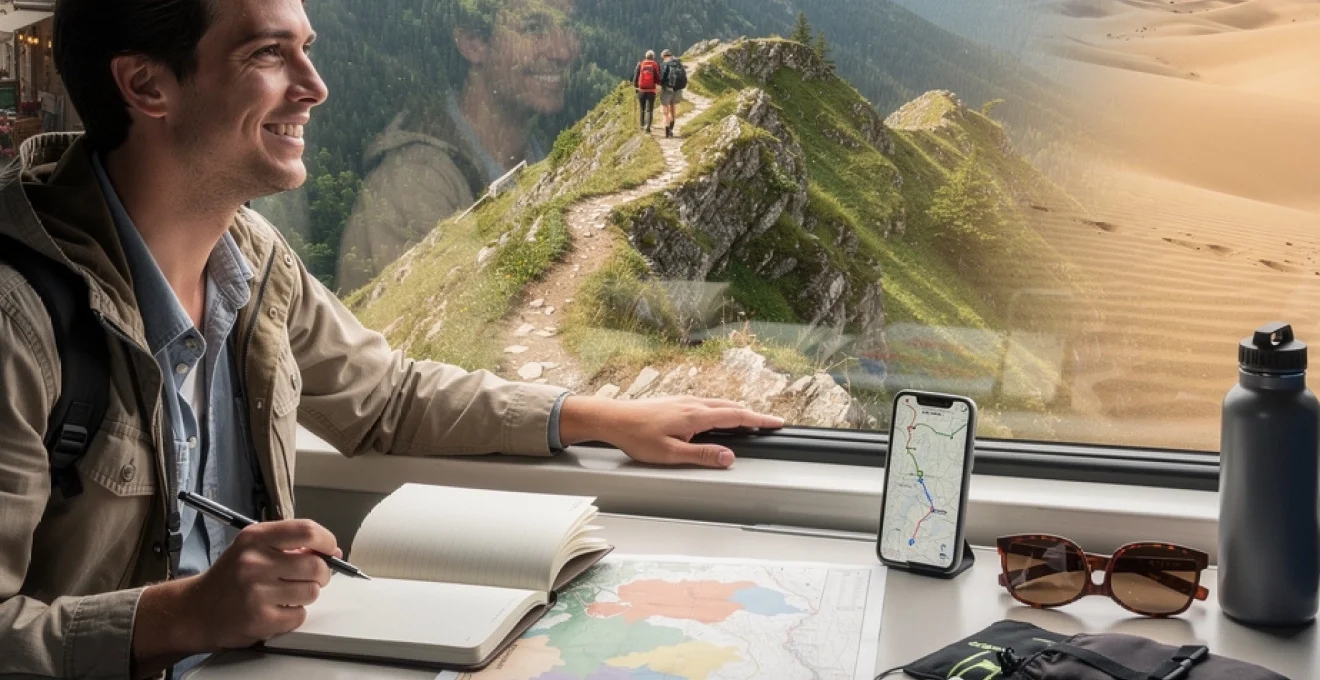
The difference between a forgettable trip and an unforgettable adventure often has little to do with the destination itself. Rather, it’s the psychological framework you bring to your travels—the lens through which you interpret experiences, the openness to uncertainty, and the willingness to step beyond prescribed tourist itineraries. Research from the Journal of Travel Research indicates that travellers who adopt what psychologists call a “growth mindset” report 73% higher satisfaction rates with their journeys, regardless of budget or destination prestige. This approach transforms ordinary moments into extraordinary memories, converting logistical challenges into compelling stories, and reshaping how you perceive not just travel, but life itself.
Adventure doesn’t require extreme sports or remote wilderness expeditions—though these certainly help. Instead, it emerges from a deliberate shift in consciousness, a recalibration of how you engage with unfamiliar environments, cultures, and experiences. Whether you’re exploring the backstreets of Hanoi or taking a weekend trip to a neighbouring county, the principles remain consistent: approach each moment with curiosity, embrace discomfort as a catalyst for growth, and recognise that the most profound discoveries often occur in the spaces between planned activities.
Cultivating the explorer’s psychological framework through cognitive reframing techniques
The foundation of adventurous travel lies not in your external circumstances but in your internal landscape. Cognitive reframing—the psychological technique of consciously altering how you interpret situations—serves as perhaps the most powerful tool in transforming mundane travel experiences into meaningful adventures. When you encounter a missed train connection, for instance, you face a choice: view it as a frustrating inconvenience or as an unexpected opportunity to explore a station neighbourhood you’d never planned to visit. The event remains identical; only your interpretation changes.
Neuroscientific research demonstrates that our brains are remarkably plastic, capable of forming new neural pathways throughout our lives. When you consistently practise reframing challenges as opportunities, you’re literally rewiring your brain’s default response patterns. This doesn’t mean forcing artificial positivity onto genuinely difficult situations, but rather maintaining what psychologists call “flexible optimism”—the ability to find constructive meaning even in setbacks.
Implementing Mindfulness-Based stress reduction (MBSR) to enhance Present-Moment awareness during travel
Mindfulness-Based Stress Reduction, originally developed by Jon Kabat-Zinn at the University of Massachusetts Medical School, offers travellers a scientifically validated method for deepening their engagement with each moment. The practice involves systematically directing attention to present-moment sensory experiences without judgement. During travel, this might mean truly tasting that street food vendor’s speciality rather than merely photographing it, or listening to the acoustic texture of a foreign language conversation without needing to understand every word.
A 2019 study published in the Journal of Positive Psychology found that travellers who practised even brief mindfulness exercises (as little as 10 minutes daily) reported significantly enhanced memory retention of travel experiences six months later. The mechanism appears straightforward: when you’re fully present during an experience, your brain encodes richer, more detailed memories. You’re not just collecting destinations; you’re cultivating awareness.
Breaking habitual pattern recognition through deliberate Novelty-Seeking behaviour
Your brain evolved to recognise patterns and create efficient shortcuts—mental heuristics that conserve cognitive energy. Whilst this serves you well in familiar environments, it can significantly diminish travel experiences. When you unconsciously seek the familiar (the international coffee chain, the English-language bookshop, the familiar cuisine), you’re essentially insulating yourself from the very novelty that makes travel transformative. Breaking these habitual patterns requires conscious effort and deliberate novelty-seeking behaviour.
Consider implementing what behavioural psychologists call “forced choice variations”—deliberately selecting options that diverge from your typical preferences. If you always order chicken, choose fish. If you typically wake at 7am, set your alarm for 5am to experience the city’s dawn rhythms. These micro-disruptions to your routine create space for genuine discovery and prevent the autopilot mode that can turn even exotic locations into extensions of your everyday environment.
Adopting the
Adopting the flaneur philosophy: urban wandering without predetermined destinations
The concept of the flâneur emerged in 19th-century Paris to describe the reflective urban wanderer: someone who strolls without a fixed goal, observing the city as both participant and spectator. Adopting this flaneur philosophy during travel means intentionally setting aside blocks of time where your only objective is to wander, notice, and absorb. Instead of optimising every hour for “must-see” attractions, you create psychological and temporal space for serendipity—those unplanned encounters and side streets that often become the highlights of a trip.
Practically, this might look like dedicating one afternoon in each new destination to aimless exploration within a defined geographic boundary. You choose a neighbourhood, put your phone on airplane mode, and follow whatever draws your attention: a side alley filled with murals, a cafe humming with local conversation, a park bench with a view over a canal. This mode of urban wandering counters our habitual productivity mindset, inviting you to value curiosity and presence over efficiency and checklists.
From a cognitive perspective, flaneur-style travel disrupts outcome-driven thinking and encourages process-oriented awareness. Instead of judging the success of your day by how many landmarks you visited, you begin to measure it by the depth of your engagement with place: the conversations you had, the details you noticed, the emotions that surfaced. Over time, this shift helps you carry an “urban explorer mindset” back into your daily life, allowing even your own city to feel more like a landscape of discovery than a backdrop for routine.
Utilising journaling protocols and reflective practice methods for deeper experiential processing
Most travellers take photos; far fewer systematically process their experiences through structured reflection. Yet research in cognitive psychology suggests that reflective writing can enhance learning, emotional integration, and long-term memory consolidation by up to 25%. When you treat your travels as qualitative data—observations, hypotheses, emotional responses—you move beyond passive consumption into active meaning-making. This is where a simple travel mindset evolves into a genuine personal growth practice.
One effective approach is to adopt a brief, repeatable journaling protocol that you can complete in 10–15 minutes each evening. For instance, you might use a three-column structure: Observation (what happened), Interpretation (what it meant to you), and Application (how it might influence your future choices or perspectives). By distinguishing between raw events and your stories about them, you strengthen your cognitive reframing skills and reduce the tendency to interpret challenges purely as failures or frustrations.
To deepen your experiential processing further, you can incorporate periodic “meta-reflection” sessions at key points in your journey—perhaps every week or at each major location change. During these sessions, review previous entries and look for patterns: recurring fears you’ve faced, types of experiences that energise you, cultural interactions that challenged your assumptions. This zoomed-out perspective functions like an internal debrief, transforming disconnected episodes into a coherent narrative arc of personal evolution.
Strategic Pre-Departure planning that preserves spontaneity and serendipitous discovery
Effective planning for adventure travel is less about scripting every hour and more about designing conditions where spontaneity can thrive without compromising safety or logistics. Think of your trip structure as scaffolding rather than a cage: a flexible framework that supports you while leaving room for improvisation. According to a 2023 report by Skift, travellers who plan key logistics but keep at least 30% of their schedule open report significantly higher satisfaction and lower stress than both over-planners and non-planners.
This strategic approach acknowledges a core paradox of the travel mindset: you want enough structure to minimise decision fatigue and avoid preventable problems, but not so much that you suffocate serendipity. By intentionally distinguishing between “non-negotiables” (visas, critical transport, essential accommodation) and “optional variables” (daily activities, dining choices, side trips), you give yourself psychological permission to deviate from the plan when opportunity arises. The result is a journey that feels both anchored and alive.
Creating flexible itinerary architecture using the 70-30 planning rule
The 70-30 planning rule offers a simple yet powerful way to balance structure and flexibility in your travel itinerary. The idea is straightforward: plan approximately 70% of your time around key goals, logistics, and anchor experiences, and deliberately leave 30% unstructured for spontaneous exploration. This proportion is supported by behavioural research suggesting that humans thrive when they combine predictable routines with regular doses of novelty and uncertainty.
In practice, the “70%” might include essential flights or train journeys, the first few nights of accommodation, and one or two core experiences per destination that are important enough to book ahead. The remaining “30%” is not a scheduling failure but a deliberate design choice—white space you protect in your calendar for wandering, following local recommendations, or simply resting. When a local invites you to a family dinner, or you discover a nearby village festival, that open bandwidth means you can say yes without derailing a tightly packed schedule.
To maintain this flexible itinerary architecture, consider using a simple coding system in your planning documents: mark non-movable commitments in one colour, and “soft plans” in another. This visual distinction reminds you that not every item carries equal weight and that changing a soft plan to accommodate an emerging opportunity is not a disruption but an expected part of your travel strategy. Over time, this reinforces a mindset where adaptability is a feature of your trip, not a flaw.
Leveraging geolocation apps like komoot and AllTrails for Off-the-Beaten-Path route discovery
In the past, discovering off-the-beaten-path routes often required insider knowledge or extensive research. Today, geolocation apps like Komoot and AllTrails function as digital guides, helping you uncover hiking trails, cycling routes, and scenic paths that rarely feature on mainstream tourist maps. Used mindfully, these tools can significantly enhance your sense of adventure while still providing safety data such as route difficulty, elevation, and recent user reviews.
To avoid turning your journey into yet another algorithm-driven experience, treat these apps as starting points rather than strict scripts. You might select a lesser-known trail, then intentionally build in time to deviate: exploring side paths, pausing at viewpoints, or engaging with locals you meet along the route. Think of the app as a compass, not a dictator; it gives you a general direction while leaving room for improvisation and curiosity.
From a psychological perspective, using geolocation tools for micro-adventures can help build confidence if you’re new to exploring unfamiliar terrain. Knowing you have a mapped route and offline navigation available reduces anxiety, making it easier to push gently beyond your comfort zone. Over time, as your navigation skills and situational awareness improve, you may find yourself relying less on digital guidance and more on instinct, observation, and local knowledge.
Building cultural intelligence through anthropological research and local custom familiarisation
Cultural intelligence—the ability to function effectively across different cultural contexts—is one of the most valuable outcomes of an adventurous travel mindset. Rather than treating culture as a backdrop for your photos, you approach each destination as an opportunity to understand alternative ways of organising life, meaning, and value. A 2022 study in the Annals of Tourism Research found that travellers who engaged in pre-trip cultural learning reported higher levels of empathy and lower incidences of cross-cultural conflict.
Before departure, consider conducting light “applied anthropology” research on your destination: social norms around greeting and eye contact, concepts of personal space, tipping practices, religious sensitivities, and gender expectations. Official tourism websites, ethnographic blogs, and regional documentaries can provide useful context. This preparation not only helps you avoid unintentional disrespect but also primes you to notice nuances you might otherwise miss.
Once on the ground, treat every interaction as an opportunity to refine your cultural understanding rather than confirm assumptions. When in doubt, observe first: how do locals queue, interact with service staff, or behave on public transport? If you’re unsure about a custom, it’s usually better to ask a respectful question than to guess. This iterative process of research, observation, and adjustment mirrors the work of anthropologists in the field—and turns your trip into a living laboratory of human diversity.
Curating equipment kits for Multi-Environment adaptability: from patagonia to sahara desert conditions
While adventure is primarily a mental orientation, appropriate gear dramatically expands the range of environments where you can comfortably and safely explore. Curating a modular, multi-environment travel kit allows you to transition from urban exploration to mountain trails or desert crossings with minimal friction. Think of your equipment not as a collection of gadgets, but as an enabling infrastructure that widens your “operating envelope” as a traveller.
A practical approach is to build your kit around layered systems rather than single-use items: base layers for moisture management, mid-layers for insulation, and outer shells for wind and rain protection. This philosophy applies equally whether you’re hiking in Patagonia’s unpredictable weather or navigating cool desert nights in the Sahara. A lightweight down jacket, packable waterproof shell, and versatile hiking shoes can carry you through a surprising range of conditions when combined intelligently.
To maintain flexibility without over-packing, apply a “cross-context utility” test to each item: does it serve multiple functions across different environments? A sarong, for instance, can act as beachwear, privacy curtain, scarf, or improvised towel. A headlamp is useful for night hikes, hostel dorms, and unexpected power cuts. By prioritising multifunctional gear and periodically reviewing your packing list after each trip, you gradually assemble a personalised adventure kit that supports spontaneity rather than weighing it down.
Engaging with local communities through immersive cultural exchange methodologies
Transformative travel rarely happens from the insulated bubble of chain hotels and tourist buses. It emerges in the relational spaces where your world intersects with that of local communities—shared meals, collaborative projects, and conversations that stretch long past sunset. Immersive cultural exchange methodologies provide structured ways to cultivate these encounters while respecting local autonomy and avoiding the extractive dynamics that sometimes accompany “voluntourism.”
Approaching each destination with a mindset of mutual learning rather than one-sided consumption fundamentally alters your behaviour. You stop asking, “What can I get from this place?” and start asking, “What can we learn from each other?” This subtle shift aligns your travel mindset with principles of ethical, responsible tourism, making your adventures not just memorable for you but also more meaningful for the people and ecosystems you encounter.
Participating in homestay networks via platforms like workaway and WWOOF
Homestay and work-exchange platforms such as Workaway and WWOOF (World Wide Opportunities on Organic Farms) offer structured frameworks for immersive cultural experiences. Instead of simply observing daily life from a distance, you participate in it: helping with harvests, assisting in small guesthouses, or contributing to creative projects in exchange for accommodation and meals. This arrangement transforms your role from transient visitor to temporary community member.
Before committing to any placement, it’s crucial to evaluate host profiles carefully, read reviews, and clarify expectations regarding work hours, living conditions, and cultural norms. Think of this due diligence as conducting a “micro-ethnography” in advance: you’re assessing not just logistics but compatibility of values and lifestyles. When the fit is right, these experiences often yield deep friendships, language practice, and a nuanced understanding of local realities that no standard tour can offer.
From a psychological standpoint, homestays also challenge and expand your comfort zone. Sharing space with strangers, adapting to different household routines, and negotiating boundaries all require emotional flexibility and communication skills. Over time, these capacities generalise beyond travel, increasing your resilience and relational intelligence in everyday life.
Attending Region-Specific festivals: holi in rajasthan, inti raymi in cusco, songkran in chiang mai
Region-specific festivals condense cultural values, histories, and collective emotions into intense, time-bound experiences. Participating in celebrations like Holi in Rajasthan, Inti Raymi in Cusco, or Songkran in Chiang Mai can feel like stepping into the living heart of a culture’s mythologies and social bonds. Rather than observing culture as a static museum exhibit, you encounter it as a dynamic, embodied phenomenon—colour, sound, ritual, and community intertwined.
To engage responsibly, treat these festivals not as entertainment products but as sacred or socially significant events into which you are being temporarily welcomed. Research the historical context and basic etiquette in advance: appropriate clothing, behavioural expectations, and any restricted areas or rituals. During the event, follow the lead of locals, ask permission before taking intimate photos, and maintain awareness of how your presence may impact the space.
The intensity of festival environments can also surface strong emotions—joy, disorientation, vulnerability, awe. Rather than seeking to control or analyse every feeling in the moment, allow yourself to experience the full sensory and emotional spectrum, then process it later through journaling or conversation. In doing so, you anchor the event not just as a spectacle, but as a milestone in your ongoing education as a global citizen.
Conducting informal ethnographic interviews at local markets and gathering spaces
Local markets, tea houses, plazas, and bus stations often function as informal social laboratories where everyday life unfolds in concentrated form. Conducting casual, respectful conversations in these spaces can yield rich insights into local perspectives that guidebooks rarely capture. Think of these dialogues as “informal ethnographic interviews”—lightweight, conversational inquiries grounded in curiosity rather than interrogation.
You don’t need academic training to do this well; you need empathy, good questions, and a willingness to listen more than you speak. Simple prompts like “What do you wish visitors understood about this place?” or “How has this neighbourhood changed in the last few years?” can open windows into complex social, economic, and environmental dynamics. Always be transparent about your intentions and avoid prying into sensitive topics unless the other person leads the way.
To honour the exchange, consider what you can offer in return: perhaps you share stories from your own home, buy something from their stall, or simply offer undivided attention in a world that rarely grants it. Over time, these micro-interviews accumulate into a mosaic of lived realities that deepen your understanding of global interconnectedness—and remind you that every destination is less a backdrop and more a network of individual lives.
Learning functional language phrases using spaced repetition systems and contextual application
Even a modest grasp of local language phrases can dramatically alter your interactions and the depth of your cultural immersion. Linguistic research suggests that using just 20–50 high-frequency expressions in context—greetings, gratitude, directions, basic questions—can significantly reduce social distance and increase perceptions of respect. Rather than aiming for fluency, focus on functional language: the words and phrases that unlock everyday exchanges.
Spaced repetition systems (SRS), such as digital flashcard apps, provide an efficient way to internalise vocabulary before and during your trip. By presenting words at scientifically calibrated intervals, these tools help transfer information from short-term to long-term memory with minimal daily time investment. To maximise effectiveness, pair SRS with contextual application: practise phrases at actual cafes, train stations, and markets rather than only in your accommodation.
Crucially, treat language use as a relational gesture rather than a performance. You will mispronounce words; you will forget gender agreements; you will occasionally say something unintentionally humorous. When this happens, lean into the shared laughter—it signals humility and openness, which are far more important than grammatical perfection. Over time, your willingness to “speak imperfectly” reinforces a broader travel mindset: one that values connection over image and learning over ego.
Transforming transportation intervals into Micro-Adventure opportunities
Many travellers treat transportation—flights, train rides, long bus journeys—as dead time to be endured or anaesthetised with scrolling. An adventurous travel mindset reframes these intervals as fertile ground for micro-adventures: small, intentional experiences that enrich your journey without requiring extra days or major detours. If you think of your entire trip as a continuous narrative, transport segments become transitional chapters rather than blank pages.
On long-haul flights, for example, you might design a simple “in-transit ritual” that includes stretching routines, reflective journaling, and a curated playlist of local music from your destination. Train journeys offer moving panoramas of landscapes rarely seen from highways; use them as opportunities for slow observation, photography, or conversations with fellow passengers. Even airport layovers can become mini-explorations—sampling regional dishes, visiting observation decks, or practising people-watching with mindful attention.
Safety and situational awareness remain paramount, of course. Not every bus stop or late-night connection is an appropriate context for exploration. The goal is not to romanticise discomfort or ignore risk, but to ask a simple question whenever you’re in motion: “Within the boundaries of safety and energy, how might I turn this waiting time into a small adventure?” Over time, this habit of creative re-framing spills over into everyday life—commutes, queues, and mundane errands become micro-opportunities for curiosity and presence.
Documenting experiences through Multi-Sensory memory anchoring techniques
One of the most subtle but powerful ways to enhance your travel mindset is to deliberately encode experiences in richer, multi-sensory detail. Neuroscience shows that memories linked to multiple sensory inputs—sight, sound, smell, taste, touch—are more durable and emotionally resonant than those based solely on visual information. In other words, if you document your journeys only through photos, you’re leaving a vast amount of potential memory on the table.
Multi-sensory memory anchoring involves consciously noting and sometimes recording the different sensory dimensions of a moment. When you’re drinking coffee in a Lisbon backstreet, for example, you might pay attention not just to the view but to the texture of the cup, the aroma of roasted beans, the cadence of Portuguese conversations around you, the feel of cobblestones under your feet. Later, when you write a brief description or make an audio note capturing these details, you create a dense “memory node” your brain can easily revisit.
There are many ways to systematise this without turning your trip into a data-collection exercise. Some travellers create a simple daily ritual of capturing three anchors: one sound, one smell, and one tactile sensation that defined the day. Others assemble small, legal-to-carry mementos—pressed flowers, ticket stubs, fabric scraps—and pair them with short written reflections. Like layering instruments in a song, each additional sensory thread enriches the overall composition, making your travels not only easier to recall but more meaningful when you do.
Overcoming psychological barriers: fear habituation and comfort zone expansion protocols
For many people, the biggest obstacles to turning a trip into a real adventure are not logistical but psychological: fear of getting lost, of embarrassment, of physical risk, of cultural misunderstanding. These fears are not inherently negative—they often contain important information about safety and boundaries. However, when left unexamined, they can quietly shrink the radius of your experiences until travel becomes little more than relocating your comfort zone to another country.
Fear habituation offers a structured way to work with these barriers rather than against them. Borrowed from exposure therapy research, the core idea is to gradually and intentionally expose yourself to mildly uncomfortable situations in controlled doses, allowing your nervous system to learn that they are survivable. Instead of forcing yourself into extreme adventures you’re not ready for, you design a ladder of incremental challenges that nudge the edges of your comfort zone without overwhelming it.
One practical protocol is to list specific travel-related fears—solo dining, initiating conversations with strangers, navigating public transport in an unfamiliar language—and rank them from least to most intimidating. Start with the lower-intensity items and set clear, measurable actions: ask one local for directions each day, take a short solo walk without your phone’s map, try a new food despite initial hesitation. After each exposure, debrief in writing: What did you expect? What actually happened? What did you learn about your capabilities?
Over time, these small experiments accumulate into a profound shift in self-perception. You start to see yourself not as someone who “isn’t adventurous” but as someone who actively trains their courage in manageable steps. The process is similar to strength training: you don’t lift the heaviest weight on day one; you progressively overload the muscle. With each successful repetition—each fear faced and integrated—your travel mindset becomes less about avoiding discomfort and more about skillfully engaging with it as a catalyst for growth, on the road and back home.