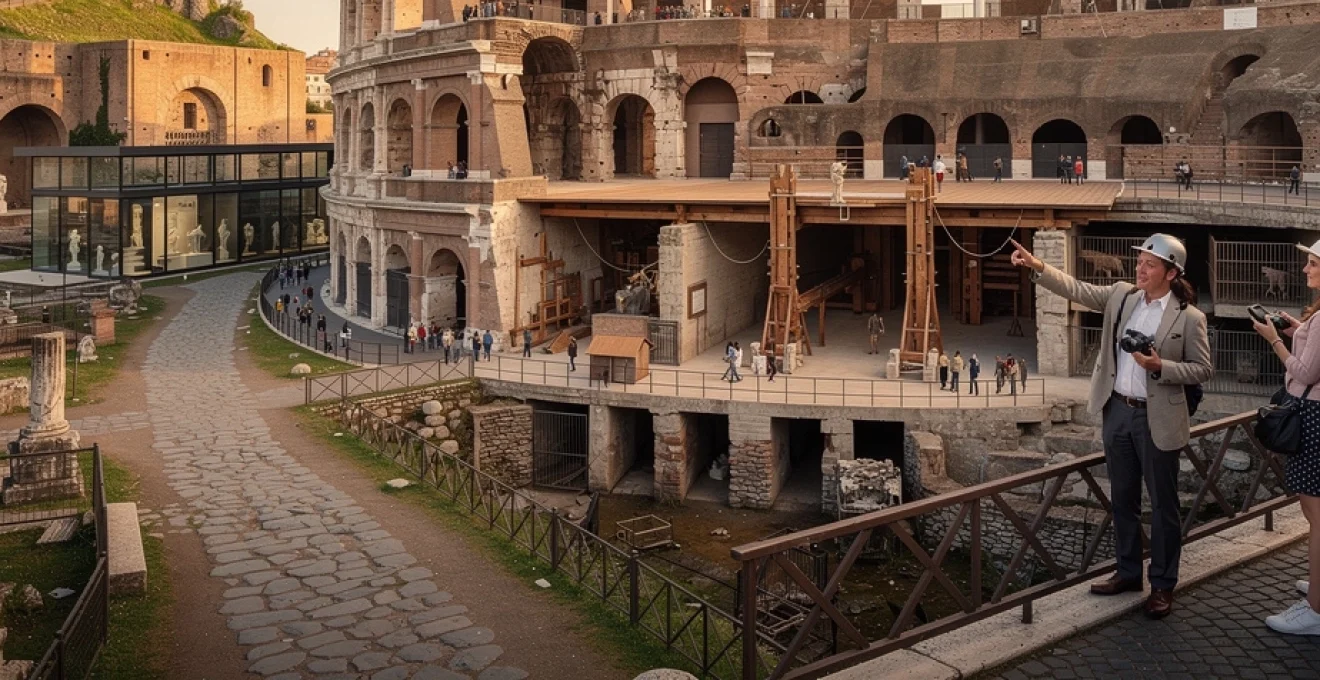
Standing before Rome’s most iconic monument, millions of visitors each year capture the obligatory selfie and move on, missing the profound layers of history hidden beneath their feet and soaring above their heads. The Colosseum offers far more than its imposing façade suggests, revealing engineering marvels, archaeological treasures, and architectural innovations that transformed entertainment and urban planning across the ancient world. Rather than settling for a superficial encounter with this UNESCO World Heritage site, discerning travellers can unlock access to restricted areas, discover underground networks that housed gladiators and wild beasts, and explore the integrated archaeological complex that tells the complete story of imperial Rome.
Beyond the standard arena floor experience, the amphitheatre’s true magnificence emerges through careful planning and expert guidance. From the intricate hypogeum chambers that operated like a sophisticated stage mechanism to the panoramic views from reconstructed upper levels, each hidden corner reveals the sophisticated urban planning and social engineering that sustained the Roman Empire for centuries.
Underground archaeological excavations and hypogeum access
The hypogeum represents one of antiquity’s most sophisticated underground complexes, extending two levels beneath the arena floor in a labyrinthine network of chambers, corridors, and mechanical installations. Archaeological excavations have revealed a subterranean world that operated with theatrical precision, where gladiators, condemned criminals, and exotic animals awaited their dramatic entrances into the arena above.
Colosseum underground chamber network and engineering marvels
The underground chamber network spans approximately 6,000 square metres, divided into distinct functional zones that supported the amphitheatre’s complex operations. Eighty vertical shafts connected the hypogeum to the arena floor, each equipped with sophisticated pulley systems and counterweight mechanisms. These engineering marvels allowed for the rapid deployment of scenery, animals, and performers, creating the surprise elements that captivated audiences for over four centuries. The chambers were designed with precise acoustics in mind, ensuring that commands could be transmitted clearly throughout the underground network during performances.
Water management systems within the hypogeum demonstrate remarkable Roman engineering prowess, with drainage channels and storage areas that supported both the underground facilities and occasional naumachiae (mock naval battles) staged in the flooded arena. The ventilation system, featuring strategically placed air shafts and circulation chambers, maintained breathable conditions in the underground spaces even during the most crowded events above.
Gladiator preparation areas and beast holding cells
Archaeological evidence reveals distinct areas where gladiators prepared for combat, including arming chambers, medical facilities, and holding areas where fighters awaited their turns in the arena. The gladiator preparation areas featured specialized equipment storage, weapon maintenance facilities, and even primitive medical stations where wounds could be treated between contests. Separate corridors ensured that different categories of fighters—from heavily armoured murmillones to lightly equipped retiarii—could be managed efficiently without interference.
Beast holding cells occupied dedicated sections of the hypogeum, with reinforced barriers and specialized feeding systems designed to house lions, tigers, bears, and exotic animals imported from across the empire. These cells included sophisticated drainage systems to manage waste and water supplies, while the connecting tunnels featured removable barriers that could channel animals directly to specific arena entrances. The scale of these facilities suggests that hundreds of animals could be housed simultaneously during major festivals and celebrations.
Mechanical lift systems and trapdoor mechanisms
The Colosseum’s mechanical lift systems represent one of antiquity’s most advanced technological achievements, employing a combination of human power, counterweights, and pulley mechanisms to raise heavy loads from the hypogeum to the arena floor. These lifts could transport not only individual gladiators and animals but also elaborate stage sets, including artificial trees, rocks, and architectural elements that transformed the arena into diverse landscapes.
Trapdoor mechanisms throughout the arena floor operated with clockwork precision, allowing for sudden appearances that enhanced the theatrical spectacle. Recent archaeological studies have identified over 30 individual trap doors, each connected to specific lift shafts and operated by teams of workers stationed in the underground chambers. The coordination required to operate these systems during live performances demonstrates the sophisticated project management capabilities of Roman engineering teams.
Advanced booking requirements for subterranean tours
Because access to the hypogeum and underground archaeological excavations is strictly regulated, you cannot simply turn up on the day and expect to enter these areas. Subterranean Colosseum tours are limited to small groups, with timed entry slots that often sell out weeks in advance during peak season. If exploring the underground chamber network is a priority, you should plan your visit around these tickets rather than trying to squeeze them into an already fixed itinerary. Many reputable tour operators bundle hypogeum access with guides who specialise in Roman history, which can significantly enhance your understanding of what you are seeing.
Official ticket quotas and security protocols mean that last-minute availability is rare, particularly for popular time slots such as late morning or golden hour. When booking, pay close attention to whether your ticket explicitly mentions “underground” or “hypogeum” access, as standard Colosseum tickets do not include these restricted areas. It is also worth checking the cancellation policy, as heavy rain or maintenance work can occasionally lead to closures of subterranean sections. Arriving at the monument at least 30 minutes before your scheduled entry time helps you clear security in good time and avoid losing your slot. In practice, treating the underground visit as the core of your Colosseum experience is the best way to ensure you actually see this hidden world beneath the arena.
Palatine hill archaeological complex integration
To truly make the most of a visit to the Colosseum beyond the usual photo stop, you need to think in terms of an integrated archaeological landscape rather than a single monument. The Colosseum, Roman Forum and Palatine Hill form one continuous complex, all covered under combined tickets and many guided tours. Standing within the amphitheatre, you are only a short walk from the political, religious and residential heart of ancient Rome. Visiting these sites together allows you to follow in the footsteps of emperors, priests and citizens as they moved between arenas of power, worship and entertainment in their daily lives.
Palatine Hill, rising above the Forum, offers a quieter, more contemplative counterpart to the intense crowds around the Colosseum. Its pine-fringed paths, scattered palace ruins and sweeping viewpoints give you space to process everything you have seen inside the stadium. From certain terraces you can look back towards the amphitheatre and understand how it fit into the broader topography of the city. For travellers interested in ancient Rome beyond gladiatorial combat, Palatine Hill is where the story of imperial power, private luxury and mythological origins comes together.
Roman forum connection via sacred way (via sacra)
The Roman Forum once functioned as the beating heart of public life, a dense cluster of temples, basilicas and administrative buildings where politics, religion and commerce intertwined. Today, a carefully laid-out path guides visitors through its ruins, and one of the most evocative routes connects directly to the Colosseum via the Via Sacra, or Sacred Way. This ancient processional road once carried triumphal parades, religious ceremonies and imperial cortèges between the Forum and the city’s major monuments. Walking it today, you experience a tangible link between the spectacle of the arena and the power structures that orchestrated those games.
From the Colosseum, the Via Sacra passes near the Arch of Titus and ascends gently towards the Curia and the Temple of Saturn, offering excellent vantage points for photography and orientation. If you have booked a combined ticket or guided itinerary, you can often start at the Colosseum and finish in the Forum, or vice versa, depending on your time slot. As you follow this route, try to imagine senators, victorious generals and foreign envoys treading the same paving stones under very different circumstances. The Sacred Way turns what might feel like separate attractions into a coherent narrative journey through Rome’s public spaces.
Domus flavia imperial palace ruins
At the summit of Palatine Hill, the sprawling ruins of the Domus Flavia reveal the scale and sophistication of imperial residential architecture. Commissioned under Emperor Domitian in the late first century AD, this palace complex served as the formal, public wing of the emperor’s residence. Visitors today can trace the outlines of grand reception halls, audience chambers and internal courtyards, many of which would have been adorned with rich marble, stucco and fountains. Standing among these foundations, you gain a powerful contrast with the Colosseum below: here, power was exercised through ceremony and diplomacy, rather than blood and spectacle.
Although much of the original decoration has vanished, archaeologists have identified key spaces such as the aula regia, where emperors granted audiences, and the basilica-like halls that hosted legal and administrative functions. Information panels help you reconstruct these interiors in your imagination, but for a deeper understanding you may want to join a tour that includes architectural reconstructions or tablet-based augmented reality. Visiting the Domus Flavia after the Colosseum puts gladiatorial games into perspective, reminding you that the arena was only one instrument in a broader toolkit of imperial image-making. In practical terms, the wide, open spaces on the hill also offer a welcome break from crowds and provide excellent viewpoints over the city.
House of augustus frescoed chambers
Just below the main palace complex lie the more intimate remains of the House of Augustus, the residence of Rome’s first emperor. Unlike the monumental spaces of the Domus Flavia, these rooms are relatively compact, with some of the finest surviving wall paintings from the early imperial period. Delicate frescoes in deep reds, blues and ochres depict architectural fantasies, mythological scenes and ornamental motifs, giving a sense of the refined aesthetic that surrounded the emperor in his private life. Access to these frescoed chambers is strictly controlled, often requiring a separate, time-specific reservation or guided visit.
For visitors seeking to go beyond standard Colosseum itineraries, the House of Augustus offers an exceptional opportunity to engage with the personal dimension of imperial power. It is one thing to stand in the vast Colosseum imagining 50,000 spectators; it is another to stand in the painted study where Augustus may have drafted speeches or policies that shaped the empire. Because group sizes are small and visit slots are short, it is advisable to build this into your planning early, especially in high season. The cool, dimly lit interiors also provide a welcome respite from the Roman sun, making them an excellent mid-day complement to an early-morning Colosseum visit.
Palatine museum artefact collections and sculptures
The Palatine Museum, located within the archaeological park, houses many of the sculptures, inscriptions and architectural fragments discovered on the hill. For travellers who enjoy connecting objects to places, this compact museum is invaluable. Marble portraits of emperors and their families, decorative reliefs from vanished façades, and everyday artefacts like lamps and pottery help you visualise the palaces and houses that once dominated the Palatine. Having just walked through the ruins, seeing original statuary and ornament in a curated environment allows you to mentally “re-furnish” the spaces you have explored.
The museum is often quieter than the Colosseum or Forum, making it an ideal stop if you want a more reflective experience away from the main crowds. Labels and displays are generally informative but concise, and many visitors find that even 30–45 minutes here greatly enriches their understanding of the wider archaeological complex. If you are travelling with children or non-specialists, focusing on a few standout pieces—such as particularly expressive busts or intricate decorative panels—can prevent fatigue and keep interest high. Combining the Palatine Museum with the House of Augustus and Domus Flavia turns your ticket into a multi-layered exploration of imperial life, rather than just a single monument visit.
Architectural analysis and construction techniques
While the drama of gladiatorial combat often dominates the popular imagination, the Colosseum is equally impressive as a case study in Roman engineering and architectural design. Approaching your visit with this in mind can transform what you see: suddenly, arches, vaults and staircases become evidence of deliberate planning rather than mere background. The structure was built rapidly, beginning under Vespasian around AD 72 and inaugurated under Titus in AD 80, a pace that would be remarkable even by modern standards. Understanding how materials were sourced, assembled and organised helps you appreciate why the amphitheatre still stands after almost two millennia of earthquakes, fires and stone robbing.
As you move through the building, take time to look beyond the iconic outer façade. Notice how the load-bearing arches distribute weight, how corridors form a honeycomb of support, and how the visible stone blocks conceal a concrete core. Thinking like an engineer, even briefly, adds a new dimension to the experience and reveals why the Colosseum became a model for later stadiums across Europe and beyond. If you are particularly interested in architecture, consider downloading a plan or schematic before your visit, so you can match what you see on site to the cross-sections and diagrams.
Travertine stone quarrying from tivoli and assembly methods
The Colosseum’s iconic exterior is built primarily from travertine, a type of limestone quarried from the area around Tivoli, approximately 20 kilometres east of Rome. Ancient sources and modern research estimate that over 100,000 cubic metres of travertine were used, transported to Rome via specially constructed roads and hauled by ox-drawn wagons. Instead of mortar, iron clamps and dowels fixed the massive blocks together, locking them into a stable, interdependent framework. When you stand close to the outer walls, you can often spot the small, rectangular holes where these metal elements were once anchored before being removed in later centuries.
Behind the travertine shell, Roman builders employed a more economical combination of brick, tufa and opus caementicium (Roman concrete). This layered approach—high-quality stone where visibility and durability mattered, cheaper materials where they did not—was a hallmark of imperial construction strategy. Think of it as an ancient version of a steel frame clad in glass and stone in a modern skyscraper: each material was used where it performed best. Visitors interested in construction techniques should pay attention to exposed cross-sections in damaged areas of the Colosseum, where you can clearly see the transition from solid stone to concrete and brick infill. These “accidental cutaways” function like a textbook diagram brought to life.
Amphitheatre design principles and crowd flow engineering
The Colosseum’s design showcases a sophisticated understanding of crowd management and sightlines, principles that still guide stadium architecture today. The elongated oval, or elliptical plan, ensured that spectators were never too far from the action, with a maximum distance of around 80 metres from any seat to the arena floor. Tiered seating rose steeply, supported by a complex system of radial and annular corridors, vaults and staircases. This allowed up to 50,000–70,000 spectators to enter and exit efficiently, minimising bottlenecks and the risk of dangerous crushes.
As you move through the interior passageways, notice how the signage and numbered entrances (reconstructed in part) would once have guided people directly to their assigned sections. The Romans effectively invented the concept of “zoned” ticketing, with each social group funneled through specific gates and staircases. In modern terms, the Colosseum functioned like a perfectly choreographed transport hub, where different flows intersected without colliding. Reflecting on this as you climb the steps gives you a new appreciation for how much thought went into visitor experience—even when those visitors were citizens of ancient Rome rather than international tourists.
Velarium retractable awning system operations
One of the Colosseum’s most ingenious features was the velarium, a vast retractable awning that shaded spectators from the intense Mediterranean sun. Operated by specialised teams of sailors from the imperial fleet, the system consisted of a network of canvas panels, ropes and wooden masts anchored to stone corbels around the top of the amphitheatre. Although the original fabric has long since disappeared, you can still see many of these stone brackets along the upper perimeter if you remember to look up. They give a sense of the scale and complexity required to partially cover such a huge open space.
Visualising the velarium in action can be challenging, but you might think of it as an enormous, manually operated umbrella that could be adjusted according to wind and sun. Historical descriptions suggest that it did not cover the arena itself, allowing light to flood the performance area while keeping the spectators in relative shade. For a more vivid impression, some museums and guidebooks include reconstructions or animations of the system in use, which you can study before or after your visit. Next time you sit in a modern stadium with a retractable roof, remember that the basic idea was tested in Rome almost 2,000 years ago.
Seating hierarchy and social stratification zones
The Colosseum was not just a place of entertainment; it was a three-dimensional diagram of Roman society. Seating was rigidly organised by status, with the best positions closest to the arena reserved for senators and equestrians, and progressively less desirable seats allocated to ordinary citizens, freed slaves and, at the very top, women and the poor. Inscriptions and surviving seating fragments indicate that entire blocks were sometimes reserved for specific groups, such as guilds, foreign envoys or army units. When you stand in the lower tiers and look upwards, you are essentially looking through the layers of a social pyramid made manifest in stone.
Understanding this hierarchy adds nuance to your visit and helps you “read” the amphitheatre in a more informed way. Ask yourself: from which angle would a senator have watched the games, and how different would the experience have been from that of a labourer squeezed into the uppermost rows? Guided tours that focus on social history can be particularly illuminating here, as they explain how seating arrangements reinforced loyalty, identity and control. For many visitors, this perspective transforms the Colosseum from a generic ruin into a vivid illustration of how public spaces can shape and reflect power relations—even in our own time.
Gladiatorial combat programmes and historical context
No visit to the Colosseum feels complete without grappling with the reality of gladiatorial combat and the broader spectacle culture of ancient Rome. Far from being random bouts of violence, games followed carefully structured programmes, often spanning several days and coordinated with religious festivals, military victories or political announcements. Morning sessions might feature animal hunts (venationes), midday could be reserved for public executions, and the afternoon would culminate in gladiator matches that pitted different fighting styles against one another. This choreography of blood and theatre served both to entertain and to project imperial power.
Modern estimates suggest that tens of thousands of people—and untold numbers of animals—died in such spectacles across the centuries. Yet contemporary Roman accounts often framed these events as demonstrations of virtue, bravery and divine favour. When you stand on or near the reconstructed arena floor, it is worth reflecting on this tension between spectacle and brutality. Was the Colosseum primarily a tool of social control, a stage for imperial generosity, or a mirror of human fascination with risk and death? Engaging with these questions can make your visit more meaningful than simply ticking a box on a sightseeing list.
To deepen your understanding, consider seeking out tours or audio guides that address the training regimes, social status and personal stories of gladiators. Many fighters were enslaved or condemned criminals, but others volunteered, attracted by the promise of fame, prize money or a chance at freedom. Excavations of gladiator barracks and graveyards outside Rome and in other cities have revealed inscriptions, equipment and even skeletal injuries that bring individual lives into focus. Knowing that a particular type of helmet or shield corresponds to the Thraex or secutor makes the combat scenes you imagine in the arena more concrete and historically grounded.
Conservation efforts and modern restoration projects
The Colosseum we see today is the product not only of ancient construction and medieval damage, but also of more than two centuries of conservation and restoration. In the 19th century, massive buttresses were added to stabilise collapsing sections, while in the 20th and 21st centuries, systematic cleaning and structural reinforcement campaigns have aimed to protect the monument from pollution, vibration and weathering. Recent projects have focused on removing centuries of grime from the travertine façade, revealing the warm, honey-coloured stone that would have gleamed in the Roman sun. As you walk around the exterior, you can often distinguish recently restored sections from darker, unrestored areas.
Ongoing conservation is a delicate balancing act between preserving authenticity and ensuring safety for millions of annual visitors. Modern engineers use techniques such as laser cleaning, micro-injection grouting and stainless-steel reinforcement bars to stabilise fragile elements without radically altering their appearance. At the same time, archaeologists must decide how much to reconstruct and how much to leave as evocative ruin. The partial reconstruction of the arena floor, for example, has sparked debate: it offers powerful interpretive value for visitors, but also changes the visual character of the interior. Paying attention to signage that explains recent works can give you insight into these ethical and practical dilemmas.
Visitor management is another crucial component of modern preservation. Timed entry tickets, restricted-access zones and controlled group sizes are all designed to reduce wear and tear on vulnerable areas. From a traveller’s perspective, these measures may sometimes feel inconvenient, but they are essential if future generations are to experience the Colosseum at all. When planning your trip, it is wise to check official sources for updates on restoration schedules, as certain sections may be temporarily closed. Far from diminishing your visit, understanding the monument as a living conservation project can make your time there feel part of an ongoing story rather than a static encounter with the past.
Alternative viewing perspectives and photography techniques
While stepping inside the amphitheatre is an unforgettable experience, some of the most rewarding moments come from viewing the Colosseum in context from a distance. Exploring alternative vantage points around the monument allows you to appreciate its relationship with the surrounding cityscape and to capture more distinctive photographs. Elevated viewpoints on the north side—near Via Nicola Salvi and the small park on Monte Oppio—offer near-frontal views of the most complete façade. From here, the elliptical form and superimposed orders of arches stand out clearly, especially in the soft light of early morning or late afternoon.
Another excellent perspective comes from the upper terraces of the Roman Forum and Palatine Hill, where you can frame the Colosseum against layers of ruins, cypress trees and distant domes. For a true bird’s-eye view, the panoramic platform atop the Vittoriano (Altar of the Fatherland) provides a sweeping vista across central Rome, with the amphitheatre clearly visible in its urban setting. If you have access to a rooftop bar or terrace in the nearby Monti district, you may also be able to capture more intimate, “peekaboo” shots that juxtapose the ancient structure with modern streets and balconies. Moving between these locations turns the Colosseum into a recurring motif in your Roman walk, rather than a single, isolated stop.
From a practical photography standpoint, the biggest challenges are crowds, harsh midday light and construction barriers that may appear without much warning. To mitigate these, aim to shoot at blue hour or golden hour, when the combination of natural and artificial lighting adds depth and texture to the stone. A small travel tripod can be useful for long exposures, especially if you want to blur passing traffic or pedestrians, though you should always respect local regulations and security instructions. Wide-angle lenses help capture the full sweep of the monument up close, while a moderate zoom is ideal for compressing the Colosseum against the skyline from distant viewpoints.
Compositionally, try to move beyond the standard centred façade shot. Use arches, trees, lampposts or nearby ruins as natural frames, or experiment with leading lines, such as cobblestone paths or railing edges, guiding the viewer’s eye towards the structure. Reflections in puddles after rain can yield striking, mirror-like images with minimal effort. Inside the amphitheatre, look for patterns formed by repeating arches, shadows and seating tiers; shooting in black and white can sometimes emphasise these graphic qualities. Ultimately, the most memorable photographs often come not from finding a completely “new” angle—an almost impossible task for such a famous site—but from being present, patient and willing to see familiar forms under changing light and weather conditions.