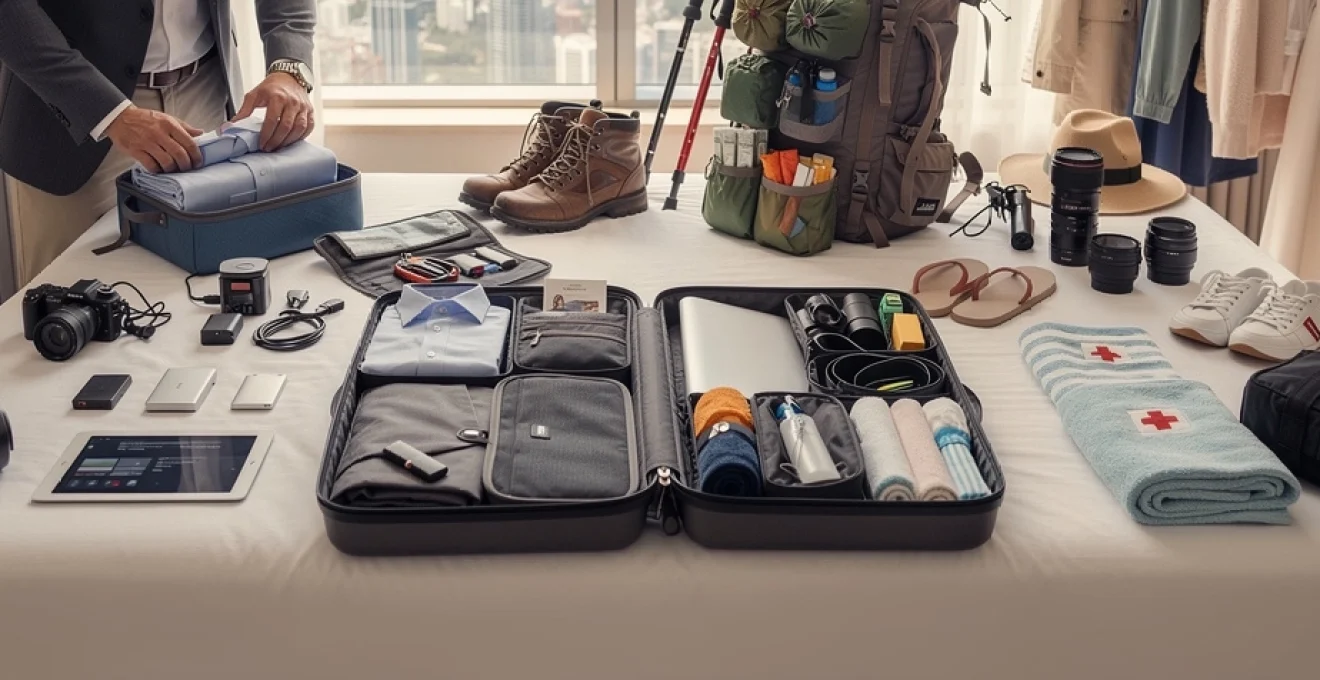
Modern travel demands strategic thinking when it comes to packing efficiency. Whether you’re preparing for a business meeting in Tokyo, embarking on an adventure through the Andes, or planning a leisurely cruise through the Mediterranean, the art of efficient packing can transform your entire travel experience. The difference between seasoned travellers and novices often lies not in their destinations, but in their ability to carry everything they need whilst maintaining mobility and freedom.
Research indicates that travellers who pack efficiently report 73% higher satisfaction rates during their journeys. The psychological burden of heavy luggage extends far beyond physical discomfort, affecting decision-making abilities and spontaneity. Professional travel consultants consistently emphasise that efficient packing is fundamentally about maximising experiences rather than minimising possessions. Understanding how to tailor your packing strategy to specific trip types ensures you’ll always have what you need without the excess weight that can derail even the most carefully planned adventures.
Strategic packing methodologies for business travel and corporate trips
Business travel presents unique challenges that demand precision and foresight. The modern corporate traveller must balance professional presentation with practical mobility, often navigating multiple time zones, climates, and cultural expectations within a single trip. Smart business packing begins with understanding that efficiency directly correlates with professional success.
Carry-on optimisation for international business flights
International business flights require meticulous planning to maximise carry-on space whilst ensuring immediate access to essential items. The key lies in strategic compartmentalisation and understanding airline restrictions across different carriers. European airlines typically enforce stricter size limitations than their American counterparts, with Ryanair’s 55cm x 40cm x 20cm restriction being amongst the most challenging. Successful business travellers invest in high-quality expandable luggage that can adjust to varying airline requirements whilst maintaining structural integrity.
Priority should be given to items that cannot be easily replaced at your destination. Critical business documents, presentation materials, and specialised electronics must remain within arm’s reach throughout your journey. Consider that business travellers lose an average of 2.3 hours per trip when essential items are checked rather than carried on, primarily due to baggage delays and retrieval processes.
Wrinkle-free garment rolling techniques for professional attire
Professional attire demands special attention to prevent wrinkles and maintain a polished appearance upon arrival. The traditional folding method proves inadequate for business clothing, leading to the development of specialised rolling techniques that preserve fabric integrity. The bundle wrapping method represents the gold standard for business packing, where garments are wrapped around a central core item, creating natural curves that prevent harsh creases.
Dress shirts benefit from the collar-first rolling approach, where the collar is kept flat and the shirt body is rolled around it. Blazers and suits require tissue paper insertion between folds to maintain structure. Investment in quality packing cubes with compression capabilities can reduce clothing volume by up to 40% whilst maintaining wrinkle-free results. The strategic placement of heavier items like shoes at the bottom creates natural pressing weight that further minimises creasing.
Professional image consultants report that business travellers who master proper garment packing techniques save an average of 45 minutes per day typically spent on clothing preparation and pressing.
Essential tech kit organisation for digital nomads
Digital nomads represent the evolution of business travel, requiring comprehensive technology solutions in compact, portable formats. The modern tech kit must accommodate multiple devices, various international power requirements, and reliable connectivity solutions. Cable management becomes paramount when carrying laptops, tablets, smartphones, cameras, and their associated chargers and adapters.
Universal power adapters with multiple USB ports eliminate the need for country-specific adapters, though backup options remain essential for critical devices. Cloud storage integration reduces dependency on physical storage devices, though portable SSDs provide valuable offline backup capabilities. Successful digital nomads typically allocate 25-30% of their luggage space to technology and accessories, understanding that their equipment directly impacts their earning potential.
Document security systems for Multi-Country business itineraries
Multi-country business travel demands sophisticated document management that ensures security whilst maintaining accessibility. Physical and digital backup systems should complement
physical document storage in hotel safes and secure day pouches. Digital copies of passports, visas, insurance policies and key contracts should be encrypted and stored in at least two locations: a zero-knowledge cloud service and an offline encrypted drive. For complex itineraries, implement a simple versioning system, labelling document folders by country and date to avoid confusion when schedules shift at the last minute.
From a physical security perspective, use RFID-blocking sleeves or wallets to protect contactless cards and biometric passports from unauthorised scans. Keep original documents separated rather than nested together; for example, store your passport in a neck wallet while backup copies and secondary cards remain in your laptop sleeve. If one item is lost or compromised, you avoid a complete documentation failure. Many seasoned executives also maintain a printed one-page summary of key bookings and contact numbers in case of device loss or battery failure, ensuring business continuity even in low-connectivity environments.
Adventure travel gear configuration for outdoor expeditions
Adventure travel requires a fundamentally different packing philosophy from corporate trips. When you’re trekking at altitude, crossing remote deserts, or navigating dense jungle, every gram in your backpack has a direct impact on your stamina and safety. Efficient packing for adventure travel is less about aesthetics and more about function, durability, and redundancy for critical systems such as shelter, warmth, and hydration.
Recent outdoor gear studies show that reducing pack weight by just 10% can improve hiking speed by 5–8% and significantly reduce joint strain over long distances. This is why experienced trekkers often obsess over the weight of individual items and favour modular packing systems. Instead of a single large compartment, you break gear into logical modules—sleep system, clothing layers, cooking kit, navigation and safety—so you can adjust quickly to changing conditions without unpacking your entire bag on a windy ridge.
Modular packing systems for himalayan trekking routes
Himalayan trekking, whether in Nepal’s Everest region or India’s Ladakh, exposes you to dramatic altitude changes and microclimates. A modular packing system allows you to adapt from humid valley floors to freezing high passes with minimal friction. The core principle is to organise your backpack into clearly defined modules using colour-coded stuff sacks or lightweight packing cubes that correspond to layers of your trekking system.
One effective configuration is to maintain four primary modules: sleep (sleeping bag, liner, thermal base layer), day-hike layers (fleece, wind shell, light gloves, beanie), storm gear (down jacket, waterproof shell, overmitts) and camp comfort (spare socks, insulated pants, headlamp, toiletries). By keeping the current day’s layers near the top and long-term items like spare base layers toward the bottom, you reduce the time spent rummaging in cold conditions. Ask yourself before every trek day: “Which module will I actually use in the next six hours?” and adjust the order accordingly.
Altitude also demands a disciplined approach to essentials such as medication and sun protection. High-UV environments and thin air mean that lip balm with SPF, glacier glasses, and altitude medication should live in your hip belt pockets or chest rig, not buried in the main compartment. Think of your backpack like a well-organised climbing rack: the tools you need most often must be accessible with one hand, even when you’re wearing gloves and standing on uneven ground.
Weight distribution strategies for patagonia backpacking adventures
Backpacking in Patagonia, with its notorious winds and mixed terrain, highlights the importance of weight distribution as much as overall pack weight. A poorly balanced pack can act like a sail, throwing you off balance during sudden gusts common in Torres del Paine or El Chaltén. Effective packing for Patagonia starts with keeping your heaviest items—water, food, cooking gear—close to your spine and centred between your shoulders and hips.
Imagine your backpack as a vertical filing cabinet. Dense items such as your tent body, cooking stove, and food bag should sit in the “middle drawer,” roughly between your shoulder blades. Lighter but bulky items—sleeping bag, puffy jacket, spare base layers—go in the bottom and top “drawers,” stabilising the load without adding leverage that pulls you backwards. Side pockets should carry only balanced, relatively light items like water bottles or sandals to prevent lateral sway on narrow trails.
Hip belt and shoulder strap fit are crucial when packing for long-distance hikes in windy regions. Before you leave home, load your backpack to your anticipated trail weight and walk for at least 30–40 minutes to identify hot spots or pressure points. Small adjustments—moving a cooking pot closer to your back or shifting your hydration bladder higher—can feel like moving furniture in a small room: minor changes in position dramatically alter how comfortable the space feels.
Climate-specific equipment selection for african safari expeditions
African safari packing introduces a different set of constraints: extreme sun exposure, dust, fluctuating temperatures, and strict weight limits on small bush planes. Many operators cap soft luggage at 12–15 kg, making efficient packing for safari trips a matter of prioritising climate-appropriate fabrics and compact gear. Neutral-coloured, lightweight, and breathable clothing is essential—think olive, tan, and khaki to avoid attracting insects and to blend into the environment.
Instead of bulky cold-weather gear, rely on a layered system: a moisture-wicking base layer, light long-sleeve shirt, and a compact insulated jacket for chilly early-morning game drives. Wide-brimmed hats with chin straps perform better than baseball caps in open vehicles, while buff-style neck gaiters protect against dust on long drives. Consider how each item performs double duty: a large scarf becomes a sunshade, makeshift pillow, or modesty cover when visiting villages or religious sites.
Optics and electronics are often the heaviest non-clothing items on safari. A single high-quality zoom lens paired with a crop-sensor camera can replace multiple lenses, significantly reducing your kit weight. Use padded insert cubes in a daypack to protect gear during bumpy drives instead of dedicated camera bags that add bulk. In many regions, electricity can be intermittent, so prioritise power banks and a compact multi-port charger over multiple single-purpose adapters.
Emergency survival kit assembly for remote wilderness areas
When travelling into remote wilderness—Arctic tundra, desert canyons, or deep rainforest—the way you pack an emergency survival kit can literally be life-saving. The key is to separate your survival essentials from your comfort gear and to assume that you may be temporarily separated from your main pack. A well-designed kit should fit in a small waterproof pouch that you can carry on your person at all times, ideally in a jacket pocket or attached to your belt.
At minimum, your compact kit should cover the “rule of threes”: shelter, warmth, and signalling. That means a mylar emergency blanket, fire-starting tools (ferro rod and waterproof matches), a small LED headlamp, whistle, compact water purification system, and a high-calorie snack bar. Many experienced guides also carry a tiny repair kit—duct tape wrapped around a lighter, a sewing needle, and a few cable ties—which can fix torn gear or broken straps long enough to reach safety. Think of this kit as your insurance policy: you hope never to file a claim, but you cannot afford to travel without coverage.
Your larger first-aid and repair kits can live inside your main pack, grouped with navigation tools in a clearly marked dry bag. In cold or wet environments, pack duplicate items for core safety functions such as fire and navigation; two fire-starting methods and two independent navigation tools (for example, map and compass plus an offline GPS app) offer resilience if one system fails. Before departure, rehearse using each item so you’re not reading instructions by headlamp in a storm.
Urban exploration and city break packing frameworks
Packing for urban exploration and short city breaks is an exercise in minimalism and versatility. You are likely to walk more than you expect, navigate public transport, and transition quickly from museums to restaurants to nightlife. The most efficient packing strategy for city trips starts with a compact, secure daypack and a tightly edited capsule wardrobe that can shift from day to night with one or two accessory changes.
For a three- to five-day city break, you typically don’t need more than one small carry-on and a personal item. Focus on a neutral colour palette—black, navy, grey, or beige—so every top works with every bottom, and add a single statement piece like a scarf or blazer to elevate outfits for evening. Ask yourself: “If I wouldn’t happily wear this item twice on the same trip, does it really earn its place in my bag?” This mindset alone can cut your clothing volume by 30–40%.
Security considerations also shift in dense urban spaces. Crossbody bags with lockable zips, RFID-blocking wallets, and minimal visible jewellery reduce your profile as a target. Keep a slim, dedicated pouch for city essentials—metro card, hotel card, small umbrella, hand sanitiser—so you are not constantly unpacking your main bag in public. Just as a well-organised desk makes work easier, a thoughtfully packed day bag makes it simpler to enjoy spontaneous detours without feeling weighed down.
Extended holiday and resort destination luggage strategies
Extended holidays and resort stays, whether for two weeks or a full month, often tempt travellers to overpack. The paradox is that the longer you stay in one place, the fewer items you actually need, thanks to laundry access and repetitive routines. Efficient packing for long holidays is about building a resilient base wardrobe and layering in destination-specific pieces for beach, pool, or excursions.
Industry data suggests that most travellers wear only 60–70% of what they pack on trips longer than 10 days. To avoid this trap, plan your luggage around a “10-day rotation,” even for a 3–4 week stay, and rely on mid-trip laundry rather than extra outfits. Prioritise durable, quick-drying fabrics and cut back on bulky items like extra shoes and beach towels, which are often provided by resorts.
Mediterranean beach resort packing optimisation
Mediterranean beach holidays demand a balance between relaxed daytime wear and stylish evening outfits suitable for seaside restaurants. The most efficient packing list for a week on the Amalfi Coast or Greek islands typically includes two to three swimsuits, one beach cover-up that can double as a casual dress, and a pair of lightweight trousers or maxi skirt for cooler evenings. Neutral leather sandals that work for both day and night save space versus packing separate beach and dinner shoes.
Sun protection is non-negotiable in the Mediterranean. A packable wide-brim hat, UV-protective sunglasses, and a high-SPF reef-safe sunscreen should be accessible in your personal item rather than buried in your checked luggage. Consider a thin Turkish towel or pareo instead of a bulky beach towel; these take up significantly less space, dry faster, and can double as a shawl or picnic blanket. As you refine your list, think of each item like a member of a small team—if it can’t handle more than one role, it’s unlikely to make the final cut.
Caribbean island-hopping luggage management
Caribbean island-hopping introduces additional constraints, particularly when using small regional airlines or ferries with strict weight and size limits. Soft-sided duffel bags or travel backpacks are often more practical than hard-shell suitcases, as they fit more easily into boat holds and small aircraft compartments. Efficient packing for island-hopping means keeping your base kit compact enough that moving between islands feels effortless rather than exhausting.
With frequent transitions, your daypack becomes almost as important as your main bag. Keep swimwear, a lightweight change of clothes, compact toiletries, and critical documents in your personal item so you’re comfortable even if your main bag is delayed on a separate boat. A small dry bag or waterproof pouch is invaluable for protecting phones and passports on wet docks and open-water crossings. In humid climates, packing a few mesh laundry bags or silica gel packets helps prevent mildew in clothing and camera gear.
All-inclusive resort essentials for cancún and riviera maya
All-inclusive resorts in Cancún and the Riviera Maya simplify many aspects of travel—meals, entertainment, and on-site activities are largely provided. This allows you to pack more strategically, focusing on comfort, sun protection, and a limited number of “evening upgrade” items rather than extensive wardrobe changes. Since many guests spend most days near the pool or beach, two or three swimwear sets and a rotation of light cover-ups usually suffice.
Because food and drinks are abundant, pack a small health kit to counterbalance indulgence: rehydration salts, a basic digestive aid, and a reusable water bottle with a built-in filter if you plan off-resort excursions. A compact underwater-capable phone case or simple action camera can capture snorkelling or cenote visits without the bulk of a full camera rig. When evaluating whether to bring extra gadgets for an all-inclusive stay, ask: “Will this item significantly enhance my enjoyment, or will it spend most of the week in the safe?” More often than not, a streamlined tech kit leads to a more relaxed holiday.
European city tour multi-destination packing systems
Multi-stop European itineraries—think Paris to Amsterdam to Berlin in 10 days—reward travellers who master “rolling” packing systems. Instead of fully unpacking in each location, aim for a modular layout that lets you lift out key segments of your wardrobe and gear in seconds. Use one packing cube for tops, one for bottoms, and one for undergarments so you can access what you need without exploding your entire suitcase across a small hotel room.
Trains and budget airlines often impose tight luggage allowances, and cobbled streets make heavy suitcases impractical. Limit yourself to one rolling carry-on or travel backpack and a compact daypack, and plan your outfits around a city-smart capsule wardrobe: one pair of comfortable walking shoes, one slightly dressier pair, two pairs of trousers or skirts, and four to five tops that layer easily. A thin, dark-coloured rain shell doubles as both weather protection and a windbreaker, while a single neutral cardigan or blazer can dress up almost any outfit for evening concerts or fine dining.
Specialised trip category packing solutions
Certain types of trips introduce unique packing challenges that go beyond standard leisure or business travel. Weddings, medical procedures abroad, photography expeditions, and cruises each require specialised strategies to protect sensitive items and navigate logistical constraints. By tailoring your packing approach to these scenarios, you can reduce stress and ensure that critical elements—formalwear, medical documentation, lenses, or cabin storage—are fully supported.
Rather than reinvent your entire packing philosophy for each niche trip, it’s helpful to think in terms of “add-on modules.” Your core clothing, toiletries, and tech kit remain largely the same, while a dedicated garment bag, medical folder, gear case, or cruise organiser layers on top. This modular mindset keeps your packing consistent and predictable, even when the purpose of travel changes dramatically.
Wedding guest travel outfit coordination and garment protection
Travelling as a wedding guest, especially for destination ceremonies, adds a layer of complexity to efficient packing. Formal outfits, delicate fabrics, and dress shoes are less forgiving than casual wear, and replacing them abroad can be difficult or expensive. Begin by planning your wedding ensemble around pieces that pack flatter and resist wrinkles, such as crepe, matte jersey, or wool blends, rather than easily crushed linen or taffeta.
To protect garments, roll tissue paper into sleeves and between layers, then use a tri-fold garment folder or compact garment bag that fits airline carry-on limits. Whenever possible, keep your main wedding outfit in your cabin baggage rather than checking it; lost luggage on the eve of a ceremony is a stress you can easily avoid. Coordinate accessories to work across multiple events—rehearsal dinner, ceremony, and farewell brunch—so you can rely on a single pair of dress shoes and a small jewellery set instead of packing multiple complete looks.
Medical tourism packing protocols for bangkok and mumbai
Medical tourism trips to hubs like Bangkok and Mumbai require an elevated focus on documentation, hygiene, and post-procedure comfort. In addition to your standard travel essentials, assemble a dedicated medical folder containing printed copies of all correspondence with your clinic, prescriptions, test results, and insurance approvals. Keep digital backups of these documents on an encrypted drive and in a secure cloud folder, as hospital Wi-Fi may not always be reliable.
Packing for recovery means prioritising loose, easy-to-dress clothing, slip-on shoes, and any doctor-recommended support garments. Bring a small comfort kit for your hospital or hotel room: earplugs, an eye mask, a long charging cable, and entertainment such as e-books or downloaded shows. Hygiene items—alcohol wipes, travel-sized antiseptic, and extra masks—are lightweight yet invaluable in clinical settings and crowded urban environments. By preparing this specialised module in advance, you free up mental energy to focus on your procedure and recovery rather than last-minute errands.
Photography tour equipment transport for iceland and new zealand
Photography-focused trips to visually dramatic destinations like Iceland and New Zealand push travellers to balance gear ambitions with airline and hiking realities. While it may be tempting to pack every lens you own, efficient packing for photography tours starts with honest assessment: what focal lengths will you use most? Many professionals complete entire trips with a three-lens kit—wide-angle, standard zoom, and telephoto—rather than a heavy collection of primes.
Transport your camera gear in a dedicated carry-on-compatible backpack or roller with configurable padded dividers. Use lens pouches to add an extra layer of shock absorption and to prevent condensation from rapid temperature shifts. Because these destinations often involve shooting in rain, wind, and sea spray, pack weather protection: rain covers for camera and bag, microfibre cloths, and a small silica gel stash to dry out gear at night. For long days in the field, think of your camera bag as a mobile workstation; organise it so batteries, filters, and memory cards are accessible without removing the entire pack in cold or wet conditions.
Cruise ship cabin space maximisation techniques
Cruise cabins, even in premium categories, offer limited storage and floor space. Efficient packing for cruises therefore extends beyond what you bring to how you deploy it once onboard. Soft-sided packing cubes and collapsible organisers are invaluable; they slide easily into drawers and wardrobes and can be compressed or expanded as your laundry cycle evolves.
On embarkation day, unpack strategically. Place frequently used items—day clothing, swimwear, gym gear—at eye level in drawers or shelves, and reserve less-used items like formalwear or jackets for higher or lower spaces. Many experienced cruisers pack a slim over-the-door organiser for small items such as sunscreen, lanyards, medication, and accessories, transforming an otherwise unused vertical surface into a tidy storage grid. By treating your cabin like a small studio apartment rather than a hotel room, you can maintain order throughout the voyage, even on itineraries spanning multiple climate zones.
Universal packing efficiency principles and weight management
Across all trip types—business, adventure, urban, resort, and specialised journeys—certain packing principles remain universal. The most effective travellers embrace a mindset of intentional minimalism: every item in the bag earns its space through versatility, durability, and genuine necessity. Studies in traveller behaviour consistently show that people rarely regret leaving marginal items at home, but often regret lugging them through airports and across cities.
One powerful strategy is to adopt fixed personal rules, such as limiting yourself to one week of clothing regardless of trip length, or capping yourself at two pairs of shoes plus the pair you wear in transit. These self-imposed constraints act like a budget for your luggage, forcing smarter choices and encouraging multi-use solutions. Rolling clothes, using packing cubes sparingly, and favouring lighter luggage frames can together shave several kilograms off your load without sacrificing comfort.
Finally, remember that efficient packing is a skill you refine over time, not a one-time achievement. After each trip, review what you used, what stayed untouched, and what you wished you had brought. Keep a simple note on your phone titled “packing lessons” and adjust your personal checklist accordingly. Over a few journeys, you’ll develop a customised system that makes every future trip smoother, lighter, and more enjoyable—no matter where in the world you’re headed.