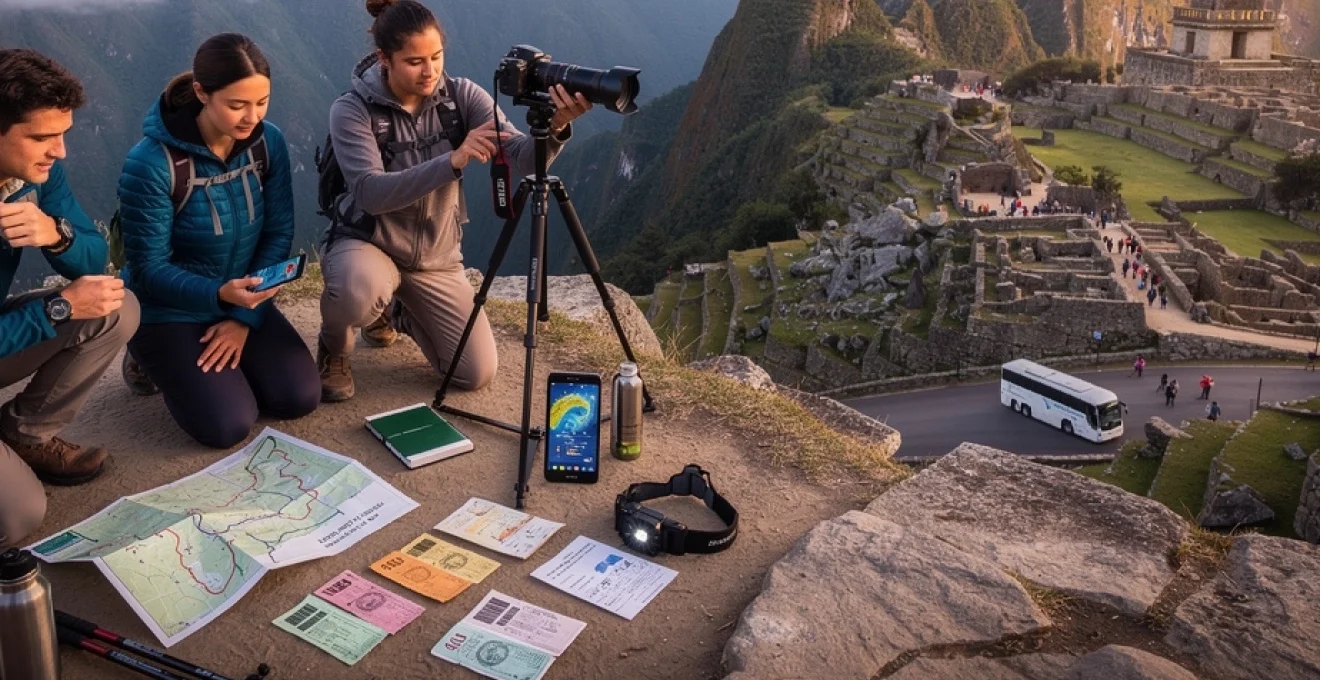
Witnessing the sunrise at Machu Picchu represents one of the most profound travel experiences available in South America. This ancient Incan citadel, perched dramatically at 2,430 metres above sea level, transforms into a golden amphitheatre as the first rays of dawn illuminate the meticulously crafted stone terraces and temples. The ethereal mist that often shrouds the surrounding peaks creates an almost mystical atmosphere, making early morning visits particularly rewarding for those seeking both photographic excellence and spiritual connection with this UNESCO World Heritage site.
Planning a successful sunrise experience at Machu Picchu requires meticulous attention to detail, from understanding the complex booking systems to coordinating pre-dawn transportation logistics. The rewards, however, are extraordinary: witnessing this wonder of the world in relative solitude, experiencing the gradual revelation of architectural marvels as light cascades across the ancient stones, and capturing images that will serve as lifelong memories of one of humanity’s most remarkable achievements.
Strategic route selection for machu picchu sunrise positioning
Selecting the optimal viewing position for sunrise at Machu Picchu requires understanding the site’s topography and how different locations offer varying perspectives of this architectural marvel. The sanctuary comprises multiple vantage points, each providing unique advantages depending on weather conditions, crowd levels, and photographic objectives. Professional photographers and seasoned travellers consistently recommend arriving at specific locations before 6:00 AM to secure prime positioning for the spectacular light show that unfolds across the Andean landscape.
Huayna picchu summit trail technical assessment
The ascent to Huayna Picchu presents perhaps the most challenging yet rewarding sunrise experience at Machu Picchu. This steep, narrow trail requires approximately 90 minutes of strenuous hiking in pre-dawn conditions, making it suitable only for experienced hikers with excellent physical conditioning. The summit provides an unparalleled bird’s-eye view of the entire citadel, allowing photographers to capture the iconic shots featuring the complete layout of terraces, plazas, and architectural complexes.
Technical considerations for this route include the limited daily permits (only 400 visitors allowed), the necessity of booking months in advance, and the requirement for proper hiking equipment including headlamps for pre-dawn navigation. The trail’s steep sections and narrow passages demand careful attention to safety protocols, particularly in low-light conditions when visibility remains limited.
Machu picchu mountain peak route analysis
The alternative summit route to Machu Picchu Mountain offers a less technically demanding but equally spectacular sunrise experience. This trail, whilst longer than the Huayna Picchu route, provides more gradual inclines and wider pathways, making it accessible to a broader range of fitness levels. The summit reaches 3,082 metres, offering expansive panoramic views across the entire Sacred Valley and surrounding Andean peaks.
This route typically requires 2-3 hours of hiking time, necessitating departure from Aguas Calientes by 3:30 AM to reach optimal viewing positions before sunrise. The broader summit area accommodates more visitors comfortably, reducing the pressure to secure specific vantage points that characterises the more constrained Huayna Picchu experience.
Temple of the sun optimal viewing coordinates
For those seeking cultural significance alongside natural beauty, the Temple of the Sun provides an exceptional sunrise viewing location within the main archaeological complex. This semicircular structure, aligned with astronomical precision, demonstrates the Incas’ sophisticated understanding of solar movements and their integration of architecture with celestial events. During winter solstice, the rising sun illuminates specific ceremonial windows, creating dramatic lighting effects that emphasise the temple’s spiritual purpose.
Positioning near the temple allows visitors to observe how the ancient architects deliberately designed structures to interact with solar phenomena. The relatively flat terrain around this area makes it accessible to visitors of varying physical abilities, whilst the proximity to other significant structures enables comprehensive exploration during the golden hour following sunrise.
Intihuatana stone astronomical alignment considerations
The Intihuatana stone, often referred to as the “hitching post of the sun,” serves as another strategically significant sunrise viewing location. This precisely carved granite monol
ith is positioned and oriented to track the movement of the sun throughout the year. For visitors planning a sunrise experience at Machu Picchu, this area is less about a direct view of the horizon and more about appreciating how the first light interacts with the stone itself. As dawn progresses, subtle shifts in shadow and illumination across the Intihuatana platform highlight the Incas’ advanced astronomical knowledge and their ability to “anchor” solar events in architecture.
Access to the Intihuatana stone is often regulated, with short, controlled visitation windows and occasional cordoned-off perimeters to protect the monument from erosion and human impact. When planning your sunrise route, it is wise to schedule time at this sector during the early morning, when the light is soft and contrast is gentle, enabling you to photograph and observe the stone’s geometric planes without harsh midday glare. While this may not be your primary sunrise lookout, integrating Intihuatana into your early circuit adds a layer of scientific and ritual context to your Machu Picchu sunrise experience that you would otherwise miss.
Advanced booking protocols and permit acquisition systems
Designing a sunrise-focused itinerary at Machu Picchu begins long before you set foot in Peru. Entrance tickets, mountain permits and Inca Trail spaces are all controlled by strict daily quotas that can sell out weeks or months in advance, especially in the dry season from May to September. Because of this, your booking strategy effectively becomes your first “logistics layer” for catching sunrise at Machu Picchu. We are no longer in an era where you can simply show up in Cusco and improvise; you must reverse engineer your ideal sunrise view and then secure the exact permits that make it possible.
The Peruvian authorities have progressively refined the permit system to protect the fragile ecosystem and archaeological structures. This has led to more complex, but also more predictable, booking pathways for sunrise visits. Understanding how the SERNANP reservation system works, how circuits and time slots are structured, and how guide requirements affect your flexibility will help you avoid the classic mistake of buying the wrong ticket type for the route you actually want to hike. Think of it as building a pyramid from the top down: you decide on your preferred sunrise vantage point, and then stack the correct permits beneath it.
SERNANP digital reservation platform navigation
The National Service of Natural Protected Areas of Peru (SERNANP) manages permits for the Inca Trail network, which is the only route that delivers a true horizon-level sunrise at Inti Punku for most travellers. Access to the Classic 4-day Inca Trail and the shorter 2-day version is capped at 500 permits per day, including guides and porters, and is only bookable through licensed trekking operators. You will not book an Inca Trail permit directly, but you should understand that reputable agencies are all querying the same SERNANP-backed database when they confirm your dates.
In practice, navigating this system means choosing your trekking dates 6–8 months in advance for peak season, and at least 3–4 months ahead even in shoulder months. Once your operator reserves your spot in the SERNANP system, your passport details are locked in and cannot be modified casually, which is why you should book only with the document you plan to travel with. If you are timing your Machu Picchu sunrise to coincide with an Inca Trail arrival at the Sun Gate, aligning your Inca Trail permit confirmation with your Machu Picchu main-entrance ticket is crucial; both have daily caps and must match chronologically.
Circuit route ticket classifications and time slot allocation
For day visitors not arriving via the Inca Trail, your sunrise strategy depends on choosing the correct Machu Picchu circuit and entry time. Since the introduction of structured routes, the Ministry of Culture has divided the site into multiple circuits, each with defined flows and, in some cases, special add-ons like Huayna Picchu, Machu Picchu Mountain or Inti Punku. Tickets are sold for specific time slots, typically in hourly blocks beginning around 6:00 AM, and your permitted stay is generally limited to about four hours.
If you are targeting early light from classic panoramic terraces or from the base of Huayna Picchu, a first-batch entry (around 6:00–7:00 AM) is ideal, giving you enough time to walk up to elevated viewpoints as the sun clears the surrounding peaks. On the other hand, tickets that include Machu Picchu Mountain often pair with mid-morning entry windows, because the longer ascent pushes your summit moment closer to late morning. Before purchasing, study the circuit descriptions carefully and verify whether your chosen ticket actually includes the side route you need; many travellers arrive expecting to “add on” Huayna Picchu or the Sun Gate, only to discover those paths are restricted to specific circuit codes and seasons.
Official guide certification requirements and booking procedures
While Machu Picchu regulations have fluctuated in recent years, local authorities increasingly encourage, and at times require, the presence of a certified guide for first-time visitors. Official guides must hold recognized credentials and be registered with the Ministry of Culture, ensuring they understand current circuit logistics, conservation rules and safe crowd-flow practices. For sunrise-focused visits, a knowledgeable guide becomes more than a storyteller; they effectively act as your time manager, keeping you on schedule so you reach your chosen vantage point before the crucial 15–20 minutes of golden light.
Most travellers secure a guide either through an all-inclusive tour package or by booking a private service in advance from Cusco or Aguas Calientes. While you can sometimes hire a guide on the spot at the Machu Picchu entrance, relying on same-day availability is risky if you have tight timing for buses, trains and sunrise photography. When you pre-book, clarify that your main goal is a structured sunrise experience so your guide plans a circuit sequence that prioritises early viewpoints and allocates time for pauses at locations such as the Temple of the Sun or Intihuatana once the site is fully lit.
Group size limitations and capacity management protocols
To maintain safety and preserve the visitor experience, Machu Picchu and the Inca Trail both operate under strict group-size and capacity guidelines. Inca Trail trekking groups are typically capped at around 16 travellers, with defined ratios of guides and support staff to clients. Inside Machu Picchu itself, circuit routes are designed to prevent bottlenecks at narrow staircases and terraces, which is why sunrise positioning can feel like joining a very slow-moving, scenic procession rather than free exploration.
From a planning perspective, smaller groups offer major advantages for sunrise experiences. With fewer people to coordinate, your guide can adjust the walking pace more easily, respond to changing weather and re-position you quickly if a particular terrace becomes crowded. When booking a tour, ask explicitly about group size, maximum capacity for add-on hikes like Huayna Picchu, and how the operator handles peak-demand days. A well-managed group will feel almost invisible at sunrise, allowing you to immerse yourself in the changing light, whereas an over-sized, poorly coordinated group can turn those first precious minutes into a hectic scramble.
Aguas calientes pre-dawn logistics and transportation coordination
Your sunrise at Machu Picchu effectively starts in Aguas Calientes long before the sky begins to brighten. This small town, officially named Machupicchu Pueblo, functions as the staging area for all early-morning entries. Because the buses to the citadel start running around 5:30 AM, and sunrise light can begin to touch the surrounding peaks as early as 5:45 AM at certain times of year, coordinating pre-dawn logistics becomes a time-sensitive exercise. You are balancing sleep, queue times, ticket checks and a 25–30 minute bus ride up a steep switchback road.
For most visitors, the simplest approach is to spend the night in Aguas Calientes, purchase bus tickets the afternoon before and be at the bus stop queue by 4:30–4:45 AM. Lines of 50 or more people are common even at that hour in high season, but departure intervals are short, and the buses are efficient. If you prefer to hike up instead of taking the bus, you should leave town by about 4:00 AM, allowing 90–110 minutes for a steep climb of roughly 1.5 hours plus time for the checkpoint. This uphill route is more demanding than it looks on a map and can feel like a stair machine at altitude, so factor in your fitness and how much energy you want to preserve for exploring the citadel itself.
Practical pre-dawn preparations in Aguas Calientes include laying out your clothing and gear the night before, carrying printed or digital copies of all tickets (train, bus, entrance) and having cash for last-minute purchases such as snacks or coffee. Many hotels offer early breakfasts or takeaway boxed meals tailored for sunrise visitors; arranging this in advance prevents you from sacrificing nutrition for punctuality. Ask yourself: do you want to sprint through logistics half-awake, or step onto the bus feeling calm, with a clear plan for where you will head the moment you enter the site?
Professional photography equipment configuration for high-altitude conditions
Sunrise at Machu Picchu is a dream scenario for photographers, but high-altitude conditions, shifting light and strict site rules mean you must be deliberate about your equipment choices. You will be working in low light that changes rapidly, often with fog that behaves more like a moving curtain than a static background. Add in the reality of walking steep stone steps while managing your camera, and it becomes obvious that a streamlined, high-performance setup is far more useful than carrying every lens you own.
For most serious photographers, a two-body, two-lens combination works best: a full-frame or APS-C body with a wide-angle zoom (around 16–35mm or 24–70mm) for sweeping citadel views, and a second body with a telephoto zoom (70–200mm or 70–300mm) for compressing mountain layers and isolating architectural details. If you are travelling lighter, a single body with a versatile zoom in the 24–105mm range can still produce outstanding sunrise images. A compact travel tripod can be useful for long exposures and bracketed shots before the crowds build, but be aware that large tripods are sometimes discouraged or restricted during peak hours; always check current regulations and be ready to adapt by using railings or stable rocks for support.
Because sunrise happens fast, camera settings should prioritise responsiveness. Shooting in aperture priority with auto ISO and exposure compensation gives you flexibility as the light shifts from pre-dawn blue hour to warm golden tones. Continuous autofocus and burst mode help capture fleeting moments when the fog briefly reveals the citadel, much like a theatre curtain lifting for a few seconds and then falling again. Extra batteries are essential in the cooler morning air—lithium cells can drain quicker in low temperatures—so store spares in an inner pocket to keep them warm. Ultimately, the best “equipment configuration” is one you can operate almost without thinking, allowing you to stay present in the experience instead of lost in menus.
Meteorological data analysis and seasonal visibility forecasting
Weather is the great wildcard of any Machu Picchu sunrise plan. The citadel sits in a cloud forest transition zone, where humid Amazonian air meets the cooler Andean peaks, creating a natural factory for mist and fast-changing conditions. On some mornings, you might wake to perfect clarity and crisp mountain silhouettes; on others, the entire site can be wrapped in thick cloud well past 8:00 AM. Rather than treating this as pure luck, you can tilt the odds in your favour by understanding seasonal patterns and using short-term forecasts intelligently.
Climatological data from recent years confirms that the driest and clearest months at Machu Picchu tend to be from May through August, with average rainfall dropping significantly compared to the November–March wet season. However, even in these “best” months, early mornings often begin with mist that gradually dissipates as the sun warms the valley. This is why many travellers describe the most magical sunrise moments not as a single instant, but as a sequence where clouds lift and reveal the ruins in dramatic stages. If your travel dates are fixed outside the core dry season, think of your sunrise as a weather-dependent bonus and plan at least one backup early-morning visit if your schedule allows.
On a day-to-day level, using reliable forecast tools that incorporate satellite data and local station readings—rather than generic city-level apps—can help you anticipate low cloud, temperature and wind. Yet even the best forecast cannot fully capture microclimate behaviour at Machu Picchu. A practical approach is to adopt a “go early, adapt on site” mindset: you commit to being in position before first light, but remain flexible about which exact terrace or route you prioritise once you see how the fog behaves. Just as a sailor reads the wind on the water rather than only trusting the chart, you read the morning sky above the Urubamba River and adjust your plan in real time.
Sacred valley acclimatisation strategies and altitude preparation protocols
Although Machu Picchu itself sits at a relatively moderate 2,430 metres, many travellers arrive directly from Cusco at 3,400 metres or combine their visit with high-altitude treks and passes. Sunrise plans that include steep hikes—such as Huayna Picchu, Machu Picchu Mountain or multi-day Inca Trail segments—place additional stress on your body, especially in the cool, low-oxygen pre-dawn hours. Effective acclimatisation in the Sacred Valley is therefore not just a comfort measure; it is a key safety and performance factor for your Machu Picchu sunrise experience.
A sensible strategy is to spend your first nights in the Sacred Valley at slightly lower elevations like Ollantaytambo or Urubamba instead of heading straight to higher Cusco. This “step-down” approach lets your body adjust gradually, reducing the risk of acute mountain sickness (AMS) symptoms such as headaches, nausea and fatigue. Light activity during these first days—short hikes to nearby ruins, gentle walks through villages—helps your system adapt without pushing it into exhaustion. Hydration, moderate carbohydrate intake and avoiding heavy alcohol consumption are simple yet effective habits that support acclimatisation.
If your itinerary includes the Inca Trail or other demanding routes before your Machu Picchu sunrise, discuss altitude preparation with your physician before travelling; some travellers benefit from prophylactic medications such as acetazolamide, while others manage well with conservative pacing alone. In the field, listen closely to your body and your guide: pushing through severe AMS symptoms to “not miss” a sunrise is never worth the risk. Think of acclimatisation as tuning an instrument before a concert; when your body is properly tuned to the altitude, your sunrise at Machu Picchu will feel less like a struggle for breath and more like the effortless, immersive experience you came for.