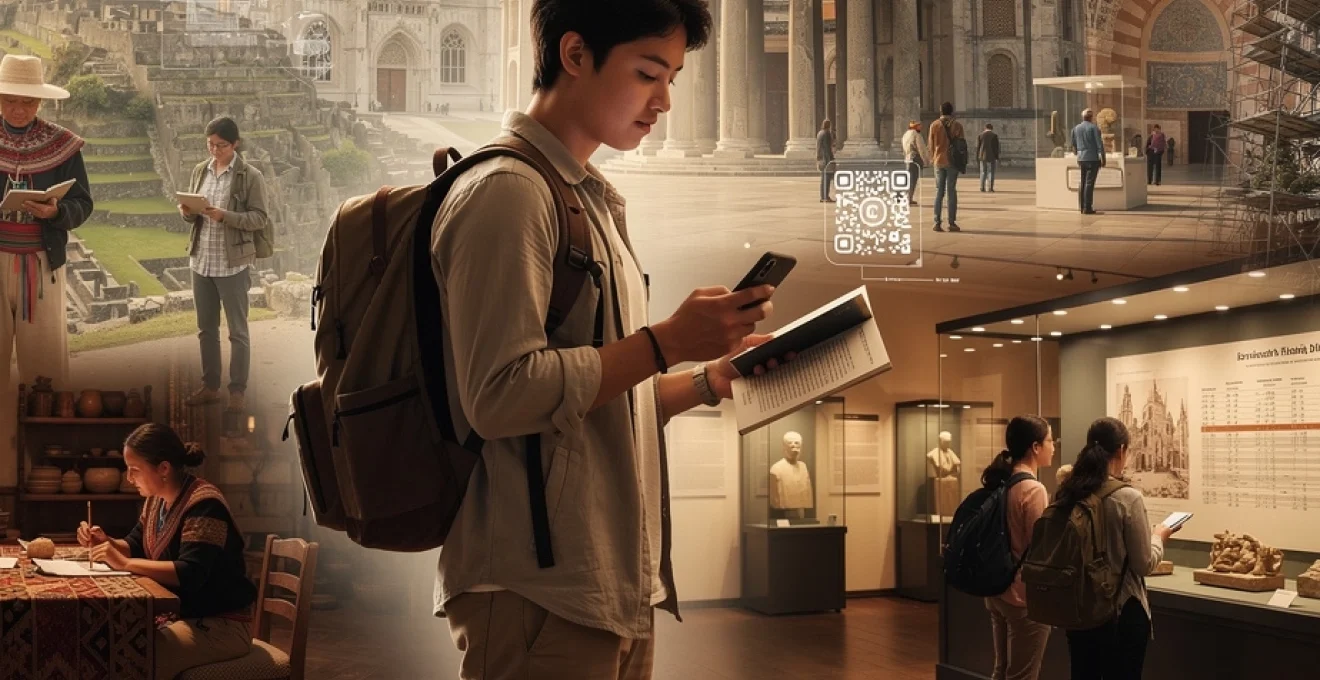
Visiting iconic landmarks presents a unique challenge for modern travellers: how do you move beyond the surface-level tourist experience to truly understand the cultural depths these sites represent? Whether standing before the Pyramids of Giza or walking through the halls of the Louvre, the difference between a meaningful cultural encounter and a superficial photo opportunity lies in your preparation, approach, and willingness to engage with the deeper narratives these places hold. The world’s most celebrated monuments serve as repositories of human achievement, spiritual belief, and artistic expression that span millennia, yet many visitors leave without grasping their profound significance.
The challenge becomes even more complex when you consider that these landmarks often attract millions of visitors annually, creating an atmosphere that can feel more commercial than contemplative. However, with the right strategies and mindset, you can pierce through the tourist veneer to connect authentically with the cultural essence of these extraordinary places. This deeper engagement not only enriches your travel experience but also fosters genuine respect for the civilisations and communities that created these enduring testaments to human creativity and faith.
Pre-visit cultural research methodologies for heritage site authentication
Effective cultural exploration begins long before you set foot at your destination. The depth of your eventual experience correlates directly with the quality of your preparatory research, which should extend far beyond basic tourist information. Authentic cultural understanding requires examining multiple perspectives, historical contexts, and ongoing scholarly debates surrounding your chosen landmarks.
UNESCO world heritage site documentation analysis
UNESCO’s comprehensive documentation system provides an invaluable starting point for understanding why specific sites achieve World Heritage status. These detailed reports examine the Outstanding Universal Value that sets each landmark apart, explaining not just what makes them historically significant but why they matter to all humanity. The nomination files contain expert analyses covering architectural innovations, cultural practices, and historical contexts that mainstream guidebooks often overlook.
When researching Westminster Abbey, for instance, UNESCO documentation reveals how the site represents over a thousand years of continuous use as a place of worship, coronation, and burial. This perspective helps visitors understand the abbey not merely as a beautiful building but as a living embodiment of British constitutional history and Anglican tradition. Such background knowledge transforms your visit from architectural appreciation to cultural immersion.
Archaeological context verification through academic sources
Academic publications offer rigorous, peer-reviewed insights that commercial travel resources cannot match. University libraries, archaeological journals, and scholarly databases contain detailed analyses of excavation findings, cultural interpretations, and ongoing research that continuously updates our understanding of these sites. Recent discoveries at Pompeii, for example, have revolutionised understanding of daily Roman life, challenging previous assumptions about social structures and cultural practices.
These sources help you distinguish between verified historical facts and romantic legends that often surround famous landmarks. The scholarly approach to archaeological evidence provides context for understanding how civilisations developed, what challenges they faced, and how their solutions continue to influence modern society.
Indigenous community perspectives and oral history integration
Many world-famous landmarks hold profound significance for indigenous communities whose voices are often marginalised in mainstream tourism narratives. Seeking out indigenous perspectives on sites like Uluru or Machu Picchu reveals layers of cultural meaning that archaeological evidence alone cannot convey. Oral traditions, spiritual beliefs, and contemporary indigenous scholarship provide essential context for understanding these places as living cultural landscapes rather than historical artifacts.
Digital archives now preserve many indigenous oral histories, allowing respectful access to traditional knowledge. Understanding these perspectives before visiting helps you appreciate the ongoing cultural significance of landmarks and approach them with appropriate reverence for their sacred or spiritual dimensions.
Historical timeline reconstruction techniques
Creating detailed chronological frameworks helps contextualise landmarks within broader historical movements and cultural developments. This approach involves mapping significant events, cultural shifts, and technological advances that influenced the creation, use, and preservation of these sites. Understanding that the Colosseum was built during the Flavian dynasty’s efforts to restore Roman morale after civil war, for instance, adds political and social dimensions to your appreciation of its architectural grandeur.
Historical timeline reconstruction also reveals how different periods have interpreted and modified these landmarks, showing their evolution as cultural symbols across changing societies. This layered understanding prevents the common mistake of viewing ancient sites through modern cultural assumptions.
On-site cultural immersion
Local guide certification and cultural authority assessment
Once you arrive on site, your choice of guide can make the difference between a shallow overview and a nuanced understanding of cultural significance. Instead of booking the first person holding a placard, look for guides who are either officially accredited by the site authority or recognised by local cultural organisations. Many famous landmarks, from the Acropolis to the Taj Mahal, maintain registers of licensed guides who have passed examinations in history, art, and language skills, ensuring a baseline of accuracy.
Cultural authority, however, goes beyond a laminated badge. Ask potential guides about their background: do they have academic training in archaeology or history, or are they members of communities with long-standing ties to the landmark? A guide from a nearby village at Angkor, for instance, may share family stories about the temples’ use during different regimes, adding context that standard narratives omit. By assessing both formal credentials and lived experience, you increase the likelihood of receiving interpretations that respect local perspectives and avoid sensationalism.
Before your visit, you can research recommended guides through national tourism boards, museum websites, or professional associations of tour guides. Once on site, pay attention to how a guide speaks about contested histories—do they acknowledge multiple viewpoints, or insist on a single, simplified story? Guides who are willing to discuss uncertainty, debate, and ongoing research usually provide a more intellectually honest and culturally respectful experience.
Ethnographic observation methods at machu picchu and angkor wat
Ethnographic observation—the careful, respectful watching of how people use and move through space—can deepen your understanding of famous landmarks. At Machu Picchu, this might mean noticing how contemporary Quechua visitors interact with the site compared with international tourists. Do they pause at different locations, observe certain silences, or engage in small rituals that indicate ongoing spiritual connections to the Inca citadel? Such details hint at how the place still functions as a living cultural landscape, not just an archaeological park.
At Angkor Wat, a similar mindset can reveal how local Buddhists and international visitors share the temple complex. You might observe the difference between someone performing a quiet act of devotion—offering incense or circling a shrine—and someone taking a quick photograph before moving on. Rather than judging either behaviour, you can treat these moments as data points in a complex cultural ecosystem where heritage, religion, and tourism intersect.
To practice respectful ethnographic observation, avoid intrusive staring or photographing people without consent. Instead, position yourself slightly to the side of main flows, take mental notes, and ask yourself why particular spaces attract certain behaviours. This simple shift—from being only a consumer of views to being an observer of cultural patterns—helps you perceive how living communities continue to shape and reinterpret world-famous heritage sites.
Sacred space protocols at westminster abbey and hagia sophia
Many iconic landmarks are first and foremost sacred spaces, with tourism permitted only within carefully negotiated boundaries. At Westminster Abbey, this means recognising that you are entering an active church where daily services, burials, and national ceremonies occur alongside steady visitor traffic. Understanding the abbey’s role in coronations and memorials, for instance, helps you grasp why certain areas are kept quiet, why photography is restricted, and why guides may ask you to pause during prayer or worship.
Hagia Sophia in Istanbul illustrates another layer of complexity: a structure that has shifted between Byzantine cathedral, Ottoman mosque, secular museum, and mosque again. Sacred space protocols here encompass not only modest dress and removal of shoes in the prayer area but also an awareness of how different communities invest the building with meaning. When you notice worshippers focusing on specific mihrabs, mosaics, or inscriptions, you witness how past and present religions intersect in a single architectural volume.
Before visiting any sacred landmark, research basic etiquette: clothing requirements, photography rules, and expectations around noise and movement. Once inside, follow the lead of local worshippers—if they pause, lower their voices, or avoid certain areas, you should do the same. By treating these spaces as functioning centres of belief rather than picturesque backdrops, you honour their cultural significance and minimise the risk of unintentionally offensive behaviour.
Traditional craft workshop participation in cultural quarters
Spending time in traditional craft workshops allows you to connect landmark monuments to the living skills that created and maintain them. In cities such as Fez, Kyoto, or Jaipur, artisans still practice techniques used in the construction and decoration of nearby mosques, temples, and palaces. Participating in a tile-making, calligraphy, or textile-dyeing workshop, even briefly, gives you a tactile sense of the labour and mastery embedded in a monument’s surfaces.
These experiences also help you understand the economic and social ecosystems that support heritage conservation. When you learn how long it takes to carve a single stone rosette or weave a silk brocade, the decorative richness of a landmark like the Alhambra or the Grand Palace in Bangkok transforms from mere ornamentation into a visible archive of human time and skill. As you practice a pattern or stroke yourself, even clumsily, you begin to see the monument through the eyes of the people who sustained these traditions for generations.
To ensure your participation aligns with responsible tourism, seek workshops that are locally owned, fairly compensate artisans, and clearly explain the cultural context of their craft. Avoid experiences that reduce traditions to quick tourist demonstrations without acknowledging their ceremonial or communal functions. When chosen carefully, these workshops can make your visit to a famous landmark feel less like an isolated spectacle and more like one chapter in a much larger story of craft, trade, and cultural identity.
Architectural significance decoding at monumental sites
Understanding the architectural language of famous landmarks enables you to read buildings as texts rather than treating them as mere backdrops. Every arch, column, and decorative motif encodes information about religious beliefs, political power, available technologies, and cross-cultural exchanges. By learning some basic interpretive tools, you can decode these messages and appreciate how monuments communicate ideas across centuries.
This approach is particularly powerful at sites where multiple architectural traditions overlap. Structures like the Pantheon, the Alhambra, and Notre-Dame have all evolved through different regimes and restoration campaigns, each adding new stylistic layers. When you train yourself to notice these layers, you begin to see the building as a palimpsest—a manuscript written, erased, and written over again—rather than a static object frozen in time.
Byzantine engineering principles at the pantheon
Although the Pantheon in Rome predates the Byzantine Empire, its engineering principles profoundly influenced later Byzantine and Christian architecture. Standing beneath its vast unreinforced concrete dome, you are essentially inside an engineering experiment that remained the world’s largest of its kind for nearly 1,300 years. The coffered ceiling not only reduces the dome’s weight but also guides the eye toward the oculus, creating a controlled shaft of light that functions almost like a theatrical spotlight on the divine.
Byzantine architects studying the Pantheon adopted and adapted its techniques, developing complex systems of domes and semi-domes that would later culminate in masterpieces like Hagia Sophia. When you look closely at the Pantheon’s thick drum walls, concealed relieving arches, and graduated concrete mixes (lighter toward the top), you see the structural logic that made these later experiments possible. Asking yourself how light, weight, and support are balanced turns the building from a mysterious marvel into a legible piece of engineering.
On site, you might compare the Pantheon’s spatial experience to other domed churches or mosques you have visited. Does the single oculus create a sense of cosmic unity, in contrast to the multiple windows of Gothic cathedrals or Ottoman mosques? Such comparisons help you understand how different civilisations used similar engineering ideas to express distinct theological and political messages, deepening your appreciation of architectural significance beyond “old” and “beautiful.”
Islamic geometric patterns analysis at the alhambra
The Alhambra in Granada offers one of the most intricate visual conversations between mathematics, spirituality, and political authority found anywhere in the world. Its Islamic geometric patterns are not merely decorative; they reflect a worldview in which order, repetition, and symmetry symbolise divine unity. When you walk through its courtyards and halls, you are surrounded by tiled surfaces that embody sophisticated understandings of geometry long before modern graphic design software.
To decode these patterns, start by looking for basic shapes—stars, polygons, and interlaced bands—and notice how they repeat without obvious beginning or end. This visual infinity can be read as an analogy for the eternal nature of God, while the complexity of the tessellations demonstrates the patron’s wealth and sophistication. Scholars have identified nearly all of the seventeen wallpaper symmetry groups in Alhambra’s designs, making the complex a living textbook of mathematical patterning.
Rather than simply admiring the “pretty tiles,” you can ask: what does this pattern tell me about how Nasrid rulers wanted to be perceived? How might these surfaces have impressed envoys from Christian courts, who were accustomed to different visual languages of power? By framing the Alhambra’s ornamentation as a coded diplomatic and theological statement, you transform your visit from a photo walk into a lesson in cultural semiotics and intellectual history.
Gothic revival elements in Notre-Dame cathedral restoration
Notre-Dame de Paris illustrates how restoration decisions can become as culturally significant as the original medieval fabric. Much of what visitors now associate with the cathedral’s “authentic” Gothic appearance—including the famous gargoyles and certain spires—results from 19th-century Gothic Revival interventions by architect Eugène Viollet-le-Duc. Understanding this layered history helps you see the building not as a pure medieval artifact but as an evolving symbol continually reshaped by changing French identities.
After the 2019 fire, debates over Notre-Dame’s reconstruction highlighted how fiercely people feel about these later additions. Should the cathedral be restored exactly as it appeared before the fire, preserving the Gothic Revival vision, or should it incorporate contemporary design elements? Following these discussions before your visit allows you to notice which parts of the structure are genuinely 13th century and which reflect 19th- or 21st-century interpretations of the Gothic style.
When you walk around the cathedral, pay attention to details such as the profiles of window tracery, the sculptural style of the portals, and the treatment of the roofline. Which elements appear more restrained and structural, and which are more expressive and romantic? Asking these questions trains you to recognise how each generation inscribes its own values onto a famous landmark, reminding us that architectural significance is never fixed but constantly renegotiated.
Museum integration strategies for contextual understanding
Museums associated with famous landmarks—whether on site or nearby—act as interpretive engines that transform scattered fragments into coherent stories. Integrating these museum visits into your itinerary, rather than treating them as optional add-ons, can dramatically enhance how you understand a monument’s cultural significance. Artifacts, models, and explanatory panels provide the connective tissue between what you see in situ and the broader historical, social, and environmental contexts.
One effective strategy is to visit the museum before the landmark whenever possible. Touring the Acropolis Museum in Athens first, for example, equips you with knowledge of sculptural programmes, architectural phases, and political symbolism that will later guide your eye on the hill itself. You learn to recognise specific metopes or frieze segments, understand why certain marbles are missing, and appreciate the ethical debates around repatriation that shape current scholarship and conservation policy.
In other cases, visiting the museum afterward allows you to process what you have experienced and fill in gaps in your understanding. After walking through Pompeii’s streets, spending time with the frescoes and household objects in the Naples Archaeological Museum helps you visualise how interiors once appeared and how people interacted with their built environment. This back-and-forth movement between site and museum mirrors the work of archaeologists and historians, reinforcing your role as an active interpreter rather than a passive spectator.
To make the most of these museum integration strategies, identify key questions before you enter: What aspects of the landmark confuse or intrigue you? Are there particular periods, communities, or technologies you want to understand better? Use the museum to pursue those questions, rather than trying to absorb every piece of information. This focused approach prevents cognitive overload and yields a deeper, more personalised grasp of cultural significance.
Digital heritage technology applications for enhanced interpretation
Digital tools have become powerful allies for travellers seeking to understand famous landmarks beyond their photogenic surfaces. When used thoughtfully, technologies such as augmented reality, multimedia guides, and virtual reconstructions can reveal lost layers of history, highlight contested narratives, and simulate missing architectural elements. However, like any interpretive medium, they require critical engagement: not every digital overlay is accurate, and not every audio guide reflects local perspectives.
Instead of treating technology as a gimmick, you can approach it as a set of lenses that can either clarify or distort cultural significance. Asking who created a particular app or digital guide, and whose voices it foregrounds, helps you assess its reliability. In many cases, official heritage bodies, universities, or reputable museums produce the most rigorously researched digital content, while commercial apps may prioritise entertainment over accuracy.
Augmented reality cultural overlay systems
Augmented reality (AR) systems superimpose digital reconstructions, texts, or animations onto the physical environment, allowing you to “see” past states of a site while standing in the present. At places like the Roman Forum or ancient Ephesus, AR applications can reconstruct collapsed columns, lost rooflines, or original polychrome decorations, helping you imagine how these spaces functioned in their prime. This can be especially valuable at heavily ruined sites where first-time visitors struggle to visualise the original scale and complexity.
Yet AR overlays are interpretations, not time machines. The choice of colours, building phases, and even the presence or absence of certain statues reflects scholarly debates and, sometimes, speculative assumptions. When using AR, treat it like a historical novel based on research: informative and engaging, but not infallible. Some advanced applications now allow users to toggle between different reconstruction hypotheses, making these uncertainties explicit and encouraging critical thinking.
To integrate AR into your visit without becoming glued to a screen, use it at select vantage points—perhaps at the entrance to a forum, inside a temple, or atop a viewing platform—and then put your device away to experience the site directly. This rhythm mirrors switching between a map and the actual landscape, ensuring that technology enhances rather than replaces your embodied engagement with the landmark.
QR code audio guide authenticity verification
Many heritage sites now use QR codes to deliver audio guides, short videos, or articles directly to your smartphone. This system can provide up-to-date information, multiple language options, and layered content ranging from basic introductions to deeper dives into specific themes. However, not all QR-linked content is equal. On popular sites, unofficial codes or third-party stickers sometimes appear, leading to commercial promotions or unvetted narratives masquerading as authoritative guides.
To verify authenticity, check whether QR codes are integrated into official signage, share consistent branding with the site’s management, or are referenced on the landmark’s official website or printed materials. When in doubt, ask staff at the visitor centre or ticket office which digital resources they endorse. This small step helps ensure that the “voice in your ear” is grounded in research and respects local sensitivities rather than spreading myths or stereotypes.
As you listen to audio commentary, pay attention to what stories are emphasised and which are missing. Does the guide address the experiences of workers, women, or minority communities connected to the site, or does it focus solely on rulers and architects? Recognising these silences is part of visiting famous landmarks with a critical, culturally aware mindset, prompting you to seek supplementary sources where necessary.
Virtual reconstruction platforms for damaged sites
For landmarks severely damaged by war, natural disaster, or environmental degradation, virtual reconstruction platforms can provide rare access to lost heritage. Projects that digitally rebuild sites like Palmyra, the Bamiyan Buddhas, or parts of Mosul’s old city allow you to encounter architectural forms that no longer exist in physical space. These platforms combine archival photographs, archaeological data, and 3D modelling to create immersive environments that can be explored from anywhere in the world.
When incorporated into an on-site visit—or accessed from home as pre-visit research—they help you grasp the scale of loss and the ethical dilemmas surrounding reconstruction. Should a destroyed monument be rebuilt exactly as it was, partially stabilised, or left as a ruin? Virtual models can simulate different scenarios, making abstract conservation debates more tangible. They also highlight the fragility of cultural heritage and the responsibilities involved in its protection.
At the same time, virtual reconstructions should not be mistaken for full replacements of the original. Just as a high-resolution photograph cannot replace standing in front of an oil painting, a digital model cannot fully replicate the material presence, weathering, and emotional resonance of a physical site. Using these platforms as complements rather than substitutes keeps your focus on the real-world communities and landscapes that give landmarks their living significance.
Post-visit cultural knowledge retention and sharing frameworks
The cultural impact of visiting famous landmarks need not end when you leave the site; in many ways, that is when deeper understanding begins to crystallise. Without some form of structured reflection, however, impressions fade and complex histories blur into a generic memory of “old buildings” and “beautiful views.” Developing simple frameworks for retaining and sharing what you have learned helps transform your trip into a lasting source of insight for both you and others.
One effective method is to keep a brief post-visit log for each landmark, noting three or four key themes: what surprised you, what challenged your assumptions, which voices were missing from the official narrative, and how the site connects to contemporary issues. Writing just a few paragraphs while memories are fresh anchors your impressions in concrete details. Over time, these logs create a comparative archive you can revisit, revealing patterns in how different cultures express power, belief, and identity through monumental architecture.
Sharing your experiences responsibly is another crucial element. When posting photographs or stories on social media, consider including a short reflection on the site’s cultural or historical significance rather than only aesthetic commentary. Did you learn about ongoing conservation challenges, contested ownership, or local rituals that shaped your understanding? By foregrounding context, you encourage your audience to see landmarks as complex cultural texts rather than merely scenic backdrops.
Finally, you can extend the life of your visit by engaging with books, documentaries, or online lectures related to the sites you have seen. Revisiting a landmark through a historian’s analysis or an indigenous community’s documentary, for example, often reveals layers you missed on the ground. In this way, travel becomes the starting point for an ongoing educational journey, and each famous landmark you visit adds depth to a growing, interconnected map of cultural understanding.