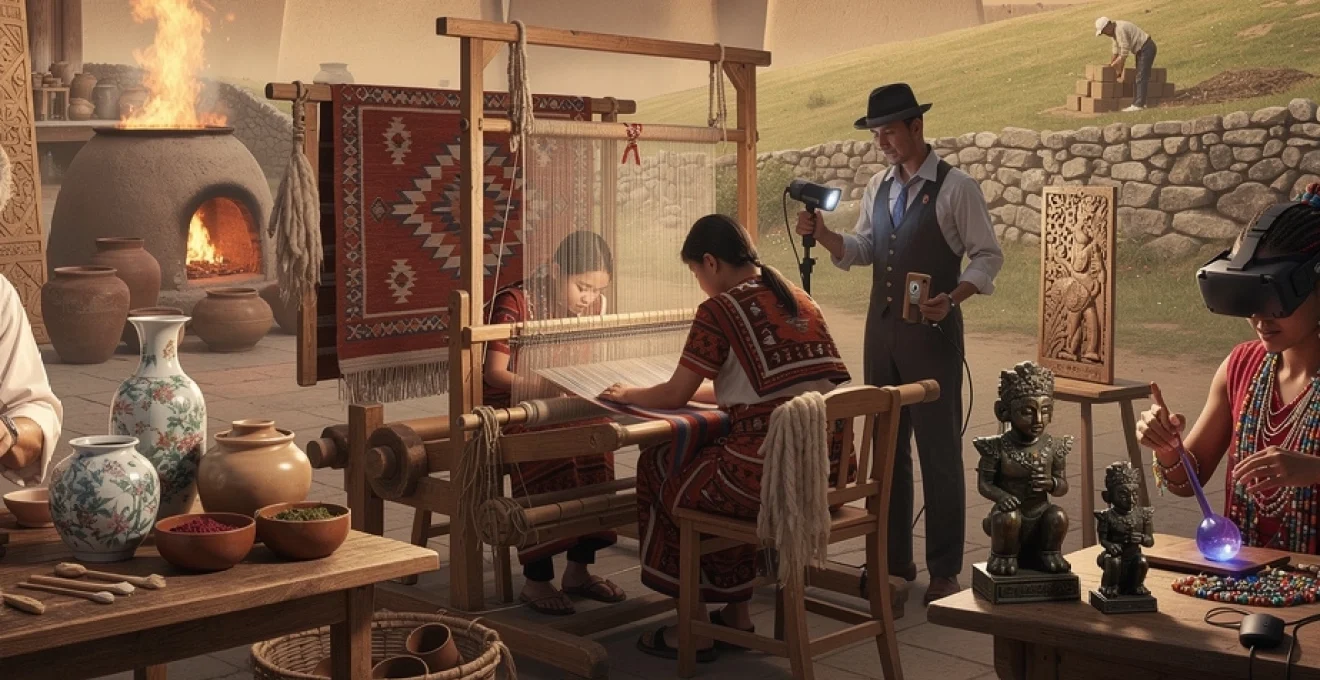
# How traditional crafts preserve cultural heritage around the world
Traditional crafts represent far more than beautiful objects or skilled handiwork—they embody centuries of accumulated wisdom, cultural identity, and community knowledge that connects us to our ancestors. Across continents, from the rugged highlands of the Andes to the ancient kilns of Jingdezhen, artisans continue practices refined over generations, safeguarding techniques that might otherwise vanish in our rapidly modernising world. These heritage crafts serve as living repositories of intangible cultural heritage, preserving not just methods of production but entire worldviews, spiritual practices, and social structures. As globalisation threatens to homogenise cultures and mass production displaces handmade goods, the preservation of traditional craftsmanship has become an urgent priority for communities, governments, and cultural organisations worldwide. Understanding how these crafts function as vessels of heritage reveals their profound importance beyond mere aesthetics or economic value.
Textile preservation methods in indigenous communities: navajo weaving and andean backstrap looms
Textile traditions among indigenous communities demonstrate perhaps the most sophisticated integration of cultural knowledge, spiritual significance, and practical artistry. These weaving practices encode complex information about cosmology, social organisation, and environmental relationships within their patterns and techniques. The preservation of textile heritage requires understanding that fabric production encompasses far more than the finished cloth—it includes knowledge of fibre cultivation, natural dye preparation, spiritual protocols, and the social contexts in which textiles function. Indigenous weavers have developed remarkably effective transmission systems that ensure continuity across generations, even as external pressures threaten these traditions.
Master-apprentice transmission models in navajo churro wool processing
The Navajo weaving tradition exemplifies how master-apprentice relationships preserve both technical skills and cultural values simultaneously. Navajo weavers typically learn their craft through immersive observation and practice within family structures, beginning in childhood. This transmission model ensures that apprentices absorb not only the mechanics of weaving but also the spiritual significance of the loom, the proper protocols for handling materials, and the stories embedded within traditional patterns. The revival of Navajo Churro sheep breeding programmes has proven critical to textile preservation, as this heritage breed produces the long, lustrous wool that Navajo weavers have used for centuries. Conservation efforts now recognise that preserving the craft requires maintaining the entire production ecosystem, from sheep husbandry through yarn preparation to final weaving.
Contemporary Navajo master weavers face the challenge of balancing commercial demands with cultural authenticity. You’ll find that many weavers now participate in documented apprenticeship programmes that provide financial support while ensuring knowledge transfer occurs according to traditional protocols. These initiatives have helped reverse declining practitioner numbers, with approximately 400 new weavers trained through formal programmes over the past decade. The integration of modern documentation methods—including video recordings of master weavers—has supplemented traditional oral transmission without replacing the essential hands-on learning that can only occur through direct mentorship.
Natural dye revival programmes: cochineal and indigo cultivation techniques
The revival of natural dye production represents a crucial component of textile heritage preservation, as synthetic dyes had nearly eliminated traditional colour-making knowledge by the mid-20th century. Cochineal cultivation, which produces vibrant crimson hues from scale insects raised on prickly pear cacti, has experienced remarkable resurgence in Oaxaca and Peru. Artisans working with natural dyes must master complex ecological knowledge, understanding seasonal cycles, host plant cultivation, and the intricate chemistry of mordants and dye extraction. Recent research has documented over 200 distinct plant species used for dyeing in the Andean region alone, representing a vast repository of botanical and chemical knowledge developed through millennia of experimentation.
Indigo cultivation and processing exemplify the sophisticated technical knowledge embedded in traditional dye production. The fermentation vats used to extract blue dye from indigo plants require precise management of temperature, pH levels, and oxygen exposure—knowledge that skilled dyers develop through years of practice. Revival programmes in Guatemala and India have demonstrated that natural dye production can provide economically sustainable livelihoods when connected to appropriate markets. Heritage dye gardens now serve as living laboratories where traditional knowledge holders work alongside botanists and chemists to document and preserve colour-making techniques that were nearly
lost due to the spread of factory-made textiles. For many communities, these gardens and dye workshops function as cultural classrooms where elders teach younger generations how colour itself carries meaning—cochineal red for life and ceremony, indigo blue for protection and the cosmos. By supporting natural dye cooperatives and purchasing ethically sourced textiles, you help ensure that this “alchemical” knowledge remains a living practice rather than a museum footnote.
Sacred geometry patterns in Shipibo-Conibo textile design documentation
Among the Shipibo-Conibo people of the Peruvian Amazon, textile patterns are far more than decoration—they are visual representations of sacred songs, healing knowledge, and cosmological maps. The intricate geometric designs known as kené are believed to encode the vibrational patterns of the universe, with each line and curve corresponding to specific spiritual pathways. Women traditionally learn these designs through dreams, visions, and close apprenticeship with elder relatives, making Shipibo textiles one of the clearest examples of how traditional crafts preserve intangible spiritual heritage.
Recent documentation projects, often led by Shipibo-Conibo organisations themselves, have begun to record these designs through high-resolution photography, digital drawing, and participatory mapping. Yet this is not simply a process of archiving motifs in a database. Elders insist that without the songs and rituals that accompany weaving, the designs lose their healing power. As a result, some initiatives now record audio of ceremonial chants alongside visual patterns, creating multi-layered archives that respect the holistic nature of Shipibo knowledge. This approach reminds us that when we talk about safeguarding traditional crafts, we must also protect the belief systems that give them meaning.
Heritage loom restoration projects at the textile museum of oaxaca
In Oaxaca, Mexico, the preservation of backstrap and treadle loom traditions has taken on a new dimension through institutional support from the Textile Museum of Oaxaca. Many historic looms, once abandoned in village attics or storage sheds, have been identified, restored, and returned to working condition. These restoration projects are not only about repairing wooden structures; they reconnect communities to forgotten weaving techniques, loom configurations, and regional garment styles that had fallen out of use.
The museum partners with village cooperatives to host on-site workshops where master weavers demonstrate how to warp, tension, and maintain these heritage looms. Younger artisans often discover that the older equipment allows for pattern complexity or cloth widths difficult to achieve on modern frames, opening new possibilities for creative production. At the same time, conservation specialists document loom measurements, joinery systems, and tool marks, creating technical records that can guide future reconstructions. For visitors, seeing these looms in motion—rather than behind glass—drives home how living practice is the best form of preservation.
Ceramic artisanship and intangible cultural heritage safeguarding in east asia
Ceramic traditions across East Asia illustrate how technical mastery, ritual use, and regional identity converge in a single craft. From unglazed stoneware fired in climbing kilns to translucent porcelain perfected over centuries, each pottery centre represents a unique interplay of clay resources, firing technologies, and cultural values. Efforts to safeguard ceramic heritage therefore focus not only on preserving individual master potters, but also on protecting kilns, clay quarries, tool-making skills, and the ceremonial contexts in which these wares are used. As you explore these traditions, you begin to see how a single bowl or jar can embody an entire landscape and way of life.
Japanese living national treasure system for bizen-yaki pottery masters
Japan’s system of Living National Treasures offers one of the most influential models for recognising and safeguarding traditional crafts, including Bizen-yaki pottery. Bizen-yaki, produced in Okayama Prefecture, is renowned for its unglazed surfaces, wood-fired kilns, and subtle colour variations created by ash deposits and flame paths. Designated master potters receive state recognition and financial support, enabling them to devote time to teaching apprentices, maintaining traditional climbing kilns, and experimenting within established aesthetic boundaries.
This system underscores an important principle: preserving traditional crafts often hinges on sustaining the people who embody them. Bizen-yaki masters must demonstrate not only technical excellence but also a commitment to transmission, frequently running small studios where apprentices live and work for years. Documentation projects complement this hands-on learning by recording kiln loading patterns, clay preparation techniques, and firing schedules—information that would be difficult to reconstruct if a master’s workshop were to close. When you hold a Bizen-yaki cup, you’re not just experiencing an object; you’re touching the legacy of an entire mentorship lineage supported by national policy.
Traditional korean onggi fermentation vessel production in ulsan
In Korea, the earthenware jars known as onggi are inseparable from culinary heritage, serving as fermentation vessels for kimchi, soy sauce, and bean paste. The city of Ulsan remains one of the few centres where traditional onggi production is still practised at scale, using hand-coiled construction, paddle-and-anvil thinning, and characteristic porous clay bodies. These jars are designed to “breathe,” allowing gases to escape during fermentation while keeping out contaminants—an elegant example of how material science and food culture intertwine in traditional crafts.
Safeguarding onggi-making has involved a mix of government designation, craft village initiatives, and culinary tourism. Workshops now welcome visitors who can try their hand at forming small vessels while learning about the microbiology of fermentation and the role of onggi in everyday Korean life. At the same time, master potters collaborate with chefs and food scientists to test how vessel size, wall thickness, and firing temperature affect fermentation outcomes. This cross-disciplinary approach demonstrates that traditional crafts are not static relics; they can adapt to modern research while preserving core techniques passed down through generations.
Chinese jingdezhen porcelain: ancient kiln architecture and firing protocols
Jingdezhen, often called the “Porcelain Capital” of China, has produced high-fired ceramics for over a thousand years. While the blue-and-white surfaces of Jingdezhen porcelain are familiar worldwide, the less visible heritage lies in the city’s ancient kiln architecture and firing protocols. Traditional dragon kilns and egg-shaped kilns, built into hillsides, use complex airflow dynamics and multi-chamber designs to achieve extremely high temperatures with wood fuel. Master firekeepers historically controlled these kilns through careful observation of flame colour, smoke patterns, and even subtle changes in sound—a kind of embodied knowledge that is difficult to capture in written form.
Recent heritage projects have focused on documenting and, where possible, restoring these kilns, many of which were abandoned with the advent of gas and electric firing. 3D scanning and structural analysis help conservators understand how brick arrangements and flue designs affect heat distribution, while oral history projects record the memories of elderly kiln workers. Some reconstructed kilns now operate for special firings, allowing a new generation of artisans to experience the unpredictability and creative potential of wood-firing. For collectors and visitors, seeing a dragon kiln lit at night is a powerful reminder that porcelain’s famed perfection emerges from controlled interaction with elemental forces of fire and earth.
UNESCO recognition of raku-yaki tea bowl manufacturing processes
Raku-yaki, the hand-moulded, low-fired tea bowls associated with the Japanese tea ceremony, offers another compelling case of ceramic heritage preservation. While UNESCO listings often highlight festivals or performing arts, the recognition of Raku-yaki manufacturing processes underscores that a single object can encapsulate profound spiritual and philosophical values. Raku bowls are shaped by hand rather than on a wheel, fired quickly at relatively low temperatures, and removed from the kiln while still glowing hot—an approach that embraces imperfection and spontaneity as aesthetic virtues.
Safeguarding efforts for Raku-yaki focus on maintaining family lineages of potters, preserving specialised kiln designs, and ensuring that the craft remains integrated with the practice of tea itself. Formal documentation includes detailed records of clay recipes, glaze formulations, and firing sequences, but masters emphasise that the heart of the craft lies in the potter’s sensitivity to timing and heat. You might think of these bowls as materialised moments—snapshots of a single decision to pull a piece from the fire. By continuing to use Raku ware in contemporary tea gatherings, practitioners ensure that this heritage remains a lived experience rather than a static display.
Metallurgical heritage conservation: damascus steel revival and maasai beadwork
Metalwork traditions reveal another dimension of how traditional crafts preserve cultural heritage, translating complex knowledge of ores, heat, and alloys into tools, weapons, jewellery, and ritual objects. From legendary sword-making techniques to bead adornment systems that encode social information, metallurgical crafts carry both technical innovation and symbolic meaning. Today, scientists, blacksmiths, and community leaders collaborate to reconstruct lost methods and protect living traditions, showing that heritage metalwork is as much about identity and story as it is about hardness and shine.
Wootz steel forging techniques and pattern-welding reconstruction studies
The fabled “Damascus steel” of historical swords, known for its watery surface patterns and exceptional cutting performance, has long fascinated both metallurgists and craftspeople. Research has shown that many of these blades were forged from wootz steel ingots produced in South Asia, using crucible processes that created a unique microstructure of carbides within a high-carbon matrix. Although traditional production methods declined in the 19th century, contemporary blacksmiths and materials scientists have undertaken reconstruction studies, combining textual analysis of historic manuscripts with experimental forging.
These projects function as a form of heritage archaeology, where each successful blade represents a recovered piece of technological memory. Detailed metallographic analysis, conducted with modern microscopes, allows researchers to compare newly forged samples with surviving historical blades, refining hypotheses about carbon content, cooling rates, and forging sequences. For craft practitioners, mastering these techniques is not simply about replicating spectacular patterns; it is about reconnecting with a lineage of innovation that emerged at the crossroads of trade routes and cultural exchange. In this way, “Damascus steel revival” becomes shorthand for a broader movement to value pre-industrial metallurgical knowledge.
Lost-wax casting methods in benin bronze sculpture reproduction
In West Africa, the royal bronze heads and plaques of the historical Kingdom of Benin stand as some of the most celebrated examples of lost-wax casting in the world. Artisans in Benin City developed highly sophisticated methods for modelling figures in beeswax, investing them in clay, and casting molten brass to produce works of extraordinary detail and symbolic complexity. These objects document royal lineages, historical events, and spiritual relationships, making the casting process a crucial vector for preserving cultural history.
Contemporary bronze casters in Benin continue to use many of the same techniques, often working in family-run foundries where skills are passed down through intensive apprenticeship. However, they face challenges ranging from fluctuating metal prices to competition from cheaper, mass-produced souvenirs. Preservation initiatives have therefore focused on strengthening local training centres, documenting workshop processes, and advocating for fair market access. Museums collaborating with Benin artisans now commission reproduction pieces using traditional methods, ensuring that knowledge of alloy preparation, mould construction, and firing sequences is actively practised rather than merely described in catalogues.
Maasai glass bead trade routes and contemporary adornment symbolism
At first glance, Maasai beadwork might seem far removed from metallurgy, yet its history is intimately tied to global trade in glass beads. Before European contact, Maasai communities in East Africa used locally available materials such as seeds, shells, and metal for adornment. The arrival of glass beads via Indian Ocean trade routes introduced new colours and possibilities, which Maasai women skilfully integrated into intricate collars, belts, and ornaments. Over time, specific colour combinations and design arrangements came to signal age sets, marital status, and social roles, turning beadwork into a wearable archive of community structure.
Today, safeguarding Maasai beadwork traditions involves negotiating changing aesthetics, tourism markets, and questions of cultural appropriation. Women’s cooperatives across Kenya and Tanzania work to maintain symbolic systems while innovating with new forms such as contemporary jewellery for international buyers. Documentation projects map historical bead trade networks and record the meanings of patterns before they are diluted by generic “African” designs. When you purchase ethically sourced Maasai beadwork, you’re not merely acquiring a colourful accessory—you’re supporting a complex tradition in which every bead threads together stories of mobility, exchange, and identity.
Architectural vernacular preservation through traditional building crafts
Traditional building crafts play a crucial role in preserving vernacular architecture, which in turn anchors communities in specific landscapes and histories. Techniques such as timber framing, earth construction, and stone masonry reflect centuries of adaptation to climate, geology, and available resources. Unlike modern construction systems that prioritise uniformity, vernacular methods celebrate local distinctiveness and often embody sustainable design principles long before “green architecture” became a buzzword. Protecting these crafts therefore helps maintain both cultural continuity and environmental resilience.
Japanese miyadaiku temple carpentry and mortise-tenon joinery systems
In Japan, miyadaiku temple carpenters are renowned for their ability to construct and restore wooden buildings without the use of nails, relying instead on complex mortise-and-tenon joinery systems. Shrines and temples built with these techniques can last for centuries, undergoing periodic cycles of dismantling and reconstruction that reiterate both technical knowledge and spiritual renewal. Each joint—whether a concealed scarf joint in a beam or an interlocking bracket under a roof eave—represents a precise response to structural forces and seasonal movement of timber.
Training as a miyadaiku carpenter typically involves long apprenticeships under master builders, combined with exposure to historic monuments designated as cultural properties. Government-supported restoration projects create living laboratories where traditional tools, measuring systems, and layout techniques are actively used. Digital surveys and structural analysis now complement this work, helping carpenters predict how ancient joints will behave under modern stress conditions such as earthquakes. Still, the heart of the craft remains in the hands and eyes of practitioners who can “read” the grain of a beam much like a scholar interprets a manuscript.
Yemeni rammed earth construction in shibam’s manhattan of the desert
The walled city of Shibam in Yemen, often called the “Manhattan of the Desert,” showcases a remarkable tradition of multi-storey rammed earth construction. Rising up to eleven stories high, these earthen towers demonstrate that sustainable building methods need not be low-rise or technologically simple. Builders compact layers of mud mixed with straw and gravel between wooden formwork, creating thick walls with excellent thermal mass that moderates extreme desert temperatures. Regular maintenance, including replastering with mud, has historically been essential to the survival of these structures.
Conflict, economic hardship, and climate change now threaten both the fabric of Shibam and the transmission of its construction techniques. International conservation programmes have partnered with local craftsmen to document traditional mixtures, formwork designs, and repair practices. Training initiatives aim to equip a new generation of builders with both heritage skills and modern safety knowledge, ensuring that restoration efforts respect original methods while addressing contemporary risks such as intense rainfall events. When we look at Shibam’s skyline, we see not just picturesque towers but a living lesson in how communities have long built tall, dense settlements with minimal environmental impact.
Scottish drystone dyking skills and landscape heritage management
Across rural Scotland, drystone dykes—stone walls built without mortar—criss-cross fields and hillsides, defining property boundaries and sheltering livestock. These structures might seem simple, yet their stability relies on an intricate understanding of gravity, friction, and stone selection. Skilled dykers know how to choose and orient each rock so that forces are transferred through the wall like water flowing along a riverbed. When maintained, such walls can endure for centuries, becoming integral features of the cultural landscape.
Heritage organisations in Scotland now recognise drystone dyking as a key traditional craft linked to both biodiversity and tourism. Training schemes invite farmers, youth groups, and volunteers to learn basic techniques, often combining classroom instruction with hands-on rebuilds of collapsed sections. This approach turns routine maintenance into an opportunity for community engagement and skills transmission. You might think of each repaired dyke as a sentence rewritten in a very old story about how people, animals, and land co-exist.
Pueblo adobe architecture: sun-dried brick production at taos pueblo
Taos Pueblo in New Mexico, continuously inhabited for over a thousand years, is one of the most iconic examples of adobe architecture in North America. The community’s multi-storey dwellings are constructed from sun-dried bricks made of clay, sand, straw, and water, then finished with earthen plaster. Adobe building is not merely a construction method; it is intertwined with Pueblo social organisation, ceremonial cycles, and land stewardship practices that emphasise balance with the surrounding environment.
Preservation efforts at Taos Pueblo focus on supporting traditional brick-making and plastering techniques while addressing contemporary challenges such as erosion, changing precipitation patterns, and visitor pressure. Community-led workshops teach younger members how to judge the right consistency of adobe mix, when to cut bricks for drying, and how to apply protective coats of plaster. Conservation scientists collaborate with Pueblo leaders to test compatible stabilisers and surface treatments that do not compromise the buildings’ breathability. As with many heritage crafts, the goal is not to freeze the architecture in time, but to ensure that the knowledge needed to rebuild and repair remains firmly rooted within the community.
Digital documentation technologies for endangered craft knowledge transfer
As traditional crafts face pressure from globalisation, environmental change, and ageing practitioner populations, digital technologies are emerging as powerful allies for preservation. When used thoughtfully, tools like 3D scanning, virtual reality, and blockchain can help record fragile techniques, expand access to training, and protect artisans’ intellectual property. The key challenge lies in ensuring that these technologies support, rather than supplant, the living apprenticeship systems at the heart of most heritage crafts. Think of digital documentation as a detailed map: invaluable for orientation, but never a substitute for walking the landscape yourself.
3D laser scanning applications in balinese wood carving pattern archives
Balinese wood carving, with its flowing floral motifs and dense narrative scenes, is widely recognised as a cornerstone of the island’s cultural identity. Carvers traditionally learn patterns by copying from temple doors, shrines, and older works in family workshops. However, increased tourism and rapid urban development have put many historic carvings at risk, while younger artisans sometimes favour faster, simplified designs for the souvenir market. To address this, cultural organisations and universities have begun using 3D laser scanning to create high-resolution digital archives of exemplary carvings.
These scans capture not only overall designs but also subtle chisel marks and depth variations, allowing researchers and apprentices to study pieces from multiple angles and scales. Digital models can be projected, printed, or even milled as reference forms, helping to reintroduce complex patterns that were falling out of use. At the same time, elders emphasise that true mastery still depends on feeling the resistance of the wood and listening to the rhythm of carving—experiences no scan can replicate. Used in this balanced way, digital archives act as memory banks that complement, rather than replace, person-to-person teaching.
Virtual reality training platforms for venetian murano glassblowing techniques
Glassblowing on the island of Murano near Venice is another craft where digital tools are beginning to support endangered knowledge. The choreography of gathering molten glass, inflating it with controlled breath, and shaping it with specialised tools is extremely difficult to capture with conventional photography or text. Virtual reality (VR) platforms now allow trainees to immerse themselves in simulated hotshops, observing master glassblowers from multiple vantage points and even practising basic motions with haptic controllers before handling real glass.
These VR systems record precise hand trajectories, timing, and tool positions, turning tacit knowledge into analysable data. Apprentices can replay complex sequences in slow motion, helping them internalise movements that might otherwise require many in-person demonstrations. Of course, VR cannot reproduce the heat, weight, or unpredictability of molten glass, so workshops still emphasise extensive real-world practice. Yet by lowering the initial barrier to entry and documenting master techniques that might otherwise disappear when a studio closes, virtual training contributes to a more resilient future for Murano’s glass heritage.
Blockchain authentication systems for aboriginal dot painting provenance
In Australia, Aboriginal dot painting and other Indigenous art forms have faced widespread issues of forgery, exploitation, and misattribution. Because many designs are closely tied to specific kinship groups and Dreaming stories, unauthorised copying does more than violate copyright—it can deeply wound cultural protocols. To counter this, some Indigenous-owned art centres and technology partners are experimenting with blockchain-based authentication systems that record provenance information in tamper-resistant ledgers.
Each artwork can be associated with a unique digital token that documents the artist’s identity, community affiliation, and sales history. Collectors and galleries can then verify authenticity by checking this record, making it harder for counterfeit pieces to enter the market. While such systems are no cure-all—they require reliable internet access, training, and careful governance—they offer a promising tool for strengthening Indigenous control over cultural expressions. In this way, cutting-edge cryptographic technology supports one of the oldest functions of traditional crafts: maintaining clear, respected relationships between makers, stories, and land.
Economic sustainability models for heritage craft communities in global markets
For traditional crafts to survive, they must be economically viable for the people who practise them. Romantic appreciation alone cannot pay for raw materials, workshop space, or apprentices’ time. Around the world, artisans and their allies are developing new business models that balance cultural integrity with market realities, from fair trade cooperatives and heritage tourism to limited-edition collaborations with contemporary designers. The most successful initiatives recognise that heritage crafts are not just products but processes embedded in community life.
One promising approach involves vertically integrated cooperatives that manage everything from raw material sourcing to final sales. By pooling resources, artisans can negotiate better prices, invest in quality control, and participate in digital marketing without sacrificing individual identity. Another strategy focuses on “slow luxury,” where high-end brands partner transparently with heritage craft communities to produce limited runs that command premium prices. When done ethically, such collaborations provide stable income streams while spotlighting traditional techniques in global conversations about sustainability and design.
Heritage tourism also plays a significant role in economic sustainability. Workshops, open studios, and craft festivals invite visitors to see making processes first-hand, turning learning experiences into revenue streams. Have you ever noticed how watching a weaver or blacksmith at work deepens your appreciation for the final object? This emotional connection often translates into more considered purchases and long-term support. At the policy level, governments can reinforce these efforts through grants, tax incentives, and heritage labelling schemes that help consumers identify genuinely traditional crafts.
Ultimately, economic models that preserve traditional crafts share a common feature: they treat artisans as knowledge holders and entrepreneurs, not as anonymous labourers. When we, as buyers, choose handmade items with clear provenance and fair compensation, we participate in a global network of support that helps keep cultural heritage alive. In that sense, every thoughtfully purchased textile, pot, or piece of jewellery becomes more than an object—it becomes a small but meaningful investment in the continuity of human creativity across generations.