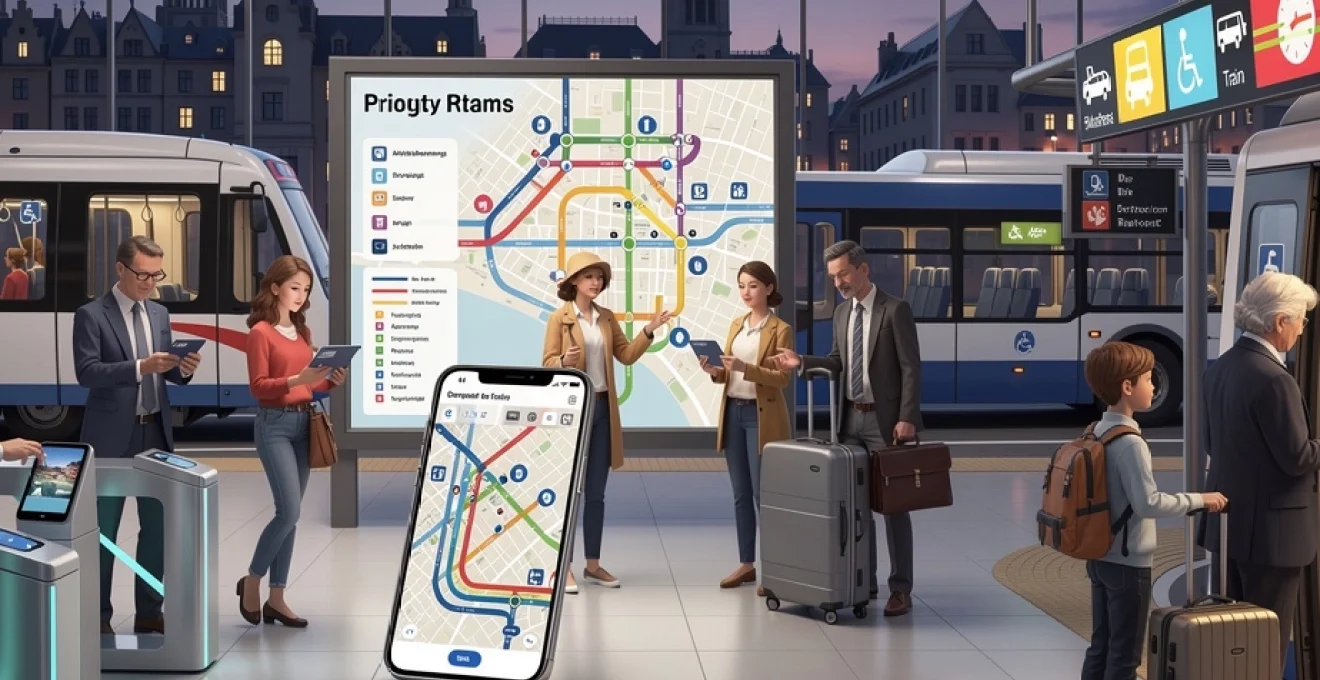
Navigating public transportation in foreign countries represents one of the most authentic ways to experience local culture whilst maintaining budget-friendly travel practices. Modern urban transit systems have evolved into sophisticated networks that connect millions of passengers daily, offering travellers unprecedented access to destinations that would otherwise require expensive taxi services or rental vehicles. The complexity of these systems, however, can present significant challenges for international visitors unfamiliar with local protocols, payment methods, and cultural expectations.
Recent statistics indicate that over 85% of international travellers utilise public transportation during their journeys, with metropolitan areas like London, Tokyo, and Paris processing more than 5 million daily passenger trips through their integrated networks. Understanding the nuances of these systems before departure can transform potentially stressful navigation experiences into seamless journeys that enhance rather than hinder travel experiences.
Pre-departure transport research and route planning strategies
Comprehensive research forms the foundation of successful public transportation navigation abroad. The complexity of modern transit networks requires thorough preparation to avoid costly mistakes and time-consuming detours that can significantly impact travel itineraries. Effective pre-departure planning involves understanding network structures, identifying primary routes between key destinations, and familiarising yourself with local terminology and wayfinding systems.
The most efficient approach involves creating a detailed transportation portfolio that includes primary routes between accommodation and major attractions, backup alternatives during service disruptions, and emergency contact information for local transport authorities. This preparation becomes particularly crucial when considering that major cities like Seoul and Singapore operate networks spanning over 300 stations, making spontaneous navigation extremely challenging for unfamiliar users.
Digital preparation should complement physical research, with downloaded offline maps and pre-saved route information providing essential backup options when cellular connectivity proves unreliable. Modern smartphones can store extensive route data, but battery life considerations necessitate having physical backup plans readily available for extended travel days.
Citymapper and moovit app integration for real-time transit data
Citymapper revolutionises urban transit navigation by providing comprehensive real-time data across more than 80 global cities, offering detailed journey planning that integrates multiple transportation modes seamlessly. The application’s strength lies in its ability to calculate optimal routes considering current service disruptions, weather conditions, and peak hour variations that significantly affect journey times.
Moovit extends this functionality by covering over 3,000 cities worldwide, making it particularly valuable for travellers visiting smaller urban centres where mainstream applications might lack comprehensive coverage. The platform’s crowd-sourced data ensures accuracy in regions where official transit information might be limited or outdated, providing confidence in navigation decisions.
Google maps offline download functionality for underground networks
Google Maps offline functionality becomes indispensable when navigating underground networks where cellular signals frequently become unreliable or unavailable entirely. The download process allows users to store detailed transit maps covering areas up to 120,000 square kilometres, ensuring continuous access to routing information regardless of connectivity status.
The offline capability proves particularly valuable in cities like Moscow or Beijing, where underground networks extend deep beneath surface level and foreign mobile carriers often struggle to maintain consistent signal strength. Preparation involves downloading relevant city sections whilst connected to reliable wifi, ensuring sufficient device storage remains available for the duration of travel.
Official transport authority websites: TfL, RATP, and JR east navigation
Transport for London (TfL) provides exemplary digital resources that serve as a model for comprehensive transit planning, offering detailed accessibility information, service disruption notifications, and historical data that helps predict optimal travel times throughout different periods. The platform’s journey planner incorporates real-time data from over 270 underground stations and 700 bus routes, providing accuracy levels that exceed third-party applications.
RATP (Régie Autonome des Transports Parisiens) offers similar functionality for Paris public transportation, with multilingual support that accommodates international visitors effectively. JR East extends these capabilities to Japan’s complex rail network, providing essential information about reserved seating, luggage storage options, and cultural protocols that enhance the travel experience significantly.
Multi-modal journey planning using Rome2Rio and trainline platforms
Rome2Rio excels at connecting transportation modes across vast distances, enabling travellers to plan comprehensive journeys that incorporate flights, trains, buses, and ferries within single search queries. This capability
makes Rome2Rio particularly powerful for planning multi-country itineraries where you may be combining budget airlines, regional trains, and local buses in a single day. You can quickly compare estimated travel times and costs, then drill down into specific legs once you have a high-level view of how to get from point A to point B.
Trainline focuses more specifically on rail (and some coach) travel across Europe and the UK, aggregating tickets from dozens of national rail operators into one booking interface. For travellers, this reduces the friction of juggling multiple booking portals and languages while trying to coordinate connections. By pairing Rome2Rio for initial research with Trainline for confirmed ticketing, you can create robust, multi-modal journey plans that minimise transfers, protect crucial connections, and keep overall public transportation costs under control.
Ticketing systems and payment methods across global networks
Understanding how to pay for public transportation abroad is just as important as knowing which line to board. Global transit networks increasingly rely on integrated ticketing systems that allow seamless transfers between buses, metros, suburban trains, and even ferries, but the specific rules can vary widely from city to city. Arriving with a basic grasp of the local payment ecosystem helps you avoid fines, long queues at ticket machines, and unnecessary tourist mark-ups.
The main variables you need to evaluate are whether the system uses contactless cards, mobile wallets, paper tickets, or a hybrid model and how fares are calculated (flat rate, zoned, or distance-based). Keeping these factors in mind before you travel makes it easier to choose between single tickets, stored-value cards, and tourist passes, and to estimate your likely daily spend on public transport.
Contactless payment integration: oyster card, navigo pass, and IC card systems
Contactless smart cards have become the backbone of many major public transportation systems, especially in Europe and East Asia. London’s Oyster card, Paris’s Navigo pass, and Japan’s IC cards such as Suica, Pasmo, and Icoca all operate on a similar principle: you load credit or a time-based pass onto a reusable card, then tap in (and often tap out) at gates or validators. This reduces the need to handle cash, speeds up boarding, and usually delivers lower fares than buying individual paper tickets.
In London, Oyster and bank card contactless payments use daily and weekly fare capping, meaning you will never pay more than the equivalent Travelcard price for the zones you travel through. Paris’s Navigo pass offers weekly and monthly options that are cost-effective for longer stays, though short-term visitors increasingly use the Navigo Easy card for pay-as-you-go travel. In Japan, IC cards can often be used across different cities and private rail companies, and they also double as e-wallets in convenience stores and vending machines, making them a practical tool for everyday travel abroad.
Mobile wallet compatibility: apple pay, google pay, and samsung pay transit features
For many travellers, the most convenient “card” is the one already on their phone or smartwatch. Cities such as London, New York, Singapore, Hong Kong, and Sydney now support direct fare payment using mobile wallets like Apple Pay, Google Pay, and Samsung Pay. In practice, this means you can tap your phone or watch at the gate in much the same way as a local contactless card, with fares automatically charged to your linked bank card in your home currency.
Before relying on this approach, confirm that your destination supports open-loop contactless payments and that your bank does not impose high foreign transaction fees. Where supported, mobile wallets often benefit from the same fare-capping rules as local smart cards, making them a powerful tool for frequent metro and bus use without the need to queue for a physical card. For added reliability, we recommend registering at least one card in your digital wallet and keeping a physical backup card in case of device failure or battery issues during a long day of travel.
Paper ticket validation protocols in european and asian metro systems
Although contactless systems are expanding rapidly, traditional paper tickets remain common, especially in smaller cities and regional networks. In many European countries such as Italy, Germany, and Austria, purchasing a ticket is only half of the process; you must also validate it before boarding or immediately upon entering the platform area. Validation machines, typically small yellow or orange boxes, print a timestamp and location on the ticket. Travelling with an unvalidated ticket can result in on-the-spot fines, even if you purchased it legitimately.
Some Asian systems also use paper tickets with magnetic strips or QR codes that must be inserted into gates at entry and exit, much like a disposable version of a smart card. To avoid confusion, always observe what local passengers do and look for signage near ticket machines explaining validation steps. When in doubt, ask a station attendant or use a simple phrase in the local language to confirm whether your ticket is already valid or needs to be stamped before you board the train or bus.
Tourist pass economics: london travelcard vs barcelona hola card ROI analysis
Tourist transport passes can offer excellent value, but only if they align with your planned usage. In London, the classic Travelcard provides unlimited travel within specified zones on the Underground, buses, and some rail services. For stays of 7 days or more where you expect to ride multiple times a day, a zone-appropriate Travelcard can quickly pay for itself, especially when combined with off-peak sightseeing schedules. For shorter visits, using contactless pay-as-you-go with daily capping often matches or beats the cost of a 1–3 day Travelcard while offering more flexibility.
Barcelona’s Hola Barcelona card offers unlimited travel on the metro, buses, trams, and urban rail for 2, 3, 4, or 5 consecutive days. Because the city’s core attractions are well served by public transport, travellers who plan to explore multiple neighbourhoods daily can achieve significant savings versus buying single tickets. To calculate your personal return on investment, estimate how many journeys you expect per day, multiply by the standard single fare, and compare that total to the pass price. If the break-even point is low and convenience is a priority, a tourist pass is often the most stress-free solution for using public transport abroad.
Metro and underground navigation techniques
Metro and underground systems are the backbone of public transportation in many global cities, but their complexity can intimidate first-time visitors. The key to navigating these dense networks is to think in layers: lines, directions, and transfer points. Rather than trying to memorise the entire map, focus first on the line colours and terminal stations, as these are usually indicated more clearly than intermediate stop names, particularly in non-Latin scripts.
When planning metro journeys abroad, identify your origin and destination stations, then determine which line or combination of lines connects them most efficiently. Pay close attention to direction indicators, which often reference the final station on the line rather than compass points. For complex interchanges, such as Shinjuku in Tokyo or Châtelet–Les Halles in Paris, factor in extra walking time between platforms and use station signage or floor maps to visualise your route before you follow the crowds.
To reduce stress, many travellers find it helpful to screenshot relevant parts of the metro map and their planned route, then keep these images accessible in their photo gallery. This acts as a quick-reference guide when you lose signal underground or when app-based navigation momentarily fails. Counting the number of stops between your boarding point and destination is also an effective tactic, especially in networks where in-train announcements may not be in your language or where station names are difficult to pronounce.
Bus network mastery and route optimisation
Buses often provide the most extensive coverage within a city, reaching residential districts, viewpoints, and cultural sites beyond the reach of metro lines. However, their flexibility also makes them harder to decode, since routes can be diverted by traffic, demonstrations, or construction. To use bus networks confidently when travelling abroad, start by identifying a few key routes that serve your accommodation, central transport hubs, and major attractions, then build your daily plans around these anchor lines.
Real-time transit apps and official transport websites are invaluable for checking bus arrival times and service alerts. In many cities, bus stops feature route diagrams with major transfer points clearly marked, enabling you to see how different lines intersect without studying the full network map. When possible, board at earlier stops on the route to secure a seat and more time to orient yourself inside the vehicle, particularly if you are managing luggage or travelling during busy periods.
Route optimisation is primarily about balancing speed, comfort, and the number of transfers. Sometimes a slightly slower direct bus with no changes is preferable to a faster connection that requires multiple interchanges, especially late at night or in unfamiliar neighbourhoods. As you gain confidence, you can start to mix modes—such as taking the metro into the city centre and then a bus to your specific destination—to combine the reliability of rail with the granular coverage of buses while still keeping your daily public transportation spend under control.
Cultural etiquette and passenger behaviour protocols
Every public transportation system abroad comes with its own unwritten rules, and understanding them can make the difference between feeling like an outsider and moving through the city with ease. While basic etiquette—such as queuing, lowering your voice, and keeping bags off seats—is widely appreciated, specific expectations can vary dramatically between cultures. Observing local behaviour for the first few journeys is often the quickest way to learn what is considered polite, acceptable, or outright rude.
From how people stand on escalators to whether they thank the bus driver when disembarking, these small social cues reveal a great deal about local norms. Adapting to them not only shows respect but can also enhance your own safety and comfort. You will find your trips smoother, with fewer awkward interactions, when you align with the rhythm of local commuters rather than unintentionally disrupting it.
Peak hour commuter dynamics in tokyo JR lines and london underground
Rush hour behaviour can be particularly intense in major cities, and entering the system unprepared may feel overwhelming. On Tokyo’s JR lines and subway, peak-hour trains are famously crowded to the point where platform attendants—sometimes called “pushers”—help passengers board. Despite the density, the atmosphere remains remarkably orderly and quiet; conversations are subdued, phone calls are rare, and many commuters spend their journeys reading or using their phones silently.
In London, the Underground at peak times is similarly crowded, but commuter norms emphasise efficiency and personal space where possible. Standing on the right of escalators to let others pass on the left is a near-sacred rule, and blocking doors or stopping suddenly at the top of steps will quickly draw irritated glances. For visitors, the best strategy is to avoid peak hours when you can; when you cannot, travel light, have your ticket or device ready in advance, and move swiftly away from gates and platform edges to keep people flowing.
Priority seating conventions: european accessibility standards vs asian courtesy systems
Priority seating is a universal feature of modern public transportation, but the way it is enforced and respected can differ. In much of Europe, seats designated for passengers with disabilities, pregnant women, and older adults are clearly marked and protected by legal accessibility standards. While you may not be fined for sitting there when seats are free, there is a strong expectation that you will immediately offer your place if someone in need boards the vehicle, and announcements often remind passengers of this obligation.
In many Asian countries, such as Japan, South Korea, and Singapore, “courtesy seats” play a similar role but are also embedded in broader social norms around respect and harmony. You will often see able-bodied commuters avoid sitting in these areas altogether, especially during busy times, to ensure that someone who needs the seat can use it without having to ask. As a visitor using public transport abroad, the safest approach is to leave these seats free unless the vehicle is nearly empty, and always be prepared to stand up promptly if you notice someone who might benefit from the seat.
Luggage management protocols on high-density networks
Managing luggage on crowded public transportation is both a practical and a cultural concern. On high-density networks like those in Hong Kong, Seoul, or New York, large suitcases can quickly become an obstacle if not positioned carefully. Whenever possible, travel with the smallest, most manoeuvrable bag you can and avoid bringing full-size luggage onto the system during rush hours. If you must, stand near doors without blocking them, or use designated luggage areas when provided on airport express lines and long-distance services.
Many cities have specific expectations about where bags should be placed: on your lap, between your legs, or in overhead racks on trains. Placing luggage on spare seats is generally frowned upon, particularly when others are standing. Keeping your belongings close also serves a security function, reducing the risk of theft or accidental loss during sudden stops. By treating your bags as part of your personal space to manage efficiently, you help keep the flow of passengers smooth and show consideration for fellow travellers sharing the same limited space.
Emergency procedures and safety protocols for international transit
Even the best-planned journeys can encounter disruptions, from minor delays to major service outages. Knowing basic emergency procedures when using public transportation abroad helps you respond calmly and effectively if something goes wrong. Most transit systems publish safety guidelines that cover fire alarms, medical incidents, security threats, and evacuation protocols, and these are often illustrated with clear pictograms to bridge language barriers.
On trains and metros, pay attention to emergency signage when you board: note the location of alarm handles, intercoms to contact the driver, and emergency exits. In the event of a breakdown in a tunnel, remaining inside the vehicle until instructed otherwise is generally the safest option, as tracks can carry live current and visibility may be poor. For buses and trams, identify the nearest exit and emergency window hammers so you understand how to leave quickly if directed by the driver or local authorities.
Personal safety also depends on situational awareness. Keep valuables secured close to your body, particularly in crowded conditions where pickpocketing is more common. If you feel uncomfortable in a particular carriage or bus, move closer to the driver, transfer to another vehicle at the next stop, or switch to a different mode of transport altogether. Many modern networks have dedicated help points, staffed information booths, or emergency numbers printed inside carriages; taking a moment to locate these as you travel abroad can significantly reduce response time in a real emergency.
Finally, consider how broader travel protection fits into your public transport plans. Having digital copies of important documents stored securely online, knowing the local emergency number (112 in much of Europe, 911 in North America, 119 in parts of Asia), and sharing your itinerary with a trusted contact all contribute to resilience when navigating unfamiliar systems. By combining this preparation with the practical navigation and etiquette strategies outlined above, you can use public transportation abroad with confidence, turning complex networks into powerful tools for exploration rather than sources of anxiety.