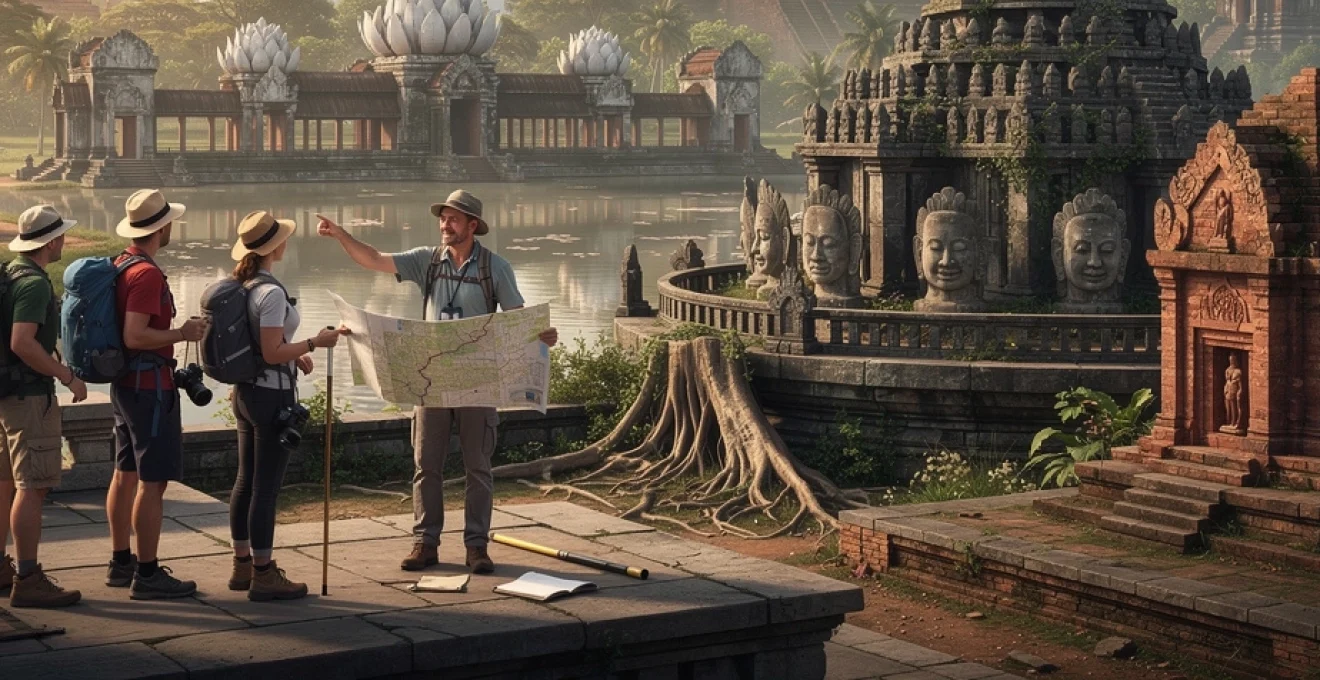
Southeast Asia holds one of the world’s most remarkable concentrations of ancient temple complexes, spanning more than a millennium of architectural evolution and religious expression. From the soaring towers of Angkor Wat to the sprawling pagoda fields of Bagan, these sacred sites represent the pinnacle of pre-modern engineering, artistic achievement, and spiritual devotion. The region’s temples embody a fascinating synthesis of Hindu, Buddhist, and indigenous belief systems, each monument revealing layers of cultural exchange, political power, and theological innovation. For travellers seeking profound encounters with history, these sites offer far more than photogenic backdrops—they provide tangible connections to civilizations that once commanded vast territories and influenced artistic traditions across Asia. Understanding their architectural symbolism, historical contexts, and preservation challenges enriches every visit, transforming casual sightseeing into meaningful cultural exploration.
Archaeological significance and UNESCO world heritage status of southeast asian temple complexes
The temple complexes scattered across Southeast Asia represent some of humanity’s most extraordinary architectural achievements, earning recognition from the international community through UNESCO World Heritage designation. These sites demonstrate sophisticated understanding of hydraulic engineering, astronomical alignment, and monumental construction techniques that rival contemporaneous European cathedrals. The Angkor Archaeological Park alone encompasses over 400 square kilometres of temples, reservoirs, and urban infrastructure, revealing a civilization capable of supporting populations exceeding one million inhabitants. Archaeological investigations have uncovered evidence of complex irrigation systems, extensive road networks, and hierarchical settlement patterns that challenge previous assumptions about pre-industrial urbanization.
UNESCO’s recognition of these sites acknowledges both their outstanding universal value and the urgent need for coordinated conservation efforts. Many temples face threats from natural erosion, vegetation encroachment, groundwater depletion, and tourism pressure. The designation brings international funding, technical expertise, and monitoring protocols essential for long-term preservation. Angkor received World Heritage status in 1992, followed by Bagan (2019), Ayutthaya (1991), and Borobudur (1991), among others. This recognition has transformed local economies, elevating temple tourism into a primary revenue source whilst simultaneously creating challenges around visitor management, infrastructure development, and community displacement.
The temples’ archaeological significance extends beyond their physical structures to encompass the cultural landscapes they inhabit. Researchers continue discovering hidden temple complexes using LiDAR technology, revealing that sites like Angkor formed part of much larger urban agglomerations than previously understood. These findings reshape scholarly understanding of medieval Southeast Asian state formation, trade networks, and environmental adaptation. The temples serve as three-dimensional historical documents, their inscriptions, iconography, and spatial organization preserving information about dynastic succession, religious patronage, taxation systems, and cosmological beliefs that written records alone cannot convey.
Angkor archaeological park: navigating cambodia’s khmer empire masterpieces
The Angkor Archaeological Park stands as the crown jewel of Southeast Asian temple architecture, containing hundreds of structures built between the 9th and 15th centuries during the Khmer Empire’s zenith. This vast complex functioned as the political, religious, and economic heart of a civilization that controlled much of mainland Southeast Asia, extending from modern Vietnam to Myanmar. The park’s monuments demonstrate remarkable architectural evolution, from early brick constructions to the refined sandstone masterpieces of the classical period. Understanding the site’s layout requires recognizing that each major temple represented a distinct cosmic diagram, with concentric enclosures symbolizing mountain ranges surrounding Mount Meru, the mythological centre of the Hindu-Buddhist universe.
Visitors navigating Angkor benefit from understanding the distinction between state temples and monastic complexes. State temples like Angkor Wat and the Baphuon served as symbolic representations of divine kingship, housing the devaraja or god-king concept central to Khmer political theology. These pyramidal structures featured steep staircases and limited access, emphasizing the ruler’s intermediary role between earthly and celestial realms. Conversely, monastic complexes such as Ta Prohm and Preah Khan functioned as Buddhist universities and public worship spaces, characterized by horizontal layouts, multiple courtyards, and extensive corridor systems designed to accommodate large congregations of monks and pilgrims.
The park’s ticket system offers one-day ($37), three-day ($62), or seven-day ($72
-day) passes, allowing you to tailor your visit according to your level of interest and available time. First-time visitors typically find the three-day pass ideal, as it permits multiple sunrise or sunset sessions and quieter explorations of less-frequented temples. Regardless of ticket type, you’ll need to present your photo-ID pass at checkpoints throughout the park, so keep it accessible and protected from heat and moisture.
Angkor wat: decoding the Vishnu-Dedicated central sanctuary and Bas-Relief galleries
Angkor Wat is often introduced as the world’s largest religious monument, but its true fascination lies in the details. Commissioned by King Suryavarman II in the early 12th century and dedicated to Vishnu, the temple reverses the usual east-facing orientation of Khmer sanctuaries and instead faces west, the direction traditionally associated with death. Scholars interpret this unusual alignment, together with the temple’s moat and galleries, as a sophisticated fusion of royal state temple and planned funerary monument. As you cross the sandstone causeway and enter the first enclosure, notice how each gallery, courtyard, and staircase draws you closer to the symbolic Mount Meru at the centre.
The bas-relief galleries form one of the most important narrative sculpture cycles in Asia, stretching nearly 1 kilometre in total length. Walking clockwise, you’ll encounter scenes such as the “Churning of the Ocean of Milk”, the Battle of Kurukshetra from the Mahabharata, and historical processions showing Suryavarman II presiding over his court. Think of these carvings as a graphic novel in stone: they educate, legitimise, and immortalise royal power in a medium designed to endure centuries of monsoon rains. To appreciate the details, plan to visit these galleries either early in the morning or late afternoon when the low-angle light reveals the subtleties of the sculpted lines.
Ascending to the upper level, where the central sanctuary is crowned by five lotus-bud towers, you enter the most sacred zone of the complex. Originally enshrining a statue of Vishnu, the central cella later housed Buddhist images, reflecting the region’s gradual religious transition. Today, visitors must adhere to strict dress codes—covered shoulders and knees—to access this level, and timed entry systems are sometimes in place to manage crowd flows. If you time your visit outside peak hours, climbing the steep, narrow staircases can feel like a physical enactment of spiritual ascent from the earthly realm to the divine summit.
Bayon temple: understanding the avalokiteshvara face towers and mahayana buddhist iconography
At the heart of Angkor Thom, the Bayon offers a striking contrast to Angkor Wat’s symmetry and clarity. Built in the late 12th and early 13th centuries by Jayavarman VII, this state temple projects a more complex, almost labyrinthine plan. From a distance, it can appear as a chaotic heap of stone; step closer, however, and the temple resolves into a dense forest of towers, each bearing four colossal faces. These serene visages—often identified as Avalokiteshvara, the bodhisattva of compassion—may also double as idealised portraits of Jayavarman VII himself, fusing Buddhist devotion with royal authority.
The iconography here marks a decisive shift from earlier Hindu emphasis toward Mahayana Buddhism. Reliefs along the outer galleries present not only mythological scenes, but also vivid depictions of everyday life: market traders, naval battles with the Cham, and even cockfighting. It’s as if the Bayon weaves a visual tapestry of 13th-century Cambodian society, grounding lofty spiritual concepts in practical realities. This multi-layered narrative makes the temple feel almost like an ancient newsreel, where religious symbolism and historical record share the same stone canvas.
For visitors, the most compelling experience often comes from wandering the upper terraces among the face towers. Standing in a narrow passageway with a dozen giant, half-smiling faces gazing down can feel uncanny—are you observing the temple, or is it watching you? To avoid heavy crowds, aim for an early morning visit just after sunrise at Angkor Wat, or arrive in the mid-to-late afternoon when tour groups thin out and the warm light softens the sandstone features.
Ta prohm: experiencing spung tree root integration and jungle reclamation preservation
Ta Prohm epitomises the romantic image of “lost temples in the jungle”, even though its condition today is the product of deliberate conservation strategy rather than neglect. Commissioned by Jayavarman VII as a Buddhist monastery dedicated to his mother, the temple once supported thousands of attendants and functionaries. After centuries of abandonment, massive spung (Tetrameles nudiflora) and silk-cotton trees colonised its courtyards, their roots snaking around doorways and prising apart stone blocks. Instead of fully clearing the vegetation, conservators from the École française d’Extrême-Orient and the Archaeological Survey of India adopted a “managed ruin” approach, stabilising key structures while retaining selected trees to demonstrate the power of nature’s reclamation.
Walking through Ta Prohm today, you experience a curated balance of decay and preservation. Timber supports and discreet steel braces hold up fragile corridors, even as roots cascade over roofs like petrified waterfalls. This hybrid condition raises fascinating questions: where should conservation draw the line between restoring and freezing a site in picturesque ruin? As you explore the dim inner galleries, listen for bird calls and the rustle of leaves above; the interplay between built environment and living forest is central to Ta Prohm’s atmosphere. Arriving before 9 a.m. or after 4 p.m. is recommended if you want quieter moments for photography and reflection.
The temple also illustrates broader challenges facing Southeast Asian heritage sites—soil destabilisation from root systems, seasonal flooding, and the strain of several thousand visitors per day. You can support sustainable preservation simply by sticking to marked paths, avoiding contact with fragile carvings, and resisting the temptation to climb on unstable stones for photos. In a landscape where small actions accumulate over millions of footsteps each year, conscientious behaviour makes a tangible difference.
Banteay srei: examining red sandstone devata carvings and 10th-century tribhuvanamahesvara architecture
Located about 25–35 kilometres northeast of Siem Reap, Banteay Srei rewards those willing to venture beyond Angkor’s main cluster. Its name, commonly translated as “Citadel of Women”, reflects the delicacy of its carvings rather than female patronage; the temple was actually commissioned by a Brahmin counsellor named Yajnavaraha in 967 CE. Unusually for Angkorian monuments, Banteay Srei is relatively small in scale yet astonishingly rich in detail, built almost entirely from fine-grained pink sandstone that allows for hairline precision in sculptural work. Dedicated to Shiva under the name Tribhuvanamahesvara (“Great Lord of the Three Worlds”), it exemplifies mature pre-classical Khmer style.
The pediments and lintels here are among the finest in Southeast Asia, portraying intricate scenes from the Ramayana and Mahabharata. Devata (female deities) and apsaras appear with elaborate headdresses, jewellery, and patterned skirts, their expressions remarkably lifelike despite more than a thousand years of weathering. For travellers interested in temple iconography, Banteay Srei offers an ideal “open-air textbook”: you can trace narrative episodes almost panel by panel, observing how sculptors used depth, overlapping figures, and swirling vegetal motifs to suggest movement and drama.
Because of its compact layout and delicate carvings, the site is particularly sensitive to visitor impact. Raised walkways and roped-off areas now protect the most fragile zones, meaning you’ll often view reliefs from a slight distance. To make the most of your visit, bring a zoom lens or binoculars and plan to spend at least 60–90 minutes studying the details rather than rushing through. Early morning and late afternoon light emphasise the temple’s rose-gold hues, turning the entire complex into a glowing sandstone jewel amidst rice fields and sugar palms.
Bagan’s pagoda plains: exploring myanmar’s theravada buddhist monument landscape
Shift your gaze west from Cambodia to central Myanmar and you encounter another vast sacred landscape: the Bagan Archaeological Zone. Between the 11th and 13th centuries, the Pagan Kingdom oversaw the construction of more than 4,000 stupas, temples, and monasteries across a broad plain flanking the Irrawaddy River. While only around 2,200 structures still stand today, the density remains unparalleled. Unlike Angkor’s forested sprawl, Bagan unfolds as an open panorama—brick and stucco silhouettes rising from dusty fields, framed by distant hills and changing skies.
Most of Bagan’s monuments reflect Theravada Buddhist practice, though earlier Mahayana and tantric influences are still visible in certain murals and iconographic programmes. Temples often combine solid stupas (symbolising the Buddha’s presence and relics) with accessible interior chambers housing standing or seated images. From an archaeological perspective, Bagan illustrates how a royal court deployed religious architecture to consolidate power and codify orthodoxy, much as the Khmer did at Angkor. For visitors, the site offers both macro and micro experiences: sweeping sunrise vistas from hilltop viewpoints, and intimate encounters with centuries-old murals inside dimly lit sanctuaries.
Access has fluctuated in recent years due to political developments and evolving heritage management policies, so it’s essential to check current travel advisories and regulations. Traditional practice of climbing pagodas for sunrise and sunset views has largely been phased out to protect fragile structures after the 2016 earthquake. However, official viewpoints, river cruises, and hot-air balloon rides between October and March still provide spectacular perspectives over Bagan’s temple-dotted plain.
Ananda temple: analysing mon architecture and gilded standing buddha positioning
Among Bagan’s many monuments, Ananda Temple stands out for its harmonious proportions and luminous interior spaces. Completed around 1105 CE under King Kyanzittha, Ananda reflects strong Mon and Indian influences, blending a cruciform ground plan with a central core tower that rises to 51 metres. Its whitewashed exterior and gilded sikhara (tower) create a striking landmark visible from afar, especially when illuminated by low-angle light at sunrise or sunset. The temple’s name likely derives from Ananda, the Buddha’s devoted attendant, underscoring its focus on wisdom and spiritual companionship.
Inside, four colossal standing Buddhas face the cardinal directions, each associated with a different historical Buddha and distinct hand gestures (mudras). Two of these images appear original, carved from teak and later gilded, while the others are later replacements. As you approach the south-facing Buddha, notice how the facial expression changes depending on your distance—an intentional optical effect that makes the figure appear stern from afar yet compassionate up close. This clever use of perspective is one of many examples of the sophisticated visual planning medieval artisans applied to their work.
The surrounding corridors are lined with hundreds of terracotta plaques illustrating scenes from the Jataka tales, recounting the Buddha’s previous lives. Exploring these friezes can feel like leafing through a moral anthology encoded in clay. To avoid crowds and appreciate the quiet echo of your footsteps in the vaulted passageways, visit early in the morning before tour buses arrive, or later in the day when group visits have tapered off. Modest clothing and silence in the inner sanctums reinforce the living religious function of this temple, still used for major festivals and rituals.
Dhammayangyi temple: investigating brickwork precision and narathu’s unfinished interior chambers
Dhammayangyi, Bagan’s largest temple by base area, projects a very different mood—imposing, mysterious, and in places deliberately sealed. Built during the short reign of King Narathu (c. 1167–1170 CE), the temple is often associated with his bloody ascent to the throne, including the alleged murder of his father and brother. Local lore claims that the king compelled workers to execute such precise bricklaying that any gap wider than a needle’s width was punished by mutilation. Whether apocryphal or not, the brickwork here does exhibit exceptional tightness, with mortar joints so fine they’re nearly invisible.
The temple’s ground plan resembles a stepped pyramid with multiple terraces, yet many internal passages are blocked with masonry, and the innermost core has never been fully accessed. This intentional closure continues to intrigue historians: was it an act of ritual sealing, a response to structural concerns, or a political decision after Narathu’s assassination? For today’s visitor, walking through Dhammayangyi’s dim corridors and emerging into sudden courtyards can feel like navigating an unfinished maze—much more austere than the luminous Ananda nearby.
Because of its relatively open surroundings, Dhammayangyi also makes a fine photographic subject in late afternoon, when its massive brick volumes catch warm light and cast long shadows. When you contemplate the temple from a distance, imagine it as a three-dimensional monument to both technical prowess and the darker side of royal ambition—a reminder that Southeast Asia’s sacred landscapes were shaped as much by politics as by piety.
Shwesandaw pagoda: accessing sunset viewpoints across the irrawaddy river valley
Historically, Shwesandaw Pagoda was one of Bagan’s most popular climbing spots for sunrise and sunset, thanks to its five-tiered terraces offering unobstructed 360-degree views. Built by King Anawrahta in the 11th century to enshrine what is believed to be a sacred hair relic of the Buddha, the monument combines religious significance with strategic placement in the heart of the plain. Its name—often translated as “Golden Hair Relic Stupa”—reflects this dual role as both reliquary and royal proclamation of Theravada orthodoxy.
In recent years, however, concerns over structural damage and visitor safety led authorities to close the terraces to the public. While you can still admire Shwesandaw from ground level, its function has shifted from viewpoint to visual anchor in the wider landscape. Alternative sunset platforms and artificial mounds now provide elevated vantage points sanctioned by heritage authorities. Before your trip, check which viewpoints are currently accessible, as policies and designated areas can change in response to conservation needs.
Even without climbing, Shwesandaw remains a powerful symbol of Bagan’s transformation under Anawrahta, who actively promoted Theravada Buddhism, imported scriptures from Sri Lanka, and endowed monasteries across his realm. Thinking of the pagoda as both a reliquary and an ideological lighthouse helps you connect its gleaming historical role with the more constrained, preservation-focused status it occupies today.
Thatbyinnyu temple: scaling bagan’s tallest whitewashed structure and terraced design
Rising to around 61 metres, Thatbyinnyu Temple currently holds the title of Bagan’s tallest monument, its name meaning “Omniscience” in reference to one of the Buddha’s key attributes. Built during King Alaungsithu’s reign in the mid-12th century, the temple exemplifies the “two-storey” type, with a square lower level supporting a slightly smaller upper platform and central spire. From a distance, Its pale, often whitewashed surfaces and vertical emphasis make it an instantly recognisable landmark, visible from many points across the plain.
Architecturally, Thatbyinnyu represents a maturing phase of Bagan design, in which structural mass is lifted upward and interior spaces become more vertically layered. You can think of it as a transitional step between squat earlier stupas and more soaring later forms. Inside, vaulted corridors once housed rich mural programmes, some of which remain visible despite centuries of weathering and previous restorations. Earthquakes over the last century have caused damage, leading to ongoing reinforcement and partial closures of upper levels, so current access may be limited to ground floors and lower terraces.
When visits to upper storeys are permitted, climbing offers not just views but insight into how vertical movement was woven into devotional practice. Pilgrims would circumambulate multiple levels, stopping at shrines and image halls along the way, turning the ascent into a moving meditation. Even if you remain at ground level, circling the exterior and noting the interplay of light and shadow across the buttresses and niches can be a rewarding exercise in “reading” structure as theology in stone.
Borobudur and prambanan: java’s volcanic stone mandala and Hindu-Buddhist synthesis
On the fertile Kedu Plain of Central Java, Indonesia, two monumental complexes—Borobudur and Prambanan—embody different yet intertwined strands of the region’s religious heritage. Set against a backdrop of volcanoes and rice fields, Borobudur represents the pinnacle of Mahayana Buddhist architecture in Southeast Asia, while nearby Prambanan forms the largest Hindu temple compound in Indonesia. Together, they illustrate how Javanese courts navigated shifting religious currents between the 8th and 10th centuries, blending Indic cosmologies with local artistic sensibilities.
Both sites were recognised by UNESCO in 1991, and ongoing conservation programmes reflect the particular vulnerabilities of volcanic stone in a tropical climate. Acidic rainfall, seismic activity, and mass tourism all pose risks, making visitor management and structural monitoring critical. For travellers, these temples offer a chance to experience what is often described as a “stone mandala”: a three-dimensional spiritual diagram you physically walk through, not just gaze upon. Sunrise visits—especially at Borobudur—have become iconic, but exploring at quieter midday or late afternoon hours can provide more contemplative experiences.
Borobudur’s nine stacked platforms: interpreting mahāyāna cosmology and narrative relief panels
Borobudur, completed in the 9th century under the Sailendra dynasty, is best understood as a giant stone mountain encoding Mahayana Buddhist doctrine. Its nine stacked platforms—six square and three circular—culminate in a central stupa symbolising ultimate enlightenment. As you ascend, you follow a carefully choreographed path from the realm of desire (Kāmadhātu) through the world of forms (Rūpadhātu) to the formless sphere (Arūpadhātu). Each level corresponds to different states of consciousness, making your physical climb an enacted meditation on spiritual progress.
The lower galleries feature over 2,600 relief panels depicting the life of the historical Buddha, the Jatakas, and various sutras such as the Lalitavistara and Gandavyuha. These narrative friezes are astonishingly detailed, showing ships, palaces, village markets, and courtly scenes that offer rare glimpses into 9th-century Javanese society. A helpful analogy is to imagine Borobudur as an ancient library where each wall is a “shelf” and each panel a “book” you can read by walking. Hiring a knowledgeable local guide or using a detailed guidebook can transform these images from decorative background into a coherent storyline.
On the circular upper terraces, the mood shifts: openwork stupas house serene Buddha statues, some of which are headless due to past looting. The relative lack of reliefs and the widening views over the surrounding countryside encourage a quieter, more contemplative state. Visitor numbers are now capped during peak times, and in recent years authorities have introduced requirements for special footwear or limited access to upper levels to reduce wear. Booking timed-entry tickets in advance and respecting designated walking routes are practical ways you can help preserve this stone mandala for future generations.
Prambanan’s trimurti temple complex: distinguishing shiva, vishnu and brahma candi architecture
Roughly 17 kilometres east of Yogyakarta, Prambanan (also known as Candi Rara Jonggrang) showcases the Hindu counterpart to Borobudur’s Buddhist vision. Built in the 9th century and likely associated with the Sanjaya dynasty, the complex centres on three towering temples dedicated to the Trimurti: Shiva the Destroyer, Vishnu the Preserver, and Brahma the Creator. The Shiva temple, rising to 47 metres, forms the dramatic focal point, flanked symmetrically by the slightly smaller Vishnu and Brahma shrines. Their vertical silhouettes evoke Himalayan peaks, reinforcing the idea of temples as man-made sacred mountains.
Each main temple hosts an inner sanctum with a principal deity image and flanking chambers containing associated figures—such as Durga, Ganesha, and Agastya in the Shiva complex. Narrative reliefs encircling the ambulatory passages illustrate the Ramayana and Bhagavata Purana, turning circumambulation into both ritual and story consumption. To distinguish the three main candi, look closely at iconographic details: Shiva’s temple is the tallest and most elaborate, Vishnu’s features conch and discus motifs, and Brahma’s is identified by four-headed symbolism and creative attributes.
Prambanan’s history includes long periods of abandonment, significant earthquake damage (notably in 2006), and ongoing reconstruction. Many of the smaller secondary shrines remain in partial ruin, their stones carefully catalogued in “archaeological fields” awaiting potential reassembly. When you visit, you are witnessing a living laboratory of anastylosis—the technique of rebuilding monuments from original components. Walking through this landscape of standing towers and ordered stone piles can feel like observing both finished chapters and loose pages of an epic architectural saga.
Plaosan temple: contrasting vajrayana buddhist twin structures with loro jonggrang proximity
Just a few kilometres north of Prambanan lies Plaosan, a lesser-visited yet highly significant Buddhist complex often attributed to a 9th-century queen from the Sailendra dynasty. The site is divided into Plaosan Lor (North Plaosan) and Plaosan Kidul (South Plaosan), with the twin main temples of Plaosan Lor drawing most attention. These multi-storey sanctuaries, surrounded by dozens of smaller shrines and perwara (guardian temples), showcase a refined blend of Javanese and Vajrayana Buddhist styles. Compared with Prambanan’s towering verticality, Plaosan feels more intimate and monastic in character.
Archaeological evidence suggests Plaosan may have functioned as a monastic training centre, possibly for nuns as well as monks—an intriguing dimension given the male-dominated historical record. The reliefs here tend to emphasise serene Bodhisattvas, floral motifs, and scenes of offering rather than dramatic narrative epics. When viewed together with nearby Prambanan, Plaosan illustrates how Hindu and Buddhist patronage coexisted in close physical and chronological proximity, sometimes even within the same royal family. You might think of the two complexes as parallel expressions of a single court’s spiritual portfolio.
For travellers seeking quieter temple experiences in Java, Plaosan is an excellent choice. The open courtyards and relatively low visitor numbers make it easier to study architectural details, photograph without crowds, and simply sit in the shade to absorb the atmosphere. Late afternoon visits are especially rewarding, as the soft light accentuates the weathered stone surfaces and rice fields around the site shimmer in the golden hour.
Ayutthaya historical park and sukhothai: thailand’s former siamese capital temple ruins
Thailand’s historical heartlands preserve two major temple landscapes that chart the evolution of Siamese statehood: Ayutthaya and Sukhothai. Both are UNESCO World Heritage Sites and can be explored relatively easily from modern transport hubs—Ayutthaya as a day trip from Bangkok, and Sukhothai via flights or buses to nearby Phitsanulok. Together, they show how Tai-speaking polities adapted Khmer, Mon, and Sri Lankan influences into distinctively Siamese forms of Buddhist architecture and urban planning.
Ayutthaya, founded in 1350 and destroyed by the Burmese in 1767, sprawls across an island formed by three rivers. Its temple ruins, or wats, are interspersed with contemporary houses, markets, and roads, giving the historical park a lived-in feel. Characteristic features include tall, bell-shaped stupas (chedi), prang towers derived from Khmer prototypes, and rows of decapitated Buddha statues that testify to wartime looting. Cycling between sites such as Wat Mahathat, Wat Phra Si Sanphet, and Wat Ratchaburana allows you to appreciate both the former capital’s scale and the layers of reconstruction that followed its fall.
Sukhothai, by contrast, feels more self-contained and park-like. Established in the 13th century and often romanticised as the cradle of Thai civilisation, it presents a more compact arrangement of temples set amid lotus ponds and grassy lawns. The Sukhothai style is distinguished by slender, flame-like finials atop Buddha images and lotus-bud chedi forms. Wat Mahathat, the principal temple, combines a central stupa with surrounding smaller stupas and assembly halls, while Wat Si Chum houses a massive seated Buddha enclosed in a narrow, windowless building that creates an almost cinematic reveal as you approach.
From a practical standpoint, both sites lend themselves well to one- or two-day stays, with bicycles being the most popular means of getting around. Early morning and late afternoon offer the best light and temperatures for exploring. While these ruins may seem less intricate than Angkor or Borobudur at first glance, looking closer at stucco details, brickwork patterns, and Buddha image styles reveals a sophisticated visual language that continues to influence Thai temple design today.
Lesser-known sacred sites: champasak’s wat phou, luang prabang monasteries and mrauk U stupas
Beyond the headline destinations, Southeast Asia shelters numerous lesser-known temple complexes that reward slower, more adventurous travellers. Visiting these sites can feel like stepping into the “footnotes” of mainstream history—places where regional power centres rose and fell before being overshadowed by larger empires. Wat Phou in southern Laos, the monastic cityscape of Luang Prabang, and the enigmatic stupas of Mrauk U in western Myanmar each offer distinctive perspectives on how geography, trade routes, and dynastic politics shaped sacred architecture.
These locations typically see far fewer visitors than Angkor or Bagan, which brings both advantages and responsibilities. On the one hand, you’ll often find quiet corners for reflection and photography without crowds; on the other, the relative lack of infrastructure means you need to plan logistics more carefully and be especially mindful of local customs. Asking permission before photographing people, supporting community-run guesthouses and guides, and minimising plastic waste are simple ways to ensure your temple explorations contribute positively to local economies and environments.
Wat phou: tracing Pre-Angkorian chenla dynasty linga worship on mount phu kao
Wat Phou, near Champasak in southern Laos, predates Angkor and offers key insights into the early development of Khmer religious architecture. Built on the lower slopes of Mount Phu Kao and aligned with a natural cliff formation resembling a linga, the complex was an important Shivaite pilgrimage centre during the Chenla and early Angkorian periods (roughly 6th–9th centuries CE). Instead of a sprawling, level city, Wat Phou unfolds along a steep axial pathway that climbs from the Mekong floodplain to the mountain’s base, mirroring the ascent from earthly to divine realms.
The site’s layout combines processional causeways, baray reservoirs, terraces with sandstone galleries, and a cliff-top sanctuary where a sacred spring still emerges from the rock. Lingas and yoni (symbolic bases) scattered around the complex attest to intensive linga worship, in which flowing water was ritually channelled over the phallic stones to absorb sacred power. For visitors, the final climb up stone stairways—often dappled with frangipani blossoms—offers sweeping views over the Mekong valley, making the historical religious symbolism of “mountain as axis mundi” immediately tangible.
Because Wat Phou receives far fewer visitors than Angkor, it retains a contemplative atmosphere, particularly at sunrise and late afternoon. Lightweight footwear with good grip is recommended for the sometimes uneven steps, especially in the wet season. Interpretive panels on-site provide basic historical context, but hiring a local guide can greatly enhance your understanding of how Wat Phou functioned as both political centre and sacred landscape long before Angkor reached its zenith.
Luang prabang’s wat xieng thong: identifying Low-Sweeping rooflines and tree of life mosaics
Luang Prabang, the former royal capital of Laos, is less about a single monumental complex and more about an ensemble of monasteries integrated into a living townscape. Among its temples, Wat Xieng Thong—“Monastery of the Golden City”—stands out as the most architecturally refined and historically significant. Built in the 16th century near the confluence of the Mekong and Nam Khan rivers, it epitomises classic Lao monastic style: low, sweeping multi-tiered roofs that nearly touch the ground, richly carved wooden gables, and gilded stencilling on dark teak surfaces.
The rear façade of the main sim (ordination hall) features the famous “Tree of Life” mosaic, created from coloured glass tesserae set against a deep red background. This stylised tree, populated with birds and mythical animals, symbolises both the Buddha’s enlightenment and the interconnectedness of all beings—a visual theology expressed in brilliant, reflective colour. Inside, high columns and dark lacquered walls create an intimate yet solemn space, with a central Buddha image surrounded by smaller statues and ritual objects that testify to the monastery’s continuing liturgical role.
Visiting Wat Xieng Thong and neighbouring monasteries offers a different kind of temple experience from Angkor or Bagan. Here, you witness living Theravada practice: monks chanting, novices sweeping courtyards, and local laypeople making offerings. Early mornings, when the alms procession winds through town and mist lingers over the river, are particularly atmospheric. Modest dress, quiet behaviour, and observing posted photography guidelines—especially during ceremonies—ensure that your curiosity coexists respectfully with ongoing religious life.
Mrauk u’s shitthaung paya: navigating labyrinthine corridors and 80,000 buddha image claims
In Myanmar’s Rakhine State, the remote archaeological site of Mrauk U preserves the vestiges of a once-powerful maritime kingdom (15th–18th centuries CE) that traded with Bengal, the Netherlands, and Portugal. Unlike the brick temples of Bagan, many of Mrauk U’s monuments are built from rough-hewn stone and nestled among low hills, giving the landscape a fortified, almost fortress-like character. Shitthaung Paya—often translated as the “Temple of 80,000 Buddhas”—is the best-known of these structures, commissioned by King Minbin in 1535–1536 to commemorate military victories.
The temple’s interior comprises a series of narrow, maze-like corridors lined with thousands of small Buddha images, reliefs of guardian figures, and ornamental motifs. While the claim of 80,000 statues is likely symbolic rather than literal, the sheer density of iconography creates a powerful immersive effect. Moving through these dim passageways by lamplight or torch can feel like traversing the inner chambers of a stone ship, with each turn revealing new clusters of figures. The design may have served both devotional and defensive purposes, as the thick walls and limited entrances would have provided refuge during conflict.
Reaching Mrauk U requires more effort than visiting Bagan—typically involving flights to Sittwe followed by a river journey—and political and security conditions in Rakhine can affect accessibility. If conditions allow travel, engaging a local guide is essential not only for navigation and interpretation but also for understanding contemporary community perspectives. As with other lesser-known sacred sites, thoughtful, low-impact tourism can support local livelihoods while helping to preserve a fragile yet fascinating chapter of Southeast Asia’s temple heritage.