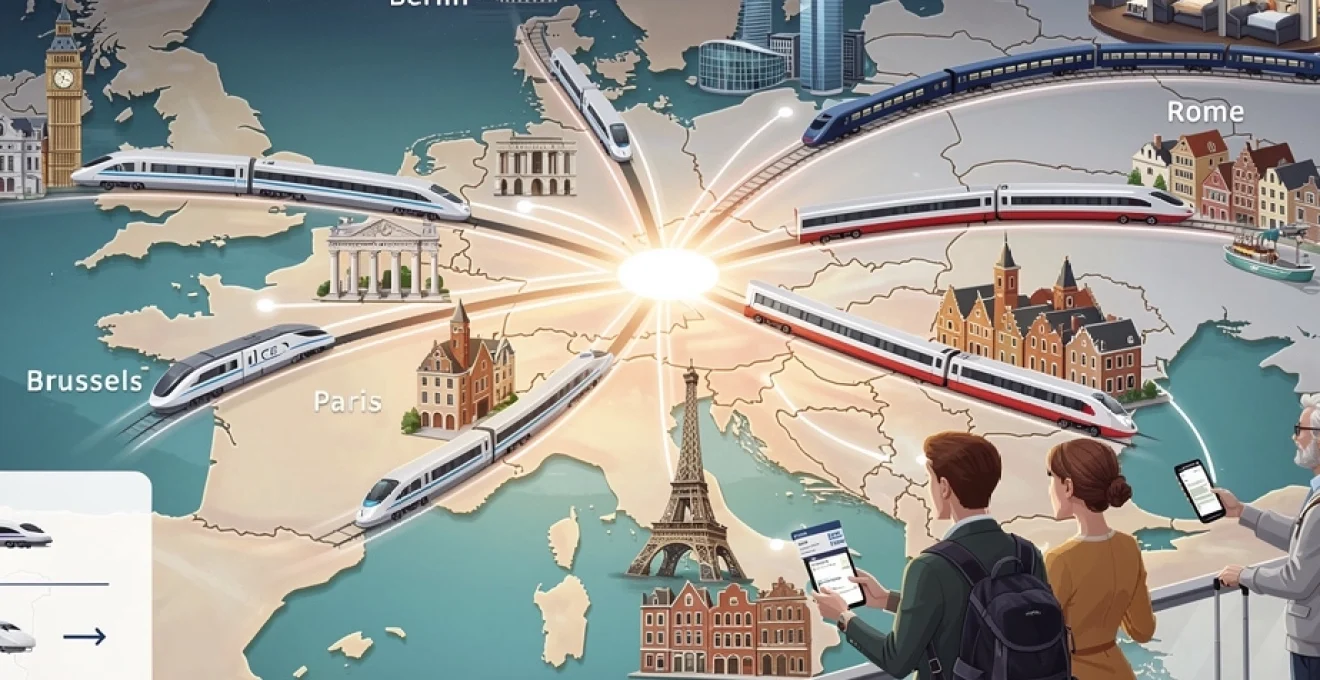
European rail travel has experienced a remarkable renaissance, transforming from a nostalgic mode of transport into the continent’s most efficient and environmentally conscious way to connect major cities. Modern high-speed networks now link distant capitals in mere hours, offering travellers unparalleled comfort whilst reducing carbon footprints by up to 90% compared to aviation. The sophisticated rail infrastructure spanning from London to Moscow and Stockholm to Rome creates opportunities for seamless multi-country journeys that would have been unimaginable just decades ago.
The integration of booking systems, standardised ticketing, and cross-border cooperation has eliminated many traditional barriers to international rail travel. Passengers can now traverse multiple countries on a single ticket, experience diverse cultures during overnight journeys, and arrive refreshed in city centres rather than distant airports. This comprehensive connectivity has made European capitals more accessible than ever, whether you’re planning a weekend city break or an extended continental adventure.
High-speed rail networks connecting major european capital cities
The backbone of European intercity travel consists of several high-speed rail networks that operate at speeds exceeding 250 kilometres per hour. These systems have revolutionised continental transport by reducing journey times dramatically whilst maintaining exceptional safety records. The TGV network in France, Germany’s ICE system, Spain’s AVE lines, and Italy’s Frecciarossa services form an interconnected web that spans the continent’s major urban centres.
Investment in high-speed rail infrastructure has reached unprecedented levels, with over €200 billion allocated across Europe since 2010. This commitment has resulted in journey time reductions of up to 50% on key routes, making rail travel competitive with aviation for distances up to 800 kilometres. The environmental benefits are equally impressive, with high-speed trains producing 14 times fewer emissions per passenger kilometre than equivalent flights.
Eurostar services between london st pancras and continental terminals
Eurostar represents one of Europe’s most successful high-speed rail ventures, connecting London St Pancras with Paris Gare du Nord, Brussels Midi, and Amsterdam Centraal through the Channel Tunnel. Since its launch in 1994, the service has carried over 200 million passengers, fundamentally changing how travellers perceive the relationship between Britain and continental Europe. The journey from London to Paris takes just 2 hours 16 minutes, whilst Brussels can be reached in 1 hour 51 minutes.
The service operates up to 19 daily departures during peak periods, offering business travellers flexibility whilst maintaining competitive pricing for leisure passengers. Eurostar’s integration with continental networks allows seamless connections to destinations throughout Europe, though passengers must allow sufficient transfer time due to the unique security requirements at St Pancras International. The recent addition of direct services to Amsterdam has further enhanced the network’s appeal, providing a comfortable alternative to short-haul flights.
TGV network integration across paris gare du nord and brussels midi
France’s TGV network serves as the central nervous system for European high-speed rail, radiating from Paris to destinations across France and neighbouring countries. The system operates over 2,800 kilometres of dedicated high-speed lines, reaching maximum speeds of 320 kilometres per hour in commercial service. TGV services connect Paris with major European capitals including Brussels, Amsterdam, Geneva, and Milan through various routes and partnerships.
The integration of TGV services with other national operators has created seamless travel opportunities across multiple countries. Passengers can travel from London to Geneva via Paris in under 7 hours, or reach Milan from Paris in approximately 7 hours 30 minutes. The network’s reliability remains exceptional, with punctuality rates consistently exceeding 85% despite the complexity of international operations and weather challenges across diverse geographical regions.
ICE High-Speed connections through berlin hauptbahnhof and amsterdam centraal
Germany’s Intercity-Express (ICE) network forms the eastern pillar of European high-speed rail, connecting Berlin, Munich, Frankfurt, and Hamburg with neighbouring capitals including Vienna, Copenhagen, and Amsterdam. The system operates at speeds up to 300 kilometres per hour on dedicated high-speed sections, though much of the network utilises upgraded conventional lines that permit speeds of 200-250 kilometres per hour. This hybrid approach has enabled extensive coverage whilst managing infrastructure costs effectively.
Berlin Hauptbahnhof
Berlin Hauptbahnhof functions as the principal hub for these services, with direct ICE departures to capital cities such as Amsterdam, Brussels (via Cologne) and Vienna. From Amsterdam Centraal, ICE and IC services provide connections onwards to Berlin in around 6 hours 20 minutes, offering a comfortable city-centre to city-centre alternative to flying. Modern rolling stock, on-board Wi‑Fi, at-seat power and quiet zones make these journeys suitable for both leisure and business travellers who value productive travel time. For many routes, advance purchase fares start from under €40 in second class, making high-speed train travel between capitals both time-efficient and cost-effective.
One key advantage of the ICE network is its integration with Germany’s dense system of regional and suburban trains. This allows you to step off a high-speed service in cities such as Frankfurt or Cologne and connect to local trains on a single ticket. When planning multi-capital journeys, tools such as int.bahn.de and the DB Navigator app provide real-time information on train formations, platform changes, and delays. By allowing a sensible buffer time for transfers, especially when changing to long-distance or sleeper trains, you can build resilient itineraries that remain flexible even when operational disruptions occur.
AVE and frecciarossa cross-border operations via madrid atocha and rome termini
Spain’s AVE network and Italy’s Frecciarossa services form the southern spine of high-speed travel between European capitals. Madrid Atocha and Rome Termini act as primary gateways, funnelling passengers from national routes onto cross-border links that connect with France and, indirectly, the wider European high-speed grid. AVE trains from Madrid and Barcelona reach the French border at Figueres and Perpignan, where TGV services continue towards Paris and Lyon. Journey times such as Barcelona–Paris in around 6 hours 30 minutes make rail a realistic alternative to short-haul flights, especially once airport transfers and security procedures are factored in.
In Italy, Frecciarossa trains operated by Trenitalia reach speeds of up to 300 kilometres per hour, knitting together Rome, Florence, Milan, Turin and Naples. From Milan and Turin, Frecciarossa and TGV services cross the Alps to Lyon and Paris, integrating Rome into the broader network via well-timed connections. For instance, you can travel from Rome Termini to Paris Gare de Lyon in roughly 11–12 hours with a single easy change in Milan or Turin. As more open-access operators enter key cross-border corridors, we are seeing sharper pricing, better onboard standards, and greater choice of departure times for passengers connecting southern and northern capitals.
International rail pass systems and multi-country ticketing solutions
Whilst high-speed networks provide the physical backbone of travel between European capitals, ticketing systems determine how easily you can use them. Over the last decade, international rail passes and digital platforms have simplified what was once a complex patchwork of national tariffs. Whether you prefer the freedom of spontaneous city hopping or the value of advance purchase fares, understanding the main options will help you build an efficient and affordable itinerary. The two cornerstone products for multi-country travel are the Eurail and Interrail passes, supported by point-to-point tickets sold through national operators and international retailers.
Choosing between a rail pass and individual tickets depends largely on how often you plan to travel and how flexible your schedule needs to be. If you are visiting several capitals over a few weeks and like the idea of changing plans at short notice, a pass can be ideal. If your route is fixed and you are happy to commit to specific trains, advance purchase tickets often work out cheaper. In practice, many experienced travellers blend both approaches, using a rail pass for flexible segments and targeted advance tickets for high-demand high-speed journeys.
Eurail pass categories and flexible travel validation procedures
Eurail passes are designed for non-European residents who wish to explore multiple countries by train. The flagship product is the Global Pass, which covers travel in up to 33 countries including France, Germany, Italy, Spain, Austria and the Benelux nations. You can choose continuous passes (for example 15 days, 22 days or 1–3 months of unlimited travel) or flexi passes that provide a set number of travel days within a longer validity period. For capital-to-capital itineraries, flexi passes such as “10 days within 2 months” often provide the best balance between freedom and cost.
Validation procedures have become far simpler thanks to digital technology. Most Eurail passes are now issued as mobile passes within the official Rail Planner app. You activate the pass before your first journey, then activate each individual travel day in the app, adding your chosen trains as you go. This system allows considerable flexibility: if you decide to stay an extra night in Vienna or skip a side trip to Bruges, you can simply not activate that day. Conductors scan the QR code displayed in the app, and there is no need to carry paper travel diaries or visit a station office to validate your pass.
Interrail pass regional coverage through schengen zone countries
Interrail passes fulfil a similar role for European residents, offering extensive coverage across the same rail networks used by Eurail. The main difference lies in eligibility and certain country-of-residence rules: with Interrail, you can only use your pass for a limited number of travel days in your home country, typically to reach an international border or airport. Beyond that, the structure mirrors Eurail, with Global and One Country passes available in both continuous and flexi formats. For residents of the Schengen Area, this creates a highly convenient tool for spontaneous cross-border travel without repeated passport checks.
From the perspective of travelling between capitals, Interrail shines on itineraries that blend marquee cities with lesser-known regional hubs. You might start in Paris, route through Luxembourg and Brussels, continue to Berlin and Warsaw, then loop back via Prague and Vienna. With an Interrail Global Pass, you can decide en route whether to insert an extra stop in a secondary city such as Leipzig or Linz. The absence of hard reservations on many German, Austrian and Benelux intercity services makes this style of travel especially practical, as you can simply board with your pass and look for an unreserved seat.
Point-to-point advance purchase strategies via trainline and national operators
Rail passes are not always the most economical solution, particularly if your trip consists of a few high-speed journeys booked well in advance. In these cases, point-to-point tickets purchased from national operators or trusted resellers can yield substantial savings. Most major European railways, including SNCF (France), Deutsche Bahn (Germany), ÖBB (Austria), Trenitalia (Italy) and Renfe (Spain), offer dynamic “Advance” or “Super Economy” fares that increase as the departure date approaches. Booking 60–90 days ahead can reduce the cost of a Paris–Berlin or Madrid–Paris ticket by more than half compared to last-minute pricing.
Third-party platforms such as Trainline and Omio aggregate fares from multiple operators, simplifying the process of comparing options and currencies. However, when you are planning complex journeys between European capitals, it is often worth checking prices directly on the national railway websites as well. For example, Berlin–Prague tickets can sometimes be substantially cheaper when purchased from Czech Railways rather than German Railways, even for the same train. Whichever channel you choose, be aware that the cheapest advance fares usually come with conditions: they are train-specific, non-refundable and only changeable for a fee. You should therefore avoid tight connections where a delay on one leg could cause you to miss a non-flexible onward train.
Rail europe booking platform integration with SNCF connect and DB navigator
Rail Europe operates as a specialist retailer rather than a railway company, but its platform is deeply integrated with national systems such as SNCF Connect, SBB (Swiss Railways) and Deutsche Bahn’s booking engines. This allows you to purchase international journeys that involve several operators in one transaction, such as London–Paris–Zurich or Brussels–Frankfurt–Vienna. Behind the scenes, Rail Europe sources the relevant tickets from each operator and issues them as e-tickets where possible. For travellers planning multi-country trips between capitals, this can be considerably more convenient than juggling multiple logins and payment processes.
The DB Navigator app from Deutsche Bahn plays a complementary role in day-to-day journey management. Even if you purchased your tickets through another platform, DB Navigator is one of the most comprehensive real-time timetable tools in Europe. It covers most long-distance and regional trains across the continent, displays live platform information, and can send push notifications of delays and changes. When planning routes such as Amsterdam–Berlin–Prague or Copenhagen–Hamburg–Munich, DB Navigator effectively functions as a control centre, helping you respond quickly to disruptions and re-plan connections on the move.
Cross-border terminal transfers and immigration procedures
One of the major advantages of traveling between European capitals by train is the relatively light touch of border controls compared to air travel. Within the Schengen Area, passport checks are usually absent during routine operations, and you simply walk off the train into the city centre. However, there are important exceptions, most notably for services connecting the United Kingdom and non-Schengen countries, or during temporary reinstatements of border checks for security reasons. Understanding where and how immigration procedures take place helps you schedule efficient connections without unnecessary stress.
Eurostar services between London and Paris, Brussels or Amsterdam operate more like international flights than typical trains. You must check in at least 30–45 minutes before departure to clear security screening and combined UK/EU border control at the departure terminal. Once this is complete, you disembark at your destination without further checks. For cross-border routes within the Schengen Zone, such as Paris–Berlin or Vienna–Rome, police and immigration officers may conduct periodic spot checks on board, but there is no formal immigration infrastructure at stations. When planning tight terminal transfers, the key factor is therefore not passport control but the time required to navigate large stations such as Paris Gare du Nord or Berlin Hauptbahnhof.
Optimal route planning between scandinavian and mediterranean capitals
Linking Nordic capitals such as Stockholm, Oslo and Copenhagen with Mediterranean cities like Rome, Athens or Madrid showcases the full potential of Europe’s interconnected rail system. Whilst distances are considerable, high-speed corridors and overnight services make these journeys surprisingly practical when properly planned. For example, a typical itinerary from Stockholm to Rome might route via Copenhagen, Hamburg, Munich and Bologna, combining day and night trains over two to three days. By treating the journey itself as part of the holiday, you can transform what might have been a tiring series of flights into a memorable overland adventure.
Route planning between these regions involves balancing journey duration, number of changes and scenery. Travellers heading from Scandinavia to Spain, for instance, can follow the western axis via Copenhagen, Hamburg and Paris, then connect onto TGV or AVE services towards Barcelona and Madrid. Alternatively, those aiming for Italy and the Balkans might route through Berlin, Vienna and Venice before continuing south. Journey planners such as int.bahn.de or the Rail Planner app are invaluable starting points, but it is wise to “break the algorithm” by inserting deliberate stopovers in pleasant intermediate cities, both to manage fatigue and to protect against delays.
Sleeper train services and overnight connection strategies
Overnight trains are a powerful tool for long-distance travel between European capitals, allowing you to cover 800–1,200 kilometres while you sleep. Instead of losing a day in transit or paying for an extra night of accommodation, you can board in one city after dinner and arrive in another in time for breakfast. Modern sleeper services have evolved far beyond their austere predecessors, with options ranging from simple couchettes to premium compartments with private showers and hotel-style bedding. When used strategically, sleeper trains can make even ambitious itineraries between northern and southern Europe both comfortable and efficient.
Planning around night trains does require a different mindset from booking daytime high-speed services. Departure and arrival times are fixed, and availability in the most popular accommodation categories can be limited in peak seasons. It is therefore sensible to book well in advance, particularly for routes serving major tourist hubs such as Vienna, Venice or Florence. You should also allow generous buffer times when connecting from a day train into a sleeper or vice versa, as any missed connection late in the evening can be costly and stressful to resolve.
ÖBB nightjet routes between vienna hauptbahnhof and european terminals
ÖBB’s Nightjet network has become the backbone of modern sleeper train travel in central Europe, with Vienna Hauptbahnhof functioning as a key hub. Regular Nightjet services link Vienna with capital cities including Berlin, Brussels, Amsterdam, Rome and Paris (via connecting day trains). On typical routes, you can choose between reclining seats, shared couchette compartments (usually 4 or 6 berths), and sleeping cars offering 1–3 berths per compartment, some with private toilets and showers. For travellers who value comfort, booking a sleeper rather than a seat is almost always worth the additional cost, especially on journeys exceeding eight hours.
Nightjet tickets are usually sold as inclusive fares that bundle the rail journey with the chosen accommodation type, often including a light breakfast served at your berth. Fares are dynamic and can start from as low as €49 for a couchette if booked early, rising significantly closer to departure. When connecting between Nightjet and other high-speed networks, it is wise to build in “firebreaks” of at least one or two hours at major interchange stations such as Vienna, Munich or Zurich. This approach reduces the risk that a moderate delay will cascade through your itinerary and ensures a more relaxed overall experience.
Trenhotel and intercités de nuit legacy services through iberian peninsula
The Iberian Peninsula has a rich history of overnight rail services, historically dominated by Trenhotel routes in Spain and Portugal. Whilst some of these have been reduced or restructured in recent years, overnight options remain an important part of the network, particularly for longer domestic routes. For example, sleeper services between Madrid and Galicia or the far south of Spain allow passengers to avoid lengthy daytime crossings of the Meseta plateau. These trains typically offer reclining seats and basic couchette-style accommodations rather than the full suite of luxury options seen on central European sleepers.
In France, Intercités de Nuit services connect Paris with destinations such as Nice, Toulouse and the Pyrenees, providing a useful bridge between the capital and more remote regions. When you combine these legacy overnight routes with high-speed daytime links, new possibilities emerge for capital-to-capital travel. A typical itinerary might involve taking a TGV from Brussels or Paris to the south of France, then connecting to an Intercités de Nuit towards the Spanish border, followed by a morning AVE into Madrid. While such journeys require more careful planning than a single high-speed hop, they offer a distinctive slow-travel experience that many rail enthusiasts actively seek out.
European sleeper amsterdam to berlin and prague corridor operations
European Sleeper is a relatively new entrant revitalising overnight connections between the Benelux region and central Europe. Its flagship route links Amsterdam and Brussels with Berlin and Prague, running several times per week and gradually expanding in frequency and reach. Departures from Amsterdam Centraal and Brussels Midi in the evening arrive in Berlin by early morning and continue onwards to Prague by late morning, neatly aligning with hotel check-in times and onward connections. As with other modern sleeper services, you can book seats, couchettes or sleepers, with pricing structured according to comfort level and booking horizon.
For travellers planning multi-capital itineraries, European Sleeper opens up attractive new combinations. You might start in London, travel via Brussels to Amsterdam, board the sleeper to Berlin, and then continue to Warsaw or Vienna by day. Because the service is included in many Eurail and Interrail passes (subject to reservation fees), it also fits neatly into flexible pass-based itineraries. As the network grows, we can expect more such independent operators to plug gaps between existing night train corridors, further enhancing the viability of train travel between distant corners of Europe.
Rail infrastructure challenges and journey duration optimisation
Despite impressive progress over the past three decades, European rail infrastructure still faces structural challenges that influence journey times between capitals. Differences in signalling systems, track gauges (notably between standard-gauge central Europe and the Iberian broad gauge), and electrification standards complicate cross-border operations. Bottlenecks on busy corridors, especially near major junctions and city approaches, can also limit the speed benefits of high-speed lines. For travellers, this means that optimising journey duration is not only a matter of choosing the fastest trains, but also of selecting routes that avoid known congestion points and unnecessary backtracking.
Practical optimisation often comes down to three tactics: travelling at off-peak times, allowing intelligent layovers, and combining high-speed and regional trains strategically. Off-peak departures are less prone to crowding and minor delays, particularly on heavily used axes such as Paris–Brussels–Amsterdam or Munich–Vienna–Budapest. Intelligent layovers turn unavoidable waits into opportunities: stopping for a few hours in Cologne, Lyon or Zurich can make a long north–south journey more pleasant and resilient. Finally, combining high-speed and regional trains can sometimes reduce total travel time; for example, taking a fast train to a secondary hub like Mannheim or Bologna and then a regional connection can outperform a slower direct route with many stops.
In the medium term, large-scale projects such as Rail Baltica, further extensions of the Spanish high-speed network, and upgrades on the Czech–Austrian corridor will continue to shorten travel times between key capitals. Until then, journey planners remain as much an art as a science. By understanding the underlying infrastructure and using modern tools to model alternatives, you can often find routes that are not only faster on paper but also more reliable in practice. In many cases, the most rewarding itineraries are those that embrace the character of Europe’s railways, trading a few extra minutes of travel time for richer experiences in the cities and landscapes between the capitals.