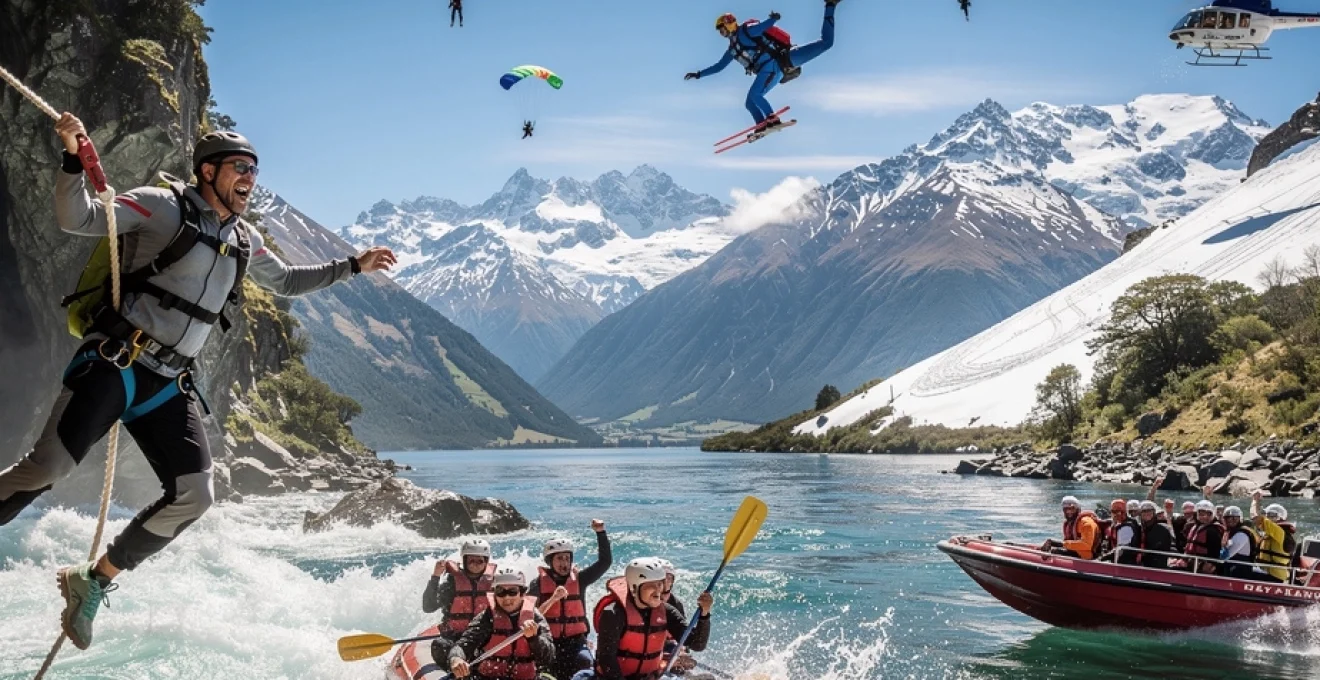
New Zealand has earned its reputation as the world’s adventure capital through decades of innovation, breathtaking natural landscapes, and a pioneering spirit that continues to push boundaries. From the snow-capped Southern Alps to the pristine rivers carving through ancient valleys, this island nation offers experiences that will test your limits and redefine what you thought possible. Whether you’re plunging towards earth at terminal velocity, navigating roaring rapids through narrow gorges, or exploring subterranean cave systems illuminated by thousands of glowworms, New Zealand delivers adrenaline-pumping activities that simply cannot be replicated elsewhere. The combination of world-class safety standards, expert operators, and dramatic scenery creates an environment where thrill-seekers can pursue their passion with confidence.
What sets New Zealand apart from other adventure destinations is the sheer variety and accessibility of extreme activities available within relatively small geographical areas. Queenstown alone offers over 200 different adventure experiences, while the entire country provides year-round opportunities for adrenaline junkies. The landscape itself—shaped by glaciers, volcanic activity, and tectonic forces—has created natural playgrounds perfectly suited for extreme sports. Understanding the technical aspects, safety protocols, and unique features of each activity will help you make informed decisions about which experiences align with your thrill-seeking goals.
Bungee jumping off kawarau bridge and nevis highwire: queenstown’s pioneering adrenaline experiences
Bungee jumping represents the quintessential New Zealand adventure experience, combining calculated risk with pure exhilaration. The country’s commercial bungee operations maintain impeccable safety records while delivering heart-stopping thrills that attract over 100,000 jumpers annually. The psychological challenge of overriding your survival instincts and stepping off a platform into freefall creates a rush that participants describe as transformative. Modern bungee systems incorporate multiple redundancy features, precision-engineered elastic cords, and carefully calculated weight-to-cord ratios that ensure each jump delivers maximum excitement with minimal risk.
AJ hackett kawarau bridge: the world’s first commercial bungee jump site
The Kawarau Bridge site holds legendary status in adventure tourism history, having launched the commercial bungee jumping industry in November 1988. This 43-metre jump over the turquoise Kawarau River remains one of the most iconic experiences in New Zealand, with thousands of jumpers each year taking the plunge from the historic suspension bridge. The site offers multiple jump styles, including the traditional ankle-tie, harness jumps, and the thrilling water-touch option where you can dip your head into the river at the bottom of your descent. The bridge’s location provides spectacular views of the surrounding Gibbston Valley, known for its award-winning wineries and rugged Central Otago landscape.
First-time jumpers appreciate the Kawarau Bridge’s moderate height, which provides genuine excitement without the overwhelming terror of higher jumps. The experienced jump crew has perfected the art of managing pre-jump nerves, guiding participants through breathing techniques and mental preparation strategies. The entire experience, from equipment fitting to the post-jump recovery boat ride, demonstrates the professionalism that has made New Zealand’s adventure industry a global benchmark. Statistical data shows that 94% of jumpers rate their Kawarau Bridge experience as life-changing, with many returning for multiple jumps throughout their New Zealand travels.
Nevis bungy: new zealand’s highest freefall drop at 134 metres
The Nevis Bungy elevates the bungee jumping experience to extreme levels, offering a 134-metre freefall that ranks among the highest in the world. Located in a remote valley 30 kilometres from Queenstown, the jump takes place from a cable car suspended high above the Nevis River. The eight-second freefall reaches speeds exceeding 120 kilometres per hour, creating an intensity that even experienced jumpers find exhilarating. The approach to the jump platform involves a scenic 4WD journey through mountainous terrain, building anticipation and allowing you to contemplate the magnitude of what lies ahead.
What distinguishes the Nevis experience is the complete isolation and dramatic setting. Unlike bridge jumps where spectators gather below,
you are suspended in a purpose-built pod in the middle of a vast gorge, surrounded only by rugged rock faces and the distant roar of the Nevis River. This isolation amplifies the psychological component of the jump, forcing you to confront your fear in an environment that feels far removed from everyday life. For many thrill seekers, the Nevis Bungy becomes the defining moment of their New Zealand adventure, a benchmark against which all other adrenaline activities are measured. Due to the technical nature of the site and its exposed alpine conditions, operators continuously monitor wind speeds and weather systems to ensure safe jump windows. If you are chasing the most intense bungee jump in New Zealand, this is where you test your limits.
The ledge bungy and swing: queenstown’s urban canyon suspension platforms
Perched high above Queenstown on Bob’s Peak, the Ledge Bungy and Ledge Swing offer a unique urban-adventure hybrid experience. Accessed via the Skyline Gondola, these platforms provide panoramic views of Lake Wakatipu, the Remarkables Range, and the town far below, creating a surreal juxtaposition between wilderness and nightlife. The Ledge Bungy features a freestyle harness system that allows you to run, flip, twist, or even attempt a handstand off the edge, making it popular with repeat jumpers who want to personalise their descent. The Ledge Swing, by contrast, launches you in a giant arc out over the town, giving you the sensation of flying across an urban canyon.
Because of its proximity to Queenstown’s bars, restaurants, and accommodation, the Ledge is an ideal option if you want to fit a high-adrenaline hit into a compact itinerary. Evening operations at certain times of year mean you can leap into a sea of city lights, a very different experience from the remote Nevis valley. The shorter drop height compared to Nevis and Kawarau makes the Ledge accessible for those who want to build confidence before progressing to more extreme jumps. Yet make no mistake: stepping off a platform with the town spread out beneath your feet is still a powerful psychological challenge that will leave your heart racing.
Safety protocols and g-force management in commercial bungee operations
Behind every seemingly reckless plunge in New Zealand bungee jumping lies a carefully engineered framework of safety protocols and g-force management. Commercial operators follow strict guidelines for equipment inspection, staff training, and emergency procedures, often exceeding international standards. Each jumper’s weight is measured precisely, and jump masters calculate cord selection, length, and backup systems using well-tested formulas and multiple cross-checks. Redundant attachment points—typically a combination of ankle and body harnesses—ensure that no single failure point can compromise the jump. It’s a bit like an aircraft pre-flight checklist: methodical, repetitive, and designed to remove human error as much as possible.
Managing g-forces during bungee jumps is critical to maintaining both safety and comfort. The elastic cords are engineered to stretch and decelerate you gradually, keeping peak g-forces within tolerable human limits, usually in the range experienced on a roller coaster rather than a fighter jet. Operators also consider rebound dynamics, ensuring that your body is not subjected to sudden whiplash-like movements at the bottom of the drop. Pre-jump briefings include body-position guidance—such as keeping your arms close to your body and avoiding abrupt twists—to help the cord absorb and distribute forces evenly. When you understand how much science and engineering goes into each jump, it becomes easier to trust the system and focus on enjoying the pure adrenaline rush.
White-water rafting through grade v rapids on the shotover and kaituna rivers
White-water rafting in New Zealand offers a different kind of high-adrenaline experience, swapping vertical drops for relentless horizontal power as you charge through technical rapids. The country’s network of glacial rivers and volcanic waterways provides everything from introductory Grade II floats to serious Grade V challenges for experienced paddlers. Rafting the Shotover, Kaituna, or Rangitikei rivers allows you to experience raw water energy up close, often in narrow gorges where rock walls tower above you. Professional guides use advanced hydrology knowledge, rope systems, and rescue techniques to keep commercial rafting well within controlled risk parameters. For many visitors, white-water rafting becomes the highlight of their New Zealand adventure tour because it combines teamwork, skill, and constant sensory input.
Shotover river canyon descent: navigating the oxenbridge tunnel and mother rapid
The Shotover River, just outside Queenstown, is famed for its steep gradient, tight canyon walls, and continuous sequence of rapids. Commercial trips typically tackle a Grade IV-V section that culminates in the legendary Oxenbridge Tunnel and Mother Rapid. During the approach, your guide will brief the team on paddle commands, safety positions, and self-rescue techniques, turning a group of strangers into a functional crew. As you enter the narrow canyon, the river constricts and accelerates, creating powerful features such as standing waves, holes, and lateral currents that demand precise manoeuvring. It feels like riding a runaway roller coaster that you help steer with every paddle stroke.
The Oxenbridge Tunnel is a unique highlight: a 170-metre-long man-made tunnel blasted in the 19th century for gold-mining operations, now repurposed as a thrilling dark-water chute. Emerging from the tunnel, rafts immediately confront Mother Rapid, a turbulent finale that tests everything you’ve learned upstream. Guides choose lines based on river levels and conditions, reading the water in real time to minimise flips and swims. While flips can happen on high-grade rivers, the use of safety kayakers, throw ropes, and secondary rafts helps ensure swimmers are quickly recovered. If you enjoy the idea of facing technical white water in a dramatic canyon environment, the Shotover descent is hard to beat.
Kaituna river’s tutea falls: rafting the highest commercially-navigated waterfall at 7 metres
On the North Island near Rotorua, the Kaituna River offers a completely different style of white-water adventure with a focus on vertical drops rather than extended rapids. The star attraction is Tutea Falls, a 7-metre waterfall that holds the title of the highest commercially rafted waterfall in the world. Approaching the lip, you can feel the raft tilt and the water surge underneath, creating an intense build-up of anticipation. Guides position the raft to hit the horizon line squarely, instructing everyone to adopt a compact “hold on” position as you plunge into the aerated pool below. For a moment, the raft may disappear completely beneath the foaming water before popping back to the surface, usually met with a chorus of disbelieving laughter.
The Kaituna trip also includes a series of smaller waterfalls and drops, offering multiple chances to perfect your technique and build confidence. Dense native forest lines the canyon, with hanging ferns and moss-covered walls giving the descent a distinctly prehistoric atmosphere. Cultural interpretation is often included, as the river corridor holds significance for local Māori communities and passes historic sites. While the overall trip is shorter than some South Island runs, the intensity of the vertical elements and the novelty of rafting waterfalls make Kaituna a must-do for thrill seekers on the North Island. It’s an excellent choice if you want high impact in a compact timeframe.
Rangitikei river expeditions: multi-day grade iv-v wilderness paddling
For those seeking a more immersive white-water experience, the Rangitikei River in the central North Island offers multi-day rafting expeditions through remote backcountry. Sections of the Rangitikei feature Grade IV-V rapids interspersed with calmer stretches, allowing you to balance high-adrenaline moments with periods of scenic floating. Expedition-style trips typically include riverside camping or stays at isolated lodges, giving you time to disconnect from digital life and reconnect with the rhythm of the river. The canyon walls here are often sheer and layered, providing a geological timeline carved by millennia of water flow. It’s like travelling through a living textbook of earth history, with each bend revealing a new chapter.
These longer expeditions also allow guides to introduce more advanced river skills, such as eddy-hopping, surfing standing waves, and reading complex rapid structures. You may have the chance to rotate into different positions in the raft, from front paddler to backup safety, to better understand team dynamics in difficult water. Because logistics and access are more complex, Rangitikei trips attract a slightly more experienced or adventure-focused clientele, although many operators still cater to first-timers with thorough training. If you want to combine wilderness immersion with serious white-water thrills in New Zealand, a Rangitikei expedition is a compelling option.
Technical river classification systems and rapid reading techniques
Understanding how rivers are graded helps you choose the right white-water rafting trip in New Zealand for your experience level. The internationally recognised International Scale of River Difficulty classifies rapids from Grade I (flat, moving water) to Grade VI (extreme and exploratory, rarely used commercially). Most adventure rafting for visitors falls between Grade III and Grade V, where rapids are powerful and irregular but still manageable by trained guides. Think of the grading scale as similar to ski-run difficulty ratings: it provides a quick reference for expected challenge, but local conditions and guide expertise remain crucial factors. Before you book, it’s worth checking minimum age, fitness recommendations, and swimming ability requirements for each river section.
Rapid reading techniques are the backbone of safe river navigation. Professional guides analyse features such as V-shaped tongues of smooth water, standing waves, holes (reversing currents), and strainers (obstacles that allow water through but block solid objects) to select the safest and most exciting lines. They also account for water level changes, which can transform a friendly Grade III into a pushy Grade IV after heavy rain. During your New Zealand rafting adventure, you’ll often hear guides explaining their decisions, giving you insight into a skill set that’s part science, part art. With practice, you begin to see how the river “speaks” through its surface patterns, much like learning to read a foreign language.
Tandem skydiving over lake wānaka and the southern alps at 15,000 feet
Tandem skydiving in New Zealand takes the concept of scenic flightseeing and supercharges it with freefall. Nowhere is this more evident than over Lake Wānaka and the Southern Alps, where drop zones offer exits from up to 15,000 feet (about 4,570 metres). This altitude provides around 60 seconds of freefall before the parachute deploys, giving you ample time to process the surreal combination of speed and silence. Strapped securely to an experienced instructor, you can focus on the sensation of wind rushing past at over 200 km/h while snow-capped peaks, braided rivers, and deep blue lakes unfold beneath you. For many travellers, tandem skydiving becomes the definitive “bucket list” activity during a New Zealand adventure trip.
Pre-jump training is straightforward yet thorough, covering body position, harness fit, and landing procedures. Operators typically offer altitude options, with higher exits giving longer freefall but requiring supplemental oxygen above specific thresholds. Modern tandem rigs use dual-parachute systems with automatic activation devices that deploy a reserve canopy if necessary, dramatically reducing risk. If you’re wondering whether you’ll actually be able to open your eyes and enjoy the view, the answer is almost always yes—once the initial shock of the exit passes, your brain quickly adjusts, and the scenery takes over. It’s a powerful reminder of how adaptable we are when we step outside our comfort zone.
Franz josef and fox glacier drop zones: skydiving above unesco world heritage ice fields
On the West Coast of the South Island, the Franz Josef and Fox Glacier regions offer some of the most dramatic skydiving landscapes in the world. Here, you leap from the plane above an environment where temperate rainforest, coastline, and active glaciers converge within a UNESCO World Heritage Area. On clear days, you can see from the Tasman Sea across the ice fields to Aoraki/Mount Cook and the Main Divide of the Southern Alps. The contrast between jagged crevasses and lush green valleys makes the descent feel like flying over two different planets at once. It’s an experience that even seasoned skydivers rank among their all-time favourites.
Glacier-region operators are accustomed to rapidly changing weather, so flexibility is key; conditions can shift quickly as moist air from the ocean meets cold alpine systems. Safety-focused companies will not hesitate to delay or cancel jumps if visibility, wind, or cloud cover compromise landing accuracy. During the climb to altitude, you’ll have time to absorb a guided aerial tour of the glaciated terrain, often with commentary on how climate change is impacting the ice. Skydiving above Franz Josef or Fox is more than an adrenaline hit—it’s also a front-row seat to some of the most dynamic landscapes on earth.
Queenstown’s remarkables range freefall: 60-second terminal velocity descents
Queenstown’s primary skydiving operations make full use of the Remarkables Range, Lake Wakatipu, and surrounding peaks to deliver classic alpine freefall experiences. Exiting at up to 15,000 feet, you’ll accelerate to terminal velocity in roughly 10–12 seconds, after which the sensation becomes less like falling and more like floating on a powerful cushion of air. The Remarkables live up to their name from altitude, with sharp ridgelines and snow-dusted summits forming a dramatic backdrop. You can track the twists of the Shotover and Kawarau rivers from above, tracing the same canyons that host jet boating and rafting adventures.
Because Queenstown is a year-round adventure hub, skydiving here is well integrated with other activities—you might raft in the morning and jump in the afternoon, or vice versa. Operators offer high-quality photo and video packages, capturing your exit, freefall reactions, and canopy flight against the iconic scenery. Wind conditions in alpine valleys can be complex, so pilots and instructors draw on detailed local experience and up-to-the-minute forecasts. For those building a full New Zealand adventure itinerary focused on Queenstown, adding a Remarkables skydive is an efficient way to tick off “jumping out of a plane” while maximising scenic impact.
Abel tasman national park coastal jumps: beach landing accuracy techniques
On the upper South Island, Abel Tasman National Park provides a very different type of skydiving experience, with golden beaches, turquoise bays, and forested headlands replacing alpine peaks. Coastal drop zones here sometimes include beach landings, giving you the rare chance to touch down on sand rather than grass. Beach landings require precise accuracy and wind-reading skills, so tandem instructors adjust approach patterns carefully to account for sea breezes, thermals, and shifting gusts. The goal is to set you down gently in a designated zone, much like a pilot aiming for a short airstrip on an island.
From altitude, you’ll see the intricate coastline of Abel Tasman, dotted with islands and inlets that kayakers, hikers, and boaters explore at sea level. Watching tiny boats trace white wakes across the water as you descend gives you a real sense of scale and perspective. Operators emphasise clear communication during the landing sequence, with simple leg-position instructions to help absorb impact correctly. If you love the idea of combining an adrenaline rush with a relaxed beach-vibe setting, a coastal skydive over Abel Tasman is an excellent choice.
Altitude acclimatisation and hypoxia management for high-altitude exits
As tandem skydiving altitudes increase, so does the need to manage physiological responses to thinner air. At 15,000 feet, oxygen levels are notably reduced compared to sea level, which can lead to mild hypoxia if not properly addressed. New Zealand skydiving operators mitigate this risk by using supplemental oxygen systems in the aircraft, particularly during the final climb phase. Instructors monitor signs of discomfort or dizziness and are trained to recognise early hypoxia indicators, such as impaired judgement or unusual euphoria. It’s similar to how mountaineers and pilots handle altitude: careful monitoring, gradual exposure, and backup systems.
For most healthy individuals, short-duration exposure at jump altitudes causes minimal issues, especially when oxygen is provided during ascent. However, if you have pre-existing respiratory or cardiovascular conditions, it’s important to discuss them with your operator beforehand and seek medical advice if necessary. Hydration also plays a role; staying well-hydrated can help your body cope better with changes in pressure and oxygen levels. Understanding these factors doesn’t need to make you anxious—instead, it highlights the depth of planning that goes into making high-altitude skydiving in New Zealand as safe as it is thrilling.
Heli-skiing and heli-boarding in the harris mountains and canterbury backcountry
Heli-skiing and heli-boarding in New Zealand elevate snow sports by granting access to vast, untouched alpine terrain far beyond the reach of conventional chairlifts. The Harris Mountains near Queenstown and Wānaka, along with the Canterbury backcountry around Methven and the Arrowsmith Range, are prime zones for these operations. Helicopters ferry small groups to remote peaks and ridgelines, where you can carve fresh tracks down powder-filled bowls, natural halfpipes, and long glacier runs. It’s the snow-sport equivalent of having a private theme park, with each drop tailored to the day’s conditions and the group’s ability level.
Safety is the foundation of every heli-ski day. Guides are certified in avalanche awareness, backcountry rescue, and snowpack assessment, and they carry transceivers, probes, and shovels. Before your first run, you’ll receive a detailed safety briefing covering helicopter protocols, avalanche transceiver use, and group spacing on descent. Operators constantly evaluate slope angles, aspect, and recent weather patterns to select terrain with acceptable avalanche risk. If conditions deteriorate, they adjust objectives or end the day early—powder is never worth compromising safety. For advanced riders and skiers, heli-skiing in New Zealand offers some of the most rewarding, leg-burning descents in the Southern Hemisphere.
The Harris Mountains typically provide a mix of high-alpine bowls and rolling glacial features, making them ideal for intermediate to advanced skiers looking to step up from resort off-piste. In Canterbury, you’ll find more continental-style terrain with wide faces and long fall lines, often with views stretching from the Main Divide to the Pacific Ocean. Run counts vary depending on package and conditions, but a standard day might include 4–10 runs, each offering up to 1,000 vertical metres of descent. If you’re planning a winter adventure trip to New Zealand and want an experience that combines helicopter flight, backcountry exploration, and technical riding, heli-skiing or heli-boarding should be high on your list.
Blackwater rafting and glowworm cave abseiling in waitomo’s subterranean networks
Waitomo’s cave systems on the North Island provide a completely different style of adventure: underground rather than alpine, illuminated by bioluminescent glowworms instead of sunlight. Blackwater rafting—also known as cave tubing—involves donning a wetsuit, helmet, and headlamp, then floating down subterranean streams on an inner tube. You’ll jump off underground waterfalls, squeeze through sculpted limestone passages, and drift beneath ceilings studded with thousands of glowworms (Arachnocampa luminosa) that resemble a star-filled night sky. It’s like swapping the open sky for a cosmic cave, with the gentle current guiding you through a hidden world.
More technical adventures in Waitomo include abseiling (rappelling) into vertical shafts such as the famous 100-metre-deep “Lost World” cave. Here, you descend on a rope into a vast cathedral-like chamber filled with stalactites, stalagmites, and echoing darkness. Qualified guides manage all rope systems, harnesses, and backups, allowing you to focus on body position and trust the equipment. Once at the bottom, the journey often continues with caving, scrambling, and sometimes ziplining through underground chambers. Because water levels in cave systems can rise quickly after heavy rain, operators monitor weather and river-flow data closely, cancelling or modifying trips when necessary for safety.
Waitomo’s blackwater rafting and cave abseiling experiences strike a balance between adrenaline and awe. While the physical exertion and occasional tight squeezes will raise your heart rate, the glowworm displays create a sense of calm and wonder. Guides often encourage you to switch off headlamps and float in silence, allowing your eyes to adjust while you watch phantom-like constellations emerge overhead. If you’re looking for an adventure activity in New Zealand that goes beyond conventional thrills and taps into a sense of exploration, Waitomo’s subterranean networks are a must-visit.
Jetboating through shotover canyons: 360-degree hamilton spin manoeuvres at 85 km/h
Jet boating is one of New Zealand’s signature adventure innovations, pioneered in the 1950s to navigate shallow rivers and now refined into a high-speed thrill ride. Nowhere showcases this better than the Shotover River canyons near Queenstown, where custom-built jet boats skim over just centimetres of water at speeds up to 85 km/h. Using powerful waterjets instead of propellers, these boats can execute rapid acceleration, abrupt stops, and the iconic 360-degree Hamilton spin. As you race through narrow rock corridors with cliff faces close enough to touch, the precision of the drivers becomes immediately apparent. It feels like being inside an action movie car chase, only on water.
The Shotover jet boating experience combines adrenaline with sightseeing, allowing you to appreciate sculpted rock formations, historic gold-mining remnants, and turquoise pools between bursts of high-speed manoeuvres. Drivers undergo extensive training and must log significant hours before carrying passengers, mastering the nuances of river levels, currents, and canyon wind patterns. Safety briefings cover handholds, seating positions, and signals you’ll use to communicate with the driver, such as a thumbs-up if you’re ready for the next spin. Because boats are designed with multiple watertight compartments and flotation systems, they maintain buoyancy even in the unlikely event of a hull breach.
Jet boating in Queenstown is also accessible year-round, with operators providing spray jackets and life vests to keep you comfortable in cooler conditions. If you’re building a packed itinerary of New Zealand adventure activities, jet boating is a time-efficient option—most trips take around an hour on the water, plus transfers—yet still deliver a substantial adrenaline hit. For many visitors, the combination of technical driving, canyon scenery, and trademark Hamilton spins makes jet boating a highlight alongside bungee jumping and skydiving. It’s an ideal way to end an adrenaline-filled day, leaving you exhilarated but back in town in time for dinner.