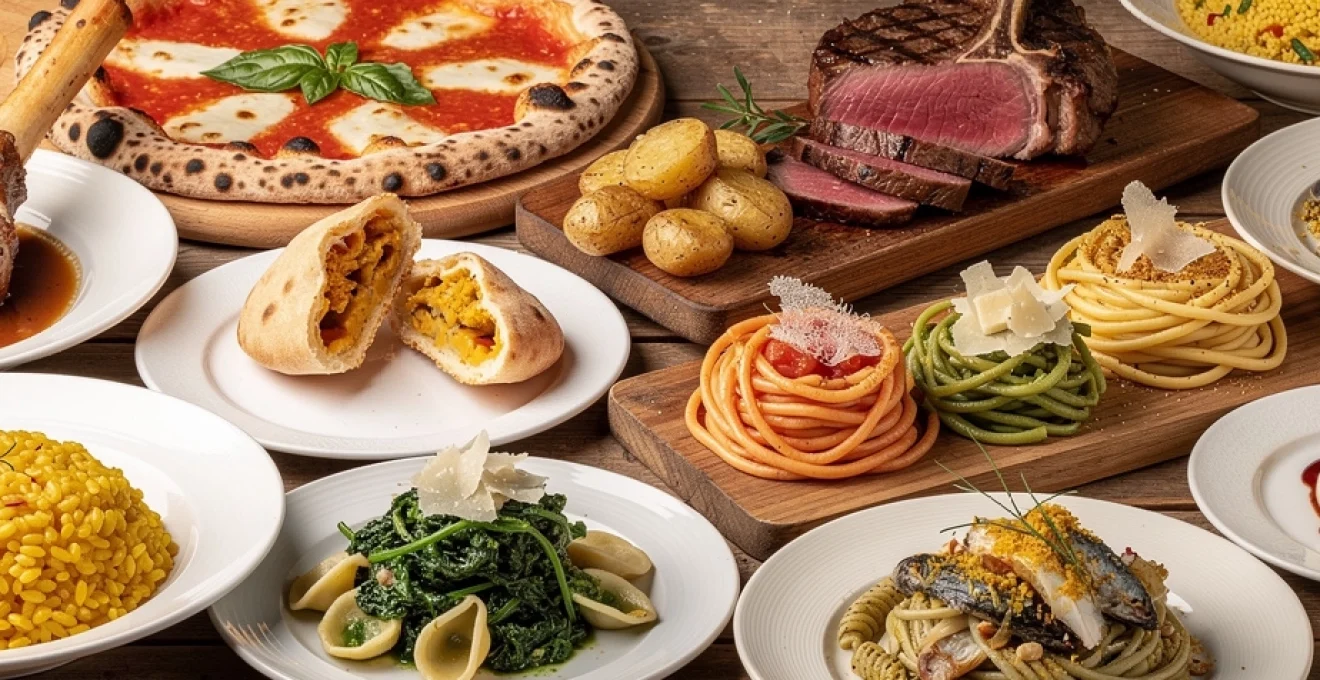
# Traditional dishes to try when visiting Italy
Italy’s culinary landscape represents centuries of regional evolution, where geographical boundaries have shaped distinct gastronomic identities across twenty regions. From the Alpine foothills of Piedmont to Sicily’s sun-drenched coastlines, each territory maintains fiercely protected recipes that reflect local agriculture, historical trade routes, and cultural influences. Understanding Italian cuisine requires moving beyond familiar exports like spaghetti bolognese—a dish that doesn’t actually exist in traditional Italian cooking—and exploring the authentic preparations that define each province. The concept of cucina regionale remains central to Italian food culture, with specific ingredients, techniques, and dishes rarely crossing regional boundaries even within the country itself.
Recent surveys by the Italian National Institute of Statistics indicate that 73% of Italian restaurants still prepare traditional regional recipes using methods passed down through generations, demonstrating remarkable resistance to globalization trends affecting other European cuisines. This commitment to authenticity means visitors can experience genuinely distinctive flavours as they travel between regions, encountering preparations that remain virtually unknown outside their place of origin. The Italian approach to food preservation through Denominazione di Origine Protetta (DOP) and Indicazione Geografica Protetta (IGP) certifications ensures that certain ingredients and dishes maintain quality standards tied to specific territories, creating a protected culinary heritage unlike anywhere else in the world.
Risotto alla milanese and ossobuco: lombardy’s golden culinary heritage
Lombardy’s capital Milan claims two interconnected dishes that epitomize northern Italian sophistication: risotto alla Milanese and ossobuco. These preparations emerged from the region’s agricultural abundance—rice paddies stretching across the Po Valley and cattle farming that provided both veal and dairy products. The combination represents alta cucina at its most refined, transforming humble ingredients through meticulous technique into dishes served at the finest establishments across Milan. Historical records trace risotto alla Milanese to the 16th century, when Flemish glassworkers at the Duomo cathedral supposedly added saffron—used for colouring stained glass—to wedding feast rice, creating the dish’s characteristic golden hue.
Saffron-infused carnaroli rice preparation techniques
Authentic risotto alla Milanese demands Carnaroli rice, a variety cultivated specifically in Lombardy and Piedmont that maintains structural integrity during the constant stirring required for proper preparation. The grain’s higher amylose content compared to the more common Arborio creates the desired all’onda consistency—a wavelike movement when the pan is tilted—without becoming mushy. Traditional preparation begins with soffritto of bone marrow, onion, and butter, a combination that provides the rich base distinguishing Milanese risotto from other regional variations. The rice undergoes toasting until translucent at the edges, a crucial step that seals each grain and prevents excessive starch release during cooking.
Saffron threads—never powder, which Milanese chefs consider inferior—are steeped in warm broth before addition, releasing their distinctive earthy-metallic flavour profile and deep yellow pigment. Quality saffron from Abruzzo or Spanish La Mancha regions costs approximately €8-12 per gram, making it among the world’s most expensive spices, yet authentic risotto requires only 0.15-0.20 grams per serving. The cooking process involves gradually adding hot beef or veal stock in small increments, allowing each addition to be absorbed before the next, whilst maintaining constant gentle stirring. This technique, requiring 18-22 minutes of active attention, coaxes starch from the rice grains to create the dish’s characteristic creamy consistency without any cream addition. The final mantecatura—vigorously beating in cold butter and grated Parmigiano Reggiano off the heat—emulsifies the released starches into a glossy, cohesive sauce that binds each grain whilst remaining fluid.
Veal shank braising methods for authentic ossobuco
Ossobuco, literally “bone with a hole,” refers to cross-cut veal shanks that reveal the marrow
that becomes the unctuous heart of the dish. Traditional Milanese butchers cut the shanks 4–5 cm thick to ensure enough marrow and connective tissue, both essential for developing a gelatin-rich sauce during slow braising. Before cooking, the pieces are lightly floured and browned in clarified butter or a mixture of butter and olive oil, creating Maillard reactions that will later deepen the flavour of the braising liquid. A classic soffritto of finely diced onion, carrot, and celery follows, softened until sweet and translucent.
The veal shanks return to the pot with dry white wine, which is reduced to cook off the alcohol and concentrate acidity, then are covered with light veal or beef stock and sometimes a spoonful of tomato paste for colour rather than overt tomato flavour. Gentle braising at 160–170°C for 2–2.5 hours allows the collagen to melt without the meat drying out—a process not unlike slow-cooking short ribs but with a more delicate end result. You know an ossobuco is correctly done when the meat barely clings to the bone and the marrow jiggles but does not completely dissolve into the sauce. Milanese purists will remind you that the marrow is not a garnish but an integral part of the dish, traditionally scooped out and spread on toasted bread or mixed into the risotto on the plate.
Gremolata garnish: lemon zest, garlic, and parsley balance
Without its final flourish of gremolata, ossobuco would risk being heavy, especially when paired with rich saffron risotto. Gremolata—a finely chopped mixture of lemon zest, fresh flat-leaf parsley, and raw garlic—acts as a culinary counterweight, cutting through the gelatinous sauce and refreshing the palate with bright aromatics. The ratio is critical: too much garlic and the garnish becomes harsh; too much lemon and it overwhelms the slow-cooked meat. Most Milanese chefs favour equal parts zest and parsley with half as much garlic, added at the very last moment so the volatile citrus oils remain vivid.
From a technical standpoint, gremolata functions much like a squeeze of lime over a rich curry or fresh herbs over a stew: it introduces high notes that contrast with the dish’s bass tones. When you stir a pinch into your risotto alla Milanese, you will notice how the saffron’s floral complexity emerges more clearly, while the marrow’s richness seems lighter and more nuanced. For travellers exploring traditional food in Italy, paying attention to these small details—the chopped garnish, the quality of the parsley, the freshness of the lemons from the Amalfi or Garda areas—can dramatically change how you experience a classic plate of ossobuco e risotto.
Traditional milanese restaurants: trattoria masuelli and antica osteria del ponte
To taste these Lombard icons prepared according to time-honoured methods, it helps to seek out restaurants that still view themselves as custodians of Milanese culinary heritage. Family-run Trattoria Masuelli San Marco, operating since 1921, is renowned among locals for its rigorously traditional risotto alla Milanese, cooked in copper pans and finished all’onda at the table. Portions are often served alongside ossobuco on the same plate, reflecting how Milanese families would enjoy these dishes together on Sundays and holidays. The decor—a blend of mid-century design and old photographs—reinforces the sense that you are participating in a living tradition rather than a staged tourist experience.
Outside the city, Antica Osteria del Ponte overlooking the Adda River offers a more refined interpretation while respecting classical techniques, pairing veal shank with single-origin saffron and carefully aged rice varietals. Here you might notice modern touches like clarified stocks or precise temperature control, but the core flavours remain faithful to their 19th-century inspirations. Booking ahead is wise in both cases, especially during trade fairs and fashion weeks, when Milan’s restaurants fill with visitors looking to pair haute couture with alta cucina. If you are planning a culinary itinerary through northern Italy, consider scheduling at least one dedicated evening in Milan for this golden duo of risotto and ossobuco.
Neapolitan pizza: denominazione di origine controllata standards and regional variations
If Milan represents Italy’s elegant, rice-based north, Naples is undeniably the spiritual home of pizza. In 2010, the European Union granted “Pizza Napoletana” Traditional Speciality Guaranteed (TSG) status, and local associations follow strict Denominazione di Origine Controllata–style guidelines that regulate everything from flour type to oven temperature. These rules are not bureaucratic fussiness; they are an attempt to preserve a craft that UNESCO recognised in 2017 as part of the world’s intangible cultural heritage. When you sit down at a pizzeria in Naples, you are not just ordering a quick meal—you are participating in a centuries-old ritual that defines southern Italian food culture.
Pizza margherita DOP: san marzano tomatoes and mozzarella di bufala campana
The most emblematic expression of Neapolitan pizza is the Margherita, a dish whose colours mirror the Italian flag: red tomatoes, white cheese, and green basil. Under the TSG and DOP frameworks, an authentic pizza Margherita must be topped with San Marzano dell’Agro Sarnese-Nocerino tomatoes and either Mozzarella di Bufala Campana DOP or Fior di Latte from Campania. San Marzano tomatoes, grown in volcanic soils near Mount Vesuvius, are prized for their low acidity, dense flesh, and natural sweetness; when crushed by hand into a raw sauce, they deliver a bright, almost fresh-fruit character that industrial tomato purées cannot replicate. The buffalo mozzarella, made from water buffalo milk, contributes a gentle tang and a creamy, elastic melt that pools in small puddles as it bakes.
Most traditional pizzerias in Naples follow a minimalist approach: a thin layer of tomato, a scattering of sliced or torn mozzarella, a few basil leaves, and a drizzle of extra-virgin olive oil. There is no mountain of toppings, no over-browning of cheese—just balance between dough, sauce, and dairy. When you bite into a properly made Margherita, you should taste the softly blistered crust first, then a burst of tomato and the lactic sweetness of the cheese, all underlined by a faint smokiness from the wood-fired oven. For many travellers, this becomes a benchmark: after eating pizza in Naples, it is difficult not to compare every future slice to this deceptively simple standard.
Wood-fired oven temperature control at 485°C for authentic leopard spotting
One detail that surprises many visitors is just how quickly a true Neapolitan pizza cooks. Official regulations stipulate that pizzas must be baked in a domed, wood-fired oven at around 430–485°C (800–905°F) for no more than 60–90 seconds. At these temperatures, the dough inflates like a balloon, creating the characteristic raised cornicione (edge) with irregular air pockets and “leopard spotting”—small, charred blisters that lend bitterness and complexity. Managing an oven at nearly 500°C is a skill comparable to tuning a race car engine: pizzaioli constantly rotate pies, add or move embers, and judge doneness by eye rather than by timer.
Why such extreme heat? A rapid bake ensures that the base remains soft and pliable while the exterior chars ever so slightly, preserving moisture in the dough. If you have ever wondered why Neapolitan pizza is meant to be eaten with knife and fork or folded into a “portafoglio” (wallet) when served as street food, this is the reason: the centre stays tender rather than crunchy. For those interested in food science, the short, intense bake minimises moisture loss and allows a unique coexistence of textures—crisp at the edge, custardy in the centre—that slower, lower-temperature baking cannot achieve.
Caputo tipo 00 flour and cold fermentation dough development
Beneath every great pizza in Italy lies an invisible backbone: well-fermented dough made from high-quality flour. Many top pizzerias in Naples rely on Caputo Tipo 00 flour, milled specifically for long-proofed doughs and prized for its finely ground texture and controlled protein content. The “00” grading refers to the finest level of milling, which produces a silky flour that can absorb significant water while still yielding an extensible, easy-to-stretch dough. Over the last decade, a quiet revolution has taken place as more pizzaioli adopt cold fermentation, allowing dough balls to rest in refrigerated conditions for 24–72 hours before use.
This slow rise, much like the extended proofing used for artisan sourdough bread, allows enzymes to break down complex starches into simpler sugars and improves gluten structure. The result? A crust that is more digestible, flavourful, and aromatic, with hints of natural sweetness and fermentation rather than raw flour. When you plan where to eat in Naples, look for pizzerias that mention long fermentation or “maturazione lenta” on their menus; these are often the places where the dough itself is treated as seriously as the toppings. It is not unusual for locals to debate hydration percentages and fermentation times with the same passion others reserve for football tactics.
Pizza fritta: Deep-Fried dough pockets from spaccanapoli district
While the classic round pizza gets most of the international attention, Naples hides another treasure in its narrow streets: pizza fritta, or deep-fried pizza. Originating in the post-war years when ovens were scarce and ingredients limited, this street food involves enclosing ricotta, provola cheese, cured meats, or even simple tomato in a circle of dough, sealing it like a large calzone, and frying it in hot oil until puffed and golden. The result is surprisingly light, with a crisp exterior and a steamy, molten interior that recalls a savoury doughnut more than a heavy pie. In neighbourhoods like Spaccanapoli and the Spanish Quarters, small friggitorie specialise in this working-class delicacy.
From a technical perspective, pizza fritta demonstrates just how adaptable Italian dough traditions can be. The same basic dough used for baked pizza can, with slight adjustments in hydration and proofing, produce an entirely different texture when fried. Think of it as the Neapolitan cousin of Sicilian arancini or Roman supplì: a portable, inexpensive way to enjoy familiar flavours on the go. If you have limited time in Naples, pairing a sit-down Margherita at a historic pizzeria with a paper-wrapped pizza fritta from a street stall offers a compact masterclass in the city’s food culture.
Pasta fresca regionale: Hand-Rolled specialities across italian provinces
Move away from the big cities and you will quickly discover that fresh pasta in Italy is anything but generic. Each region—and often each town—has its own preferred shape, flour blend, and traditional sauce, reflecting local agriculture and social history. In central and southern regions, water-and-semolina doughs dominate; in the wealthier north, egg yolks appear more frequently, signalling a historic abundance of livestock. As you travel, paying attention to these differences turns every plate of pasta into a kind of edible map, telling you where you are and what the land around you produces best.
Pici senesi: Hand-Rolled tuscan spaghetti with aglione sauce
In the hills around Siena and Montepulciano, the signature fresh pasta is pici, a thick, rustic cousin of spaghetti made by hand-rolling ropes of dough on a wooden board. Traditionally composed of just soft wheat flour, water, and a little olive oil, pici reflects Tuscany’s cucina povera, where eggs were once too precious to waste on everyday noodles. The uneven thickness and slightly irregular shape are not flaws but virtues: they create a satisfying chew and help the sauce cling to the surface. One of the most beloved preparations, pici all’aglione, showcases a large, mild local garlic variety simmered gently with tomatoes and olive oil into a silky, fragrant sauce.
Ordering pici in a trattoria near Siena offers more than just a meal; it connects you with a rural tradition that families have preserved for generations. Many agriturismi still invite guests to roll their own strands before lunch, an experience that quickly reveals why machine-made approximations cannot reproduce the same texture. If you enjoy cooking at home, this is one of the easiest regional pastas to attempt without special equipment—you simply roll, cut, and cook, allowing slight imperfections to remind you of Tuscan farm kitchens rather than factory lines.
Orecchiette con cime di rapa: pugliese Ear-Shaped pasta shaping technique
Travel south to Puglia, and the pasta landscape changes along with the climate. Here, the most iconic shape is orecchiette, literally “little ears,” made from a firm dough of durum wheat semolina and water. The shaping technique is deceptively simple yet requires practice: a small piece of dough is dragged with the tip of a knife or thumb across a board, then flipped inside out to create a concave disc with a slightly rough surface. This “ear” is ideally suited to capturing sauces, especially the region’s most famous pairing, cime di rapa (broccoli rabe or turnip tops), blanched and sautéed with garlic, anchovy, and chilli.
In Bari’s old town, it is still common to see women sitting outside their doorways in the afternoon, rolling and shaping orecchiette on wooden boards, a scene that appears in countless photographs of traditional Italian food culture. For visitors, watching this process is a reminder that pasta in Italy is as much a social activity as a culinary one, passed down through touch and repetition rather than written recipes. When you order orecchiette con cime di rapa, notice how the bitterness of the greens, the savoury depth of the anchovy, and the dense chew of the pasta create a dish that is both simple and complex—like a well-composed folk song with only a few notes.
Tajarin piemontesi: egg Yolk-Rich ribbon pasta with white truffle from alba
Piedmont, in Italy’s north-west, tells a very different story through its pasta. Here, wealth from agriculture and industry translated into richer doughs, especially in the Langhe hills around Alba. Tajarin (or tagliolini) are ultra-thin ribbons made with an unusually high proportion of egg yolks—sometimes up to 30 yolks per kilogram of flour—resulting in a golden, almost custard-like noodle. The dough is rolled very thin and cut into fine strands, which cook in just a minute or two, emerging tender yet resilient. On their own, tajarin are buttery and luxurious; paired with shaved white truffle from Alba in autumn, they become one of Italy’s most coveted seasonal dishes.
White truffles, often selling at auction for over €3,000 per kilo in peak years, are not cooked but shaved raw over the hot pasta, releasing an aroma some describe as a fusion of garlic, fermented cheese, and damp forest floor. It may sound intense, and it is—but the richness of the yolk-based pasta acts as the perfect stage for this fleeting, perfumed ingredient. If you are planning a food-focused trip to Italy in October or November, arranging a tajarin with tartufo bianco in Alba or nearby towns should be high on your list. Think of it as the northern counterpart to Naples’ Margherita: a dish where apparent simplicity hides extraordinary craftsmanship and ingredients.
Trofie al pesto genovese: ligurian twisted pasta with basil DOP and parmigiano reggiano
On the Ligurian coast, where terraced hills plunge into the sea, fresh pasta takes yet another form: trofie, short, twisted strands traditionally made by rolling pieces of dough between the palms. Unlike the egg-rich tajarin, trofie are based on semolina and water, producing a firm, slightly gnocchi-like bite that stands up well to robust sauces. Their most famous partner is pesto Genovese, a raw sauce of DOP Genovese basil, pine nuts, garlic, Parmigiano Reggiano, Pecorino, and olive oil, traditionally pounded in a marble mortar with a wooden pestle. Modern chefs may use blenders, but purists argue that the slower, cooler grinding preserves the basil’s bright green colour and delicate aroma.
In many Ligurian homes, trofie are cooked in the same pot as diced potatoes and green beans, then all three are tossed with pesto in a single bowl—a clever expression of the region’s frugality and resourcefulness. For travellers exploring Cinque Terre or Genoa, ordering trofie al pesto offers a taste of how closely local cuisine is tied to the landscape: the basil comes from small plots overlooking the sea, the olive oil from nearby groves, the cheese from neighbouring regions. It is a dish that, like many in Italy, would not taste the same if made anywhere else.
Bistecca alla fiorentina: T-Bone steak from chianina cattle breed
Tuscany’s contribution to Italy’s roster of must-try traditional dishes is as imposing as the region’s stone palazzi: bistecca alla Fiorentina, a massive T-bone steak cut from Chianina cattle. One of the oldest and largest cattle breeds in the world, Chianina yield meat that is lean yet remarkably flavourful, with a fine grain that responds beautifully to high-heat grilling. The steak is typically cut 4–6 cm thick and weighs between 800 grams and 1.5 kilograms, designed to be shared between two or more people. Seasoning is minimalist—usually just coarse salt, sometimes a drizzle of local olive oil and a sprig of rosemary—because the emphasis is on the quality of the beef and the skill of the grill master.
Cooking a Fiorentina is closer to searing a roast than grilling a conventional steak. Traditional Florentine restaurants use charcoal or wood embers, positioning the meat first close to the heat to develop a thick crust, then further away so the interior warms gently. The goal is a deeply charred exterior and an interior that remains al sangue (rare), often around 50–52°C at the centre. Some visitors accustomed to well-done steaks may be surprised at the redness, but overcooking is considered almost sacrilegious in Tuscany. When you order one in Florence or the surrounding countryside, expect a theatrical presentation: the raw cut may be shown at the table before cooking, and the finished steak is often sliced in front of you, its juices pooling on a wooden board.
Sicilian seafood traditions: couscous di pesce and pasta con le sarde
Further south, Sicily offers a very different expression of Italian culinary tradition, shaped by centuries of Greek, Arab, and Spanish influence. Surrounded by the Mediterranean on all sides, the island has developed a seafood culture that feels distinct from the mainland, incorporating spices, dried fruits, and grains rarely seen together elsewhere in Italy. Two dishes in particular—couscous di pesce from the west and pasta con le sarde from the north and east—illustrate how Sicily’s food reflects its role as a crossroads of civilisations.
Couscous di pesce, especially common in Trapani and Mazara del Vallo, marries North African techniques with local fish. Traditionally, semolina grains are hand-rolled and steamed over a fragrant fish broth in a perforated pot called a couscoussiera, then served with a rich stew of mixed seafood—often including rockfish, mullet, and crustaceans—flavoured with tomato, saffron, and local spices. The dish is a reminder of Arab rule in Sicily between the 9th and 11th centuries, yet it has been fully absorbed into the island’s identity, featured at festivals and family gatherings. For visitors, it offers a welcome contrast to pasta and pizza, showing that “Italian food” encompasses far more than many people expect.
Pasta con le sarde, literally “pasta with sardines,” is perhaps the quintessential Sicilian first course, balancing sweet, salty, and herbal notes in a way that may surprise first-time tasters. The sauce combines fresh sardines or anchovies, wild fennel fronds, pine nuts, raisins, saffron, and sometimes tomato, all tossed with bucatini or other long pasta. A final layer of toasted breadcrumbs—often called the “poor man’s cheese”—adds crunch and absorbs excess oil, much like a crumble topping on a fruit dessert. The flavour profile, with its interplay of sea and field, sweetness and bitterness, reflects the island’s complex history and its reliance on both fishing and agriculture.
When you order either of these dishes in Sicily, you are tasting more than regional specialities; you are experiencing how migration, trade, and conquest have shaped what ends up on the plate. It is worth asking your server where the fish was caught or whether the fennel is wild—these details often spark stories about local fishermen, foraging traditions, and family recipes. For curious travellers, such conversations can be as memorable as the dishes themselves.
Tiramisu veneto and panna cotta piemontese: regional dessert masterpieces
No exploration of traditional dishes to try when visiting Italy would be complete without considering how Italians end a meal. While desserts vary widely from region to region, two have achieved international fame while still retaining strong local identities: tiramisu from the Veneto and panna cotta from Piedmont. Both embody the Italian knack for transforming a handful of simple ingredients into something greater than the sum of its parts—an approach that mirrors the country’s savoury cooking.
Tiramisu, whose name means “pick me up,” emerged in the late 20th century in the Treviso area near Venice, though several establishments claim to have invented it. The classic version layers coffee-soaked savoiardi (ladyfingers) with a cream of mascarpone, egg yolks, and sugar, sometimes fortified with Marsala or another fortified wine, then dusted with cocoa powder. There is no baking involved; the structure relies on the biscuits absorbing liquid while the mascarpone mixture sets in the fridge. When you dig a spoon through the layers, you encounter contrasting textures and temperatures—cold cream, soft but slightly resistant biscuits, a bitter cocoa top—that together create an almost addictive richness.
Panna cotta, by contrast, is all about smooth, understated elegance. Originating in Piedmont, possibly as a way to use surplus cream from the region’s dairies, it consists of gently sweetened cream set with gelatin and often flavoured with vanilla. The best versions wobble delicately on the plate, much like a well-made custard or flan, but without eggs. They are typically served with a fruit coulis, caramel, or even a drizzle of aged balsamic vinegar—a nod to northern Italy’s love of sweet-sour contrasts. For travellers who may feel overwhelmed by richer desserts after a multi-course meal, panna cotta offers a light yet satisfying alternative.
When deciding what to eat in Italy, it is tempting to focus only on the savoury classics: pizza, pasta, risotto, and grilled meats. Yet taking the time to sample regional desserts like tiramisu in a Venetian osteria or panna cotta in a Piedmontese trattoria completes the picture of how Italians think about flavour, texture, and balance. Much like a squeeze of lemon over ossobuco or a handful of basil on a Margherita, these sweets provide a final, memorable note—one that lingers long after you have left the table and, eventually, the country itself.