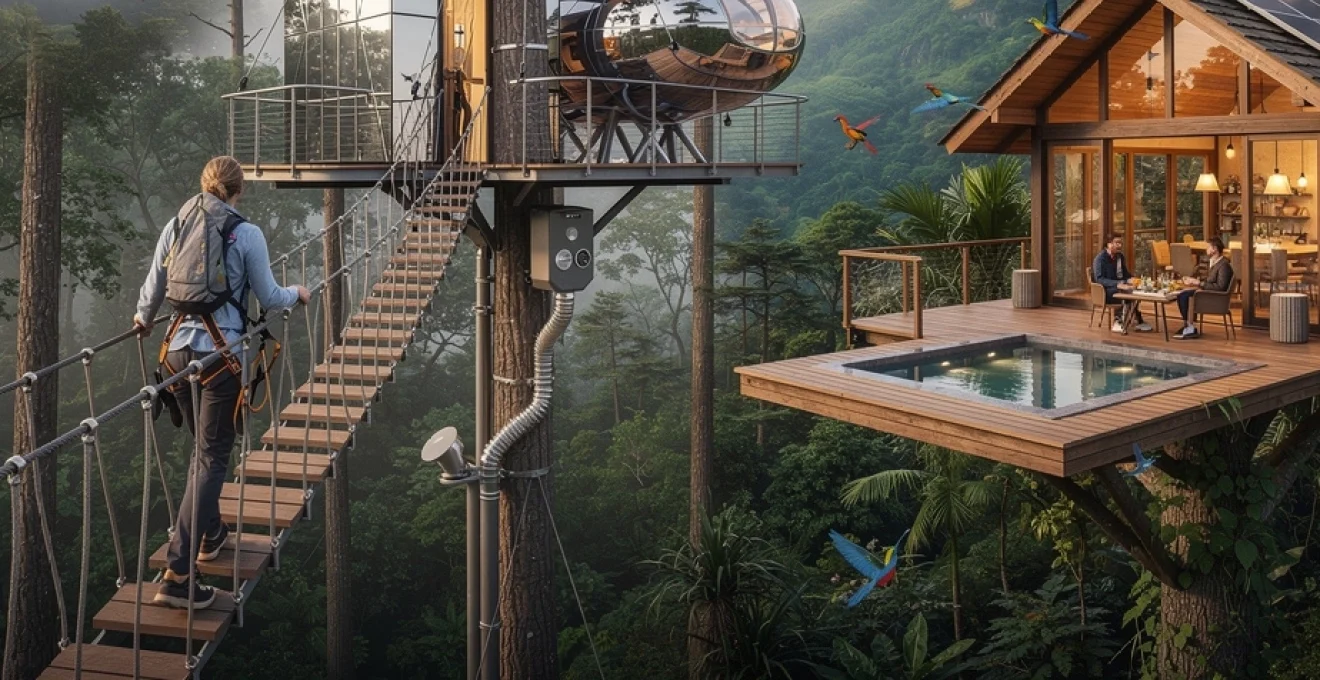
The allure of sleeping among the treetops transcends age, tapping into a universal desire for adventure, reconnection with nature, and the kind of wonder that defined childhood exploration. With 40% of global travellers now planning to stay in unique accommodations like treehouses at least once annually, the hospitality industry has responded with increasingly sophisticated offerings that blend architectural innovation, environmental sustainability, and luxury amenities. These elevated retreats represent far more than novelty lodging—they provide immersive experiences that challenge conventional notions of accommodation whilst fostering deeper relationships with the natural world. From solar-powered pods suspended in Scandinavian forests to luxurious safari-style tents nestled in Costa Rican rainforests, today’s treehouse accommodations demonstrate how thoughtful design can create spaces that are simultaneously thrilling, comfortable, and ecologically responsible.
Architectural design and structural engineering of elevated treehouse accommodations
The construction of professionally designed treehouse accommodations requires a sophisticated understanding of both architectural principles and arboricultural science. Unlike the simple childhood structures built with reclaimed timber and rope, contemporary treehouse hotels employ advanced engineering techniques that prioritize both guest safety and tree health. The structural integrity of these elevated dwellings depends upon careful calculation of weight distribution, wind loading, and seasonal movement patterns of the host trees. Engineers must account for the fact that living trees continue to grow, sway in wind, and respond to environmental stressors throughout the lifetime of the structure attached to them.
Canopy-level construction techniques at treehotel harads, swedish lapland
The Treehotel in Swedish Lapland exemplifies cutting-edge approaches to treehouse construction, with rooms suspended 4-6 meters above ground in the boreal forest. Each of the seven unique structures employs different load-bearing strategies adapted to the specific characteristics of the surrounding trees. The Mirrorcube, perhaps the most iconic unit, uses an aluminium frame that minimizes weight whilst maintaining structural rigidity. The exterior’s mirrored panels, beyond their striking aesthetic appeal, serve a functional purpose by reflecting the surrounding forest and reducing the structure’s visual impact on wildlife. The installation process for such structures requires specialized equipment including cranes and skilled arborists who can assess tree stability and install attachment points without compromising vascular tissues essential for tree survival.
Suspension bridge integration at finca bellavista, costa rica
At Finca Bellavista in Costa Rica’s Piedras Blancas region, an entire community of treehouses is interconnected through an extensive network of suspension bridges and ziplines. This infrastructure presents unique engineering challenges, as the walkways must accommodate dynamic loads whilst remaining flexible enough to move with the trees during wind events. The suspension bridge systems employ aircraft-grade cables and weatherproof decking materials that can withstand the humid tropical environment where annual rainfall exceeds 4,000 millimeters. The design philosophy embraces the natural movement of the forest canopy rather than attempting to create rigid connections that would stress both structures and trees. This approach has proven remarkably successful, with some platforms having remained operational for over fifteen years without significant degradation.
Load-bearing tree selection and arboricultural health assessment standards
The foundation of any successful treehouse accommodation begins with proper tree selection and ongoing health monitoring. Certified arborists conduct thorough assessments examining trunk diameter, species characteristics, root system stability, and signs of disease or pest infestation. Generally, mature hardwood species with trunk diameters exceeding 30 centimeters provide the most reliable support, though specific requirements vary based on the proposed structure’s weight and attachment methodology. Species such as oak, maple, and certain pine varieties demonstrate excellent load-bearing capacity, whilst trees with brittle wood or shallow root systems require additional support structures or should be avoided entirely. Many premium treehouse accommodations implement annual inspections using resistance tomography and sonic testing to identify internal decay that might not be visible externally, ensuring guest safety whilst preserving tree health for future generations.
Weatherproofing and thermal insulation in treehouse construction
Creating comfortable year-round accommodations in the forest canopy requires sophisticated climate control strategies. Unlike ground-level structures that benefit from earth’s thermal mass, treehouses experience greater temperature fluct
uations and greater exposure to wind, rain, and solar gain. To mitigate these factors, many elevated accommodations employ high‑performance building envelopes with multi-layer insulation, vapour barriers, and rain screens similar to those used in alpine architecture. In cold climates such as Swedish Lapland or the Norwegian fjords, triple-glazed windows and insulated floors reduce heat loss, while radiant heating systems or high‑efficiency wood stoves provide steady warmth without overloading the electrical system. In tropical and rainforest environments, designers often prioritise cross‑ventilation, deep roof overhangs, and breathable materials over heavy insulation to manage humidity and prevent condensation. Durable cladding such as treated timber, composite panels, or corrugated metal is paired with corrosion-resistant fasteners to withstand decades of exposure to moisture and UV radiation. By combining these strategies, contemporary treehouse accommodations can maintain comfortable interior conditions with relatively low energy consumption, even in challenging climates.
Luxury treehouse resorts in tropical and rainforest environments
In tropical and rainforest regions, luxury treehouse resorts push the boundaries of what elevated accommodation can offer, merging five‑star amenities with immersive canopy experiences. These properties leverage their unique locations—often adjacent to rivers, coral-fringed coasts, or primary rainforest—to deliver adventure without sacrificing comfort. High thread‑count linens, private plunge pools, and on‑call concierges coexist with howler monkey wake‑up calls and uninterrupted views of mist‑covered valleys. For travellers seeking a treehouse stay that feels more like a boutique hotel than a rustic cabin, destinations in Costa Rica, Thailand, and New Zealand offer some of the most refined options. At the same time, many of these high‑end treehouse resorts are pioneers in sustainable tourism, investing heavily in habitat conservation, community partnerships, and low‑impact building techniques.
Pacuare lodge canopy villas in costa rica’s talamanca mountain range
Set deep within Costa Rica’s Talamanca Mountain Range, Pacuare Lodge has become synonymous with canopy‑level luxury on the banks of the Pacuare River. Accessible primarily by white‑water rafting or 4×4 transfer, its canopy villas rise above the forest floor, giving guests a literal bird’s‑eye view of one of the most biodiverse regions on the planet. The treehouse‑style suites incorporate hardwood decks, private plunge pools, and open‑air lounges screened with fine mesh to keep insects at bay while allowing the sounds and scents of the jungle to filter through. Construction materials are locally sourced where possible, and much of the resort’s power is generated through renewable systems, minimising the carbon footprint of each stay. For travellers who want an adventure-focused treehouse accommodation without giving up gourmet dining or spa treatments, Pacuare Lodge illustrates how luxury and low‑impact design can coexist.
Because the lodge is embedded in dense rainforest, wildlife encounters are almost inevitable: toucans, sloths, and frogs often appear within view of the decks, making the villas feel like elevated hides rather than standard hotel rooms. Guided excursions—from canyoning and canopy tours to visits with nearby Indigenous communities—reinforce the sense that the treehouse is just one node in a larger ecological and cultural network. If you are considering a stay, it is worth noting that the remote location means fewer crowds but also greater dependence on the lodge’s logistics, from river conditions to seasonal rainfall. Booking during shoulder seasons can provide a balance of reliable weather, lower occupancy, and more personalised experiences in the treetops.
Soneva kiri’s private dining pod experience in koh kood, thailand
On the Thai island of Koh Kood, Soneva Kiri has taken the idea of treehouse experiences beyond accommodation and into the culinary realm with its renowned private dining pods. Suspended high in the forest canopy and hoisted by discreet winch systems, these woven “nests” allow diners to enjoy panoramic views of the coastline while servers reach the pod via harness and zipline. The engineering behind these pods mirrors that of permanent treehouse accommodations: careful load calculations, redundant safety systems, and non‑invasive attachment points that protect the host trees. Although guests do not typically sleep in these pods, the experience highlights how tree‑based architecture can transform even a single meal into an adventure.
Stays at Soneva Kiri also include villas with elevated decks and open‑air lounges that echo the feeling of sleeping in a treehouse, even when structural support comes partly from stilts anchored in the ground. High ceilings, extensive use of natural materials like bamboo and reclaimed timber, and the omnipresent sound of the jungle blur the boundary between interior and exterior spaces. For travellers interested in luxury treehouse resorts in Southeast Asia, Soneva Kiri demonstrates how design can combine playful concepts—like sky‑high dining—with serious sustainability initiatives, including on‑site water bottling, organic gardens, and advanced waste management. As with many high‑end island properties, rates vary significantly by season, with monsoon months offering lower prices but also higher humidity and occasional storms.
Hapuku lodge treehouse accommodation in kaikoura, new zealand
Hapuku Lodge + Tree Houses, set near Kaikoura on New Zealand’s South Island, offers elevated suites that rise approximately 10 metres above the ground, overlooking both the Seaward Kaikoura Mountains and the Pacific Ocean. Rather than relying on a single host tree, these architect‑designed treehouses rest on steel supports integrated with native Kanuka groves, effectively combining stilt architecture with canopy immersion. Floor‑to‑ceiling windows frame sweeping views of migrating whales offshore and snow‑dusted peaks inland, turning the landscape into a living artwork that shifts with the light. Interiors feature locally crafted furniture, fireplaces, and deep soaking tubs, reinforcing the sense that you’re in a modern design hotel that just happens to be nestled in the treetops.
Hapuku’s approach is particularly instructive for destinations where seismic activity, strong winds, or protected tree species make direct load‑bearing attachments impractical. By using engineered supports that rise through the canopy, the lodge can offer the sensory benefits of a treehouse stay—elevated perspectives, birdsong at eye level, and minimal ground disturbance—while reducing stress on individual trees. For guests, this translates into a stable, weather‑resistant retreat that remains usable year‑round, even in New Zealand’s variable maritime climate. Activities such as whale watching, coastal cycling, and hiking are easily accessible, making Hapuku Lodge a strong option if you want to pair a treehouse holiday with marine wildlife encounters and gourmet farm‑to‑table cuisine.
Proximity to wildlife corridors and biodiversity hotspot access
One of the defining advantages of treehouse accommodations in tropical and rainforest settings is their proximity to wildlife corridors and biodiversity hotspots. Elevated platforms often encroach less on animal movement than extensive ground‑level development, allowing species from butterflies to primates to continue using their traditional routes. In Costa Rica, Thailand, and Laos, many operators partner with biologists to map key wildlife pathways before construction, adjusting building footprints and access trails to reduce habitat fragmentation. For travellers, this means a higher chance of observing wildlife behaviour directly from the deck—whether it is a family of gibbons brachiating through the canopy or nocturnal species emerging at dusk.
However, being close to biodiversity hotspots also carries responsibilities. Light pollution, noise, and food waste can all disrupt local ecosystems if not carefully managed. Leading treehouse resorts now implement guidelines on low‑intensity outdoor lighting, sound curfews, and secure waste storage to avoid attracting opportunistic wildlife. When you evaluate a potential stay, it can be useful to ask how the property monitors its impact on local fauna and whether part of your nightly rate contributes to conservation or community projects. Done well, treehouse tourism can function much like a bridge rather than a barrier, connecting guests to nature while supporting the long‑term health of the landscapes they come to experience.
European heritage treehouse accommodations and forest glamping sites
Across Europe, a growing number of heritage estates and forest parks are reimagining their landscapes with elevated cabins and treehouse glamping sites. Rather than building vast new hotels, many landowners are introducing small clusters of tree‑based or stilt‑supported lodgings that sit lightly within historic woodlands. This approach complements existing châteaux, manor houses, or traditional farmsteads, offering guests a choice between classic rooms and adventurous treetop suites. The result is a distinct European blend: medieval or rustic aesthetics paired with modern comforts and rigorous environmental standards. For travellers, these forest glamping sites provide an accessible way to combine cultural sightseeing with a treehouse holiday, often just a short drive from iconic cities or wine regions.
Château dans les arbres dordogne medieval-style treehouses, france
In France’s Dordogne region, Château dans les Arbres has become a reference point for medieval‑inspired treehouse accommodation. Each elevated suite is designed to evoke a miniature castle, complete with turrets, stone‑effect façades, and wooden bridges that connect towers to surrounding platforms. Despite their whimsical appearance, these structures incorporate contemporary insulation, heating, and plumbing, allowing year‑round stays in a region known for both hot summers and crisp winters. Private hot tubs on the decks, views over rolling countryside, and proximity to historic bastide towns make the property particularly appealing for romantic getaways and family holidays alike.
The design philosophy here illustrates how treehouse architecture can pay homage to local heritage rather than competing with it. By echoing the forms of nearby castles and fortified farms, the treehouses feel like a natural extension of the landscape’s history, not a foreign import. Guests can spend the day exploring prehistoric cave art at Lascaux or the markets of Sarlat, then retreat to a treetop “château” that turns the night’s stay into part of the story. When planning a visit, you will want to consider seasonal variations: summer brings vibrant local festivals and outdoor dining, while spring and autumn often offer lower rates, quieter trails, and milder temperatures ideal for forest walks.
Baumgeflüster mecklenburg-vorpommern forest retreats, germany
In northern Germany, Baumgeflüster—literally “whispering trees”—offers minimalist, design‑forward treehouse cabins set within the forests of Mecklenburg‑Vorpommern. Rather than relying on overt fantasy or medieval motifs, these elevated units emphasise clean lines, large windows, and a subdued palette that lets the surrounding beech and oak forests take centre stage. The cabins are typically raised several metres off the ground on discreet supports, with access via staircases or gently sloping ramps. Inside, compact but well‑equipped interiors include efficient wood stoves, modern bathrooms, and small kitchenettes, making them suitable for longer “workation” stays as well as weekend escapes.
For travellers looking for quiet forest glamping in Europe, Baumgeflüster highlights how a treehouse stay can function as a restorative retreat rather than an adrenaline‑fuelled adventure. The emphasis is on slow tourism: walking or cycling through nearby nature reserves, birdwatching from the deck, and enjoying local produce in simple, home‑cooked meals. Because the region is relatively flat and criss‑crossed by trails, it is also accessible for a wider range of mobility levels than more mountainous destinations. If you are comparing options, note that shoulder and low seasons in northern Germany can offer attractive pricing and fewer visitors, although you will want to pack for cooler, variable weather.
Cabanes als arbres sustainable treehouse network in catalonia, spain
In Catalonia, Cabanes als Arbres operates a network of treehouses that pair rustic charm with a strong commitment to sustainability. Perched in oak and pine forests, the cabins are accessed via suspended walkways or wooden staircases and intentionally kept off‑grid to reduce their environmental footprint. Lighting is typically powered by solar panels, while water is conserved through dry toilets and carefully managed supply systems. Guests receive breakfast in baskets hoisted up by pulley—an evocative reminder that you are living above ground, in a space where direct vehicle access is neither possible nor desirable.
This model demonstrates how European treehouse accommodations can deliver a sense of seclusion and immersion without venturing into truly remote wilderness. From the cabins, it is still feasible to visit medieval villages, volcanic landscapes like La Garrotxa, or the Costa Brava coastline on day trips. Yet when you return, the quiet of the forest and the absence of artificial light create a night sky experience that feels remarkably wild for such a densely populated continent. For travellers prioritising eco‑credentials, Cabanes als Arbres’ focus on renewable energy, minimal earthworks, and local sourcing offers a clear blueprint of what responsible treehouse tourism can look like in Europe.
Off-grid treehouse stays with renewable energy systems
As interest in sustainable travel grows, off‑grid treehouse accommodations powered by renewable energy systems are moving from niche curiosity to mainstream option. These properties demonstrate that comfort and environmental responsibility are not mutually exclusive; with careful design, it is possible to provide hot showers, lighting, and even Wi‑Fi using solar, micro‑hydro, or hybrid systems. For many guests, part of the appeal lies in understanding how their temporary home functions—seeing battery banks, inverters, and rainwater tanks turns an overnight stay into a subtle sustainability workshop. At the same time, off‑grid treehouses often sit in more secluded locations, where connection to nature replaces connection to the main electrical grid as the primary value.
Solar photovoltaic integration at treehouse point, washington state
Treehouse Point in Washington State, USA, is widely known from television features and design magazines, but its approach to integrated, small‑scale solar systems is equally noteworthy. Nestled in temperate rainforest near Issaquah, the property’s treehouses rely on efficient LED lighting, careful appliance selection, and rooftop or nearby ground‑mounted solar panels to offset much of their energy use. Because many units have limited roof area due to their compact footprints and surrounding canopy, designers have to think creatively about panel placement and orientation, sometimes using shared arrays that feed multiple structures.
For guests, the solar integration is largely invisible day to day—you still plug in a reading lamp or charge a phone as you would in any hotel room. Yet behind the scenes, charge controllers, battery storage, and smart metering ensure that the system remains balanced even during cloudy Pacific Northwest winters. This is a useful reminder that off‑grid treehouse stays depend as much on energy efficiency as on energy generation. If you are inspired to build or book a similar retreat, it is worth asking how often the systems are maintained and whether backup options, such as small generators or grid tie‑ins, exist for extended low‑sun periods. Understanding these mechanics can deepen your appreciation for just how much work goes into that seemingly simple forest glow at night.
Rainwater harvesting and greywater recycling infrastructure
Water management is another critical component of off‑grid treehouse accommodations, especially in regions where extending municipal supply lines would be prohibitively expensive or environmentally damaging. Many elevated lodgings employ rainwater harvesting systems, with gutters feeding storage tanks located either at ground level or cleverly concealed beneath decks. This captured water is then filtered and, depending on local regulations, used for non‑potable applications such as showering, washing dishes, or flushing toilets. Greywater from sinks and showers may be treated through natural reed beds or compact bio‑filtration units before being returned to the environment, reducing strain on septic systems and protecting nearby streams.
From a guest perspective, these systems may only be apparent through subtle cues: signage encouraging shorter showers, slightly lower water pressure, or visible tanks near access paths. Yet they are fundamental to making remote treehouse stays viable without over‑extracting from local aquifers or importing water by truck. When evaluating eco‑friendly treehouse stays, you might ask whether the property uses rainwater harvesting or greywater recycling, as this can be a good indicator of its broader sustainability ethos. In essence, a well‑designed water system acts like a forest itself: catching, storing, and gradually releasing a precious resource in tune with seasonal cycles.
Composting toilet systems and zero-waste accommodation practices
Composting toilets are increasingly standard in off‑grid treehouse accommodations, both for logistical and environmental reasons. Elevated structures and shallow soils can make conventional septic systems impractical or risky, especially near waterways. Modern composting units, however, can operate efficiently with minimal odour, transforming human waste into stable compost over time. In many treehouse cabins, toilets are housed in compact en‑suite rooms with ventilation stacks that carry gases above roof level, ensuring guest comfort while keeping plumbing requirements simple. Some sites choose centralised composting facilities, with individual cabins using separating toilets that are serviced by staff on a regular schedule.
Beyond sanitation, zero‑waste principles often extend to other aspects of off‑grid treehouse hospitality: bulk soap dispensers replace single‑use toiletry bottles, glass or stainless‑steel containers stand in for plastic packaging, and recycling or compost bins are clearly labelled for guest use. You may even encounter guidelines about packing out certain types of waste or avoiding micro‑plastics in personal care products to protect local ecosystems. While these practices require a small behavioural shift from visitors, they also create a sense of shared responsibility, turning the stay into a collaborative effort between host, guest, and the surrounding environment. In that way, the zero‑waste treehouse becomes not just a place to sleep, but a living example of circular thinking in tourism.
Adventure-focused treehouse lodging in remote wilderness locations
For many travellers, the most compelling treehouse accommodations are those that double as gateways to remote wilderness adventures. Rather than serving merely as photogenic backdrops, these elevated lodgings are integrated into networks of trails, ziplines, safari drives, or river routes that define the overall experience. You might hike in with a backpack, clip into a harness to reach your bedroom, or fall asleep to the distant call of lions or wolves. In such settings, safety protocols, local guides, and seasonal planning become just as important as thread counts or minibar selections. The reward is the chance to feel genuinely removed from everyday life, with the treehouse functioning as both shelter and lookout point in a landscape that still feels untamed.
Treehotel mirrorcube and ufo pods in boreal forest biome
Returning to Swedish Lapland, the Treehotel’s Mirrorcube and UFO pods epitomise adventure‑oriented design in a boreal forest biome. Accessed by narrow bridges or retractable stairways, these elevated units require guests to navigate snow, ice, and darkness during much of the year—an experience that adds a tangible sense of expedition to a simple walk back to bed. The Mirrorcube’s reflective surfaces blur the boundary between structure and forest, creating the surreal feeling of floating among the trees, while the UFO pod leans into science fiction aesthetics with its saucer shape and hatch‑style entrance. Inside, compact but well‑insulated interiors ensure that, no matter how harsh the Arctic winds outside, you remain warm and secure.
What makes Treehotel particularly interesting from an adventure perspective is the range of seasonal activities integrated into the stay. In winter, guests can combine a night in the treetops with dog‑sledding, snowshoeing, or Northern Lights excursions; in summer, long daylight hours lend themselves to hiking, fishing, and river rafting. The location within the boreal forest also provides opportunities to learn about reindeer herding, Sami culture, and the ecological importance of these vast coniferous ecosystems. When planning a trip, think carefully about your preferred version of “adventure”: is it the challenge of braving ‑20°C nights and chasing auroras, or the gentler exploration of midnight sun landscapes and forest trails?
Lions sands treehouse sleep-outs in sabi sand game reserve, south africa
In South Africa’s Sabi Sand Game Reserve, adjacent to Kruger National Park, Lion Sands operates a series of open‑air treehouse platforms that offer some of the most dramatic sleep‑outs in the safari world. Elevated above the bush and partially enclosed by timber and glass, these structures provide 360‑degree views of the surrounding savannah, with only mosquito nets and canvas screens separating you from the night. Guests typically arrive at dusk, escorted by guides and rangers who provide a safety briefing before leaving you with radios, lanterns, and a gourmet picnic. As darkness falls, the sounds of the African bush—hyenas calling, owls hooting, and occasionally lions roaring—become the night’s soundtrack.
From an engineering standpoint, these platforms function like simplified treehouses or raised hides, built on robust supports designed to withstand both weather and potential animal interaction. The emphasis is less on full hotel‑style amenities and more on delivering an intense, time‑bounded experience that complements stays at the main lodge. For many, a single night in a Lion Sands treehouse is enough to redefine what “close to nature” means, highlighting the power of elevation to provide safety without complete separation. If you are considering such a stay, keep in mind that weather, moon phase, and seasonal animal movements can all influence the experience—planning around drier months and consulting with lodge staff about optimal timing can help maximise your chances of clear skies and active wildlife.
Gibbon experience jungle zipline network and treehouse complex, laos
In the forests of northern Laos, the Gibbon Experience combines one of the world’s highest treehouse complexes with an extensive network of ziplines that criss‑cross a protected national park. Reaching your elevated accommodation involves trekking through dense jungle and then gliding along steel cables, sometimes hundreds of metres long, directly into platforms built high in emergent trees. The treehouses themselves are open‑sided structures, designed to prioritise airflow and views over conventional hotel finishes. Overnight, guests sleep under mosquito nets while listening to the dawn chorus of gibbons—a signature attraction that helped inspire the project’s name and conservation mission.
This model illustrates how treehouse tourism can fund and incentivise forest protection in regions under pressure from logging or agricultural expansion. By making the intact canopy economically valuable through visitor fees and local employment, the Gibbon Experience has contributed to the creation and maintenance of the Nam Kan National Park. For visitors, the combination of physical challenge, basic but atmospheric accommodation, and direct exposure to both wildlife and conservation issues creates a powerful, often transformative, travel narrative. Because conditions can be muddy, steep, and humid, it is important to arrive prepared—with good footwear, a modest level of fitness, and an openness to the occasional leech or sudden downpour.
Booking platforms and seasonal pricing strategies for treehouse accommodations
With demand for unique stays rising, booking a treehouse accommodation now often resembles securing a coveted restaurant reservation or festival ticket. Many properties list on major platforms that specialise in distinctive lodging, alongside their own direct booking sites and, in some cases, curated travel agencies focusing on eco‑lodges or adventure travel. This fragmentation can make comparison shopping more complex but also gives you more leverage: prices, minimum stays, and added‑value inclusions (such as guided activities or meals) may differ across channels. Because treehouses are inherently low‑density—often comprising fewer units than conventional hotels—availability is particularly sensitive to school holidays, local festivals, and regional travel trends.
Seasonal pricing strategies typically reflect both weather patterns and experiential value. In Scandinavian boreal forests, for instance, peak rates may coincide with Northern Lights season, while in tropical rainforests, drier months command higher prices due to easier access and fewer insects. Conversely, monsoon or shoulder seasons can offer significantly reduced rates, although you will need to accept a higher likelihood of rain, cloud cover, or access constraints. Some operators also adjust pricing based on inclusions: an adventure‑focused package with guided hikes, zipline access, or safaris may cost more upfront but deliver better value than assembling activities à la carte. To navigate this, it is helpful to define your priorities in advance—whether that is a particular wildlife event, a preferred climate, or simply the most budget‑friendly way to sleep in the trees.
From a practical standpoint, flexible dates and midweek stays often unlock the best combination of price and availability for popular treehouse resorts. Signing up for newsletters or alerts from your preferred properties can provide early notice of new openings, off‑peak discounts, or last‑minute cancellations. When browsing booking platforms, pay close attention to details such as access requirements (4×4 roads, mandatory guided transfers, or fitness levels), included amenities (heating, Wi‑Fi, breakfast), and sustainability practices, as these can vary widely even within the same region. Ultimately, treating the process like planning an expedition rather than a generic hotel stay will help ensure that, once you finally climb into the canopy, the experience lives up to the anticipation.