Standing majestically at 324 metres, the Eiffel Tower represents far more than a simple tourist attraction—it serves as the architectural centrepiece of Paris and arguably the most recognisable structure in the world. However, transforming your visit from a potentially frustrating queue-filled experience into a memorable highlight requires strategic planning and insider knowledge. With over 7 million annual visitors competing for access to three distinct levels, understanding the tower’s complex operational systems becomes crucial for maximising your time and enjoyment.
The tower’s popularity presents unique challenges that distinguish it from other Parisian landmarks. Unlike museums where crowds disperse across multiple galleries, the Eiffel Tower concentrates visitors into vertical spaces with limited capacity. This constraint, combined with stringent security protocols and weather-dependent closures, creates a dynamic environment where preparation significantly impacts your experience quality.
Eiffel tower ticketing systems and advanced booking strategies
The official Eiffel Tower website operates a sophisticated reservation system designed to manage visitor flow whilst maximising revenue potential. Understanding this digital infrastructure proves essential for securing optimal time slots and avoiding the notorious on-site queues that can extend beyond three hours during peak periods.
Timed entry slots and peak season allocation management
The tower’s ticketing system releases slots precisely 60 days in advance for lift access and 40 days for stair access, typically opening at 8:30 AM Paris time. During summer months and holiday periods, desirable time slots frequently sell out within hours of release. The system allocates tickets across 30-minute windows, with approximately 2,400 visitors permitted per hour across all access points.
Peak season allocation follows predictable patterns that savvy visitors can exploit. Morning slots between 9:00-10:30 AM and evening slots after 7:00 PM during summer months offer the best combination of lighting conditions and reduced crowds. Weekend availability becomes particularly scarce, with Sunday afternoon slots typically disappearing fastest.
Lift access categories: second floor vs summit level pricing
The tower’s pricing structure reflects both capacity constraints and experience differentiation. Standard adult tickets range from €14.50 for stair access to the second floor up to €36.10 for lift access to the summit. However, these base prices don’t reflect the true cost comparison when considering time investment and experience quality.
Second floor access provides arguably superior viewing angles for photography, positioning visitors 115 metres above ground level—high enough to capture panoramic city views whilst maintaining sufficient detail to identify individual landmarks. Summit access, whilst offering greater elevation at 276 metres, often results in distant perspectives where architectural details become indistinguishable.
Skip-the-line priority access and group booking options
Despite marketing claims, no ticket option provides genuine “skip-the-line” access in the traditional sense. All visitors must undergo mandatory security screening and queue for lift access based on capacity limitations. However, pre-purchased timed tickets do bypass the initial ticket purchase queue, which represents the longest wait during busy periods.
Group bookings for 20 or more visitors receive preferential treatment through dedicated entrance channels and can arrange private guide services. These arrangements require minimum 30-day advance notice and carry premium pricing starting at €25 per person above standard rates.
Mobile app integration and digital ticket validation process
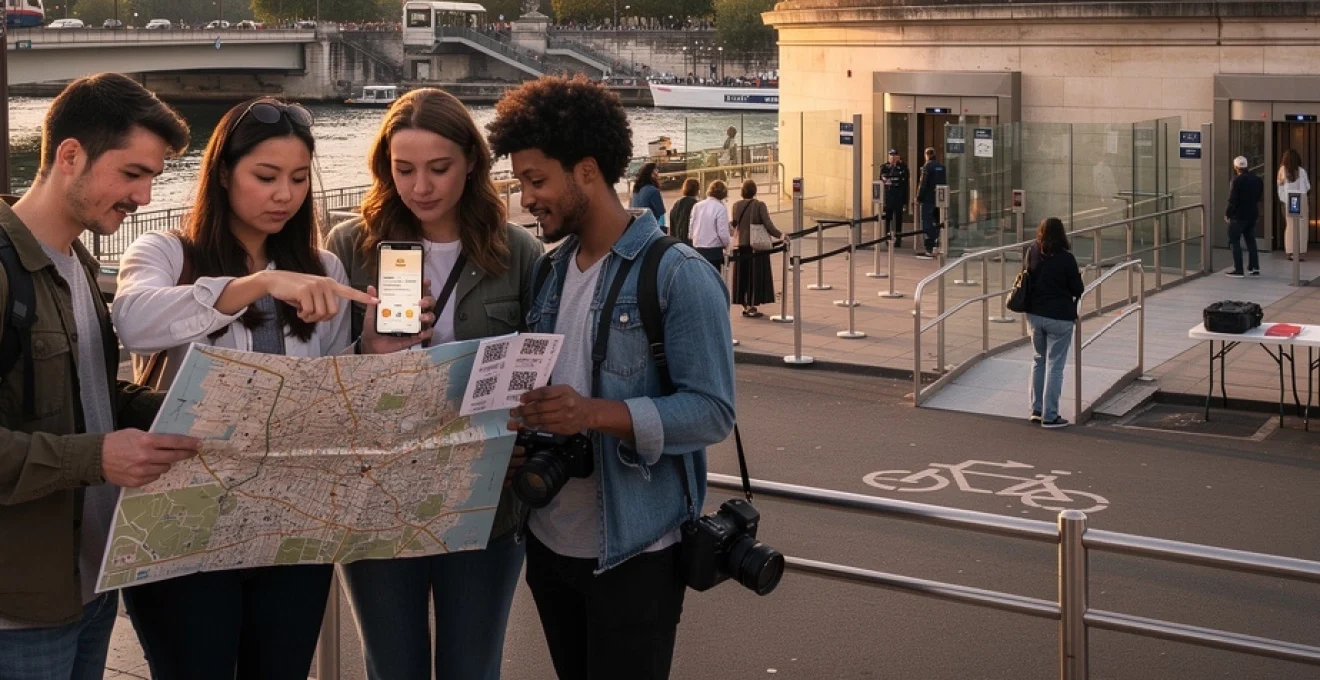
The tower’s digital infrastructure requires visitors to present either printed tickets or smartphone displays with maximum brightness settings. The official app provides additional features including augmented reality overlays and historical information, though connectivity issues frequently occur due to network congestion around the site.
Digital ticket validation occurs at multiple checkpoints, requiring QR code scanning at entrance security, pillar access points, and lift queues. Visitors should ensure battery life exceeds 50% capacity and consider portable charging options, as the complete visit duration often extends 3-4 hours including queuing time.
Architectural access points and visitor flow navigation
The Eiffel Tower’s structural design creates natural bottlenecks that significantly impact visitor experience. Understanding these architectural constraints and their operational implications enables more strategic planning for your ascent timing and route selection.
Pillar entry distribution and queue management
Each of the four pillars (North, South, East and West) fulfils a specific operational role that directly affects how you will queue and move through the monument. The South pillar is reserved for stair access, while the North, East and West pillars handle elevator traffic, with separate lines for visitors holding e-tickets and those buying on site. On the esplanade, colour-coded signage and floor markings (typically green for visitors with tickets, blue for stairs, and other colours for on-site purchases) help distribute crowds, but confusion is common when visitors arrive late for their time slot or join the wrong queue.
Queue management is dynamic and adjusts to real-time crowd levels. During busy periods, staff may redirect visitors between pillars to balance waiting times, especially when one elevator bank is experiencing technical delays. To navigate this efficiently, you should first identify your access type (stairs vs lift, second floor vs summit), locate the corresponding pillar, and then follow the “Visitors with tickets” signs rather than simply joining the nearest line. Think of the esplanade like a small train station: knowing which “platform” (pillar) your “train” (ticket type) departs from will save you a significant amount of time.
Elevator capacity limitations and alternative stairway routes
The Eiffel Tower’s elevators are impressive pieces of engineering, but they operate within strict capacity limits for safety and mechanical reasons. The first set of lifts, which transport visitors between the ground and the second floor, carry several dozen people per cabin and must load, travel, unload, and return in a tightly controlled cycle. When you multiply this by thousands of visitors per hour, even a small delay quickly cascades into longer queues, particularly for summit-bound guests who must transfer to a second, smaller set of elevators from the second floor.
Because of these constraints, the stairways play a critical role as pressure valves in the overall visitor flow. The 674 steps between the ground and second floor (with a break at the first floor) offer a faster and often more predictable route than waiting for the lift, especially in high season or at midday when elevator lines can easily exceed 60–90 minutes. If you are reasonably fit and comfortable with heights, stair access to the second floor is not only cheaper, but can also be 30–45 minutes quicker, allowing you to experience the structure’s ironwork up close as you climb.
However, it is important to understand that there is no public stair access between the second floor and the summit. All summit visits require taking a dedicated elevator, which is subject to even tighter capacity restrictions and occasional weather-related closures. In practice, this means that even if you choose to climb up by stairs, you may still encounter a queue on the second floor while waiting for the summit elevator. A practical strategy is to ascend via the stairs, head straight to the summit lift queue on arrival at the second level, and then explore the second and first floors more leisurely on the way back down.
Security checkpoint protocols and bulletproof glass perimeter
In response to evolving security requirements across France, the Eiffel Tower is enclosed by a bulletproof glass perimeter and controlled access points. Every visitor, regardless of ticket type or booking status, must pass through two separate security screenings: the first at the perimeter entrance to the gardens and esplanade, and the second immediately before entering a pillar to take the stairs or elevator. These checks are similar to airport-style controls, including bag scans and walk-through detectors, and are strictly enforced.
The glass barrier, while designed primarily for safety, also alters how you enter and move around the base of the monument. There are now two main entrances (South and East) where you will join dedicated lines for “Visitors with tickets” and “Visitors without tickets.” During busy times, the initial security check can add 15–20 minutes to your schedule, even before you reach the pillar queues. To avoid delays and potential refusals, you should arrive with minimal luggage, respect the posted maximum bag dimensions, and leave prohibited items—such as pocket knives, tools, scooters or non-folding strollers—at your accommodation or a secure luggage storage facility elsewhere in the city.
Because security staff cannot store restricted items, any object deemed dangerous or non-compliant will force you to either discard it or abandon your visit. This is particularly relevant if you are heading to the Eiffel Tower directly before or after catching a train or flight and are tempted to bring large suitcases. The absence of lockers on site means it is far better to plan ahead and use station or third-party luggage storage services. Think of these checkpoints as a fixed “time tax” on your visit: by budgeting extra time and streamlining what you carry, you transform a potential bottleneck into a smooth, predictable step.
Accessibility infrastructure for mobility-impaired visitors
For visitors with reduced mobility, the Eiffel Tower offers a range of accessibility measures, though there are still some structural limitations due to the age and design of the monument. Elevators provide step-free access to the esplanade and up to the second floor, which is generally considered the highest practical level for wheelchair users and visitors with certain mobility conditions. Access to the summit may be restricted for safety reasons, particularly in case of evacuation procedures or high wind conditions that affect lift operations.
Upon arrival on the esplanade, visitors with disabilities are encouraged to make themselves known to reception teams, who can provide guidance on the most suitable routes, dedicated waiting areas, and priority assistance where available. Accessible restrooms, adapted signage, and staff trained to support a wide range of needs all contribute to a more inclusive experience. That said, the tower’s crowds, narrow circulation points and occasional lift disruptions mean that even with these systems in place, visiting at off-peak times (early morning or later evening) remains advisable for those seeking a calmer environment.
If you are travelling with a mobility aid or using medical devices, it is wise to carry official documentation explaining your equipment to facilitate security screening. Reduced-rate tickets are available for disabled visitors and, in some cases, their companions, but documentary proof may be requested during both ticket checks and random inspections. Ultimately, while the Eiffel Tower cannot match the accessibility of a purpose-built modern museum, proactive planning and communication with staff can significantly enhance comfort and reduce stress for mobility-impaired visitors.
Optimal viewing levels and photography positioning strategy
Choosing the right level for your visit is not just a question of budget; it is central to how you will experience and photograph Paris from the Eiffel Tower. Each platform—the first floor at 57 metres, the second floor at 115 metres, and the summit at 276 metres—offers a distinct balance between sweeping panoramas and recognisable urban detail. For most travellers focused on photography, the second floor usually represents the “sweet spot,” combining broad city views with enough proximity to identify major landmarks like the Louvre, Notre-Dame, and the Arc de Triomphe.
The summit, while enticing for its status and height, can actually be less satisfying for capturing the city in detail. From this elevation, Paris becomes more of an abstract pattern of rooftops and avenues, with individual monuments appearing smaller and more distant. If your priority is creating compelling images of Paris rather than simply saying you have been to the top, consider allocating your time primarily to the second and first floors. The first floor’s glass floor panels and oblique architecture also provide creative framing opportunities, particularly for those seeking unique angles beyond the classic skyline shots.
Timing is another crucial component of a successful photography strategy at the Eiffel Tower. Visiting around golden hour—roughly one hour before sunset—allows you to witness the city under warm, directional light and then gradually transition into blue hour as the city lights begin to glow. This approach effectively gives you two visual experiences in one visit. If you time your descent so that you reach the gardens or Trocadéro just before the top-of-the-hour sparkle show, you will also have the chance to capture the illuminated tower from below, completing your photographic narrative of the monument from multiple vantage points.
Seasonal weather impact and structural visibility conditions
Weather conditions play a far more significant role in Eiffel Tower visits than many first-time travellers anticipate. Because the tower is fully exposed and the summit stands almost 300 metres above ground, it experiences more extreme wind, temperature and visibility variations than street level. In high winds, heavy rain, ice, or intense heat, operations may be partially or fully suspended—most commonly affecting the summit elevators, which are the most sensitive segment of the infrastructure. When this happens, summit ticket holders are typically offered access to the second floor only, sometimes with partial refunds depending on the circumstances.
Seasonality also affects what you will see from each level. In winter, clear, crisp days can provide exceptionally sharp visibility, with distant suburbs and landmarks appearing more defined than in the hazy heat of summer. However, low cloud cover can completely obscure the summit, turning what should be a panoramic viewpoint into a grey, enclosed space with minimal visibility. Before committing to a summit visit—especially in late autumn and winter—it is wise to check live webcams or recent user photos online to assess whether the top of the tower is actually above the cloud line.
In summer, heat and humidity can produce atmospheric haze that softens the skyline, particularly during midday. While this can result in atmospheric, almost painterly photographs, it may disappoint visitors seeking razor-sharp vistas. Practically, this means that early morning and late afternoon are generally preferable in warm months, both for comfort and for clarity. In shoulder seasons such as April–May and September–October, you often enjoy the best compromise: milder temperatures, fewer storms, and more stable visibility conditions. Regardless of season, bringing an extra layer—even in summer—is sensible, as temperatures at the summit can feel several degrees cooler due to wind chill.
Transportation hub connectivity and metro line integration
Efficiently integrating the Eiffel Tower into your wider Paris itinerary depends heavily on how you use the city’s public transport network. The monument is not directly served by a metro stop beneath its base, but it is well connected via nearby stations on multiple lines and the RER C suburban rail. Understanding these options helps you minimise unnecessary walking and transfers, particularly if you are pairing your visit with other major attractions on the same day.
For many visitors, the choice comes down to a trade-off between the scenic approach and the most direct route. Some stations, like Bir-Hakeim, bring you relatively close to the Champ de Mars with a short, practical walk, ideal if you are pressed for time or travelling with children. Others, such as Trocadéro, involve a longer walk but reward you with some of the most iconic views of the tower across the Seine. By mapping your journey in advance—using the RATP system, a navigation app, or your hotel’s advice—you can select the station that best aligns with the rest of your day’s itinerary.
Bir-hakeim station and line 6 direct access routes
Bir-Hakeim on Metro Line 6 is one of the most straightforward entry points for visiting the Eiffel Tower. The line itself runs above ground along part of its route, offering fleeting but memorable glimpses of the tower as you approach. From Bir-Hakeim, the walk to the tower typically takes around 10–12 minutes at a moderate pace, leading you through the 15th arrondissement and across to the Champ de Mars. This route is relatively flat and stroller-friendly, making it a practical choice for families or visitors with limited mobility who still prefer to avoid taxis.
Line 6 also connects conveniently with several other key metro lines, including Line 1 (at Charles de Gaulle–Étoile and Nation) and Line 4 (at Denfert-Rochereau), allowing you to link a visit to the Eiffel Tower with central attractions such as the Louvre or Île de la Cité. If you are staying near major hubs like Gare de Lyon, Montparnasse, or Nation, a single transfer onto Line 6 will usually bring you within easy walking distance of the monument. When you factor in transfer times and walking distances, Bir-Hakeim often represents the best “time-to-view” ratio for integrating the Eiffel Tower into a broader sightseeing day.
Trocadéro metro stop and cross-seine pedestrian approach
If your priority is a dramatic first sight of the Eiffel Tower rather than the shortest route, Trocadéro on Line 9 (and Line 6) is hard to beat. Emerging from the station, you quickly reach the esplanade of the Palais de Chaillot, which frames the tower across the Seine with one of the most famous vistas in Paris. This elevated viewpoint is ideal for photography, especially at sunrise or during the evening light show, and many guided tours and professional photographers use it as their preferred backdrop.
From Trocadéro, the walk to the tower takes around 15–20 minutes, depending on how often you pause for photos. You will cross the Pont d’Iéna, which funnels you directly towards the bulletproof glass perimeter and the main security entrances. Because this route is so popular, it can feel crowded during peak hours, but the visual payoff is substantial. For visitors staying on the Right Bank or in neighbourhoods connected by Line 9—such as the Marais or Opéra district—Trocadéro also offers a logical interchange between sightseeing and travel convenience.
RER C champ de Mars–Tour eiffel station proximity
For those arriving from further afield—such as Versailles, certain Left Bank districts, or locations along the Seine corridor—the RER C line provides a direct rail connection to the Eiffel Tower via Champ de Mars–Tour Eiffel station. This stop is only about a 5-minute walk from the monument, making it one of the closest transit options in terms of pure distance. If you are combining a morning at Versailles with an afternoon or evening at the tower, this line is particularly useful, as it allows you to transition smoothly between the two without navigating multiple metro changes.
However, the RER C can be affected by engineering works or timetable variations, especially on weekends and public holidays, so it is important to check live updates before you travel. Within central Paris, the line intersects with several major hubs, offering onward connections to other metro lines. When planning your itinerary, think of RER C as a backbone running along the river: if your accommodation or previous activity is close to one of its stations, it can significantly streamline your journey to the Eiffel Tower.
Surrounding attraction clustering and time allocation framework
Because a full Eiffel Tower experience—including security checks, ascent, exploration of multiple levels, and descent—can easily occupy three to four hours, integrating it into a broader Paris itinerary requires deliberate clustering with nearby attractions. The immediate surroundings of the tower offer a range of complementary experiences, from river cruises and museums to iconic viewpoints and neighbourhood walks. Planning your day in geographic “zones” rather than bouncing across the city helps you reduce transit time and maximise the value of your pre-booked tickets.
On the Left Bank, the Champ de Mars, Musée du Quai Branly–Jacques Chirac, and the Invalides complex (including Napoleon’s tomb and the Army Museum) can all be combined with a morning or afternoon at the Eiffel Tower. On the Right Bank, Trocadéro’s terraces and gardens, as well as cruises departing from nearby river piers, make natural pairings, especially if you time a Seine boat tour to coincide with late afternoon or early evening light. A practical framework is to assign half a day to the tower and its immediate environment, and the remaining half either to another district (such as Saint-Germain or the Marais) or to a major indoor attraction.
In terms of strict time budgeting, you might allocate 60–90 minutes for security and ascent, 45–60 minutes for the second floor and summit (if applicable), and another 30–45 minutes for the first floor and gardens, not including transit to and from the site. If you add a one-hour Seine cruise or an extended photo session at Trocadéro, your total Eiffel Tower “cluster” naturally expands to a half-day block. By consciously grouping these experiences and avoiding overly ambitious cross-city hops on the same day, you will reduce fatigue, limit exposure to transport delays, and transform your Eiffel Tower visit from a rushed checklist item into a well-paced highlight of your Paris itinerary.