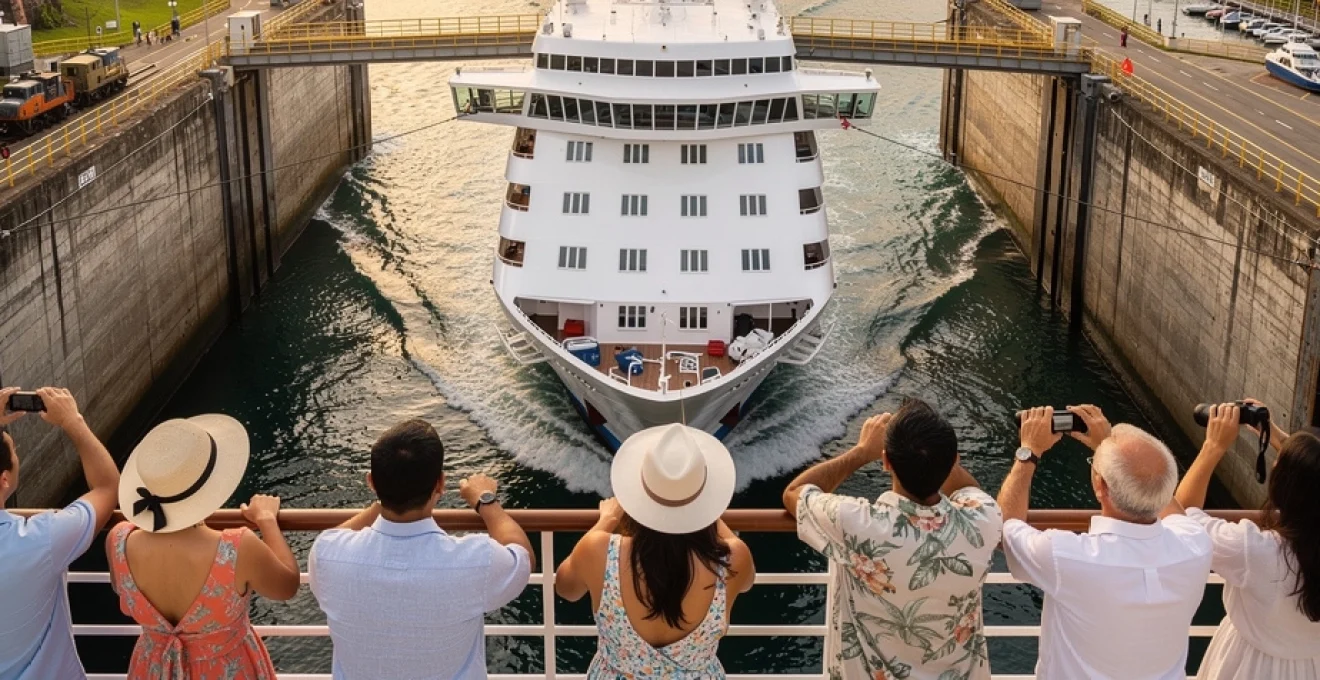
Few maritime experiences rival the engineering spectacle and natural beauty of a Panama Canal transit. This 82-kilometre waterway, connecting the Atlantic and Pacific Oceans through the heart of Central America, represents one of humanity’s most ambitious infrastructure achievements. Whether you’re fascinated by the intricate lock systems that lift massive vessels 26 metres above sea level or drawn to the lush rainforest ecosystems flanking the channel, a Panama Canal cruise delivers an unforgettable blend of mechanical precision and tropical splendour. From the moment your vessel approaches the first set of locks, you’ll witness a carefully choreographed ballet of water, steel, and human expertise that has been refined over more than a century of operation.
The experience transcends simple sightseeing—you become an active participant in a global trade route that handles approximately 11,000 vessel transits annually. As your ship glides through narrow chambers with mere inches of clearance on either side, you’ll gain profound appreciation for the thousands of workers who carved this passage through mountains and jungle between 1904 and 1914. The journey offers multiple perspectives: engineering marvel, historical monument, ecological treasure, and strategic shipping corridor all rolled into one eight to ten-hour passage that will fundamentally change how you view large-scale infrastructure projects.
Navigating the two ocean crossing routes: full transit vs partial transit itineraries
Understanding the fundamental differences between complete and partial Panama Canal crossings helps you select the voyage that best matches your interests and schedule. These options cater to different passenger priorities, from comprehensive ocean-to-ocean experiences to shorter introductions to the canal’s operations.
Complete panama canal transit from colón to balboa
A full transit represents the classic Panama Canal experience, taking you from the Caribbean port of Colón on the Atlantic side to Balboa near Panama City on the Pacific coast—or vice versa. This complete journey encompasses all three sets of locks on each side of the waterway, along with the entire crossing of Gatun Lake, the artificial reservoir that forms the canal’s elevated midsection. You’ll experience the entire 85-foot elevation change as your vessel is lifted from sea level to the lake’s height, then lowered again on the opposite side.
Full transit cruises typically form part of longer repositioning voyages or comprehensive Central America itineraries lasting 10 to 17 days. These cruises often include port calls in multiple countries, allowing you to explore colonial cities like Cartagena, rainforest reserves in Costa Rica, and Mayan archaeological sites along the way. The complete crossing takes approximately eight to ten hours from first lock entry to final lock exit, though the entire day becomes an event as passengers position themselves for optimal viewing throughout the passage.
Partial transit experiences with lake gatún turnarounds
Partial transits offer a condensed Panama Canal experience, typically entering from one ocean, navigating through one or two sets of locks, venturing into Gatun Lake, then reversing course to exit through the same locks. These abbreviated passages still provide the essential canal experience—watching lock operations, sailing through the Gaillard Cut’s dramatic rock walls, and observing tropical wildlife along the lake shores—but in a shorter timeframe that fits within week-long Caribbean or Panama-focused itineraries.
These partial voyages generally last six to seven hours and prove particularly popular with passengers on shorter holiday schedules or those combining the canal visit with beach destinations. Despite the abbreviated route, you’ll still witness the lock mechanisms in action, observe the locomotive “mules” that guide ships through the chambers, and cruise portions of the world’s largest artificial lake. The experience differs mainly in that you return through the same passage rather than emerging on the opposite ocean.
Duration differences between 7-day and 14-day canal cruise options
Week-long Panama Canal itineraries typically focus on either partial transits combined with Caribbean ports or concentrated exploration of Panama and neighbouring Costa Rica. These cruises offer manageable holiday durations for working professionals whilst still delivering the canal’s highlights. You might embark in Florida, transit the canal partially, explore Panama’s rainforest and indigenous cultures, then return to your departure port.
Extended 14 to 17-day voyages accommodate full transits with substantial port time on both Atlantic and Pacific coasts. These comprehensive journeys might begin in
one U.S. homeport such as Fort Lauderdale or Los Angeles and finish in a gateway city like San Diego, Vancouver, or even on the opposite coast. With the extra sea days, longer itineraries tend to feel more relaxed, giving you time to attend enrichment lectures about canal history, enjoy the ship’s amenities, and recover from early mornings on deck during transit day. If you prefer a deeper immersion in Central America and the canal itself rather than a quick overview, the added days of a 14-day canal cruise can be well worth the investment.
Repositioning cruises: atlantic to pacific seasonal migration patterns
Many full-transit Panama Canal cruises are actually seasonal repositioning sailings, moving ships between their Caribbean and Alaska or West Coast schedules. In spring, vessels often travel from Florida or the Caribbean through the canal to reach summer homeports like Seattle or Vancouver. In autumn, the pattern reverses, with ships leaving Alaska or the Pacific coast to return to winter Caribbean itineraries. These repositioning cruises usually offer excellent value, as cruise lines price them competitively to encourage guests to join these one-way journeys.
Because repositioning itineraries typically span 14 to 21 days, they include more sea days and a broader range of ports along both coasts of Central and sometimes South America. You might combine your Panama Canal transit with calls in ports such as Puerto Quetzal in Guatemala, Puntarenas in Costa Rica, and Cartagena in Colombia. If you enjoy long, unhurried days at sea, in-depth onboard programming, and the sense of undertaking a true voyage between oceans, these Atlantic to Pacific crossings offer one of the most rewarding ways to experience the Panama Canal cruise route.
Engineering marvels along the waterway: lock systems and operational mechanics
Even if you arrive primarily for the scenery, you quickly realise a Panama Canal transit is also a live masterclass in large-scale engineering. The canal’s lock complexes function like giant water elevators, raising and lowering ships smoothly and precisely without pumps, relying instead on gravity-fed freshwater from Lake Gatún. Watching a 100,000-tonne cruise ship glide into a concrete chamber with only centimetres to spare on each side feels almost like watching a key slide perfectly into a lock. Understanding how each component works enhances your appreciation of the experience as you cruise through the Panama Canal.
Gatún locks three-step elevation process to lake gatún
On the Atlantic side, the original Gatún Locks lift ships from sea level up to Lake Gatún in three distinct stages. Your vessel moves into the first chamber, the gates close behind you, and gravity-fed water from the lake flows in through hidden culverts in the walls and floor. As the water level rises, your ship is gently lifted, often so smoothly that you barely feel movement underfoot until you compare the concrete walls or the surrounding hills as reference points. This process repeats in the second and third chambers, ultimately raising your ship about 26 metres to the level of the lake.
From the deck, you can clearly see the difference in water height between chambers as the massive steel gates open and close. Each chamber at Gatún holds millions of gallons of freshwater, and the entire three-step elevation process typically takes around 90 minutes depending on traffic and operational conditions. If you stand on a forward observation deck, you’ll have a front-row view of the gates swinging shut, water boiling up around the hull, and the chamber walls slowly “shrinking” as your cruise ship climbs toward Lake Gatún. For many travellers, this first set of locks delivers the most dramatic visual impression of how the Panama Canal functions.
Pedro miguel and miraflores locks descent sequence
On the Pacific side, the descent sequence unfolds through the Pedro Miguel and Miraflores Locks, reversing the elevation you gained on the Atlantic approach. At Pedro Miguel, a single chamber lowers ships about 9.5 metres from the level of the Gaillard Cut toward the Pacific tide zone. After a short stretch of navigation through Miraflores Lake, your vessel enters the twin-chamber Miraflores Locks for the final drop back to sea level. Because the Pacific experiences a wider tidal range than the Caribbean, the total descent at Miraflores can vary but is typically around 16.5 metres.
From an observer’s perspective, descending through these locks can feel even more dramatic than the ascent. As the water drains away through the culverts, the ship gradually sinks within the concrete canyon, and the tops of the lock walls and the Miraflores Visitor Centre balconies appear higher and higher above you. If you position yourself at the stern, you can watch the upper gates close behind your ship and then open again at the lower level, signalling your return to the open Pacific. For those who enjoy photography, the Miraflores descent offers excellent opportunities to capture both the mechanical action of the gates and the surrounding urban skyline of Panama City in the distance.
Neopanamax expansion locks: agua clara and cocolí dimensions
In 2016, the Panama Canal Authority opened a third lane of larger locks—Agua Clara on the Atlantic side and Cocolí on the Pacific—to accommodate the new generation of Neopanamax vessels. These expansion locks are wider and longer than the original ones, measuring about 427 metres in length and 55 metres in width. While most mainstream cruise ships still use the historic locks, some newer vessels now transit via the expansion route, giving passengers a different perspective on modern canal operations. If your itinerary specifies a Neopanamax-capable ship, you may find yourself gliding through these immense chambers alongside some of the world’s largest container ships.
The Agua Clara and Cocolí locks also incorporate water-saving basins and rolling gates rather than the original swinging gate design. From deck level, the expansion complexes feel more industrial and streamlined, with wider approaches and tugboats performing most of the positioning duties instead of the traditional mules. Yet the core principle remains the same: gravity-fed freshwater moves colossal ships up and down with surprising grace and efficiency. Experiencing both the original and expansion locks on different cruises can feel a bit like comparing a beautifully preserved vintage machine to its modern, high-capacity successor.
Observing locomotive mules and towing operations from deck
One of the most distinctive features of a Panama Canal cruise is the chance to watch the electric locomotives, known as “mules,” at work. On the original locks, these powerful machines run along tracks on the lock walls, attached to your ship by taut steel cables. Their role is not to pull the ship through but to stabilise and centre it, preventing contact with the concrete sides when clearance may be as little as 30 centimetres. From lower outside decks, you can see crew members ashore catching heaving lines, securing cables, and communicating by hand signals and radio with the bridge and locomotive operators.
At the bow and stern, the choreography between ship and shore teams becomes especially apparent when entering or exiting a chamber. Tugboats may assist on particularly windy days or with heavily laden cargo vessels, nudging them delicately into position much like a pilot guiding a plane into a tight gate at the airport. Watching these operations from above, you gain a sense of how much precise coordination and human skill underpins every transit. For those curious about details, many ships provide live commentary explaining each step of the mule and tug operations as you move through the locks.
Water conservation basin system and artificial lake gatún
A Panama Canal transit also prompts a natural question: where does all the water come from? The answer lies in Lake Gatún, the vast artificial reservoir that forms the central stretch of the canal and supplies the freshwater needed to operate the locks. Rainfall in Panama’s interior feeds the Chagres River and other tributaries, which in turn replenish the lake. Each full transit of the original locks traditionally used tens of millions of gallons of freshwater, which then flowed out to sea. To reduce this environmental footprint and support growing traffic, the expansion locks at Agua Clara and Cocolí incorporate water-saving basins that recycle a significant portion of each chamber’s water.
As you cruise across Lake Gatún, it might be hard to imagine that the tranquil, island-dotted landscape beneath your ship once comprised hills, valleys, and villages before being flooded in the early 20th century. Today, the lake sits about 26 metres above sea level and doubles as a critical source of drinking water for Panama’s population. For passengers, Lake Gatún is not just an engineering component but also a scenic highlight, with tropical forest lining the shore and opportunities to spot monkeys, birds, and even crocodiles from your balcony or outer decks. Understanding the lake’s dual role—as both reservoir and navigation channel—adds depth to what might otherwise seem like a simple mid-journey crossing.
Port calls and shore excursions: cartagena, costa rica, and gateway cities
While the day in the locks often steals the spotlight, most Panama Canal cruises also feature compelling port calls before and after your transit. These stops allow you to experience colonial architecture, vibrant Latin American culture, and lush rainforest ecosystems that frame the canal corridor. Choosing the right shore excursions can transform your voyage from a simple canal crossing into a broader exploration of the region’s history and biodiversity. As you review itineraries, pay attention to how many hours you’ll have ashore in each port and what types of tours are available that match your interests and activity level.
Pre-transit exploration of colón 2000 cruise terminal and portobelo
On the Atlantic side, many full-transit cruises embark or call at Colón, utilising the Colón 2000 cruise terminal complex. The terminal itself offers modern facilities, duty-free shopping, and a secure base for excursions into the surrounding province. While Colón city has limited tourist appeal, it serves as a gateway to more rewarding sites nearby. One popular option is a visit to Portobelo, a historic Caribbean town about an hour’s drive away, which once served as a key Spanish treasure port. Here you can explore colonial-era forts, crumbling stone batteries, and a pretty bay that hints at the region’s former strategic importance.
Cruise lines also offer excursions to the Agua Clara Visitor Center overlooking the expansion locks, where you can observe Neopanamax ships transiting from a different vantage point. Some tours combine this with a ride on the historic Panama Canal Railway, which parallels the waterway between Colón and the Pacific side. If your schedule allows, arriving in Colón a day early and staying overnight in Panama City gives you more flexibility to see both sides of the isthmus before boarding your ship. This can be especially useful if you’re keen to photograph the canal from land as well as during your transit.
Cartagena de indias colonial walled city and san felipe de barajas fortress
For many travellers, Cartagena de Indias in Colombia is a standout highlight of a Panama Canal cruise itinerary. The city’s UNESCO-listed walled old town blends colourful colonial facades, leafy plazas, and ornate churches within thick stone ramparts that once defended Spanish treasure fleets. Shore excursions typically include guided walking tours through the historic centre, where you can wander narrow streets lined with bougainvillea-draped balconies and sample local snacks or Colombian coffee. The ambient heat and humidity can be intense, so lightweight clothing, a hat, and plenty of water are essential for enjoying your time ashore.
Most tours also visit the imposing Castillo San Felipe de Barajas, a 17th-century fortress built to protect Cartagena from pirate raids and foreign navies. Climbing its terraced ramps rewards you with panoramic views over the city and harbour, a reminder of why this port was so fiercely contested. If you prefer a more relaxed day, some excursions focus on shopping for emeralds and handicrafts or spending time at nearby beaches. Whatever you choose, Cartagena provides a rich cultural counterpoint to the more industrial scenery around the canal itself, helping you understand the broader maritime story of this region.
Puerto limón rainforest expeditions and tortuguero national park access
On Costa Rica’s Caribbean coast, Puerto Limón frequently features as a port of call on Panama Canal itineraries. From here, a range of excursions venture into the country’s famed rainforest and canal systems. Riverboat tours along jungle-fringed waterways offer a gentle introduction to Costa Rica’s wildlife, with chances to spot sloths draped over tree branches, toucans and other tropical birds in the canopy, and perhaps monkeys or caimans along the banks. For more active travellers, zip-line adventures through the treetops or guided hikes in nearby reserves provide a closer look at the region’s biodiversity.
Some longer tours depart Limón early in the morning to reach the fringes of Tortuguero National Park, a maze of canals and lagoons often dubbed the “Amazon of Costa Rica.” While full multi-day visits to Tortuguero usually require land-based stays, cruise excursions can still give you a taste of this watery wilderness. Because rain showers are common even in the drier months, packing a lightweight rain jacket and waterproof bag for your camera or phone is wise. If you’re interested in conservation, look for excursions that highlight local community efforts to protect sea turtles and other species, adding a meaningful dimension to your Costa Rica port day.
Post-canal fuerte amador marina complex in panama city
On the Pacific side, many cruise itineraries use Fuerte Amador—located on the Amador Causeway just outside Panama City—as a turnaround or embarkation port. This modern marina and shopping area sits at the entrance to the canal, offering views of ships queuing to enter the locks and of the city skyline. From here, it’s a short transfer into the capital, where you can explore both the historic Casco Viejo district and the more contemporary business centre. Casco Viejo, with its restored plazas, churches, and boutique hotels, provides an atmospheric backdrop for an afternoon stroll or a leisurely meal at a rooftop restaurant overlooking the bay.
Many cruise lines offer combined city and canal tours from Fuerte Amador, visiting landmarks such as the Metropolitan Cathedral, the Presidential Palace (Palacio de las Garzas), and the BioMuseo, a museum focusing on Panama’s biodiversity. You can also join excursions to indigenous Emberá villages along nearby rivers or to Pacific beaches for a more relaxed finale to your voyage. If your schedule permits, staying an extra night or two in Panama City after disembarkation allows you to experience the city’s nightlife and culinary scene, providing a satisfying urban bookend to your time in the locks and rainforest.
Onboard experience during canal passage: viewing positions and commentary
The day your ship transits the Panama Canal is unlike any other sea day. From early morning, passengers gravitate to open decks, observation lounges, and private balconies to secure the best vantage points. Because much of the action occurs at the bow and stern as the ship enters and exits locks, you’ll want to plan your movements strategically. Many experienced travellers recommend starting at the front of the ship for the first set of locks to watch the gates open and the mules connect, then later relocating aft to observe the lock doors closing behind you and the water levels changing. Remember that you will pass through multiple lock complexes, so there are several opportunities to switch positions without feeling you’ve missed anything crucial.
On most mainstream lines, the transit is accompanied by live narration from either a canal expert brought onboard or a knowledgeable member of the ship’s staff. This commentary, usually broadcast over the outdoor speakers and on the in-cabin television channel, explains each stage of the process, offers historical context, and points out landmarks such as the Bridge of the Americas and the Centennial Bridge. If you prefer a quieter experience, you can always retreat to a side deck or your balcony, using a portable radio or the cabin TV audio to follow along while enjoying a less crowded view. Bringing binoculars can greatly enhance your ability to see wildlife on shore, workers on the lock walls, and other ships navigating nearby.
Because a Panama Canal transit can last eight to ten hours, pacing yourself throughout the day is important. The tropical sun can be intense, and standing at the rail for hours without shade quickly leads to fatigue. Lightweight clothing, sunscreen, a wide-brimmed hat, and plenty of water are essential, especially if you spend time on the forward decks where shade is limited. Many passengers adopt a rhythm of alternating between outdoor observation and short breaks in air-conditioned lounges or the buffet, which often extends its hours on transit day. You might find yourself asking: do I really want to be in one spot the whole time, or is it better to move around and experience different perspectives? For most people, a flexible approach makes the day more comfortable and memorable.
Regional climate patterns and optimal sailing seasons through the isthmus
Given the canal’s equatorial location, weather plays a significant role in shaping your experience. Panama has a tropical climate with relatively consistent temperatures—typically around 28–32°C (82–90°F) during the day—but marked wet and dry seasons. The driest months, from roughly mid-December to mid-April, align with the peak season for Panama Canal cruises. During this period, you can expect plenty of sunshine and lower rainfall, especially on the Pacific side, though humidity remains high. These conditions make it easier to spend long stretches on deck watching the locks without frequent interruptions from heavy showers.
The wet season, extending from May to November, brings more frequent downpours, particularly in the afternoons, and increased cloud cover. On the Caribbean side, short but intense showers can occur at almost any time of year, often followed by bright sunshine. While fewer cruises operate at the height of the rainy season, those that do may be less crowded and sometimes more attractively priced. It’s worth noting that rain rarely disrupts canal operations; the waterway functions year-round, and ships transit in all but the most extreme weather. However, you’ll want to pack a lightweight rain jacket or poncho and be prepared to duck inside if a sudden squall passes over while you’re on deck.
Hurricane risk is another consideration when planning when to cruise through the Panama Canal. Although Panama itself lies south of the main Caribbean hurricane belt and rarely experiences direct hits, storms elsewhere in the region can affect itineraries and sea conditions, particularly on the Atlantic approach. The official Atlantic hurricane season runs from June to November, with peak activity between August and October. Many travellers therefore favour canal cruises during the shoulder and dry seasons—late autumn and winter—when the chance of major weather disruptions is lower. Ultimately, deciding on the best time to cruise the Panama Canal comes down to your tolerance for heat and humidity, your flexibility regarding rain, and your preference for either peak-season buzz or quieter shoulder-season sailings.
Cruise line options: holland america, princess cruises, and specialty expedition vessels
Several major cruise lines and smaller operators offer Panama Canal itineraries, each with its own style and strengths. Holland America Line and Princess Cruises are widely regarded as pioneers in the region, with decades of experience operating both full and partial transits. Their ships are often designed with ample outdoor deck space and forward viewing areas, which is particularly valuable on canal day. Onboard, you can expect detailed commentary, enrichment lectures, and sometimes guest historians or canal pilots sharing insights. These lines typically offer a broad range of itineraries, from seven-night partial transits to extended repositioning voyages linking the Caribbean, West Coast, and Alaska seasons.
Holland America, in particular, is known for its in-depth Panama Canal programming and mid-sized ships that fit comfortably within the original locks, giving guests an especially close view of the walls and mules. Princess Cruises, by contrast, operates both Panamax and larger vessels, including some that may use the expansion locks. If you have a strong preference for transiting the historic chambers, it’s worth checking which specific ship and route you’re booking. Both lines tend to attract travellers who value a balance of classic cruise experiences—such as traditional dining and live entertainment—with educational content focused on the canal’s history, engineering, and ecology.
Beyond the mainstream operators, a number of smaller and expedition-style vessels also cruise through the Panama Canal. Lines specialising in adventure travel and small-ship cruising may offer itineraries that combine a full or partial transit with extended time in remote national parks, indigenous territories, or lesser-visited islands along both coasts. On these ships, passenger numbers are lower, and the onboard atmosphere is often more informal and lecture-driven, appealing to travellers who prioritise learning and wildlife viewing over large-scale entertainment. Because smaller vessels can access narrower inlets and more secluded anchorages, you may find yourself exploring parts of Costa Rica or Panama that bigger ships simply cannot reach.
When comparing cruise lines for a Panama Canal voyage, consider factors such as ship size, the balance of sea days and port calls, onboard enrichment offerings, and the style of service that best suits you. Do you want the broader amenities of a large resort-style ship, or would you rather trade multiple dining venues and production shows for intimate nature briefings and Zodiac excursions? The good news is that, regardless of which operator you choose, the canal transit itself remains the star of the show. With thoughtful planning, you can select a Panama Canal cruise that not only delivers the iconic lock experience but also matches your preferred way of travelling between two great oceans.