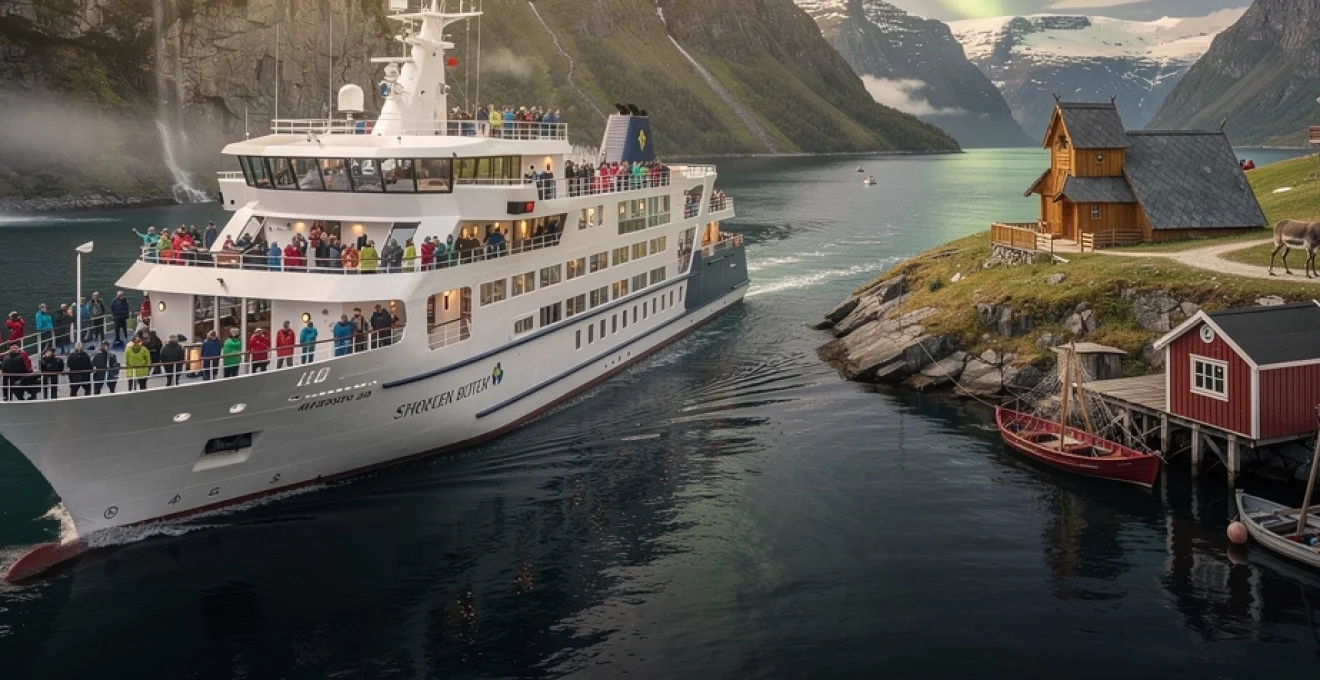
The Norwegian fjords represent one of Earth’s most extraordinary natural phenomena, where towering granite cliffs plunge dramatically into sapphire-blue waters that mirror ancient glacial valleys. These magnificent waterways, carved over millions of years by massive ice sheets, create an unparalleled cruising experience that transcends conventional ocean voyaging. Unlike tropical Caribbean routes or Mediterranean coastal journeys, Norwegian fjord cruising offers passengers intimate encounters with pristine wilderness, where silence is broken only by cascading waterfalls and the distant calls of Arctic wildlife.
What distinguishes fjord cruising from other maritime experiences is the profound sense of scale and geological drama that unfolds at every turn. Passengers find themselves navigating through narrow channels where vertical rock faces rise over 1,000 metres directly from the waterline, creating natural amphitheatres of breathtaking proportions. This unique landscape, combined with extreme seasonal variations in daylight and weather patterns, establishes Norwegian fjord routes as genuinely transformative travel experiences that engage all the senses whilst providing deep connections to both natural history and indigenous cultural heritage.
Geological formations and glacial morphology of norwegian fjordlands
The Norwegian fjords represent approximately 2.5 million years of relentless glacial carving, where massive ice sheets gouged deep U-shaped valleys that subsequently filled with seawater as ice ages retreated. This geological process created some of the world’s most dramatic coastal topography, with fjords extending up to 200 kilometres inland whilst maintaining depths that frequently exceed 1,000 metres. The distinctive characteristics of each fjord system reflect variations in bedrock composition, glacial flow patterns, and post-glacial geological activity that continues to shape these landscapes today.
Modern cruise passengers witness geological storytelling on an epic scale, where each fjord reveals distinct chapters in Earth’s climatological history. The steep-sided valleys demonstrate the immense erosional power of glacial ice, whilst hanging valleys and tributary fjords illustrate complex patterns of ice flow and retreat. Sedimentary layers visible in exposed cliff faces provide tangible evidence of ancient marine environments, tectonic uplift, and volcanic activity spanning hundreds of millions of years.
Geirangerfjord’s UNESCO-Protected vertical rock faces and cascading waterfalls
Geirangerfjord stands as perhaps the most visually spectacular fjord system in Norway, featuring vertical granite walls that rise directly from the water to heights exceeding 1,500 metres. The famous Seven Sisters waterfall complex demonstrates the dramatic topography created by glacial over-deepening, where tributary valleys hang suspended above the main fjord floor. These waterfalls, including Friaren (The Suitor) and De Syv Søstrene (The Seven Sisters), plunge directly into the fjord from heights reaching 250 metres, creating ethereal mist clouds that often shroud the upper cliff faces.
The geological significance of Geirangerfjord extends beyond its visual impact, as the exposed rock faces reveal Precambrian gneiss formations dating back over one billion years. Cruise passengers can observe distinct metamorphic banding patterns in the cliff walls, representing ancient mountain-building episodes that predate complex life on Earth. The fjord’s designation as a UNESCO World Heritage site recognises both its outstanding geological value and its pristine state of preservation, where human intervention remains minimal despite centuries of settlement.
Nærøyfjord’s narrow glacial valley configuration and towering mountain walls
Nærøyfjord represents Europe’s narrowest fjord passage, with sections measuring just 250 metres between opposing cliff faces that rise over 1,700 metres above sea level. This extreme constriction creates a cathedral-like atmosphere where sound reverberates dramatically off the granite walls, amplifying every waterfall cascade and bird call. The narrow configuration results from intensive glacial scouring combined with resistant bedrock that channelled ice flow into increasingly confined pathways.
The fjord’s geological character showcases classic examples of glacial erosion features, including polished rock surfaces, striations indicating ice flow direction, and massive rock buttresses shaped by freeze-thaw cycles. Passengers frequently observe rockfall evidence and active erosion processes, where frost weathering continues to modify cliff faces
that tower above the navigation channel. For cruise guests, this makes Nærøyfjord feel almost like sailing through the nave of a stone cathedral, the ship dwarfed on all sides by soaring rock. Because the waterway is so confined, the play of light and shadow is especially striking; in early morning and late afternoon, entire cliff faces glow gold while the water remains ink-dark beneath. This is one of the reasons why even seasoned travellers describe Norwegian fjord cruising here as more immersive and three-dimensional than conventional open-sea voyages.
Sognefjord’s record-breaking depth measurements and submerged glacial valleys
Sognefjord, often called the “King of the Fjords”, is Norway’s longest and deepest fjord, stretching approximately 205 kilometres inland from the North Sea. At its deepest point, near Vadheimsfjorden, bathymetric surveys record depths of around 1,308 metres, meaning that much of the fjord floor lies far below sea level and even beneath surrounding ocean depths. This over-deepening is a textbook example of glacial excavation, where thick, slow-moving ice masses carved troughs far deeper than adjacent continental shelves.
What you see from the deck is only part of the story: beneath the surface, submerged lateral valleys, old river channels and morainic ridges form a complex underwater landscape. Modern cruise ship navigation systems constantly reference high-resolution seabed mapping to chart safe passages along these steep submarine walls, where depth can change by hundreds of metres over short horizontal distances. When you glide through Sognefjord’s mirror-still waters, you are effectively sailing above a drowned mountain range, a perspective that makes this Norwegian fjord cruise route feel more like exploring a flooded canyon than a typical coastal voyage.
Hardangerfjord’s unique geological stratification and precambrian rock formations
Hardangerfjord, Norway’s second-longest fjord system, reveals an intricate geological cross-section where ancient Precambrian basement rocks sit beneath younger sedimentary layers and glacial deposits. Along its 179-kilometre length, you can observe banded gneisses, folded schists and intrusive granites, all sculpted by successive glaciations into terraces, hanging valleys and towering cliff faces. This stacked geology effectively turns the fjord walls into a visible timeline, allowing you to “read” hundreds of millions of years of Earth’s history as your ship progresses inland.
The inner branches of Hardangerfjord, such as Sørfjorden, combine this rugged bedrock with fertile slopes where orchards cling to surprisingly narrow ledges. Here, the same glacial processes that carved deep basins also deposited nutrient-rich moraines, now supporting apple, pear and cherry production famed across Norway. For cruise passengers, this juxtaposition of raw rock and cultivated landscape is striking: waterfalls thunder from high plateaus while below, neat rows of fruit trees step down almost to the waterline. Few other cruise routes offer such an immediate contrast between primordial geology and human adaptation to a challenging environment.
Arctic maritime climate phenomena and seasonal navigation patterns
Norwegian fjord cruises unfold within one of the world’s most distinctive maritime climate zones, shaped by the interaction between the warm North Atlantic Current and cold Arctic air masses. This combination produces relatively mild coastal temperatures for such high latitudes, yet also generates rapid weather changes, strong local winds and dramatic seasonal contrasts in light. For travellers used to predictable sunshine on Mediterranean or Caribbean itineraries, the dynamic climate of the Norwegian coast becomes a central part of the experience rather than a mere backdrop.
Because fjords are narrow and often oriented roughly east–west or north–south, each system develops its own microclimate, with sharp differences between sun-exposed slopes and shaded cliff faces. Cruise operators plan seasonal navigation patterns around these conditions, timing departures to coincide with the midnight sun period in summer, optimal Northern Lights viewing in winter and more settled weather in the shoulder seasons of spring and autumn. Understanding how light, tide and wind behave in these confined waterways is crucial, and it’s one of the reasons why Norwegian fjord cruising feels so intrinsically linked to the rhythms of the natural world.
Midnight sun navigation through lofoten islands during summer solstice
North of the Arctic Circle, the midnight sun transforms Norwegian fjord voyages into almost continuous daylight expeditions during late May, June and early July. Around the Lofoten Islands, where sharp granite peaks shoot directly out of the sea, cruise ships often adjust schedules so that key passages and anchorages occur late at night, when the low sun paints the landscape in copper and rose-gold tones. Instead of traditional “evenings at sea,” you might find yourself on deck at 1am, watching fishing villages glow softly beneath a sun that never quite sets.
This extended daylight has practical implications too. Calm nocturnal conditions and excellent visibility allow captains to navigate narrow straits and scenic sounds when the water is at its stillest, creating glass-like reflections that double the impact of the rugged coastal scenery. For guests, it can feel as though time has been stretched, giving you more hours each day to absorb the surroundings. Compared with a typical cruise route where nights are spent over open water, midnight sun navigation through Lofoten makes a Norwegian fjords cruise feel more like a seamless, 24-hour nature documentary unfolding in real time.
Aurora borealis viewing opportunities from tromsø fjord anchorages
In winter, the same high latitudes that produce the midnight sun give you front-row seats to one of Earth’s most spectacular natural light shows: the aurora borealis. Between late September and early April, especially from November to March, fjord anchorages near Tromsø offer ideal conditions for Northern Lights viewing. Here, relatively mild coastal temperatures, accessible dark-sky locations and frequent geomagnetic activity intersect, giving cruise passengers a better chance of witnessing the aurora than in many inland locations at similar latitudes.
Unlike large city stays, being at anchor in a sheltered fjord means minimal light pollution and unobstructed horizons. When solar particles collide with Earth’s atmosphere high above, curtains of green, violet and occasionally red light can ripple across the sky, reflected in the still water below. Many expedition-style Norwegian fjord cruises now integrate flexible evening schedules, allowing the crew to switch off non-essential deck lighting and broadcast real-time aurora alerts to cabins. The result is a distinctly different kind of nightlife at sea: instead of stage shows or casinos, guests step outside wrapped in warm layers, scanning the horizon for that first ghostly shimmer.
Tidal bore effects in saltstraumen and moskstraumen maelstroms
While most fjord waters feel calm and protected, certain straits along the Norwegian coast demonstrate just how powerful tidal forces can be in confined channels. Near Bodø, Saltstraumen is often described as the world’s strongest tidal current, where up to 400 million cubic metres of water rush through a narrow strait with each tide change. When cruise itineraries or smaller excursion boats pass near this area, passengers can observe whirlpools, standing waves and turbulent eddies that resemble a horizontal waterfall.
Further out toward the Lofoten wall, the Moskstraumen maelstrom—famous in both Norse legend and European literature—forms where tidal flows, seabed topography and ocean swells converge. Modern vessels maintain a safe distance, but the visible churning of the water hints at the underlying energy of the coastal system. Experiencing these phenomena underscores a key difference between Norwegian fjord cruising and more placid tropical routes: here, you are constantly reminded of the raw physical forces that sculpted the coastline and that still define navigation choices today.
Weather pattern variations between inner fjord systems and open norwegian sea
One of the more surprising aspects of a Norwegian fjords cruise is how quickly conditions change as you move from open sea into the shelter of inner fjords. Out on the Norwegian Sea, you may encounter Atlantic swells, brisk winds and low cloud sweeping in from the west. Yet within an hour of turning inland, the water can become almost perfectly calm, with towering cliffs blocking wind and creating a microclimate where temperatures feel several degrees warmer and waterfalls hang in still, silver threads.
This contrast is particularly noticeable in spring and autumn, when frontal systems bring changeable weather to the coast. Cruise operators often time fjord entries to coincide with the passage of these systems, using the protected inner waterways as natural havens during less favourable conditions offshore. For travellers who worry about rough seas, this sheltered aspect of Norwegian fjords travel is a strong advantage: while no route can guarantee perfectly smooth sailing, fjord cruising tends to involve far fewer long stretches of open-ocean exposure than typical transits between Mediterranean or Caribbean ports.
Endemic wildlife ecosystems and marine biodiversity hotspots
The Norwegian fjords host rich and surprisingly varied ecosystems, where cold, nutrient-rich waters support everything from microscopic plankton to top predators like orca and sea eagles. Steep bathymetry and strong tidal mixing create upwelling zones that act as feeding grounds for fish, seabirds and marine mammals. For cruise passengers, this means that wildlife encounters are not limited to scheduled excursions; at almost any point along the route, you might glance up from your breakfast table to see a porpoise surfacing or a white-tailed eagle gliding along a cliff edge.
In the outer fjords and along the open coast, schools of herring and spawning cod attract pods of orca and humpback whales, particularly in northern Norway between late autumn and mid-winter. Inner fjord systems, while less frequented by the largest whales, provide habitat for harbour seals, otters and a variety of fish species adapted to low-light, deep-water environments. On land, mixed birch and pine forests harbour elk, red deer and smaller carnivores such as fox and lynx, though these are more elusive from the ship itself. To increase your chances of wildlife sightings during a Norwegian fjords cruise, bring compact binoculars, spend time on deck during early morning and late evening, and consider adding smaller-boat or kayak excursions in key biodiversity hotspots like Vesterålen or the Lofoten archipelago.
Traditional sami cultural heritage sites and coastal settlement architecture
Beyond its geological drama, a journey through the Norwegian fjords also offers an encounter with the living cultures that have adapted to these demanding environments for millennia. Among the most significant are the Sámi, the Indigenous people of the Arctic whose traditional territories span northern Norway, Sweden, Finland and Russia’s Kola Peninsula. Although many travellers associate Sámi culture exclusively with inland reindeer herding, coastal and Sea Sámi communities have long relied on a dual economy of fishing, small-scale farming and seasonal herding, closely tied to fjord and coastal ecosystems.
As your ship approaches northern ports such as Hammerfest, Honningsvåg and Alta, you enter regions where Sámi history and modern life are woven into the fabric of everyday coastal settlements. Distinctive architectural features—colourful wooden houses, boathouses on stilts, turf-roofed storage huts and occasionally traditional lavvu (tent-like structures)—reflect centuries of adaptation to harsh winters, strong winds and variable light. Compared with many Mediterranean or Caribbean cruise stops, where port areas can feel detached from older traditions, Norwegian fjord communities often preserve a tangible continuity between past and present, inviting you to look beyond the scenery and engage with the stories of the people who call these latitudes home.
Hammerfest’s indigenous reindeer herding traditions and seasonal migration routes
Hammerfest, one of the world’s northernmost towns, sits within a landscape shaped as much by reindeer as by humans. For generations, Sámi families have guided semi-domesticated reindeer along seasonal migration routes between coastal grazing grounds and inland plateaus, following patterns tuned to snow cover, plant growth and insect activity. Even if you visit outside peak migration periods, local cultural centres and guided experiences explain how these routes intersect fjord systems, mountain passes and traditional camp locations.
For cruise guests, understanding reindeer herding practices offers a new way to interpret the landscapes you sail past. Those open, seemingly empty plateaus above the fjords are in fact part of a complex living network, where each valley, river and ridge has a role in the annual cycle of movement. Visiting Hammerfest on a Norwegian fjords cruise is therefore more than a quick photo stop at the harbour; it is an opportunity to appreciate how Indigenous knowledge, seasonal rhythms and climate change are reshaping reindeer migration today. Many excursions also provide practical insights—what plants reindeer rely on, how herders navigate in winter darkness, and how modern infrastructure can both support and disrupt ancient routes.
Honningsvåg’s historic fishing village preservation and stave church architecture
Honningsvåg, gateway to the North Cape, exemplifies the resilience of northern fishing communities that have endured storms, wartime destruction and shifting fish stocks. While much of the town was rebuilt after World War II, careful preservation of older building styles and layouts gives visitors a sense of what traditional Norwegian fishing villages looked like along the fjords. Brightly painted clapboard houses, rorbuer (fishermen’s cabins) and sturdy boathouses line the water’s edge, often perched on rock ledges or stilts to cope with tides and winter storms.
In the surrounding region, small wooden churches—some inspired by the iconic stave church tradition—testify to centuries of maritime Christianity, where fishermen relied on blessings for safe passage through dangerous coastal waters. Even if your itinerary does not include one of the famous medieval stave churches, local parish churches often incorporate similar steep roofs, intricate woodwork and symbolic carvings adapted to the northern climate. Walking through Honningsvåg on a fjords cruise, you see how architecture functions not just as shelter, but as a conversation between people, weather and topography, quite unlike the resort-style construction common in many warmer cruise destinations.
Alta’s UNESCO world heritage rock art sites and ancient sami ceremonial grounds
Further east along the coast, Alta is home to one of northern Europe’s most significant concentrations of prehistoric rock carvings, inscribed on the UNESCO World Heritage List. These petroglyphs, some over 7,000 years old, depict reindeer, elk, fish, boats and human figures engaged in hunting and ritual activities. For visitors arriving on a Norwegian fjords cruise, excursions to the Alta Museum and surrounding rock art sites provide a deep-time perspective on how humans have interacted with Arctic and sub-Arctic environments since the end of the last Ice Age.
The area around Alta also contains locations associated with ancient Sámi ceremonial practices, including offering sites and sacred landscapes where natural features such as unusual rock formations or waterfalls held spiritual significance. While many of these places are not individually marked to protect their integrity, guided tours led by local experts can help you understand the cultural layers hidden within seemingly untouched terrain. Compared to the often purely recreational focus of sun-and-sand cruises, this encounter with Indigenous cosmology and early human artistry is one of the reasons why travel through Norwegian fjords feels intellectually and emotionally richer.
Cruise ship engineering adaptations for fjord navigation
Navigating narrow, deep and often winding fjords demands different ship design priorities than those used for wide, warm-water cruise corridors. Modern fjord-capable vessels typically feature reinforced hulls, powerful bow thrusters and advanced dynamic positioning systems that allow precise manoeuvring in tight spaces and during dockings at small coastal ports. Because many Norwegian fjord harbours lack extensive breakwaters, ships must also be able to respond quickly to shifting winds and currents, maintaining both safety and passenger comfort.
Environmental considerations play an especially important role here. To reduce emissions in sensitive fjord ecosystems, several cruise lines operating in Norway have adopted hybrid propulsion systems, battery banks for zero-emission segments and shore-power connectivity that allows ships to plug into renewable hydroelectric grids while alongside. The Norwegian government has announced increasingly strict regulations for emissions in UNESCO-listed fjords, accelerating the transition toward cleaner, quieter ships. For travellers, this means that a Norwegian fjords cruise can feel noticeably more peaceful than voyages on older, conventional vessels—electric operation in certain stretches reduces engine noise and vibrations, enhancing the sense of gliding silently between towering cliffs.
Comparative analysis against mediterranean and caribbean cruise corridors
When you compare a Norwegian fjords cruise with classic Mediterranean or Caribbean itineraries, the differences extend far beyond temperature and scenery. In warm-water regions, cruise routes often focus on long open-ocean transits between major ports, where the ship itself becomes the primary attraction, complete with water parks, shopping promenades and late-night entertainment. In Norway, by contrast, the landscape takes centre stage; ships tend to be smaller, days at sea are shorter and much of the on-board programming is geared toward natural history talks, cultural presentations and flexible deck time to watch the passing fjord walls.
Port experiences also diverge. Mediterranean and Caribbean stops frequently emphasise beaches, historic city centres and resort complexes, whereas fjord ports introduce you to working towns, tiny villages and outdoor excursions such as hiking, rib-boat safaris or visits to glaciers and orchards. Even the daily rhythm changes: in the tropics, you often retreat indoors during the hottest hours, while in Norway’s long summer days or extended winter nights, you may find yourself outside late into the evening, chasing golden-hour light or scanning for aurora. If you are deciding between Norwegian fjords versus Mediterranean cruise holidays, ask yourself whether you prefer predictable warmth and resort-style amenities, or a more elemental, nature-focused journey where weather, light and landscape constantly shape the experience.
From an engineering and navigational perspective, fjord cruising demands closer interaction with the environment. Captains must consider tidal windows for passing shallow sills at fjord mouths, ice conditions in shoulder seasons, and strict speed limits designed to reduce wake erosion along fragile shorelines. These constraints might sound restrictive, but they contribute to the unhurried pace that many travellers treasure—ships often slow to a crawl in particularly scenic stretches, inviting you to linger on deck rather than rush to the next spectacle. In this way, a voyage through the Norwegian fjords feels less like crossing distances on a floating resort and more like participating in a carefully choreographed dialogue between human technology and one of Earth’s most extraordinary coastal landscapes.