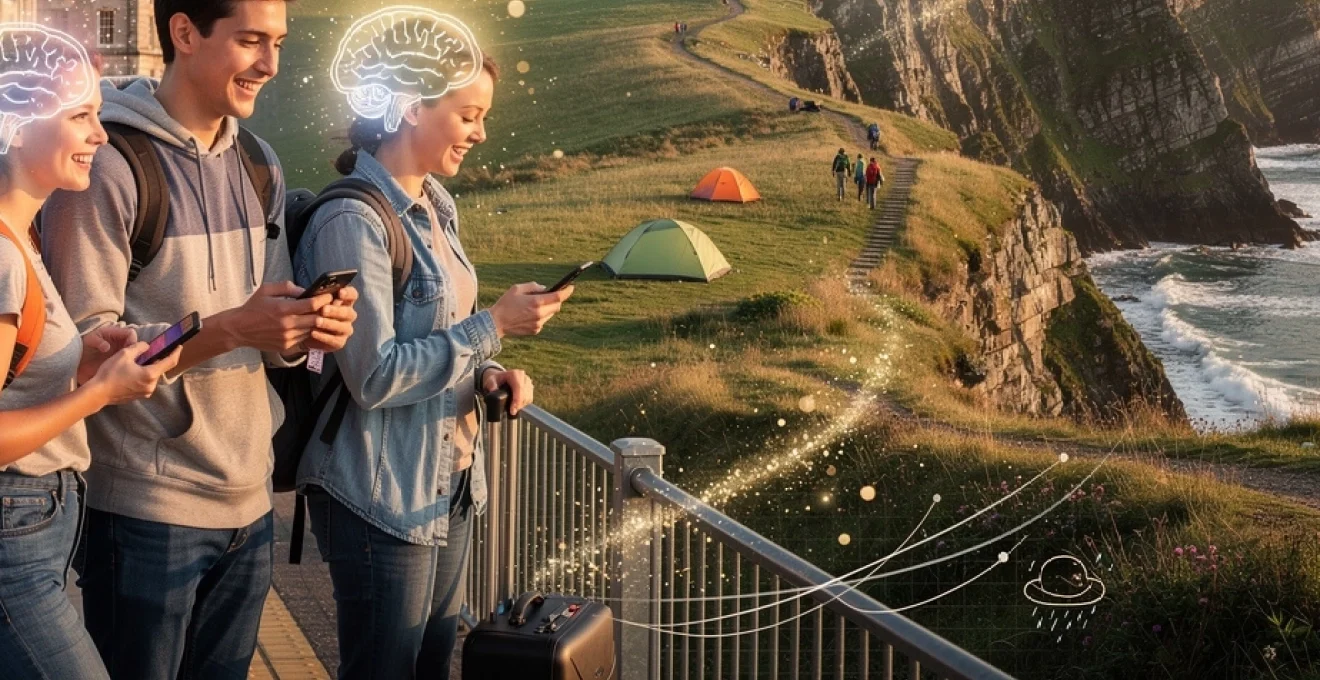
The most cherished travel memories often emerge from the least planned adventures. While meticulously organised holidays serve their purpose, spontaneous weekend escapes possess a unique psychological power that transforms ordinary breaks into extraordinary experiences. Recent neuroscience research reveals that unstructured travel experiences trigger distinct cognitive processes, creating more vivid memories and enhanced emotional satisfaction than their carefully orchestrated counterparts.
The phenomenon extends beyond simple novelty-seeking behaviour. When travellers abandon rigid itineraries and embrace uncertainty, they activate dormant cognitive mechanisms that heighten sensory perception and emotional processing. This neurological response explains why that impromptu coastal drive or unexpected mountain retreat continues to resurface in conversations years later, while expensive, thoroughly planned holidays often fade into generic recollections of standard tourist attractions.
Psychological mechanisms behind spontaneous travel Decision-Making
The decision to embark on an unplanned weekend getaway activates several fascinating psychological processes that distinguish spontaneous travel from conventional holiday planning. Understanding these mechanisms reveals why impulsive travel decisions often yield superior satisfaction rates compared to extensively researched alternatives.
Dopamine release patterns in unstructured holiday planning
Spontaneous travel triggers a complex neurochemical cascade that begins the moment you decide to break free from routine. Research conducted by behavioural neuroscientists demonstrates that uncertain rewards generate significantly higher dopamine release than predictable outcomes. When you book a last-minute train ticket without knowing exactly where you’ll stay or what you’ll discover, your brain enters a heightened state of anticipation that amplifies every subsequent experience.
This dopamine elevation persists throughout unplanned journeys because each moment presents potential surprises. Unlike structured holidays where attractions and activities are predetermined, spontaneous getaways maintain constant uncertainty, keeping dopamine levels elevated and enhancing your perception of novelty and excitement.
Cognitive load reduction through minimal Pre-Trip research
Paradoxically, doing less research often results in more satisfying travel experiences. The cognitive load theory explains that excessive pre-trip planning can overwhelm working memory capacity, leading to decision fatigue and reduced enjoyment. When you limit advance research, you preserve mental resources for real-time experience processing and emotional engagement.
This principle becomes particularly evident when comparing travellers who spend weeks researching restaurants versus those who discover local eateries organically. The latter group consistently reports higher satisfaction levels, largely because they avoid the disappointment that often accompanies inflated expectations. Minimal preparation preserves the element of surprise that transforms ordinary discoveries into memorable highlights.
Flow state achievement in Real-Time destination discovery
Unplanned travel facilitates entry into flow states—periods of complete absorption where self-consciousness disappears and time perception alters. Without predetermined schedules or must-see attractions, spontaneous travellers naturally align their activities with immediate interests and energy levels, creating optimal conditions for flow state emergence.
Consider the difference between rushing through a cathedral because it appears on your itinerary versus stumbling upon the same building and choosing to explore it purely from curiosity. The latter scenario eliminates external pressure and allows genuine engagement with the environment, significantly increasing the likelihood of achieving that transcendent state where travel transforms from mere sightseeing into profound experience.
Memory consolidation enhancement via novel experience processing
The brain processes unexpected experiences differently than anticipated ones, allocating additional neural resources to novel stimuli through a mechanism called the novelty encoding advantage. Spontaneous travel maximises this advantage by presenting continuous streams of unfiltered, unexpected experiences that receive enhanced memory consolidation treatment.
Research indicates that memories formed during unstructured experiences undergo more robust encoding processes, resulting in clearer recollection and stronger emotional associations. This explains why you might vividly remember every detail of an impromptu conversation with a stranger in a forgotten village, while struggling to recall specific museums from a carefully planned cultural tour.
Risk-reward dynamics of Last-Minute destination selection
The economics of spontaneous travel present intriguing risk-reward calculations that often favour the bold and flexible. While conventional wisdom suggests early booking secures better prices and availability, the reality of modern travel markets reveals numerous opportunities for last-minute adventurers willing
to trade certainty for flexibility. As pricing algorithms and capacity management have evolved, last-minute weekend getaways have shifted from being a budget gamble to a calculated opportunity—especially if you understand how the underlying systems work.
Dynamic pricing algorithms in weekend hotel booking platforms
Modern hotel booking platforms use sophisticated dynamic pricing algorithms that adjust room rates in real time based on demand forecasts, occupancy levels, and even local event calendars. For spontaneous travellers, this means that waiting until the last 48 hours before check-in can sometimes unlock significant discounts as hotels move to fill unsold inventory. Industry reports from STR and similar analytics firms consistently show sharper price drops on Friday and Saturday mornings in urban centres with high hotel density.
However, dynamic pricing is not a guaranteed path to savings. In destinations hosting major events, concerts, or sports fixtures, prices tend to rise steeply as availability shrinks. The key is to use last-minute hotel apps that aggregate data from multiple providers and display price history trends, giving you a quick sense of whether you are securing genuine value or overpaying due to a local surge in demand. When an unplanned weekend getaway is flexible on neighbourhood and star rating rather than fixed on a single “dream hotel”, you can often let the algorithm work in your favour.
Availability fluctuations in budget airline route networks
Budget airlines have transformed the feasibility of impulsive weekend trips, especially across Europe and within regions like Southeast Asia. Their route networks are highly responsive to seasonal demand, with flight frequencies ramping up for peak periods and shrinking in shoulder seasons. For spontaneous travellers, this creates windows of opportunity where unsold seats are discounted heavily in the final days before departure, particularly on early-morning or late-night flights that are harder to fill.
At the same time, the risk is clear: low-cost carriers operate with lean capacity, and popular city pairs can sell out entirely for prime time slots. This makes flexibility in departure airport, travel time, and even final destination extremely valuable. Rather than deciding “I must fly to Barcelona this Friday,” a more fruitful approach is to search “anywhere this weekend” from your nearest hub and allow the live fares to guide your unplanned weekend getaway. You trade a narrow preference for a broader set of options, often discovering underrated cities you might never have shortlisted with traditional planning.
Serendipitous discovery opportunities in off-peak tourism periods
Stepping outside the rigid structure of peak-season travel opens a rich field of serendipitous discovery. Off-peak tourism periods—late autumn city breaks, winter coastal escapes, early spring countryside retreats—tend to combine lower prices with quieter streets, making them ideal for last-minute weekend escapes. When you are not competing with thousands of other visitors for the same “top 10 things to do”, you naturally drift toward local cafes, neighbourhood markets, and unpublicised events.
This shift in focus has a powerful psychological impact. Without the pressure to “tick off” major highlights, you become more attuned to subtle pleasures: a conversation with a shopkeeper, an empty museum gallery on a rainy afternoon, or a nearly deserted hiking trail. These unplanned discoveries often carry stronger emotional weight than crowded bucket-list attractions, reinforcing why an unplanned weekend getaway can become your most memorable trip even if you never set foot in the city’s headline landmark.
Weather pattern uncertainty as adventure catalyst mechanism
Weather uncertainty is often treated as a threat to weekend travel, but for spontaneous trips it can act as a catalyst for adventure. Instead of booking months in advance and hoping for the best, you can scan real-time weather maps on a Thursday and select a destination based on where the sun—or the snow or the storm—will be. This reactive approach turns meteorological unpredictability into a design feature of your break rather than a frustrating flaw.
Interestingly, research on memory and emotion indicates that dramatic weather conditions often enhance the vividness of travel recollections. Think about how many of your favourite stories involve unexpected rainstorms, heatwaves, or foggy mornings. When you embrace this variability in your decision-making, you allow your weekend escape to be shaped by dynamic environmental conditions, which in turn enrich the narrative you bring home. A clear forecast might lead you to a last-minute coastal hike; a rainy outlook might push you toward a museum-rich city where cosy interiors become the backdrop to your most compelling stories.
Neurological impact of spontaneous travel on memory formation
Beyond psychology and economics, unplanned weekend getaways leave such a strong imprint because they engage the brain’s memory systems in distinctive ways. Neuroimaging studies suggest that novelty-rich experiences activate both the hippocampus, which handles spatial and episodic memory, and the dopaminergic midbrain, which is involved in reward processing. When both systems fire together, memories are not only formed more easily, they are also tagged as emotionally significant.
Spontaneous travel magnifies this effect by breaking your normal “autopilot” routines. Instead of commuting the same route or visiting familiar places, you are constantly navigating new streets, interpreting unfamiliar cues, and making small decisions on the fly. This continuous low-level problem-solving strengthens the neural pathways related to orientation, decision-making, and emotional evaluation. In practice, this is why you can often recall the layout of a city you visited once—on an unplanned weekend trip—better than the exact schedule of a meticulously planned package holiday.
There is also emerging evidence that these bursts of novel experience can have lasting benefits for cognitive flexibility and resilience. Much like cross-training for the brain, short, intense doses of unfamiliar environments encourage you to adapt quickly, reframe setbacks, and remain open to changing conditions. When your Friday night train is delayed or your first-choice hotel is full, your brain practices shifting strategies without becoming overwhelmed. Over time, this makes future uncertainties—both in travel and daily life—feel less threatening and more like solvable puzzles.
Digital enablement technologies for impulse weekend escapes
Unplanned weekend trips may sound romantic and analogue, but in reality they are deeply enabled by sophisticated digital tools. Smartphones, real-time data feeds, and integrated booking platforms have dramatically lowered the friction associated with spontaneous travel. What once required phone calls, paper maps, and guesswork can now be accomplished from a train platform or café table in a matter of minutes.
Rather than replacing serendipity, these technologies can actually protect it. By handling the basic logistics—where you will sleep, how you will get from the airport, whether a museum is open—they free up mental bandwidth to notice details, follow intuition, and say “yes” to unexpected invitations. Used intentionally, digital tools act like an invisible safety net that allows you to lean into spontaneity without veering into chaos.
Real-time booking API integration in mobile travel applications
Many of the apps you casually use to book a room or train ticket are powered by real-time booking APIs connecting to airlines, rail operators, car hire companies, and hotels. For impulsive weekend getaways, this instantaneous access to live inventory is crucial. You can check seat availability, compare hotel prices across dozens of providers, and confirm a car rental within seconds—all without committing weeks in advance.
From a traveller’s perspective, the technical layer disappears; what you experience is the freedom to make decisions at the very last moment without fear that there will be “nothing left.” If you decide on Saturday morning that you want to extend your stay by one more night, API-driven platforms can show you which properties still have space and at what price. This flexibility supports the core appeal of spontaneous travel: the ability to let the weekend evolve organically, changing course based on how you feel rather than on what is already booked.
Geolocation-based recommendation algorithms for proximity travel
Geolocation services have also transformed how we explore once we arrive. Instead of consulting a pre-written list of attractions, you can open a map-based app and instantly see what lies within a ten or twenty-minute walk. Recommendation algorithms draw on anonymised data from thousands of other users, surfacing hidden-gem coffee shops, small galleries, family-run restaurants, and quiet parks that may never appear on major review sites.
This proximity-based approach is particularly powerful for unplanned weekend getaways when you may not even know the name of the neighbourhood you are in. With a few taps, you can pivot from a busy high street to a riverside path or from a crowded museum district to a residential zone with local bakeries and bars. Instead of sticking rigidly to a pre-set “top sights” route, you move like a curious local, following what feels interesting in the moment. In many ways, your phone becomes a digital version of asking a passer-by, “What would you do around here this afternoon?”
Social media influence vectors in last-minute destination choice
Social media plays a more subtle, but increasingly influential role in spontaneous travel decision-making. A single Instagram Story from a friend at a lakeside cabin or a short video of a street festival can plant the seed for your next unplanned weekend getaway. Because these glimpses are immediate and unfiltered, they often feel more attainable than glossy tourism board campaigns or polished travel shows.
Of course, there is a risk of falling into the “comparison trap” or chasing destinations purely for their visual appeal. The key is to treat social media as an inspiration feed rather than a checklist. When you see an image that sparks curiosity—an empty winter beach, a hilltop view above a misty village—ask yourself what actually appeals: the quiet, the colours, the architecture, the sense of space? Then, instead of fixating on that exact location, use spontaneous travel tools to find somewhere nearby or analogous that fits your budget and timeframe. In doing so, you transform passive scrolling into active, intentional decision-making.
Case study analysis: iconic unplanned weekend adventures
The abstract principles behind spontaneous travel become much clearer when we ground them in concrete stories. Across the UK and beyond, countless memorable trips have begun not with elaborate itineraries, but with a simple thought on a Thursday or Friday: “What if we went somewhere this weekend?” By tracing a few representative examples, we can see how psychology, technology, and logistics combine to turn a casual idea into a standout memory.
These case studies are not prescriptive blueprints but illustrations of what becomes possible when you allow flexibility, curiosity, and a modest level of risk into your travel choices. As you read them, you might notice echoes of your own experiences—or recognise opportunities you have not yet taken.
Bath’s roman heritage discovery through spontaneous somerset exploration
Imagine finishing work in Bristol or London on a Friday and noticing a last-minute rail discount to Bath Spa. You book a ticket almost as an afterthought, planning little more than “a soak and a stroll.” Arriving with no schedule gives you permission to wander the Georgian streets, follow the smell of baking bread into an independent café, and linger in bookshops rather than rushing straight to the major sights.
Perhaps you join a guided tour of the Roman Baths because you happen to pass by just as one is starting, or you discover the Thermae Bath Spa not through a brochure but by noticing steam rising above the skyline at dusk. With no expectation that the weekend must be “life-changing,” small moments stand out: the echo of footsteps in Bath Abbey, the weight of history in the worn stone steps, the warmth of the mineral water contrasting with cool evening air on the rooftop pool. By the time you board the Sunday train home, you realise that a city you had mentally filed under “one-day tourist stop” has become a personal touchstone for relaxation and slow discovery.
Peak district wild camping adventures via manchester urban escapes
For city dwellers in Manchester or Sheffield, the Peak District is a textbook example of why an unplanned weekend getaway can become your most memorable trip. With decent weather on the horizon and no firm plans, you can throw a tent, stove, and warm layers into the boot of a car or a train luggage rack and be among rolling hills in under an hour. Because you have not booked a rigid campsite or scheduled guided activities, you are free to follow your instincts toward quieter valleys and less-travelled ridges.
Maybe you end up wild camping on a legal spot with panoramic views, cooking a simple meal as the lights of the city twinkle on the horizon. Perhaps a chance encounter with another hiker at a trail junction leads you to a waterfall or stone circle that never appears on standard itineraries. The combination of physical exertion, fresh air, and minimal digital interference intensifies your sense of presence; your brain stores the weekend not as a blur but as a sequence of distinct, emotionally charged frames. Back at your desk on Monday, the memory of sunrise on the moors feels more vivid than many far more expensive trips.
Cornwall coastal path trekking from impromptu london departures
Sometimes, spontaneity involves going just far enough that the weekend feels like a mini-expedition. Consider a Friday afternoon in London when train prices to the usual city-break favourites are high, but a late-evening service to Penzance is unexpectedly affordable. With a quick search, you book a modest guesthouse for the first night and decide that everything else can be figured out as you go.
The next morning, you step onto the South West Coast Path with only a rough idea of how far you will walk. Freed from a fixed schedule, you let the landscape set the pace—lingering on secluded coves, detouring to hilltop viewpoints, and stopping whenever a fishing village pub or bakery looks inviting. You might end the day in a different town than you expected, booking a room via a mobile app while sipping a drink at the bar. The journey becomes a string of flexible decisions tied together by the constant presence of the sea, creating a narrative that feels both cohesive and delightfully unplanned.
Scottish highlands photography expeditions through edinburgh gateway access
For photography enthusiasts, the Scottish Highlands offer an ideal canvas for last-minute creative exploration. Starting from Edinburgh, you can rent a car on a Friday morning and set off with only a loose sense of direction—perhaps north toward Glencoe or west toward the Isle of Skye, guided more by weather forecasts and light conditions than by hotel reservations. Because you are not committed to a strict circuit, you can change plans whenever the sky or scenery demands it.
You might pull over at an unmarked lay-by when the clouds break over a loch, or follow a single-track road simply because the landscape ahead looks interesting. In this context, “getting lost” is not a failure but a strategy: the side road becomes your secret viewpoint, the unplanned stop your favourite image of the trip. At night, you can embrace flexibility by booking B&Bs a few hours before arrival, allowing the day’s discoveries to determine where you sleep. Many photographers later report that their most striking shots—and the stories behind them—came not from iconic locations they had researched exhaustively, but from these improvised detours.
Optimisation strategies for maximising spontaneous travel ROI
While spontaneity thrives on flexibility, a few strategic choices can dramatically increase the “return on experience” of your unplanned weekend getaway. Think of it as creating a light scaffolding that supports the adventure without constraining it. By making smart decisions about timing, budget, and boundaries, you allow yourself to say “yes” more often once the trip is underway.
One useful approach is to set rough parameters before you start browsing options. For example, you might decide on a travel radius (no more than four hours from home), a budget ceiling, and a general theme such as “nature-focused,” “food-centric,” or “culture-heavy.” Within those loose guidelines, everything else can remain flexible. This balances the thrill of the unknown with a sense of control that makes last-minute trips feel exciting rather than stressful.
- Pre-pack a minimalist “go bag” with essentials for a 2–3 day trip so you can leave within an hour if an opportunity arises.
- Maintain a short personal list of “always appealing” nearby destinations that you would be happy to visit again at short notice.
- Use fare-alerts and hotel-deal notifications not to chase the absolute cheapest option, but to spot patterns in when and where value appears.
It is also wise to build in small safety nets that protect your enjoyment. Flexible tickets, cancellable hotel rates for the first night, and basic travel insurance can all reduce the psychological cost of changing your mind. If you know that you can abandon a plan with minimal financial penalty, you are more likely to follow your instincts when a better opportunity appears on the horizon. Ironically, a little structure is often what makes true spontaneity sustainable.
Finally, remember that the “ROI” of a spontaneous weekend is not measured only in how many sights you see or how far you travel. It includes mental reset, creative inspiration, strengthened relationships, and the stories you will be telling years from now. When you optimise for these deeper returns—by staying present, embracing detours, and letting go of rigid expectations—you transform a simple unplanned break into one of the defining journeys of your travel life.