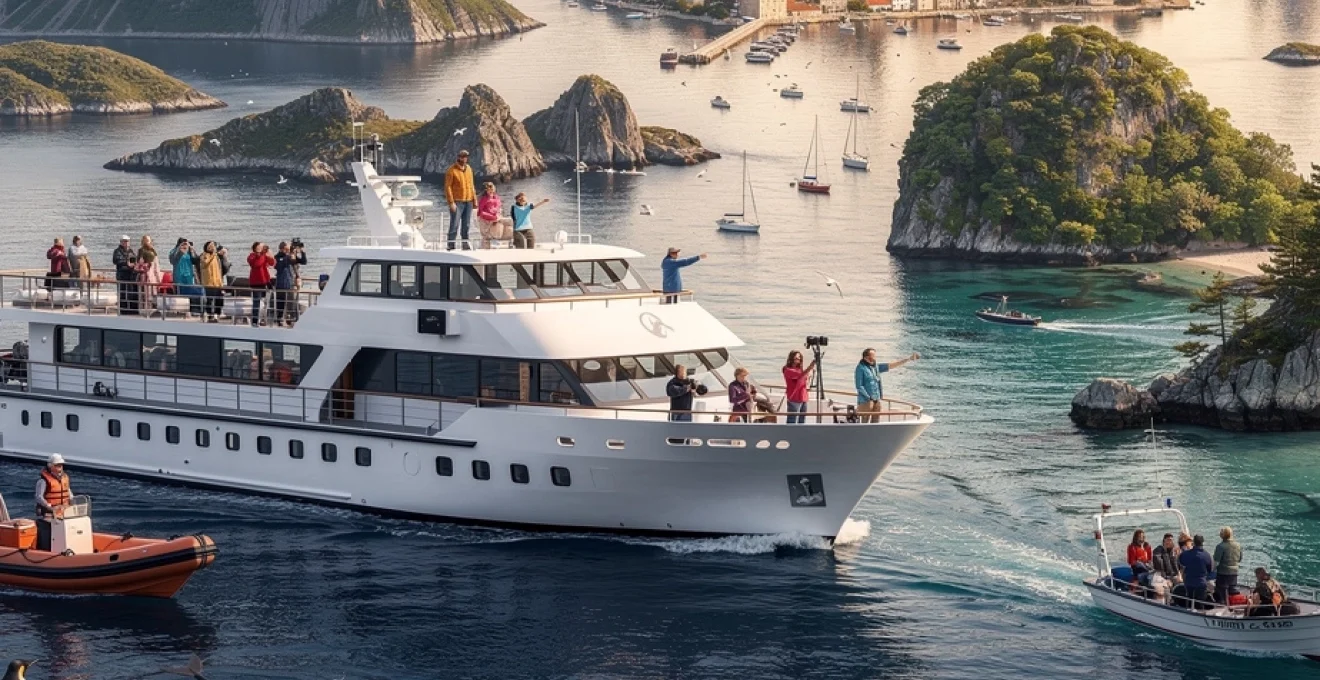
The way you travel shapes the stories you bring home. While flights compress continents into hours and road trips tether you to asphalt ribbons, maritime exploration offers something fundamentally different: a journey where the voyage itself becomes as meaningful as the destination. When you approach a coastline from the water, you experience geography the way early explorers did—gradually, with anticipation building as mountains emerge from the horizon and harbour lights twinkle against darkening skies. This perspective reveals landscapes that remain invisible from airports and motorways, opening access to remote wilderness areas, secluded archipelagos, and coastal communities that exist beyond the reach of conventional tourism infrastructure.
Maritime travel creates a rhythm entirely distinct from land-based holidays. Instead of rushing between hotels with suitcases in tow, you unpack once and wake each morning to new vistas framed by your cabin window. The gentle motion of waves replaces the jarring transitions of airports and train stations, whilst onboard amenities transform transit time from wasted hours into opportunities for enrichment, relaxation, and genuine connection with fellow travellers. Whether you’re navigating Norwegian fjords on an expedition vessel, island-hopping through the Caribbean, or circumnavigating entire continents on extended voyages, water-based exploration fundamentally alters your relationship with place and time.
Uninterrupted access to remote archipelagos and coastal wilderness areas
Some of Earth’s most spectacular landscapes exist where land meets sea, in regions so remote or protected that conventional tourism simply cannot reach them. Maritime vessels—particularly smaller expedition ships and purpose-built cruisers—provide the only practical means of accessing these extraordinary environments. Unlike aircraft that must bypass such areas entirely or road networks that terminate kilometres before coastlines, boats navigate directly to the heart of coastal wilderness, anchoring in pristine bays and manoeuvring through narrow channels that land-based visitors can only imagine.
Navigating norway’s lofoten islands and svalbard fjords by expedition vessel
Norway’s dramatic coastline stretches across more than 100,000 kilometres when you account for its countless islands, fjords, and inlets. The Lofoten archipelago rises from the Norwegian Sea like a jagged wall of granite, its fishing villages clinging to shorelines beneath peaks that soar nearly straight from the water. Traditional road access exists only along limited routes, leaving vast stretches of coastline reachable solely by boat. Expedition vessels navigate between these islands, anchoring in sheltered bays where you can kayak beneath towering cliffs or hike to vantage points offering 360-degree views of Arctic seascapes.
Further north, Svalbard’s glaciated wilderness presents an even more compelling case for maritime exploration. This High Arctic archipelago lies roughly halfway between mainland Norway and the North Pole, where polar bears outnumber human residents. The handful of settlements connect by boat and snowmobile, never by road. Expedition ships equipped with ice-strengthened hulls probe deep into fjord systems, manoeuvring around calving glaciers whilst naturalist guides scan for wildlife. You might witness walrus colonies hauled out on remote beaches, Arctic foxes patrolling tundra slopes, or the ethereal spectacle of the midnight sun illuminating iceberg-studded waters at 2 AM.
Reaching croatia’s elaphiti islands and dalmatian coast hidden coves
The Dalmatian Coast fractures into more than a thousand islands, creating a maritime labyrinth of limestone cliffs, pine-forested shores, and crystalline coves accessible only from the Adriatic. Whilst Dubrovnik and Split attract massive cruise ships and coach tours, smaller vessels slip between islands like Šipan, Lopud, and Koločep in the Elaphiti archipelago, where car-free villages preserve centuries-old Mediterranean rhythms. These traditional gulets and modern yacht cruisers anchor in secluded bays where you can swim directly from the stern platform into waters so clear you can observe fish darting across the seabed five metres below.
The intimacy of small-ship cruising through this region creates experiences impossible to replicate through land-based tourism. Morning might find you exploring a 15th-century Franciscan monastery on a near-deserted island, whilst
afternoons might see your boat weaving between uninhabited islets where the only sounds are cicadas and the soft slap of waves against the hull. Arriving from the sea allows you to approach walled towns and fortified harbours as sailors once did, with terracotta roofs and church spires gradually filling your field of vision. You gain a sense of how maritime trade shaped this coastline, from Venetian outposts to tiny fishing hamlets that still depend on the daily catch. For travellers seeking a unique travel perspective, this kind of slow, water-based access turns a famous region into a mosaic of intimate, low-key anchorages and authentic coastal encounters.
Exploring scotland’s outer hebrides and st kilda archipelago via small ship cruising
Off Scotland’s rugged west coast, the Outer Hebrides form a broken chain of islands battered by Atlantic swells and sculpted by relentless winds. While ferries connect the larger islands, many of the most dramatic headlands, sea stacks, and bird cliffs remain inaccessible without a vessel capable of anchoring in exposed bays and manoeuvring close to rock walls. Small ship cruises and expedition yachts thread through narrow sounds between Harris, Lewis, and the Uists, often adjusting routes in real time to follow weather windows and wildlife sightings. This flexibility turns the Hebrides into a living, shifting itinerary rather than a fixed checklist of stops.
The isolated St Kilda archipelago, a UNESCO World Heritage Site located some 64 kilometres west of the main island chain, offers a powerful illustration of how boats unlock remote wilderness. There are no scheduled ferries, no hotels, and no permanent civilian residents—only seabird colonies, archaeological remnants, and a small seasonal research and conservation presence. Access is strictly controlled and almost entirely dependent on favourable sea conditions, meaning that only a fraction of visitors who dream of St Kilda ever set foot on its shores. Arriving by small expedition vessel, you may circle sea stacks teeming with gannets, land to visit the abandoned village street, and feel the profound isolation that drove islanders to evacuate in 1930. It is an experience that simply cannot be replicated without travelling by sea.
Accessing indonesia’s raja ampat and komodo national park marine reserves
In the heart of the Coral Triangle, Indonesia’s Raja Ampat archipelago has earned a reputation as one of the world’s most biodiverse marine environments. Scattered across remote waters off West Papua, its karst islets, mangrove-fringed bays, and coral-encrusted reefs are largely unreachable by conventional transport. Liveaboard dive boats and small expedition cruise ships act as floating base camps, allowing you to wake up each morning within swimming distance of new snorkelling spots and dive sites. Because you move with the water rather than commuting from a fixed resort, your itinerary can follow optimal tides, visibility, and wildlife activity, maximising your time in the water.
Further south, Komodo National Park illustrates another advantage of exploring destinations by boat or cruise: seamless integration of land and sea experiences. Ships anchor off Komodo and Rinca islands, where guided walks bring you face-to-face—at a respectful distance—with the famed Komodo dragons. Within the same day, you can snorkel current-swept channels patrolled by reef sharks, drift over manta ray cleaning stations, or relax on pink-sand beaches that remain blissfully uncrowded. Marine reserves like these often limit land-based development to protect fragile ecosystems, but carefully regulated small ships and liveaboards provide controlled access that balances conservation with meaningful visitor experiences.
Multi-destination itineraries without accommodation transfers or packing disruption
One of the most practical advantages of water-based travel is the ability to visit multiple destinations without constant packing, unpacking, and hotel changes. On a typical overland trip, every new city or island requires logistics: checking out, arranging transport, navigating unfamiliar streets, and settling into new accommodation. By contrast, a cruise ship or small expedition vessel functions as a mobile hotel, restaurant, and transport hub all in one. You unpack once, personalise your cabin, and then watch as the world scrolls past your window like a moving panorama.
This continuity shifts your focus from logistics to immersion. Instead of spending energy managing transfers, you can use sea days to rest, attend enrichment talks, review photos, or plan the next port’s activities. For travellers with limited time off work or those who simply prefer a low-stress approach, multi-destination cruise itineraries compress an impressive amount of geographic diversity into a single, cohesive journey. You experience the satisfaction of covering distance—crossing seas, climate zones, and cultural boundaries—without sacrificing comfort or mental bandwidth.
Mediterranean grand voyages: barcelona to venice via côte d’azur and amalfi coast
Consider a grand voyage across the Mediterranean, tracing a route from Barcelona to Venice. Over the course of 10–14 days, you might call at Marseille or Nice along the Côte d’Azur, loop around to coastal Tuscany, pause in Rome’s port of Civitavecchia, and then continue south to the Amalfi Coast. On a land-based itinerary, replicating this path would involve a complex sequence of flights, trains, rental cars, and hotel stays—each with its own potential for delays, language barriers, and packing fatigue. By cruising, you simply step ashore in each new harbour with a daypack, knowing your room and belongings await your return.
Approaching these storied coastlines from the sea also restores something of their original character. Many Mediterranean cities were designed as maritime gateways, with waterfronts that served as front doors to their historic centres. Sailing into ports like Dubrovnik, Kotor, or Venice gives you a cinematic sense of arrival that no airport transfer can match. You can watch as medieval walls, hillside villages, and terraced vineyards assemble themselves in your field of view, much like scenes unfolding in a slow-tracking shot. For photographers and history enthusiasts alike, this combination of logistical ease and visual drama makes multi-stop Mediterranean cruises an especially compelling way to travel.
Caribbean island-hopping: lesser antilles circuit from st lucia to grenada
The Lesser Antilles—stretching from Martinique down to Grenada—offer another textbook case of how cruising simplifies complex itineraries. These islands are relatively close together but separated by international borders, distinct currencies, and patchy inter-island flight schedules. Attempting to visit three or four on a single land-based trip can quickly become a tangle of timetables and transfer costs. A small-ship Caribbean cruise, by contrast, transforms this archipelago into an effortless island-hopping circuit, linking St Lucia, St Vincent and the Grenadines, and Grenada in a smooth maritime arc.
From your floating base, you might spend one day hiking the Pitons, the next snorkelling in Tobago Cays Marine Park, and another wandering pastel-coloured streets in Grenada’s St George’s. Because you do not need to constantly repack or queue at airports, each port day feels longer and more relaxed. You can linger over a beachside lunch or a local rum tasting without worrying about making your next connection. For travellers who crave variety—different beaches, dialects, cuisines, and coral reefs—this style of Caribbean cruising offers a rich, low-friction way to experience multiple islands in a single, cohesive journey.
Southeast asian river and coastal combinations: mekong delta to ha long bay routes
In Southeast Asia, combined river and coastal routes highlight another aspect of why exploring destinations by boat offers a unique travel perspective: the ability to trace entire waterways from inland origins to maritime endpoints. Itineraries that link the Mekong Delta with coastal Vietnam and ultimately Ha Long Bay allow you to follow the natural flow of trade and culture. You might start among the floating markets and rice paddies of the delta, continue along the South China Sea coast past Nha Trang and Da Nang, and conclude amid the limestone karsts of northern Vietnam.
Such routes often blend different vessel types—a river cruise ship for the Mekong’s narrower channels, followed by an ocean-going ship or traditional junk-style boat for the coastal and Ha Long segments. Yet from the traveller’s perspective, the experience feels seamless because luggage transfers and connections are handled behind the scenes. Instead of juggling flights between Ho Chi Minh City, Hue, and Hanoi, you watch landscapes evolve steadily: riverbanks giving way to open coastlines, then reassembling into karst islands and hidden lagoons. This continuous narrative of place is difficult to replicate with disjointed overland hops.
Baltic capitals circuit: stockholm to st petersburg via tallinn and helsinki
In Northern Europe, a Baltic Sea circuit linking Stockholm, Helsinki, Tallinn, and (when political conditions allow) St Petersburg exemplifies cruising’s efficiency for city-focused travel. These capitals share deep maritime histories, yet travelling between them by land requires lengthy bus journeys, multiple border crossings, or short but frequent flights that quickly accumulate costs and carbon footprint. A cruise itinerary stitches them together overnight, using sailing hours that would otherwise be spent in hotel lobbies or airport security lines.
Imagine wandering Stockholm’s Gamla Stan in the evening, returning to your ship, and waking up to Helsinki’s harbourfront markets the next morning. Later in the voyage, medieval Tallinn appears outside your cabin as if conjured overnight, its spires and red roofs clustered above the city walls. For travellers interested in architecture, design, and modern urban culture, this style of trip allows you to sample multiple cities at a comfortable pace, with no need to change hotels or decipher public transport maps in each new language. The ship becomes a familiar anchor in a region of constantly changing skylines.
Onboard marine ecosystem observation and wildlife encounter opportunities
Exploring destinations by boat or cruise does more than simplify logistics; it also immerses you in living marine ecosystems. When your primary mode of transport is the ocean itself, you gain constant exposure to seabirds, marine mammals, and the subtle shifts in water colour and wave patterns that signal underwater life. Ships can position themselves along migration routes, linger near nutrient-rich upwellings, and deploy smaller craft like Zodiacs for closer, low-impact encounters. For wildlife enthusiasts and casual travellers alike, this transforms transit time into prime observation time.
Responsible operators work with marine biologists and naturalist guides to interpret what you are seeing, turning chance sightings into meaningful learning experiences. You might stand on deck as whales surface alongside, binoculars in hand, while a guide explains feeding behaviours or conservation challenges. At night, some regions even offer bioluminescent displays where each wave crest flashes with tiny sparks of light, like a starry sky inverted onto the sea. In this way, a cruise becomes not just a means of reaching destinations, but a moving classroom for understanding ocean health and biodiversity.
Galápagos islands endemic species viewing from naturalist-led expedition ships
Few places illustrate the educational power of water-based exploration as effectively as the Galápagos Islands. This Ecuadorian archipelago, made famous by Charles Darwin, is accessible almost entirely by boat, with strict visitor regulations designed to protect its fragile ecosystems. Small expedition ships, often capped at 16–100 passengers, follow carefully managed routes that rotate landing sites to minimise human impact. Each day typically includes a combination of shore walks, snorkelling sessions, and Zodiac cruises, all led by licensed naturalist guides trained to interpret geology, evolution, and animal behaviour.
Because many Galápagos species evolved without land predators, wildlife often shows remarkable tolerance for human presence—provided guidelines are followed. You might sit on a lava rock as a blue-footed booby performs a mating dance metres away, or watch marine iguanas grazing on underwater algae during a shallow snorkel. Travelling by expedition ship allows you to reach multiple islands with distinct microclimates and endemic species, from giant tortoises in the highlands to flightless cormorants along rugged coastlines. In effect, the vessel becomes your laboratory ship, transporting you between live case studies in evolution.
Antarctic peninsula penguin colonies and leopard seal observation platforms
The Antarctic Peninsula, one of the most remote destinations on Earth, is only accessible to travellers by ship. Expedition vessels equipped with ice-strengthened hulls and advanced navigation systems traverse the Drake Passage or approach via the Scotia Sea, entering a world of tabular icebergs, glaciated mountains, and silent bays. Once in Antarctic waters, the ship serves as both observation platform and safe haven, allowing passengers to watch humpback whales feeding in krill-rich waters and Adélie or gentoo penguins porpoising through the surf.
Zodiac excursions bring you closer still, landing on snow-covered beaches where penguin colonies stretch across the landscape in dense, noisy clusters. From this low vantage point, you can observe intricate behaviours: parents feeding chicks, adults tobogganing across ice, and leopard seals patrolling offshore edges. Because there are no hotels or permanent tourist facilities on the peninsula, the ship is essential—not just for comfort, but for environmental protection. Waste management, power generation, and safety systems remain on board, reducing the need for any land-based infrastructure in this pristine region.
Alaska’s inside passage humpback whale and orca migration corridors
Closer to home for North American travellers, Alaska’s Inside Passage showcases how cruising can align your route with wildlife movement patterns. This sheltered coastal channel, running between the mainland and a series of islands, forms a migration corridor for humpback whales, orcas, and countless seabirds. Cruise ships—especially smaller expedition-style vessels—often slow or pause when whales are spotted, announcing sightings over the PA system so passengers can quickly reach outer decks. For many, the first view of a humpback fluke disappearing beneath the surface becomes a defining memory of the trip.
Because you spend days within this marine ecosystem rather than viewing it from a single shore-based vantage point, you can witness a wider range of behaviours and conditions. One morning may bring glassy, mist-shrouded waters with distant whale blows backlit by the rising sun; another afternoon might see pods of orcas travelling purposefully along the coastline, dorsal fins slicing through choppy seas. Naturalist talks explain how these animals navigate, feed, and communicate, helping you appreciate that you are not just passing through a scenic corridor, but moving along vital marine highways.
Baja california grey whale calving lagoons accessible by zodiac tender
On Mexico’s Pacific coast, Baja California’s grey whale calving lagoons offer one of the most intimate large-animal encounters available to responsible travellers. Each winter, grey whales migrate thousands of kilometres from Arctic feeding grounds to sheltered bays like Magdalena Bay and Laguna San Ignacio, where they give birth and nurse their calves. Regulations limit vessel numbers and approach distances, but expedition ships anchor offshore and use Zodiacs to enter designated interaction zones under the guidance of local captains.
In these lagoons, curious whales sometimes approach small boats, rolling onto their sides to look at passengers or even allowing gentle touches under strict guidelines. Experiencing this from the water, at eye level with an animal the size of a bus, can fundamentally change how you think about marine life and conservation. Without ships and tenders to bridge the distance between remote lagoons and traveller infrastructure, such encounters would remain the exclusive domain of scientists and local fishers. Instead, carefully managed cruise itineraries open them to a wider audience, fostering empathy and support for ongoing protection efforts.
Exclusive shore excursion access and port-side cultural immersion
While much of the appeal of cruising lies on the water, shore excursions provide a complementary perspective on the cultures, histories, and daily lives of coastal communities. Well-designed itineraries coordinate arrival times with local events, markets, and festivals, offering you a chance to experience destinations when they are most alive. In many ports, ships dock within walking distance of historic centres, allowing you to step directly from gangway to cobbled street without lengthy transfers. This physical proximity often leads to a more organic form of cultural immersion than staying in out-of-town hotels or resort enclaves.
Exclusive access can also come in the form of timed-entry tours, private museum openings, or small-group visits to family-run vineyards and workshops that would be difficult to book independently—especially in places where language barriers or limited online infrastructure complicate planning. Because cruise lines build long-term relationships with local operators, they can often secure special experiences such as after-hours cathedral tours, cooking classes in local homes, or performances by community dance troupes. For you as a traveller, this means less time negotiating logistics and more time engaging meaningfully with people and places.
Panoramic seascape photography and ever-changing coastal vantage points
From a photographer’s standpoint, one of the most compelling reasons to explore destinations by boat or cruise is the constant access to shifting vantage points. On land, your perspective is constrained by roads, property lines, and topography; at sea, you can circle headlands, align with bays, and position yourself for optimal light in ways that static viewpoints simply do not allow. Dawn and dusk become particularly magical, as low-angle sunlight ignites cliff faces, silhouettes lighthouses, and paints reflections across calm harbours.
Even if you travel with nothing more than a smartphone, the ship’s elevated decks act like natural viewing platforms. You can frame shots that include both foreground detail—such as rigging lines, railings, or fellow passengers—and sweeping backgrounds of mountains, islands, or city skylines. Time-lapse sequences of approaches and departures, captured from a fixed spot on deck, can later tell the visual story of your voyage in minutes. And because the scenery is always moving, you have endless opportunities to experiment with composition, shutter speed, and perspective, whether you are documenting crashing surf, glassy fjords, or star-filled night skies unpolluted by city lights.
Maritime navigation experience and nautical heritage understanding
Finally, travelling by boat or cruise offers insight into the art and science of navigation itself—a dimension of travel that most modern journeys obscure. On many ships, bridge tours and navigation lectures reveal how captains and officers read electronic charts, radar, and weather models, while still relying on age-old principles of seamanship. You may learn how tides, currents, and wind patterns influence route planning, or how international maritime regulations govern everything from shipping lanes to environmental protection zones.
Beyond the technical side, maritime travel also connects you with a deep heritage of exploration, trade, and human resilience. Sailing into ports that once launched great voyages of discovery or served as vital nodes in global commerce can feel like stepping into a living history book. Museums, preserved tall ships, and waterfront memorials tell stories of sailors, fisherfolk, migrants, and merchants whose lives were shaped by the sea. As you watch modern pilots guide your vessel through narrow channels, you become part of that ongoing narrative. The journey ceases to be merely a means of getting from A to B and becomes a way of understanding how oceans have always linked cultures, economies, and ideas across vast distances.