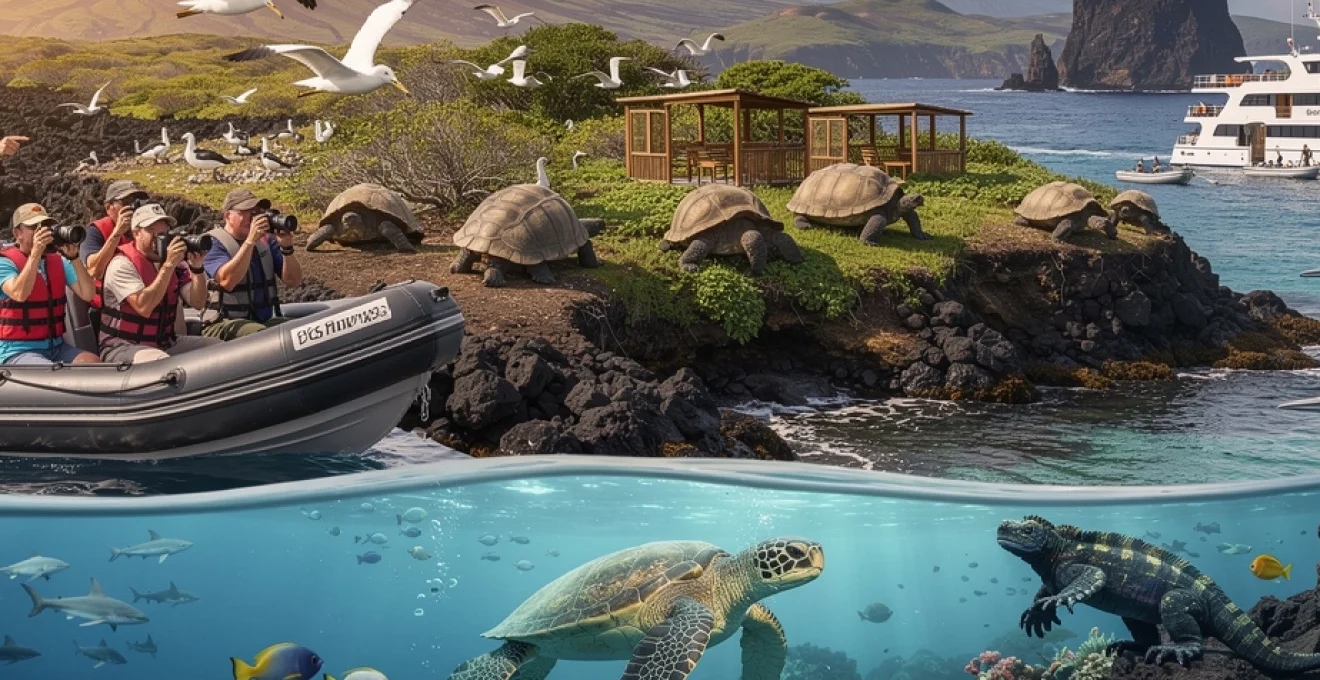
The Galápagos archipelago stands as one of Earth’s most extraordinary natural laboratories, where evolution unfolds before your eyes and wildlife encounters transcend anything you’ve experienced elsewhere. Situated approximately 600 miles off Ecuador’s Pacific coast, these volcanic islands harbour ecosystems so pristine and species so fearless that visitors often find themselves questioning whether such intimate animal interactions can truly be real. The islands’ geographic isolation has created a biodiversity hotspot unlike anywhere else on the planet, with over 80% of land birds, 97% of reptiles, and countless marine species found nowhere else on Earth. For those seeking an authentic immersion into evolutionary biology and untamed nature, exploring the Galápagos by expedition cruise vessel represents the most comprehensive and rewarding approach to experiencing this UNESCO World Heritage site.
Charles Darwin’s five-week visit in 1835 aboard HMS Beagle fundamentally changed scientific understanding of life on Earth. Today’s visitors follow in those historic footsteps, but with access to specialized naturalist guides, protective regulations, and meticulously planned itineraries that maximize wildlife encounters whilst minimizing environmental impact. The archipelago’s strict conservation protocols limit visitor numbers and mandate guided excursions, making the choice between land-based stays and live-aboard cruises more significant than you might initially realize.
Naturalist-guided shore excursions on santiago, fernandina, and española islands
The outer islands of the Galápagos archipelago offer wildlife spectacles that simply cannot be accessed through day trips from populated centres. Santiago, Fernandina, and Española represent three dramatically different volcanic landscapes, each supporting unique assemblages of endemic species that have evolved in remarkable isolation. Expedition cruise vessels navigate to these remote locations overnight, allowing you to wake at visitor sites where wildlife interactions begin the moment you step onto volcanic shores.
Santiago Island’s Sullivan Bay showcases relatively recent Pahoehoe lava flows from eruptions less than 120 years ago, creating an otherworldly terrain where pioneering plant species and lava lizards demonstrate nature’s persistent colonization of barren landscapes. The contrast between lifeless volcanic rock and thriving tide pools teeming with Sally Lightfoot crabs, marine iguanas, and Galápagos penguins illustrates evolutionary processes in real-time. Your naturalist guide will point out subtleties you’d otherwise miss: the specific cactus adaptations that allow survival in this harsh environment, or the territorial behaviours of male lava lizards performing push-ups to attract mates.
Fernandina Island, the youngest and most volcanically active in the archipelago, remained largely inaccessible until recent decades. Its isolation has preserved ecosystems in near-pristine condition, making landings at Punta Espinoza feel like stepping into a prehistoric world. The density of marine iguanas here exceeds anywhere else in the Galápagos, with hundreds of these remarkable reptiles clustering together for warmth after their cold-water foraging dives. Observing their unique salt-expelling behaviours—violent sneezing that crystallizes excess sodium on their heads—provides insights into the extraordinary adaptations required for marine herbivory.
Endemic species encounters: waved albatross colonies at punta suárez
Española Island hosts one of nature’s most spectacular avian gatherings between April and December each year. The waved albatross, found nowhere else on Earth except this single nesting colony, returns annually to breed at Punta Suárez. These magnificent seabirds, with wingspans exceeding 2.5 metres, perform elaborate courtship rituals involving synchronized bill-circling, sky-pointing, and distinctive braying calls that echo across the clifftops. Witnessing these behaviours during the breeding season represents a wildlife experience of exceptional rarity.
The albatross colony’s vulnerability underscores the conservation challenges facing Galápagos wildlife. With an estimated global population of just 35,000 individuals, the species’ dependence on this single breeding location makes them particularly susceptible to environmental changes and human disturbances. Your cruise naturalist will explain ongoing conservation efforts, including studies tracking their incredible foraging journeys across thousands of miles of Pacific Ocean. The emotional connection formed when a lone albatross chick regards you with curious eyes whilst awaiting parents that may be absent for days creates profound appreciation for
the delicate balance that allows such specialised species to survive. On a cruise-based itinerary, your time ashore here is carefully managed to avoid disturbance, while still allowing you to linger at viewing points and observe courtship, nesting, and fledging behaviour under the close guidance of certified naturalists.
Marine iguana behavioural observations at espinoza point
At Punta Espinoza on Fernandina, the sheer number of marine iguanas can feel almost surreal. These are the only lizards on Earth that forage in the ocean, grazing on underwater algae before hauling themselves back onto black lava to warm up. On a cruise excursion, you typically land early in the morning when the reptiles are still sluggish from their cold dives, allowing you to observe their thermoregulation routines without stress or crowding.
Naturalist guides help you decode behaviours that might otherwise look like random movements. That seemingly aggressive head-bobbing between males, for instance, is part of a ritualised dominance display that helps avoid full-on fights. The snorting and sneezing you’ll hear is actually a finely tuned salt-removal system, expelling excess sodium from their blood after hours in the sea. Because cruise groups are limited to 16 visitors per guide under Galápagos National Park rules, you can spread out along the trail, photograph individual animals, and quietly watch these behavioural adaptations unfold just a few metres from your feet.
The contrast between marine iguanas here and those you may see on more visited central islands also becomes apparent over the course of a cruise. On Fernandina, with virtually no introduced predators, they bask in dense piles on undisturbed lava benches, while hawks and herons patrol the margins. Your guide may point out how body size, colour, and even foraging patterns vary subtly from population to population, illustrating Darwin’s theory of evolution in a way that feels far more compelling than any textbook diagram.
Darwin’s finch adaptive radiation studies along highland trails
No discussion of Galápagos wildlife would be complete without Darwin’s finches, and an expedition cruise gives you repeated chances to see these birds across different islands and habitats. On highland trails in Santa Cruz or San Cristóbal, you’ll often pause under Scalesia forests while your naturalist mimics finch calls, drawing in several species at once. At first glance they look almost identical; with a pair of binoculars and a trained eye, the differences in beak shape and size quickly become obvious.
These variations are more than cosmetic. Some finches have thick, powerful bills designed to crack tough seeds, while others possess slender, probing beaks ideal for gleaning insects or even sipping nectar. On longer shore walks, guides often reference the landmark Peter and Rosemary Grant studies, which have tracked finch populations for over four decades and documented evolutionary change occurring over just a few generations. Standing on the very lava slopes where this research took place, you begin to understand how fluctuations in rainfall, food availability, and competition drive rapid adaptation.
Cruise itineraries that include multiple highland sites are especially valuable if you’re interested in adaptive radiation. By visiting several islands in succession, you can compare finch communities in arid lowlands, humid highlands, and transition zones, observing how a single ancestral species diversified into more than a dozen ecological specialists. For keen photographers and birders, this variety is one of the strongest arguments for choosing a multi-day Galápagos cruise over isolated day trips.
Giant tortoise conservation programmes at charles darwin research station
Giant tortoises are the undisputed icons of the Galápagos, and a cruise visit to the Charles Darwin Research Station on Santa Cruz offers an in-depth look at what it takes to protect them. Here you’ll walk past incubation rooms where eggs collected from vulnerable nesting sites are carefully monitored, then on to outdoor corrals where tiny hatchlings, some no bigger than a grapefruit, slowly grow under controlled conditions. Many visitors are surprised to learn that tortoises do not reach full size for decades, which is one reason their recovery from historical overexploitation has been so painstakingly slow.
Interpretive displays and talks from research staff outline how whaling ships and pirates once slaughtered hundreds of thousands of tortoises, pushing several subspecies to the brink of extinction. You’ll hear success stories too, such as the reintroduction of Española tortoises after a captive breeding programme that began with just a handful of surviving adults. For conservation-minded travellers, seeing row upon row of juveniles destined to repopulate their ancestral islands can be deeply moving.
Because expedition cruises typically schedule ample time at the research station and in the nearby highlands, you’re not limited to viewing animals in pens. Many itineraries also include a visit to private reserves where semi-wild tortoises roam through lush pastures and cloud forest, wallowing in muddy pools or crunching on grass just metres away. Guides explain how community-based tourism and park entrance fees help fund these conservation programmes, giving you clear insight into how your decision to visit the Galápagos by cruise contributes directly to preserving its most famous residents.
Small-vessel navigation through protected marine zones and volcanic archipelago geography
One of the main advantages of exploring the Galápagos Islands by cruise is the ability of small vessels to navigate between remote visitor sites while you sleep. The archipelago stretches across roughly 45,000 square kilometres of ocean, and many of the most pristine islands sit far beyond the range of standard day boats. Purpose-built expedition yachts, catamarans, and small ships can cross these distances safely overnight, arriving at secluded bays and coves just as the first light hits the water.
From a geological perspective, sailing through the archipelago is like travelling along a slow-motion conveyor belt of volcanic evolution. Western islands such as Fernandina and Isabela are geologically young, with active shield volcanoes and fresh lava flows, while the older eastern islands have eroded into gentler landscapes of beaches, cliffs, and highland forests. A cruise itinerary designed around this gradient allows you to appreciate how the underlying hotspot has shaped not just the geography, but also the distribution of endemic species and habitats.
Galápagos national park visitor site regulations and zodiac landing protocols
The Galápagos National Park has established more than 170 designated visitor sites, each with strict regulations governing how, when, and how many people can land. On a cruise, your daily routine is shaped by these rules, but in practice they enhance the experience rather than limit it. Groups are capped at 16 guests per naturalist guide, and landing times are staggered between vessels to prevent overcrowding. This means you often find yourself walking along a trail or snorkelling in a bay with only a handful of other people in sight.
Access to most landing sites is via inflatable boats known as Zodiacs or pangas. Before your first excursion, crew members provide a safety briefing covering lifejackets, boarding techniques, and the difference between “wet” and “dry” landings. On a wet landing, you step out into shallow water and wade ashore; on a dry landing, the Zodiac noses up to rock or concrete steps so you can disembark without getting your feet wet. Guides and boat drivers coordinate these manoeuvres with impressive precision, helping guests of all mobility levels reach shore safely.
Once ashore, you’re expected to follow marked trails, keep at least two metres from wildlife, and refrain from eating or leaving any rubbish. National Park rules also prohibit the collection of shells, rocks, or organic material, and require that all visitors scrub and disinfect their footwear between landing sites to prevent seed and pathogen transfer. Expedition cruise staff build these protocols into the rhythm of the day, so they become second nature – much like buckling a seat belt – ensuring that high visitor interest in the Galápagos does not compromise the fragile ecosystems you’ve come so far to see.
Itinerary planning: western islands circuit versus central-eastern route options
Choosing the right Galápagos cruise itinerary can feel daunting at first glance. Most live-aboard operators divide their programmes into two broad circuits: the western route, focusing on Isabela, Fernandina, and often the northern island of Genovesa, and the central-eastern route, which typically includes Santa Cruz, San Cristóbal, Española, and Bartolomé. Each offers a distinct mix of wildlife, landscapes, and activity levels, so the best choice depends on your priorities.
The western circuit is especially appealing if you’re interested in recent volcanic activity and cooler-water marine life. Here you’ll find towering shield volcanoes, nutrient-rich upwellings that attract dolphins and whales, and some of the most dramatic lava fields in the archipelago. It’s also the stronghold of the flightless cormorant and offers excellent chances to see Galápagos penguins. The central-eastern route, by contrast, is ideal for iconic land birds and classic postcard landscapes: think blue-footed booby colonies on North Seymour, waved albatross on Española, and the cinematic Pinnacle Rock viewpoint on Bartolomé.
Many travellers wonder whether a 4-, 8-, or 15-day cruise is necessary to “do the Galápagos properly.” While even a 4-day itinerary can deliver memorable encounters, longer cruises provide a deeper, more varied experience by combining both western and eastern sectors. If time or budget constraints force you to choose, discuss your interests with a specialist operator: are you more excited by nesting seabird colonies and giant tortoises, or by remote lava landscapes and cold-water snorkelling with marine megafauna? A well-designed cruise itinerary will align closely with your answers.
Intimate wildlife photography opportunities from 16-passenger expedition vessels
Photographers, whether amateur or professional, gain enormous benefits from travelling the Galápagos by small expedition vessel. With only around 12–16 guests on board, Zodiac loads are quick and flexible, allowing you to reach shore during prime early-morning and late-afternoon light. Smaller groups also mean you can spread out along the trail, taking your time to frame shots of nesting boobies, basking iguanas, or hunting herons without feeling rushed by a crowd behind you.
On deck, low railings and uncluttered bow areas provide clear sightlines for photographing dolphins riding the bow wave, frigatebirds soaring overhead, or sunset silhouettes of volcanic cones. Many vessels now offer camera rinse tubs, dedicated charging stations, and evening review sessions where naturalists help you identify species captured in your images. This level of access and support is hard to replicate on larger ships carrying 80–100 passengers, where shore times and vantage points are inevitably more constrained.
Because Galápagos wildlife is so remarkably tolerant of human presence, you can often use shorter lenses than you might expect, resulting in crisp, intimate portraits without disturbing the animals. That said, your guides will remind you that it’s better to step back and zoom in than to creep too close. Adhering to these ethical photography practices not only protects the subjects of your images but also ensures that the islands remain a model for low-impact wildlife tourism worldwide.
Underwater biodiversity: snorkelling and diving at kicker rock and devil’s crown
For many visitors, it’s the underwater world of the Galápagos that proves most unforgettable. The confluence of major ocean currents around the archipelago creates an exceptionally productive marine ecosystem, where cold, nutrient-rich waters support dense schools of fish, large predators, and unique endemic species. Cruising between islands allows you to visit multiple snorkelling and diving sites in a single trip, each with its own characteristic mix of habitats and marine life.
Kicker Rock (León Dormido) off San Cristóbal and Devil’s Crown near Floreana are two of the most celebrated sites. Both are eroded volcanic cones rising steeply from deep water, their submerged walls encrusted with corals, sponges, and algae. Strong currents funnel plankton and small fish past these natural pinnacles, attracting larger predators and creating the kind of high-energy environments that divers and snorkellers dream of. Thanks to the logistical support of your cruise vessel, you can enter and exit the water safely, with Zodiac drivers tracking your drift and naturalists guiding the group.
Galápagos penguin and flightless cormorant pelagic observations
Seeing penguins and cormorants underwater in the Galápagos is like watching evolution in fast-forward. Galápagos penguins, the only penguin species to live naturally north of the equator, rocket past in pursuit of baitfish, using their wings as flippers with astonishing agility. Flightless cormorants, meanwhile, have traded flight for swimming, their stubby wings and powerful legs propelling them like feathered torpedoes along the reef. Both species exploit the cool, nutrient-rich currents that bathe western islands and certain offshore sites.
On many cruises, you’ll start by spotting these birds from the deck or Zodiac as they rest on lava ledges or preen on wave-washed rocks. With guidance from your naturalist, you then enter the water at a respectful distance and simply wait. More often than not, curiosity or simple coincidence brings them close, offering fleeting but thrilling views as they twist and turn through schools of fish. Because Galápagos wildlife is not baited or fed, every such encounter is entirely natural, shaped by the rhythms of the sea rather than a human schedule.
If you’re particularly keen on observing these species, consider an itinerary that includes the western coast of Isabela and Fernandina, where cooler upwellings make penguin and cormorant sightings more frequent. While no responsible operator can guarantee encounters, travelling by cruise significantly increases your chances by giving you access to multiple key sites across several days, rather than relying on a single day trip with fixed timing.
Hammerhead shark aggregations and manta ray cleaning stations
The Galápagos Marine Reserve is renowned among divers for its populations of scalloped hammerhead sharks and giant mantas, which gather in specific areas to feed and be cleaned by smaller fish. At offshore seamounts and channels, currents concentrate nutrients and attract dense schools of jacks, tuna, and reef fish, creating the perfect hunting grounds for these apex predators. While the most intense hammerhead aggregations occur at distant islands like Darwin and Wolf, closer-in sites around Kicker Rock and certain western channels still offer excellent viewing opportunities.
Diving with large sharks can sound intimidating, but in the Galápagos it’s more akin to watching a distant parade than a close-up confrontation. Hammerheads are shy by nature and often remain at the edge of visibility, their distinctive silhouettes gliding in and out of the blue. Manta rays, by contrast, may circle cleaning stations repeatedly, their enormous wingspans and slow, graceful movements giving the impression of underwater birds soaring in slow motion. On many cruises, certified divers can join optional advanced dives, while snorkellers watch from shallower depths where reef sharks and turtles are more common.
Because conditions at these sites can involve strong currents and cooler thermoclines, honest self-assessment of your comfort and experience level is essential. Your cruise operator will provide appropriate briefings, equipment, and guide-to-guest ratios, and may suggest alternative snorkelling options if a particular dive proves too challenging. Approached with respect and preparation, these encounters can be among the most powerful wildlife experiences of your life, offering a visceral sense of how intact ocean ecosystems function.
Sea lion interaction ethics and marine reserve snorkelling guidelines
Galápagos sea lions are famously playful, and snorkelling with them is often a highlight of any cruise. Young animals, in particular, seem to delight in zooming past snorkellers, blowing bubbles, and mimicking your movements. It can be tempting to reach out or chase them, but strict marine reserve guidelines – and basic respect – require a more restrained approach. By floating calmly and letting the animals dictate the encounter, you’ll often find that they come closer and stay longer.
Before your first swim, your naturalist will review key snorkelling guidelines designed to protect both you and the wildlife. These include maintaining a safe distance from all animals, never blocking their exit routes to the surface, and avoiding rapid movements that could be interpreted as aggression or play. Touching, feeding, or attempting to ride sea lions is not only unethical but also illegal under Galápagos National Park regulations. Remember that even a small pup has powerful jaws and sharp teeth, and that habituating wild animals to human contact can lead to long-term problems.
Most expedition vessels provide well-fitting wetsuits, masks, and fins, as well as flotation aids for less-confident swimmers. This equipment not only keeps you comfortable in the often-chilly Humboldt and Cromwell currents but also allows you to stay relatively still in the water, reducing the urge to paddle frantically and disturb the scene. By following your guide’s instructions and respecting the boundaries of the animals, you’ll enjoy authentic, low-impact interactions that embody the spirit of responsible wildlife tourism.
Chromis and surgeonfish endemic subspecies identification
Beyond the charismatic megafauna, the Galápagos marine environment hosts a rich array of smaller fish species, many of which are found nowhere else. Among the most conspicuous are chromis and surgeonfish, which often form shimmering schools over rocky reefs and lava outcrops. At first, these may seem like generic “background fish,” but with a bit of guidance you’ll start to recognise endemic subspecies such as the Galápagos brown chromis or the distinctive yellow-tailed surgeonfish that graze algae from the rocks.
During evening briefings on board, naturalists often use identification charts or underwater photographs to help you match what you saw in the water to specific species. This process can feel a bit like learning to read a new language: once your eye is trained, details that were previously invisible suddenly pop into focus. You may find yourself spotting subtle differences in colour bands, fin shapes, or body size that distinguish closely related species or island-specific forms.
Why does this level of detail matter for the average snorkeller? Because noticing these nuances deepens your appreciation of the Galápagos as an evolutionary hotspot, not just a place of “big animals.” Every chromis darting above a coral head and every surgeonfish nibbling at algae is part of a finely tuned ecological web. By the end of a week-long cruise, many guests report that what began as a blur of blue and silver has transformed into a recognisable cast of characters, each with its own role in the underwater drama.
Comparative analysis: land-based accommodation versus live-aboard cruise itineraries
When planning a Galápagos trip, one of the first decisions you’ll face is whether to stay in land-based accommodation or join a live-aboard cruise. Both approaches have merits, and in some cases a hybrid itinerary that combines a short cruise with a few nights in a town like Puerto Ayora offers the best of both worlds. However, if your primary goal is a unique wildlife experience, several key differences tip the balance in favour of an expedition cruise.
Land-based stays are generally more affordable and offer greater flexibility for independent exploration, café-hopping, and beach time near populated areas. From your hotel, you can book day trips to nearby islands and visitor sites, snorkel at accessible bays, and enjoy evenings in local restaurants. The trade-off is that day boats must return before dark and are restricted to locations within a reasonable radius, limiting how far into the archipelago you can venture. This often means visiting the same high-demand sites as many other travellers, with correspondingly larger crowds.
Live-aboard cruises, by contrast, function as mobile basecamps, carrying you overnight to remote islands such as Fernandina, Genovesa, or the western flanks of Isabela that are rarely accessible on day tours. Because your transport, accommodation, and meals are all integrated, you spend far less time in transit and far more time ashore or in the water. The structure of a cruise – usually two to three excursions per day, plus optional lectures – also allows for a deeper, more cohesive understanding of the islands’ ecology and geology.
From an environmental standpoint, both models have impacts and safeguards. The Galápagos National Park caps visitor numbers, regulates vessel sizes, and monitors waste management for ships, while land-based tourism must contend with issues such as urban expansion, freshwater use, and invasive species. Many conservation organisations now argue that well-managed small-ship cruising distributes visitor pressure more evenly across designated sites, whereas concentrating most tourists in a handful of towns can strain local infrastructure. Ultimately, the most sustainable choice comes down to selecting reputable operators – whether cruise or hotel – that prioritise conservation, hire local staff, and adhere strictly to park regulations.
Seasonal wildlife migration patterns and optimal cruise departure timing
One of the great advantages of the Galápagos is that there is no single “off-season” for wildlife. Thanks to the islands’ equatorial location and complex oceanography, some species are breeding, nesting, or pupping at almost any time of year. That said, seasonal shifts in water temperature, currents, and rainfall do influence what you’re most likely to see, as well as overall conditions for snorkelling and hiking. Understanding these patterns can help you choose the best cruise departure date for your interests.
Broadly speaking, the Galápagos year divides into a warmer, wetter season from December to May and a cooler, drier season from June to November. The warm season often brings calmer seas, clearer skies, and more comfortable water temperatures for swimming, along with lush vegetation and active land bird courtship displays. The cool season is dominated by the Humboldt and Cromwell currents, which lower sea surface temperatures but dramatically increase productivity, drawing more pelagic species such as whales, dolphins, and large schools of fish closer to the islands.
Blue-footed booby mating displays during june-august breeding season
Blue-footed boobies, perhaps the most instantly recognisable of Galápagos seabirds, offer some of their most exuberant behaviour during the June–August breeding season. On islands like North Seymour and Española, males select small clearings on the rocky ground and begin their courtship routines: raising each sky-blue foot in turn, spreading their wings, and offering pebbles or twigs to prospective mates. The brightness of a male’s feet is influenced by his diet and overall health, so vivid turquoise tones can be an important signal of fitness.
Travelling by cruise during this period means you can visit several booby colonies across different islands, observing the full spectrum of breeding activity from elaborate dances to egg incubation and chick rearing. Because landings are carefully timed to avoid excessive heat and disturbance, you often arrive in the cooler early morning or late afternoon when birds are most active. Photographers in particular will appreciate the soft light and the ability to position themselves, under guide supervision, for unobstructed views of these rituals.
Outside the core breeding months, blue-footed boobies remain present year-round, but their behaviour shifts more toward feeding and roosting. If your schedule is fixed for another time of year, don’t worry – you’re still highly likely to see them plunge-diving offshore or resting on cliffs and rocks. However, if witnessing their famous mating displays is high on your wish list, targeting a June–August cruise in the central or southern islands offers the best odds.
Green sea turtle nesting activity at gardner bay and bachas beach
Green sea turtles use several Galápagos beaches for nesting, with peak activity typically spanning December through March. On sites such as Gardner Bay on Española and Bachas Beach on Santa Cruz, night-time nesting remains off-limits to tourists to minimise disturbance. What you can often see during permitted daylight visits, however, are the traces of this hidden drama: distinctive tractor-like tracks leading from the surf to the dunes, freshly covered nest mounds, and occasional hatchling tracks from successful emergences.
On early-morning or late-afternoon cruises to these beaches, your naturalist will point out subtle signs in the sand and explain how temperature-dependent sex determination, predation, and ocean conditions influence turtle survival rates. In some years, you may even witness late-arriving females finishing a nest or disoriented hatchlings making a belated dash for the sea, though such encounters are relatively rare and always managed with strict hands-off policies. Seeing the delicate imprints of tiny flippers across a dawn-lit beach can be as powerful as any direct turtle sighting, reminding you of the fragility of these ancient mariners’ life cycle.
If swimming with turtles is a priority, the warmer-water months from January to May often provide the most comfortable conditions and good visibility at snorkelling sites like Gardner Bay, Punta Cormorant, or Black Turtle Cove (the latter visited by Zodiac only). Turtles graze on seagrass, rest on the seabed, or rise every few minutes to breathe, offering unhurried viewing opportunities as long as you maintain the required distance and avoid blocking their path to the surface.
Galápagos fur seal pupping cycles at genovesa island’s darwin bay
Galápagos fur seals, actually a type of sea lion, favour cooler, shadier shorelines and are most numerous along the western and northern coasts. On Genovesa Island, particularly around Darwin Bay, you may encounter small harems tucked into lava crevices and shaded ledges, especially during the pupping season, which generally peaks between August and November. Newborn pups, dark and fluffy, remain close to rocky nursery pools while mothers alternate between nursing and foraging trips at sea.
A cruise itinerary that includes Genovesa allows you to land at sunrise or sunset, when fur seals are more active and temperatures are milder. From the marked trail, you can watch as pups clamber clumsily over rocks, call to their returning mothers, or practise their swimming in sheltered tide pools. Naturalists explain how mothers recognise their own pup’s unique call among dozens of others and how changing ocean conditions linked to El Niño events can dramatically affect pup survival by altering prey availability.
Because fur seal colonies are often tucked into narrow ledges and boulder-strewn coves, strict adherence to distance regulations is especially important here. On a small-group cruise, guides can manage positioning carefully, ensuring that each guest has a clear line of sight without encroaching on resting animals. For those fascinated by behaviour and social structure, lingering at a respectful distance and simply watching these interactions can be one of the most rewarding slow moments of your voyage.
Expedition cruise vessel categories: luxury yachts, motor catamarans, and classic sailing ships
Not all Galápagos cruises are created equal, and the type of vessel you choose will significantly shape your experience. Broadly, the fleet can be grouped into three main categories: luxury yachts, motor catamarans, and classic or motor-assisted sailing ships. All licensed vessels must comply with Galápagos National Park regulations regarding group size, guiding standards, and waste management, so the differences lie more in comfort, stability, and onboard ambiance than in access to wildlife.
Luxury yachts, typically carrying 16–40 passengers, offer the highest level of comfort, with spacious cabins, ensuite bathrooms, air conditioning, and often amenities such as hot tubs, observation lounges, and fine dining. If you value creature comforts after long days of hiking and snorkelling, or if you’re travelling with family members who might appreciate a bit more space and privacy, this category can be worth the premium. Many luxury vessels also feature multiple naturalist guides, allowing for activity-level splits – so keen hikers can tackle longer trails while others opt for shorter walks or Zodiac cruises.
Motor catamarans, usually in the 12–16 passenger range, are prized for their stability and speed. Their twin-hull design reduces rolling compared to monohulls of similar size, which can be a significant advantage if you’re prone to seasickness. Cats also tend to have generous deck space and panoramic windows, making them excellent platforms for wildlife watching between landings. Cabins may be slightly more compact than on larger yachts but are generally comfortable, and the intimate group size fosters a relaxed, communal atmosphere where it’s easy to get to know your fellow travellers.
Classic sailing ships and motor-sailers appeal to those drawn to the romance of traditional maritime travel. While most modern itineraries rely primarily on engines to keep to schedule, raising the sails whenever wind and routing permit adds a distinctive, low-impact dimension to the voyage. Accommodation on these vessels is often simpler, with smaller cabins and shared or compact ensuite facilities, but the trade-off is a strong sense of adventure and connection to the seafaring history of the region. Spending an evening on deck under a canopy of stars, sails silhouetted against the Milky Way, can be a highlight in its own right.
Whichever vessel type you choose, consider factors such as group size, motion sensitivity, and how much time you expect to spend on board versus ashore. Ask operators about guide qualifications, safety records, and their specific sustainability practices – for example, whether they minimise single-use plastics, treat all wastewater on board, and employ local crew. By matching your personal preferences with the right ship, you’ll be well placed to enjoy the full richness of a Galápagos expedition cruise and the unique wildlife experiences that come with it.