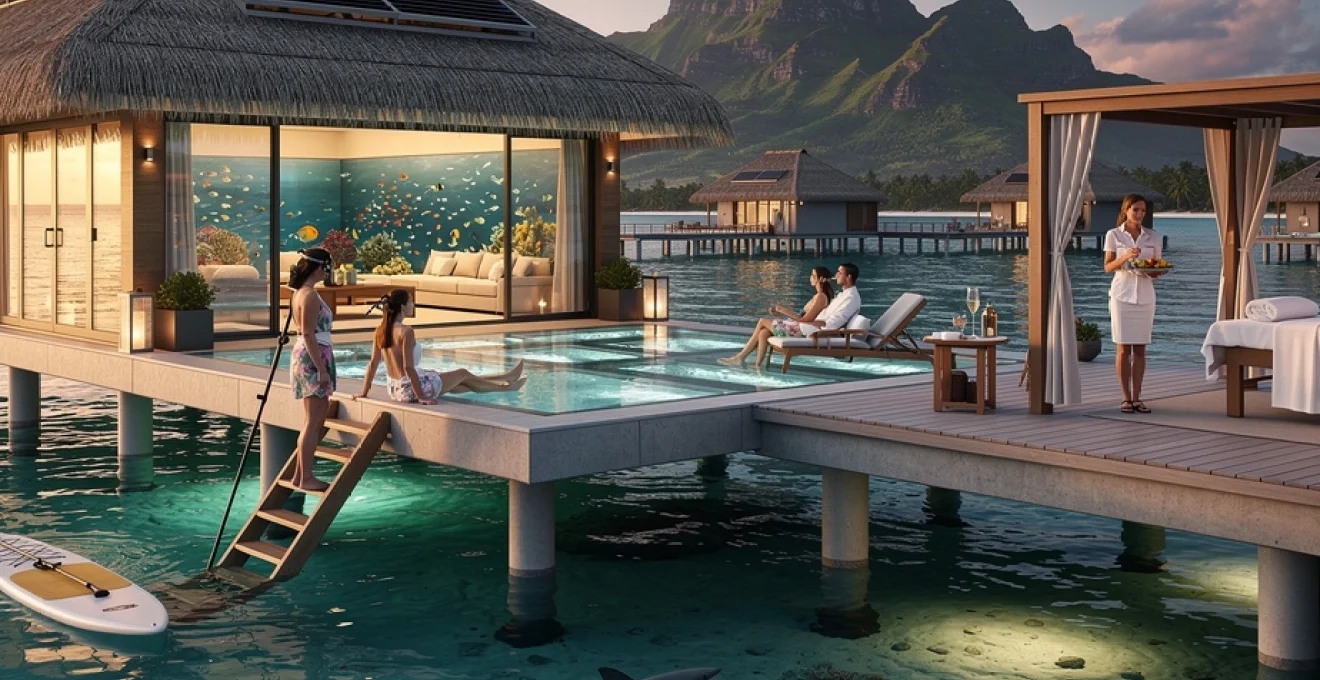
The moment you step onto your private deck suspended above crystalline waters, with Mount Otemanu’s volcanic peaks piercing the horizon and tropical fish darting beneath your feet, you understand why Bora Bora’s overwater bungalows have become the ultimate symbol of luxury travel. These architectural marvels represent far more than accommodation—they embody a fundamental reimagining of what it means to experience paradise. French Polynesia’s flagship resort island has perfected the art of blending cutting-edge engineering with traditional Polynesian aesthetics, creating intimate sanctuaries where guests enjoy unprecedented access to one of the world’s most pristine marine environments whilst surrounded by five-star amenities that would rival any metropolitan luxury hotel.
Architectural innovation: Over-Water construction techniques in french polynesia
The engineering brilliance behind Bora Bora’s overwater bungalows often goes unnoticed by guests relaxing on their private decks, yet these structures represent decades of architectural evolution. What began in 1967 as simple fishing hut conversions on Ra’iātea has transformed into sophisticated examples of marine construction that must withstand tropical storms, relentless saltwater exposure, and the constant motion of one of the world’s most dynamic ecosystems. Modern overwater villas employ advanced materials and techniques that would have been unimaginable to the pioneering hoteliers who first envisioned guests sleeping above the reef.
Pontoon foundation systems and lagoon engineering at four seasons resort
The foundation systems supporting luxury overwater bungalows bear little resemblance to traditional land-based construction. At properties like the Four Seasons Bora Bora, engineers drive reinforced concrete pylons deep into the lagoon floor, creating stable platforms that can support structures weighing several tonnes whilst maintaining the delicate balance of the surrounding coral ecosystem. These pylons must be positioned with millimetre precision to avoid damaging existing coral formations, a process that requires extensive marine surveys and environmental impact assessments before construction even begins.
The pontoon walkways connecting bungalows to shore represent another engineering challenge entirely. These elevated pathways must flex slightly with tidal movements and wave action without creating uncomfortable bouncing sensations for guests carrying luggage or traversing the distance in darkness. High-end resorts employ sophisticated suspension systems that absorb motion whilst maintaining structural integrity over decades of constant use. The walkways also conceal extensive utility infrastructure—freshwater pipes, electrical conduits, fibre-optic cables for high-speed internet, and drainage systems—all protected from corrosive saltwater by multiple layers of specialized coatings and materials.
Hurricane-resistant design standards for overwater villas
French Polynesia sits within a cyclone-prone region, and any structure built above water must withstand wind speeds exceeding 200 kilometres per hour alongside the associated storm surges and wave action. Modern overwater bungalows incorporate hurricane-resistant features that guests rarely see but which prove essential during severe weather events. Roof structures use reinforced trusses anchored with specialized fastening systems designed to prevent uplift, whilst window and door assemblies employ impact-resistant glass and locking mechanisms that create watertight seals.
Some newer resorts have implemented innovative “breathing foundation” systems that allow slight structural movement during extreme conditions, dissipating forces rather than rigidly resisting them. This approach, borrowed from earthquake engineering principles, has proven remarkably effective at preventing catastrophic failures. Additionally, several properties maintain emergency protocols whereby certain bungalows can be temporarily detached from their moorings and towed to protected areas when cyclone warnings are issued—a contingency that demonstrates the extraordinary measures required to operate luxury accommodations in such exposed locations.
Glass floor panel integration and marine ecosystem viewing technology
The iconic glass floor panels found in most Bora Bora overwater bungalows—affectionately termed “Tahitian television” by early innovators—represent a sophisticated marriage of architecture and marine biology. These viewing portals employ specialized laminated glass capable of supporting the weight of multiple adults whilst resisting scratches from sand and coral fragments tracked in from the lagoon. The glass must also incorporate UV-filtering properties to prevent excessive heat gain whilst maintaining optical clarity that allows unob
pstructed views into the lagoon. Integrating these panels requires careful coordination between structural engineers and marine consultants, as even small changes in light penetration can influence algae growth and fish behaviour beneath the bungalows.
Many of Bora Bora’s leading resorts enhance this natural spectacle with discreet underwater LED lighting systems positioned around each villa. These lights use specific wavelengths that attract plankton and small fish without disturbing larger marine species, effectively transforming the water beneath your overwater bungalow into a living, breathing aquarium after dark. At some properties, guests can even control the intensity and timing of these lights via in-room tablets, personalising their nocturnal marine show to coincide with a late-night swim or candlelit dinner on the deck.
Traditional polynesian thatched roofing with modern climate control systems
One of the most distinctive visual signatures of overwater bungalows in Bora Bora is their pandanus-thatched roofing, a direct nod to traditional Polynesian architecture. While these roofs appear rustic, their construction is anything but simple. Modern thatched systems are layered over waterproof membranes and treated timber structures, combining natural insulation with advanced moisture barriers that prevent rot in Bora Bora’s humid, salt-laden environment. Skilled local artisans still weave and install the thatch by hand, preserving cultural craftsmanship while working within strict engineering specifications.
Inside, concealed climate control systems ensure that guests enjoy cool, dry air even during the hottest months. High-efficiency air-conditioning units are paired with strategically placed ceiling fans and operable louvered windows, allowing guests to choose between natural ventilation and conditioned comfort. Roof cavities often house sound insulation and reflective materials that reduce heat gain, meaning you can sleep under a traditional thatched ceiling without sacrificing the consistent temperatures and quiet expected of world-class luxury travel. This subtle blend of heritage and high technology is one of the reasons Bora Bora’s overwater villas feel both authentically Polynesian and undeniably contemporary.
Exclusive amenities distinguishing bora bora overwater accommodations
Beyond their striking architecture, overwater bungalows in Bora Bora differentiate themselves through a suite of exclusive amenities that few other destinations can match. These are not simply hotel rooms on stilts; they are self-contained sanctuaries where you can swim, dine, spa and star-gaze without ever leaving your private platform. For travellers comparing overwater bungalows across the Maldives, the Caribbean and Southeast Asia, it is often these high-touch details and thoughtfully curated experiences that make Bora Bora feel like the definitive upgrade.
Private infinity plunge pools with mount otemanu vistas
One of the most coveted features in Bora Bora’s top-tier overwater villas is the private infinity plunge pool that appears to merge seamlessly with the lagoon. Resorts such as Four Seasons Resort Bora Bora, The St. Regis Bora Bora Resort and InterContinental Bora Bora Resort & Thalasso Spa position their pools to frame postcard-perfect views of Mount Otemanu, enabling you to float in your own pool while gazing at the island’s iconic volcanic peak. This visual alignment is no accident; architects model sun paths and sight lines to ensure that key villas capture both the best light and the clearest mountain vistas.
For many guests, these plunge pools redefine what a luxury suite should offer. You might start your day with an energising swim as the first light hits Mount Otemanu, then return in the afternoon to cool off between snorkeling sessions. In the evening, the pool becomes a cinematic foreground for sunset colours reflecting off the lagoon. If you’re planning a honeymoon or milestone celebration, opting for a Mount Otemanu view with a private pool is often the single upgrade that delivers the most dramatic impact on your overall experience.
Direct lagoon access via descending staircases and water sports equipment
Another hallmark of Bora Bora’s overwater bungalows is direct lagoon access from each villa’s deck. Most properties integrate wide, non-slip staircases that descend from your private terrace straight into the warm, shallow waters of the lagoon. This allows you to move effortlessly between lounging on your deck and swimming with reef fish—no need to navigate busy public beaches or crowded piers. Handrails, freshwater showers and strategically placed ladders make the transition from sea to sunbed as smooth as stepping into your own backyard pool.
To maximise this connection to the water, many overwater accommodations include complimentary water sports equipment. At Conrad Bora Bora Nui and Le Meridien, for example, guests frequently find snorkel masks, fins and sometimes even stand-up paddleboards stored on their decks. Having this gear at arm’s length encourages spontaneous adventures—why not paddle out at sunrise or snorkel beneath your bungalow after breakfast? Just be mindful of currents and depth, and always check with resort staff about recommended swim zones, especially if you are travelling with children or are new to open-water swimming.
Butler service protocols at conrad bora bora nui and st. regis properties
True to their reputation for redefining luxury travel, several Bora Bora resorts extend traditional hospitality with dedicated butler service. At Conrad Bora Bora Nui and The St. Regis Bora Bora Resort, butlers operate under finely tuned service protocols designed to anticipate guest needs while preserving privacy. Upon arrival, your butler will typically introduce themselves, understand your preferences—breakfast times, minibar selections, activity interests—and then calibrate their presence accordingly. For some guests, that means frequent check-ins and curated experiences; for others, it means discreet, almost invisible support.
What does this look like in practice? Imagine returning from a lagoon excursion to find your bath drawn with locally sourced bath salts, or stepping onto your deck at dusk to discover a perfectly timed champagne service as the sun sinks behind the motus. Butlers can arrange overwater villa dining with bespoke menus, secure coveted spa appointments, or coordinate private boat charters that depart directly from your bungalow. If you value seamless logistics and personalised touches, this enhanced level of service is a compelling reason to choose Bora Bora overwater bungalows over standard beachfront rooms.
In-villa spa treatment rooms and outdoor massage pavilions
Wellness is another arena where Bora Bora’s overwater accommodations outpace many competitors. Several high-end resorts transform portions of their largest villas into in-villa spa treatment rooms, complete with massage tables, aromatherapy diffusers and sound systems tuned to the gentle lap of the lagoon. Therapists arrive by golf cart or boat, setting up everything needed for a professional-grade treatment without requiring you to leave your private space. For travellers seeking a truly immersive retreat, scheduling a massage or facial after a morning of swimming beneath your bungalow can feel like the ultimate indulgence.
Outdoor massage pavilions take this concept one step further, placing treatment tables beneath thatched roofs on private decks where sea breezes and ocean views become part of the therapy. At InterContinental Thalasso’s spa, glass floors under certain treatment rooms allow you to watch fish glide by as tension melts from your shoulders. These experiences highlight how Bora Bora has turned the overwater bungalow into more than just a place to sleep—it becomes a personalised wellness studio, open-air living room and observation deck rolled into one.
Marine biodiversity integration: turning accommodation into aquarium experience
What truly sets Bora Bora’s overwater bungalows apart from other luxury hotels is the way they integrate marine biodiversity into the everyday guest experience. Rather than isolating travellers from the surrounding ecosystem, these villas are designed to function as private observatories where you can witness the lagoon’s complex food chains and behaviours in real time. For marine enthusiasts, this is akin to living inside a high-end aquarium where the walls have disappeared and the fish swim free.
Blacktip reef shark and stingray observation from overwater decks
Few moments encapsulate Bora Bora’s wild elegance better than watching blacktip reef sharks and stingrays cruise past your deck in the late afternoon. These graceful predators, often less than a metre in length, are a common sight in the shallow lagoons surrounding major resorts. From the safety and comfort of your overwater terrace, you can observe their hunting patterns, social interactions and effortless glide through the turquoise water. It is an experience that feels thrilling yet surprisingly calming—like watching a nature documentary unfold just metres away.
Resorts carefully manage shark and ray interactions to prioritise both guest safety and animal welfare. While some properties host supervised feeding sessions at designated locations, many encourage passive observation from private decks or guided snorkeling excursions with marine biologists. If you are curious but cautious, start by watching these animals from above; you may find that, over the course of your stay, initial apprehension gives way to fascination as you recognise individual patterns and behaviours.
Coral garden proximity at InterContinental bora bora resort & thalasso spa
InterContinental Bora Bora Resort & Thalasso Spa has become particularly renowned for its proximity to vibrant coral gardens that lie just a short swim or boat ride from its overwater bungalows. These carefully protected patches of reef host a dense concentration of hard and soft corals, creating habitat for everything from clownfish and butterflyfish to octopus and moray eels. For guests, the result is world-class snorkeling almost on your doorstep—no long boat transfer required, no crowded tour boats competing for space.
The resort collaborates with marine scientists to monitor coral health and implement restoration projects, including coral nurseries and transplantation initiatives designed to counteract bleaching events. As a guest, you can join eco-tours that explain these efforts in accessible language, helping you understand how your overwater stay supports broader conservation goals. In many ways, your villa at Thalasso becomes a gateway to one of Bora Bora’s best underwater classrooms, where every snorkel session offers new lessons in reef ecology.
Underwater lighting systems for nocturnal marine life viewing
As the sun sets over Bora Bora, the lagoon undergoes a subtle transformation. Nocturnal species emerge, and the water column comes alive with different colours and movements. To showcase this hidden world, many overwater bungalows now incorporate underwater lighting systems along their supporting pylons or beneath their decks. These lights, usually controllable from the villa, cast soft beams that attract plankton, which in turn lure small fish, squid and occasionally juvenile sharks into view.
For you as a guest, this means that a late-night stroll across your deck can feel like stepping into a private marine observatory. Sit quietly for a few minutes, and you may notice patterns—certain species drawn to the lights at specific times, subtle changes in water clarity, even the way moon phases influence activity levels. If you are travelling with children, these evenings spent peering into the illuminated lagoon can be some of the most educational and memorable moments of the trip, turning a luxury holiday into a hands-on marine biology lesson.
Premium pricing architecture and market positioning strategy
With such extraordinary design and experiences, it is no surprise that overwater bungalows in Bora Bora command premium pricing. Yet those higher nightly rates are not arbitrary; they reflect substantial construction costs, rigorous environmental protections and the limited availability of suitable lagoon real estate. Understanding how resorts structure their pricing can help you choose between overwater and beachfront categories more strategically and maximise the value of your stay.
Rate differential analysis: overwater versus beachfront accommodations
In Bora Bora, the price gap between beachfront villas and entry-level overwater bungalows often ranges from 30% to 70%, depending on the resort and season. Why such a difference? Building over water requires specialised engineering, corrosion-resistant materials and ongoing maintenance that far exceed the costs of a garden or beach suite. Additionally, overwater inventory is limited by lagoon depth, coral distribution and environmental regulations, creating a classic supply-and-demand scenario that supports higher rates.
If you are working within a defined budget but still want the overwater experience, consider a split-stay strategy. Many travellers book a few nights in a garden or beach villa—often at significantly lower nightly rates—before upgrading to an overwater bungalow for the final part of their trip. This approach lets you enjoy the resort’s facilities while reserving the most iconic, Instagram-worthy nights for when you can fully appreciate them, such as over a birthday, anniversary or honeymoon celebration.
Peak season pricing during southern hemisphere winter months
Bora Bora’s peak travel season typically coincides with the Southern Hemisphere winter, from June through August, when the weather is drier, humidity is lower and many travellers from Europe and North America are seeking an escape. During these months, overwater bungalow rates can climb significantly—sometimes by 20–40% compared to shoulder periods in April–May or September–October. Occupancy rates for five-star properties often exceed 90%, reducing the likelihood of last-minute discounts or upgrades.
If your dates are flexible and you are comfortable with the occasional tropical shower, targeting the shoulder seasons can provide a sweet spot between value and conditions. The lagoon remains warm year-round, and many guests report that a brief rain shower followed by a rainbow over Mount Otemanu can be its own form of luxury. For those bound to travel during school holidays or fixed vacation windows, booking nine to twelve months in advance is the best strategy to secure preferred overwater categories at more favourable rates.
All-inclusive packages at le meridien and sofitel private island
Unlike some Caribbean destinations, Bora Bora is not universally all-inclusive, and many luxury resorts operate on an à la carte basis. However, properties such as Le Meridien and Sofitel Private Island periodically offer semi-inclusive or all-inclusive packages that bundle meals, select drinks and activities with your overwater bungalow. While the nightly rate may appear higher at first glance, these packages can significantly reduce bill shock at check-out, especially considering the import-driven cost of dining in French Polynesia.
When evaluating whether an all-inclusive offer makes sense, consider your typical travel style. Do you enjoy three-course dinners and premium cocktails each evening, or are you more likely to snack lightly and explore local eateries by boat? Also pay attention to what is actually included—some packages cover non-motorised water sports and a spa credit, while others focus primarily on food and beverage. If you plan to spend most of your time relaxing on your deck and taking advantage of resort amenities, a well-structured package can make overwater luxury in Bora Bora feel surprisingly predictable from a budgeting standpoint.
Sunset and celestial observation advantages in lagoon positioning
One of the lesser-discussed yet deeply impactful aspects of overwater bungalow design in Bora Bora is lagoon positioning—where your villa sits in relation to the setting sun and night sky. Resorts like Conrad Bora Bora Nui, located on the western side of the main island, are famed for their uninterrupted sunset views. From these vantage points, your deck becomes a front-row seat as the sky shifts from cyan to gold to deep magenta, with the silhouette of nearby motus providing dramatic contrast. For many guests, these nightly shows become the emotional high point of their stay.
Celestial observation is another unexpected benefit of sleeping above the water. With minimal light pollution and vast horizons, Bora Bora offers excellent stargazing opportunities directly from overwater terraces. On clear nights, you can often see the Milky Way stretching across the sky, while the lagoon reflects constellations like a second, shimmering canvas. Some properties provide telescopes or even curated stargazing experiences that blend Polynesian navigation lore with modern astronomy. If you are choosing between different bungalow categories, consider not just the view of Mount Otemanu but also your orientation relative to the sunset and the open ocean—subtle differences here can dramatically change the feel of your evenings.
Environmental sustainability measures in overwater resort development
Given their intimate relationship with the lagoon, overwater resorts in Bora Bora face increasing expectations to operate sustainably. The best properties recognise that their long-term viability depends on the health of surrounding coral reefs and marine life. As a result, many have implemented ambitious environmental sustainability programmes that go far beyond basic recycling or towel reuse, integrating regenerative practices into construction, energy use and daily operations.
Coral reef restoration programmes at six senses bora bora
Six Senses Bora Bora, a newer entrant to the destination’s luxury landscape, has made coral reef restoration a cornerstone of its environmental strategy. Partnering with marine biologists and local NGOs, the resort maintains underwater nurseries where fragments of resilient coral species are grown on structures such as “coral trees” or metal frames before being transplanted to damaged reef areas. Guests are invited to participate in these initiatives through guided snorkel tours and hands-on workshops, turning a standard lagoon excursion into a meaningful contribution to reef recovery.
These programmes do more than repair past damage; they serve as living laboratories for understanding how Bora Bora’s reefs can adapt to warming seas and acidification. When you choose an overwater bungalow at a property engaged in active restoration, you are effectively voting with your travel budget for a model of luxury that seeks to give back more than it takes. Over time, the goal is that these restored coral gardens enhance snorkelling directly beneath and around the bungalows, creating an even richer marine experience for future guests.
Solar panel integration and seawater air-conditioning technology
Energy consumption is one of the biggest environmental challenges for overwater resorts, especially given the popularity of air-conditioning in a tropical climate. To address this, several Bora Bora properties have invested in solar panel arrays positioned on back-of-house rooftops or discreet sections of overwater walkways. These systems can supply a significant portion of daytime electricity demand, particularly for public areas and staff housing, reducing reliance on imported fossil fuels that are both costly and carbon-intensive.
Perhaps even more innovative is the adoption of Seawater Air-Conditioning (SWAC) technology, pioneered in French Polynesia by InterContinental Thalasso and now inspiring similar projects across the region. SWAC systems draw cold, deep-ocean water through insulated pipes and use it to chill the resort’s air-conditioning loop, dramatically cutting energy usage compared to conventional chillers. For guests, the result is the same—quiet, efficient cooling in your overwater bungalow—but with a fraction of the environmental footprint. If sustainability is a priority for you, seeking out properties that use SWAC or similar systems is one of the most impactful choices you can make.
Wastewater treatment systems protecting motu toopua ecosystem
Finally, effective wastewater management is critical in a delicate lagoon environment. Resorts located on motus such as Motu Toopua, home to Conrad Bora Bora Nui, rely on advanced treatment plants that process greywater and sewage to stringent standards before reuse or safe discharge. These facilities often operate with multiple filtration stages, biological treatment and UV sterilisation to ensure that nutrients and contaminants do not harm nearby coral reefs or seagrass beds. In some cases, reclaimed water is used for irrigating landscaped areas, reducing the demand on freshwater resources.
As a guest, you may never see these behind-the-scenes systems, but their presence is a key reason why overwater bungalow development in Bora Bora can coexist with thriving marine ecosystems. When evaluating where to stay, do not hesitate to ask resorts about their wastewater treatment and environmental certifications; the most responsible properties are usually proud to share this information. In the long run, it is precisely these hidden investments that allow Bora Bora’s overwater bungalows to remain not only the pinnacle of luxury travel, but also a model for how high-end tourism and environmental stewardship can reinforce one another.