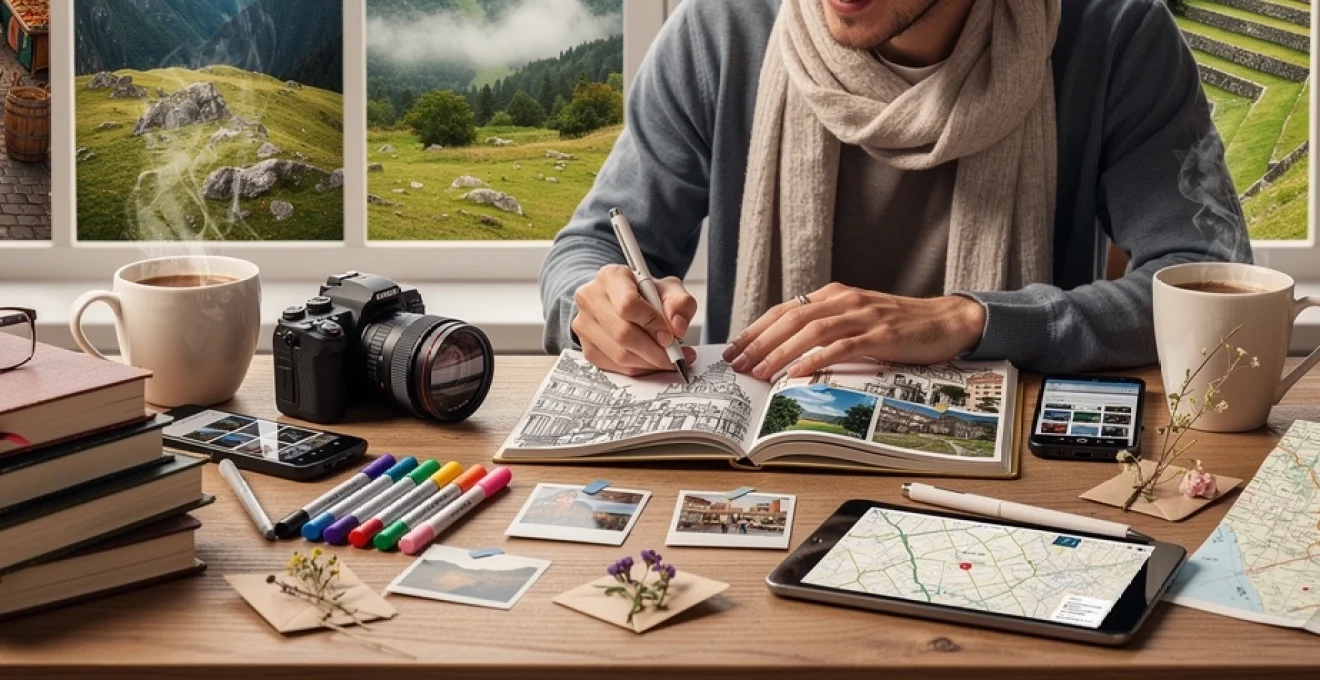
Travel transforms us in ways that extend far beyond the postcards we send home or the photographs we share on social media. While modern technology captures the visual essence of our journeys, something profound happens when you pause to document your experiences through the intimate act of journaling. The practice of reflective travel documentation creates a bridge between momentary experiences and lasting transformation, turning fleeting encounters into permanent sources of wisdom and growth.
Research in cognitive psychology reveals that travellers who maintain detailed journals report significantly higher levels of satisfaction with their experiences and demonstrate enhanced memory retention of cultural encounters. The simple act of putting pen to paper during your adventures activates multiple cognitive processes simultaneously, creating what neuroscientists term “elaborative encoding” – a mechanism that embeds experiences more deeply into long-term memory. This isn’t merely about creating a souvenir; it’s about fundamentally altering how your brain processes and integrates new experiences.
Neuropsychological benefits of reflective travel documentation
Memory consolidation through active recall techniques
The human brain processes approximately 11 million bits of information per second during travel, yet consciously registers only about 40 bits. This overwhelming flood of sensory data explains why many travel memories fade rapidly after returning home. Journaling serves as a cognitive anchor, forcing your mind to actively select, process, and articulate the most meaningful elements of each experience.
When you write about climbing the steps of Angkor Wat at sunrise or navigating the bustling spice markets of Istanbul, you’re engaging in what psychologists call “retrieval practice.” This process strengthens neural pathways associated with those memories, making them more accessible years later. Studies indicate that travellers who journal regularly can recall specific details of their experiences with 73% greater accuracy compared to those who rely solely on photographs or mental notes.
Enhanced mindfulness and Present-Moment awareness during exploration
Travel journaling naturally cultivates mindfulness by requiring you to pause and observe your surroundings with intentional focus. This practice transforms passive tourism into active engagement, encouraging deeper connection with places and people. The act of describing a Venetian sunset or the texture of ancient stones at Machu Picchu forces you to notice details that might otherwise escape attention.
Research demonstrates that travellers who maintain journals report 40% higher levels of present-moment awareness during their journeys. This heightened consciousness extends beyond the writing process itself, influencing how you perceive and interact with new environments throughout your trip. The journal becomes a mindfulness training tool, gradually rewiring your brain to notice subtleties in cultural expressions, architectural details, and human interactions.
Cognitive processing of cultural immersion experiences
Cultural shock and adaptation represent complex neurological processes that benefit tremendously from written reflection. When confronted with unfamiliar social norms, communication styles, or belief systems, your brain struggles to categorise these experiences within existing frameworks. Journaling provides a structured method for processing cultural dissonance and integrating new perspectives into your worldview.
The act of writing about cultural encounters activates the brain’s executive function regions, facilitating critical thinking and perspective-taking abilities. Travellers who document their cultural observations demonstrate measurably improved cultural intelligence scores compared to those who don’t engage in reflective practices. This enhanced understanding proves invaluable not only for future travels but for navigating increasingly diverse professional and social environments at home.
Emotional intelligence development through Cross-Cultural encounters
Travel journaling serves as an emotional laboratory, providing space to explore and understand your reactions to unfamiliar situations. Whether documenting frustration with language barriers in rural Japan or joy at unexpected kindness from strangers in Morocco, written reflection helps you recognise emotional patterns and develop greater self-awareness.
The process of articulating emotional responses to cultural differences enhances empathy and reduces unconscious bias, creating more thoughtful and respectful travellers.
Studies tracking emotional intelligence development show that consistent travel journaling correlates with 35% improvement in empathy scores and 28% enhancement in emotional regulation abilities. These skills prove invaluable in professional contexts, particularly for careers requiring cross-cultural communication or international collaboration.
Strategic journal architecture for maximum travel impact</h2
Multi-modal documentation systems: visual, textual, and sensory integration
Designing your travel journal with multiple modes of expression dramatically increases how much of a trip you actually remember. Instead of relying solely on written descriptions, combining sketches, quick maps, lists, and even symbolic colour codes mirrors how the brain encodes lived experience through different sensory channels. This multi-modal approach to travel journaling transforms a simple notebook into a rich, layered record of your adventures.
Textual entries capture narrative and meaning: what happened, who you met, and how you felt. Visual elements such as thumbnails of a street corner in Prague, a mosque silhouette in Istanbul, or the curve of a mountain ridge in Patagonia engage spatial and visual memory systems. Sensory notes – the smell of cardamom in a market, the humidity on your skin before a monsoon, the specific sound of a tram line – trigger what neuroscientists call “context-dependent recall,” allowing you to re-enter a moment with surprising clarity years later.
To build a multi-modal documentation system, you can designate simple zones on each page: a small box for a sketch, a few lines for “sensory highlights,” and a short reflective paragraph. This structure remains flexible while nudging you to move beyond “we went here, then there” accounts. Over time, you will find that your travel journal reads less like an itinerary and more like a fully embodied memory archive, where your senses and emotions are as present as your words.
Temporal structuring methods: chronological vs. thematic organisation
One of the most strategic choices in travel journaling is how you organise time. A chronological travel journal follows your journey day by day, capturing the unfolding narrative of movement, surprise, and adaptation. This structure is excellent for reconstructing the rhythm of a long trip, understanding how your perceptions evolved, and tracking cause-and-effect patterns: a missed connection in one city that leads to a serendipitous encounter in another, for example.
Thematic organisation, by contrast, cuts across time and focuses on recurring motifs such as “conversations with strangers,” “moments of fear and courage,” or “food that changed my expectations.” This approach is powerful for travellers who want to analyse specific dimensions of their journey, such as how their confidence grew when navigating foreign transport systems or how their assumptions about hospitality shifted across cultures. Thematic journaling also lends itself well to retrospective entries written after you return home, when patterns become clearer.
You do not have to choose one method exclusively. Many experienced travellers use a hybrid model: brief chronological notes during the day, followed by occasional thematic spreads that synthesise a week or an entire destination. Ask yourself: are you primarily trying to remember the sequence of events, or are you more interested in understanding the meaning behind recurring experiences? Your answer can guide the temporal architecture of your travel diary and make your journaling practice more intentional.
Geographic context mapping and location-specific notation techniques
Place is the silent protagonist of every travel story, and effective travel journaling anchors your experiences to specific locations with clarity and precision. Geographic context mapping involves using simple sketches, hand-drawn maps, or coordinates to situate your memories in space. Even a rough outline of a neighbourhood in Istanbul or a hiking route in the Scottish Highlands can later help you recall distances, transitions, and hidden corners that photographs fail to capture.
Location-specific notation techniques might include recording street names, metro lines, GPS coordinates, or landmark references in the margin of your entries. Some travellers highlight place names in a consistent colour or precede them with a small symbol, making it effortless to scan a filled journal and locate all references to, say, “Chiang Mai night markets” or “Tokyo alleyway bars.” This type of geographic tagging boosts spatial memory and helps you reconstruct routes, which is especially useful when sharing recommendations with others or planning a return visit.
You can also integrate simple mapping with emotional or sensory codes. For instance, draw a tiny map of a Tuscan hill town and mark where you felt most at peace, most challenged, or most surprised. This transforms cartography into a personal emotional geography, revealing how specific locations shape your inner state. Over time, your travel journal becomes a customised atlas of experiences rather than a generic list of sights.
Cultural observation frameworks for anthropological recording
Approaching your travel journal as a light, informal field notebook can dramatically elevate the depth of your cultural observations. Instead of simply noting that a place felt “busy” or “friendly,” you can adopt simple anthropological frameworks to structure what you see. This might include paying attention to rituals (daily tea ceremonies, prayer times, market openings), roles (how different generations interact), and spaces (how public squares, cafés, and temples are used by locals versus tourists).
One practical method is to use repeating prompts that you revisit in each new destination. For example: “How do people greet each other?”, “Where do locals gather at the end of the day?”, “How is public space shared or contested?”, or “What roles do street vendors play in the community?”. Writing brief answers to the same set of questions across Prague, Istanbul, Tokyo, and Marrakech generates comparative data and sharpens your cultural literacy.
This kind of structured observation not only enriches your travel journal; it also encourages you to move from passive consumption of culture to active, respectful witnessing. You begin to notice non-verbal cues, power dynamics, and unspoken rules that would otherwise remain invisible. In the long term, your travel diaries become valuable documents of how cities and communities change over time, and they support more ethical, informed travel decisions.
Advanced journaling methodologies for destination-specific experiences
Urban exploration documentation in cities like prague and istanbul
Urban environments present an overwhelming density of stimuli, and without a method, it is easy for city experiences to blur together. In historic cities like Prague and Istanbul, travel journaling benefits from “layered urban mapping” – a technique where you record not only what you see, but also how different layers of time and culture intersect. For instance, you might describe Gothic spires framed by tram cables in Prague, or Ottoman-era mosques surrounded by glass office towers in Istanbul.
A practical approach is to dedicate specific pages to different “layers” of the city: architecture, street life, transportation, street art, and public rituals. During a day of urban exploration, you can jot down short notes or sketches in each category instead of trying to capture everything in a single narrative. Ask yourself: how does the city sound at 6 a.m. compared to midnight? Where does history feel closest to the surface? These targeted questions guide your attention and make your city journal far more textured.
Because cities are also defined by movement, consider tracking your routes through quick diagrams of metro lines, bridge crossings, or hill climbs. These schematic notes turn your urban journal into a kinetic record of how you inhabited the city. Years later, tracing your drawn path across Prague’s Old Town or up Istanbul’s steep streets will often evoke more vivid memories than any static photograph could.
Natural environment recording techniques for patagonia and scottish highlands
When you journal in remote natural environments like Patagonia or the Scottish Highlands, the focus shifts from density of human activity to the scale and rhythm of landscapes. Here, advanced travel journaling techniques prioritise environmental detail, weather patterns, and your physical state. Recording wind direction, cloud formations, changing light, and trail conditions may sound technical, but these small notes anchor the emotion of standing in vast, wild spaces.
One effective method is the “sit spot” entry: choose a single location – a lakeside rock, a mountain ridge, a glen – and spend 10–15 minutes documenting only what you can see, hear, and feel without moving. Describe the pattern of waves, the colour gradients in the sky, the way your breathing changes at altitude. This kind of deep, sensory-focused journaling is like turning up the resolution on your experience of nature, and it often becomes a form of meditation.
Because multi-day treks can be physically demanding, your travel journal can also serve as a log of resilience and adaptation. Briefly track energy levels, challenges, fears, and small victories (“crossed my first suspension bridge despite vertigo”). Over time, these entries reveal how wilderness travel reshapes your sense of capability. When you later face stress back home, re-reading how you navigated a stormy pass in Patagonia or an unexpected whiteout in the Highlands can provide tangible evidence of inner strength.
Cultural heritage site analysis methods for angkor wat and machu picchu
Iconic cultural heritage sites such as Angkor Wat and Machu Picchu are often experienced in crowds and under time pressure, which can make them feel strangely distant despite their grandeur. Strategic travel journaling helps you move beyond the postcard view into a more personal, analytical relationship with these places. Think of your notebook as a lens that slows you down and helps you ask better questions.
Begin by dividing your entry into three zones: physical description (what you literally see and hear), historical context (key dates, stories, or legends you learn), and personal reflection (how the site affects you emotionally or philosophically). At Angkor Wat, you might write about the precise carvings on a bas-relief, note the shift from Hindu to Buddhist iconography, and then reflect on how empires rise and fall. At Machu Picchu, you could describe the stonework, log what you learn about Inca astronomy, and then examine your feelings about human ingenuity and fragility in such a dramatic landscape.
Another advanced method is to create “before and after” entries. Before visiting, write down what you expect, based on films, social media, or guidebooks. After your visit, use your travel journal to compare expectation with reality. Where were you surprised? What did no one talk about? This comparative journaling surfaces your assumptions and reveals how direct experience reshapes your understanding of heritage and authenticity.
Gastronomic journey mapping in tuscany and tokyo food districts
Food is one of the most powerful gateways into culture, and dedicated gastronomic journaling can transform meals from mere consumption into meaningful experiences. In regions like Tuscany or Tokyo’s food districts, every plate carries layers of history, geography, and social ritual. Capturing this in your travel journal involves more than rating how “delicious” something was; it means mapping flavours, contexts, and stories.
An effective technique is to create a simple table or structured entry for significant meals, with fields like: where you ate, who you were with, what you ordered, how it was prepared, and what the experience meant to you. For a Tuscan dinner, you might note the particular olive oil, the origin of the wine, and how the pace of the meal encouraged long conversation. In a Tokyo alleyway izakaya, you could record the sequence of small dishes, the etiquette of ordering, and the sounds of after-work crowds around you.
Over time, these gastronomic notes form a personalised “flavour map” of your travels. You begin to notice patterns: perhaps you are drawn to fermented foods, communal dining, or street food scenes where the boundary between cook and guest blurs. This awareness can guide future travel choices and deepen your appreciation of global food cultures. It also makes your travel journal a surprisingly practical resource when friends ask for recommendations or when you attempt to recreate a favourite dish back home.
Digital integration tools for modern travel journaling
While traditional pen-and-paper travel journals remain powerful, digital tools can extend and complement your practice when used intentionally. Smartphone note apps, voice memos, and lightweight tablets allow you to capture observations in real time, even when conditions are not ideal for writing. For example, recording a quick audio reflection while walking through a bustling bazaar preserves the ambient soundscape and your immediate reactions, which you can later transcribe or summarise in your physical journal.
Location-based apps and digital maps make geographic tagging more precise. You can pin key moments on a map as you move, attach brief notes or photos, and later reference these pins when expanding your entries. Some travellers use cloud-based notebooks to create a parallel digital travel journal with searchable tags like “architectural details,” “unexpected kindness,” or “language mistakes.” This hybrid system combines the depth of handwritten reflection with the efficiency of digital organisation and retrieval.
However, it is worth being mindful of the potential downside of screens during travel. The goal of integrating digital tools into your travel journaling is to deepen presence, not to fragment your attention. Try establishing simple boundaries: perhaps you only use your phone for quick capture and navigation, and reserve deeper reflection for offline time in the evening with your notebook. By consciously designing a digital–analog balance, you can enjoy the best of both worlds without letting constant connectivity dilute the transformative potential of your adventures.
Long-term retrospective analysis and personal growth tracking
The true power of travel journaling often reveals itself months or years after a trip ends. When you revisit old diaries, you are not only remembering destinations; you are observing past versions of yourself in motion. This retrospective analysis allows you to track how your reactions to unfamiliar cultures, challenges, and serendipitous encounters have evolved over time. In effect, your collection of travel journals becomes a longitudinal study of your own growth as a traveller and as a person.
One powerful practice is to schedule periodic “review sessions” with your past travel journals – perhaps once a year. During these sessions, you can highlight recurring themes: fears you faced more than once, types of places that consistently energise or drain you, or patterns in the kind of people you connect with on the road. You might notice, for example, that urban chaos once overwhelmed you but later entries show increasing comfort and curiosity in similar environments. Recognising these shifts reinforces a sense of progress and resilience.
Travel journaling also supports future goal-setting. As you analyse your past experiences, you can identify gaps in your explorations – types of destinations you avoided, cultural practices you did not fully engage with, or personal limits you accepted without question. Your next journal can then include intentional prompts such as “seek one meaningful conversation with a local each day” or “try a form of transport I have never used before.” In this way, travel becomes not just a series of isolated trips, but an ongoing, purposeful curriculum in which each journey builds on lessons recorded in the last.