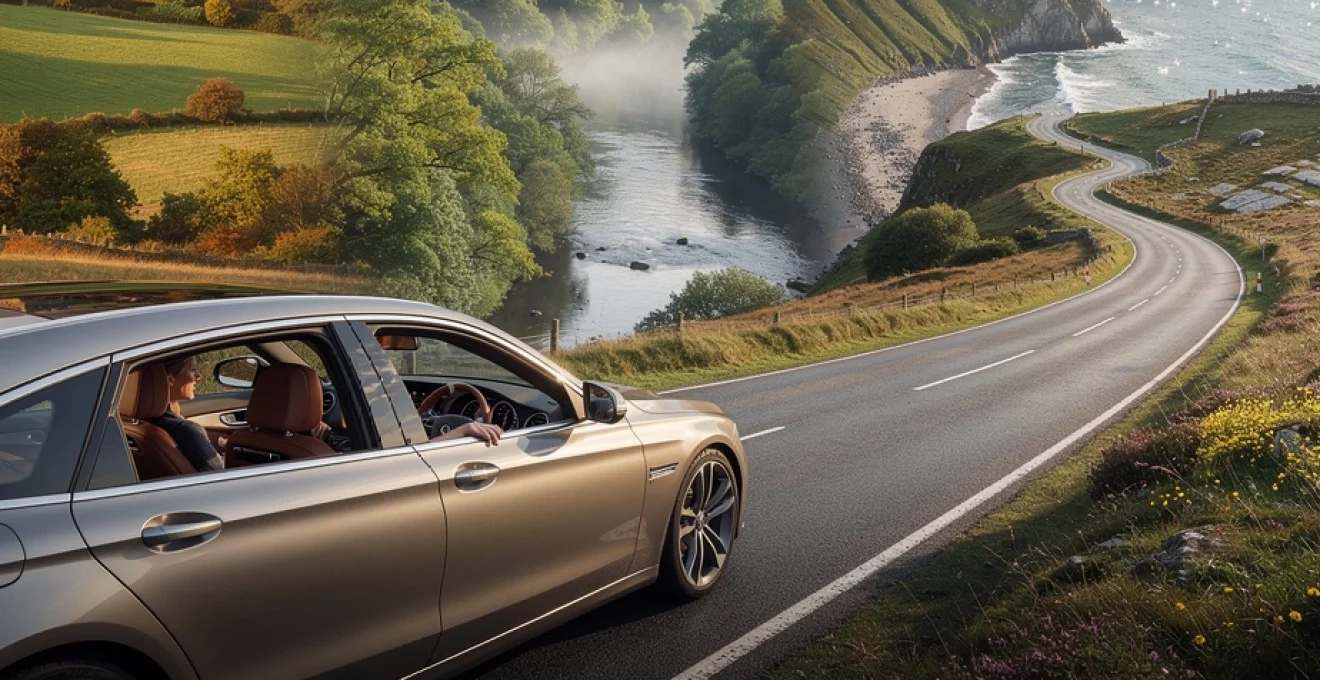
The human brain craves novelty and complexity, particularly when it comes to visual stimulation during travel. When you embark on a journey through diverse topographical features, your neural pathways activate in ways that monotonous highway stretches simply cannot achieve. This phenomenon extends far beyond simple aesthetic appreciation—it represents a fundamental interaction between environmental psychology, sensory perception, and the deep-seated human need for exploration. Modern research demonstrates that landscape diversity triggers enhanced cognitive engagement, improved memory formation, and increased emotional resonance with the travel experience itself.
Road journeys through varied terrain create what environmental psychologists term “restorative experiences,” where the mind naturally shifts between focused attention and soft fascination. Unlike virtual reality route planning systems that simulate environments, real-world landscape transitions provide authentic sensory feedback that engages multiple cognitive systems simultaneously. The interplay between anticipation, discovery, and reflection transforms ordinary transportation into meaningful exploration, creating lasting memories that extend far beyond the destination itself.
Psychological impact of topographical diversity on driver engagement
The relationship between landscape variety and psychological engagement operates through several interconnected mechanisms that influence both conscious awareness and subconscious processing. When drivers encounter dramatic topographical changes, their brains must continuously adapt visual processing systems, spatial orientation mechanisms, and attention allocation strategies. This constant neural adjustment prevents the mental fatigue commonly associated with monotonous driving conditions, maintaining alertness levels significantly higher than those experienced on uniform terrain.
Cognitive load theory applied to scenic route navigation
Cognitive load theory suggests that moderate environmental complexity optimises mental engagement without overwhelming processing capacity. Scenic routes through varied landscapes present information at precisely the right complexity level—challenging enough to maintain interest while remaining manageable for safe navigation. The theory explains why drivers report feeling more alert and engaged when traversing routes that transition between valleys, hillsides, and plateaus compared to extended motorway journeys.
Research indicates that optimal cognitive load occurs when environmental stimuli change every 30-45 seconds, aligning perfectly with natural landscape transitions found in areas like the Scottish Highlands or Yorkshire Dales. This timing allows the brain to process and appreciate each visual scene while anticipating upcoming changes, creating a rhythm that enhances both safety and enjoyment.
Attention restoration theory through landscape transitions
Attention Restoration Theory identifies four key elements that natural environments provide for mental recovery: being away, fascination, extent, and compatibility. Varied landscapes excel in delivering all four components simultaneously. The being away element activates when familiar urban or suburban environments give way to contrasting natural settings. Fascination emerges through the effortless engagement with changing scenery, while extent manifests in the perceived vastness of diverse topographical features.
The compatibility factor proves particularly significant in diverse landscapes, where human evolutionary preferences for varied terrain align with modern travel experiences. Studies show that people experience measurable stress reduction when transitioning between different landscape types within a single journey, suggesting that variety itself serves as a restorative mechanism.
Visual stimulation patterns in mountainous terrain versus coastal roads
Mountainous terrain and coastal roads create distinctly different visual stimulation patterns that engage separate neural networks. Mountain driving activates spatial processing centres more intensively due to three-dimensional navigation challenges and varying elevation perspectives. The brain must constantly recalibrate depth perception, distance estimation, and spatial relationships as viewpoints change with altitude and direction.
Coastal routes, by contrast, stimulate pattern recognition systems through repetitive wave movements, cloud formations, and horizon interactions. The interplay between static landforms and dynamic seascapes creates visual rhythms that promote meditative states while maintaining sufficient complexity to prevent boredom. This dual engagement explains why coastal drives often feel both relaxing and stimulating simultaneously.
Neurological response to elevation changes along alpine routes
Elevation changes trigger specific neurological responses that extend beyond visual processing to encompass vestibular system activation and atmospheric pressure sensitivity. As altitude increases, the brain receives multiple environmental cues indicating spatial displacement: changing air pressure, temperature variations, and modified acoustic properties. These physiological changes create embodied awareness of landscape transition that purely flat terrain cannot provide.
Alpine routes demonstrate this effect most dramatically, where elevation gains of several hundred metres occur over relatively
short distances. Drivers experience a shifting sense of orientation as valleys open into high passes and then descend again into sheltered glens. Neurologically, these repeated elevation cycles stimulate the hippocampus and parietal lobes, reinforcing spatial memory and route learning. This is one reason why journeys through alpine or highland regions often feel more vivid and easier to recall in detail than featureless motorway drives.
There is also a subtle interplay between physiological arousal and perceived risk. Steep gradients, hairpin bends, and exposed ridgelines increase heart rate and sharpen attention, but when managed within safe limits they contribute to a heightened sense of presence rather than anxiety. The result is an immersive driving experience where you feel not just as if you are travelling through a landscape, but actively participating in its three-dimensional form.
Geographical transition zones and their sensory enhancement properties
While dramatic peaks and coastlines capture attention, it is often the transitions between landscape types that create the deepest immersion. Geographical transition zones—where forest gives way to moorland, river valleys climb towards high plateaus, or coastal plains rise into upland ridges—act as natural chapters in a road journey. Each transition recalibrates your senses, offering fresh visual, auditory, and tactile information.
From a wayfinding and spatial cognition perspective, these edges between environments are powerful landmarks. They signal progress along the route, provide reference points for mental maps, and create a narrative structure for the journey. Instead of a single continuous scene, you move through a sequence of distinct sensory worlds, each with its own microclimate, soundscape, and emotional tone.
Microclimate variations between forest canopies and open moorland
One of the most noticeable geographical transitions in Britain occurs when you emerge from dense woodland onto open moorland or fell. Under a forest canopy, light is filtered, wind is softened, and humidity often rises. As you drive, shadows move quickly across the road surface, dappled light plays through leaves, and the air temperature can feel several degrees cooler than in open country. Your body subconsciously registers these microclimate cues, helping to anchor each stage of the journey in memory.
When the trees thin and you rise onto moorland, the microclimate flips. Wind becomes a constant companion, visibility expands, and temperature may drop again despite the apparent openness. In places like the North York Moors or the high tops above the Yorkshire Dales, this shift can feel like stepping from an interior room into a vast outdoor amphitheatre. For drivers and passengers, such changes break monotony, re-energise attention, and deepen the sense of immersion by making the environment feel alive and responsive.
Acoustic landscape changes from river valleys to highland plateaus
Sound plays a quieter but equally powerful role in making a road journey more immersive. In river valleys, especially in regions like Snowdonia, the Lake District, or the Trossachs, water dominates the acoustic landscape. Even with windows closed, you may sense the presence of rivers and cascades in the soft roar that rises and falls as the road weaves close to or away from the water. Bridges, tunnels of overhanging trees, and stone walls further shape how sound reflects back into the vehicle.
As you ascend to highland plateaus or open moorland, the acoustic texture changes. The constant murmur of water is replaced by wind, distant sheep calls, or the occasional mechanical echo from another vehicle crossing an exposed ridge. With fewer reflective surfaces, sound feels thinner and more diffuse, reinforcing the perception of space and altitude. These shifts in acoustic landscape function like an invisible soundtrack to the journey, subtly signalling each new chapter and helping you feel more present in the places you pass through.
Olfactory markers distinguishing coastal salt air from heather-scented highlands
While we often focus on what we can see from the windscreen, smell is one of the most powerful anchors of place memory during a road journey. Coastal drives along the Cornish, Welsh or Northumberland coasts carry the unmistakable tang of salt air, seaweed, and tidal mudflats—particularly noticeable when you pause at lay-bys, harbours, or cliff-top car parks. This marine scent profile not only signals proximity to the sea but also evokes strong emotional associations with holidays, freedom, and open horizons.
Contrast this with the olfactory markers of highland and moorland regions. In late summer and early autumn, heather-clad uplands in the Cairngorms or North York Moors release a faintly sweet, resinous aroma, especially after rain. Peaty ground, bracken, and conifer plantations each contribute distinct smells, building a layered scent-scape that changes with weather and season. When your route moves between coast and upland—say, from the Fife coastline into the Highlands—you experience a clear olfactory transition that deepens immersion by engaging memory and emotion alongside vision.
Tactile temperature gradients experienced through glen coe to loch lomond
Temperature is typically measured in numbers on a dashboard, but along varied routes it is also experienced as a tactile sensation on the skin. Consider a classic Scottish journey: passing through the dramatic, glacier-carved walls of Glen Coe and then descending towards the more sheltered shores of Loch Lomond. On the high pass, wind chill and exposure can make even a mild day feel sharp and bracing; you might find yourself reaching instinctively for an extra layer during a brief stop.
As you drop into lower, wooded valleys and approach large bodies of water, the air often feels softer and more humid. Sun-warmed rock faces radiate accumulated heat, while forested sections provide pockets of cooler shade. These temperature gradients, sometimes shifting noticeably over a matter of kilometres, act as tactile confirmation that the landscape is changing around you. For road-trippers who enjoy driving with windows cracked or roofs down, this tactile dimension transforms a drive from a purely visual experience into something fully multisensory.
Iconic british landscape corridors for maximum journey immersion
Some routes in Britain are celebrated not just for their destinations but for the sustained variety of landscapes they offer in a single, continuous drive. These landscape corridors thread together coastlines, highlands, forests, and historic settlements, creating journeys where immersion builds kilometre by kilometre. They are ideal for travellers who want to experience the psychological benefits of varied terrain without constant backtracking or detours.
Take Scotland’s west coast routes, for instance. A journey that weaves from Loch Lomond through Glen Coe, onwards to Fort William and the Road to the Isles towards Mallaig, delivers an almost textbook progression of topographical diversity: inland lochs, steep-sided glens, open moorland, sea lochs, and Atlantic coastline. In England, the A591 through the Lake District connects Windermere, Grasmere, Thirlmere, and Keswick in a ribbon of lakeside sections, tight wooded valleys, and high passes that exemplify how constant landscape change keeps drivers engaged. For those planning an immersive British road trip, prioritising such corridors ensures that every hour on the road feels purposeful and sensorially rich, rather than simply a means to an end.
Temporal dynamics of seasonal landscape metamorphosis
Varied landscapes are not static backdrops; they evolve through the year in ways that can radically transform a familiar route. Seasonal metamorphosis adds a fourth dimension—time—to the immersive qualities of a road journey. The same stretch of road driven in October and again in May can feel like two entirely different experiences, even though the topography is unchanged.
This temporal variation has practical and psychological implications. On the practical side, drivers must adapt to changing daylight hours, road conditions, and weather patterns. Psychologically, each season offers its own palette of colours, light, and textures that can either soothe or stimulate. By planning routes with seasonal change in mind, you can align your journey with the kind of immersion you are seeking—whether that is the reflective quiet of winter landscapes or the energising vibrancy of summer bloom.
Autumnal colour progression through cotswolds stone villages
Autumn is perhaps the most visually dramatic season for road journeys through Britain’s rural heartlands, and few areas showcase this better than the Cotswolds. Honey-coloured stone villages, already rich in texture, become framed by trees shifting from green to ochre, amber, and deep crimson. As you drive from one valley to the next, you can see the colour change progress at different altitudes and exposures, almost like watching a slow-motion wave of pigment wash across the landscape.
The Cotswold lanes that thread through beech woods and along hedgerows provide constant micro-transitions: sudden tunnels of gold leaves, open views over patchwork fields, and village greens carpeted in fallen foliage. For drivers and photographers alike, this progression creates a sense of anticipation—what shade will the next hilltop copse or riverside avenue reveal? The combination of architectural harmony and seasonal colour amplifies route memorability, turning even short journeys between villages into rich visual narratives.
Spring emergence patterns along yorkshire dales limestone pavements
In the Yorkshire Dales, spring is less about a single dramatic burst and more about a sequence of subtle emergences that reward attentive travellers. Limestone pavements around Malham and Ribblesdale, stark and monochrome in winter, begin to soften as mosses, saxifrages, and early wildflowers colonise the grykes and clints. Seen from the road, these changes appear first as a green haze on previously grey slopes, then as distinct patches of colour edging drystone walls and verges.
As lambs appear in the fields and rivers swell with snowmelt, the entire landscape takes on a sense of renewal that is almost kinetic. Driving these valleys in spring, you are not just moving through space; you are moving through a biological process unfolding in real time. This dynamic quality deepens immersion by making each journey feel time-specific—you are witnessing a moment in the landscape’s annual cycle that will look and feel different only a few weeks later.
Winter light quality transformation across northumberland’s hadrian’s wall country
Winter often discourages long drives, yet it can be one of the most rewarding times to explore open, historic landscapes like Hadrian’s Wall Country in Northumberland. With leaves off the trees and low-angled sunlight stretching shadows across the fells, the underlying form of the land becomes dramatically apparent. Earthworks, Roman forts, and the undulating line of the Wall itself stand out in crisp relief, especially on frosty mornings or after a light dusting of snow.
The quality of winter light—cool, slanting, and often rapidly changing—transforms even short sections of road into cinematic sequences. Clouds race across wide skies, shafts of sunlight pick out isolated farms or crags, and dusk arrives with a blue-grey wash that feels both austere and peaceful. For drivers, this heightened contrast and clarity help with depth perception and spatial awareness, while also creating a timeless atmosphere that draws you into the region’s layered history.
Summer wildflower succession in peak district moorland ecosystems
In the Peak District, summer immersion is driven as much by what happens at ground level as by sweeping vistas. Moorland plateaus, which may appear sombre and uniform in winter, become hosts to a rolling succession of wildflowers and grasses from late spring through high summer. Early in the season, cotton grass and bilberry provide delicate splashes of white and green; later, heather blooms shift entire hillsides into shades of purple and pink.
Driving across routes like the Snake Pass or the Cat and Fiddle, you witness these changes week by week: verges brimming with foxgloves, meadows exploding with buttercups and clover, and distant slopes gradually taking on their heather cloak. When combined with longer daylight hours and warmer temperatures, this botanical rhythm makes summer road journeys feel expansive and generous. You are surrounded not just by static scenery but by living systems at their peak, reinforcing the sense that the route itself is part of a larger ecological story.
Architectural heritage integration within natural landscape matrices
One reason British road journeys feel uniquely immersive is the way built heritage is woven into the natural landscape. Villages, farmsteads, castles, and industrial relics rarely sit apart from their surroundings; instead, they echo local geology, climate, and land use. For drivers, this integration creates a layered experience where each view offers both environmental and cultural information in a single glance.
Consider how Cotswold stone cottages mirror the colours of nearby limestone outcrops, or how slate-roofed farmhouses in the Lake District seem to grow out of the valley sides. In Northumberland, medieval castles perch on volcanic crags or dune-backed headlands, turning coastal drives into journeys through both time and space. As you move between regions, these architectural signatures shift—red sandstone in the Borders, whitewashed crofts in the Hebrides, half-timbered houses in the Welsh Marches—providing constant visual cues that you have entered a new cultural as well as geographical zone.
From an immersive travel perspective, this fusion of architecture and landscape acts as a form of narrative continuity. Historic bridges frame river crossings, church towers punctuate skylines, and dry-stone walls trace field patterns that have survived for centuries. You are not only navigating topography; you are tracing human responses to that topography over long periods. For many travellers, this sense of continuity deepens emotional engagement with the route, turning a simple drive into a journey through living heritage.
Route planning methodologies for optimal landscape diversity exposure
Designing a road journey that truly leverages varied landscapes is both an art and a science. Rather than simply selecting the fastest route between two points, you can use a mix of digital tools, map-based planning, and on-the-ground flexibility to maximise landscape diversity exposure. The goal is to create an itinerary that balances efficient progress with regular shifts in topography, land use, and sensory character.
A useful starting point is to identify natural transition zones and iconic landscape corridors on a physical or digital map. Look for routes that cross watersheds, climb from valleys to uplands, or run parallel to changing coastlines. Where possible, link A-roads and well-maintained B-roads that traverse these shifts, using motorways only for unavoidable connections. You might, for example, choose to drive between London and Edinburgh not purely via the M1 and A1, but by detouring through the Peak District and Yorkshire Dales, accepting a longer travel time in exchange for richer immersion.
It can help to think of your journey as a curated sequence of “landscape chapters.” Aim to experience at least three distinct landscape types in a full-day drive—perhaps lowland farmland, upland moor, and coastal fringe. Navigation apps and sat nav systems increasingly allow for scenic route options or custom waypoints, making it easier to encode these preferences into your planning. For those who enjoy more experimental travel, leaving short sections of the route unplanned can also introduce serendipitous discoveries, provided you maintain clear wayfinding anchors and realistic time buffers.
Finally, consider temporal as well as spatial diversity. When you plan departure times to catch sunrise over an estuary, midday light in high moors, and golden hour in a wooded valley, you compound the immersive impact of the landscapes you traverse. The combination of varied terrain, shifting light, and seasonal change turns a road journey into an experience that engages the full spectrum of your senses and cognitive capacities. In an age when virtual navigation tools can simulate almost any route, this carefully designed real-world variety remains one of the most rewarding ways to travel.