Few nations on Earth can match the sheer geographical drama that Chile presents to visitors and researchers alike. This remarkable country stretches along South America’s western edge like a ribbon, compressing an extraordinary range of climates, ecosystems, and geological phenomena into a territory that defies conventional geographical logic. From hyperarid deserts where rainfall hasn’t been recorded in living memory to glacial systems that rival Antarctica’s ice fields, Chile’s environmental diversity represents one of the planet’s most compelling natural laboratories. The country’s unique shape and position create conditions where you can experience Mediterranean warmth, tropical stargazing, temperate rainforests, and subpolar landscapes without ever crossing an international border. This isn’t merely tourist marketing—it’s a geographical reality that has fascinated scientists, adventurers, and nature enthusiasts for generations.
Geographical positioning: chile’s unique 4,300-kilometre latitudinal extension
Chile’s extraordinary length-to-width ratio creates what geographers consider one of the most unusual national territories on the planet. Stretching approximately 4,300 kilometres from north to south whilst averaging merely 175 kilometres in width, the country spans more than 38 degrees of latitude. To put this in perspective, that’s equivalent to the distance from Denmark to the Sahara Desert, or from Canada’s Hudson Bay to the Gulf of Mexico. This remarkable extension means Chile encompasses climate zones that would normally require transcontinental travel to experience.
The country’s western boundary follows the Pacific Ocean’s coastline, whilst the eastern border traces the formidable Andes mountain range, creating a natural corridor that concentrates diverse climatic influences. This positioning between ocean currents and high-altitude geography generates microclimates and transitional zones that shift dramatically over relatively short distances. The Humboldt Current, flowing northward along Chile’s coast, brings cold Antarctic waters that profoundly influence coastal temperatures and precipitation patterns, particularly in the north where it contributes to the Atacama Desert’s extreme aridity.
Chile’s latitudinal span encompasses five distinct climate classifications according to the Köppen system: desert, Mediterranean, oceanic, tundra, and even ice cap conditions in the far south. This diversity isn’t merely academic—it translates into ecosystems ranging from cacti-studded valleys to moss-draped temperate rainforests, and from sun-scorched salt flats to glacial fjords where icebergs calve into frigid waters. Few countries offer such compressed geographical variety, making Chile an exceptional case study for understanding how latitude, ocean currents, and topography interact to create environmental diversity.
Atacama desert climate zones and extreme aridity phenomena
The Atacama Desert holds the distinction of being Earth’s driest non-polar desert, with some weather stations in the region having never recorded measurable rainfall since monitoring began. This hyperaridity results from a unique combination of geographical factors: the rain shadow effect of the Andes Mountains to the east, the cold Humboldt Current offshore, and a persistent subtropical high-pressure system that prevents cloud formation. The result is an environment so inhospitable to moisture that it serves as an analogue for Mars research, with NASA using Atacama locations to test equipment designed for the Red Planet.
Average annual precipitation in the driest sections measures less than 1 millimetre, with some areas receiving no measurable rain for decades at a time. Yet paradoxically, this desert supports life through coastal fog called camanchaca, which provides sufficient moisture for specialised plant communities and insects adapted to extract water from air. The desert’s extreme dryness also preserves archaeological materials with remarkable fidelity—pre-Columbian textiles, mummies, and wooden artefacts remain intact after centuries, offering anthropologists unprecedented insights into ancient Andean cultures.
Valle de la luna and valle de la muerte: hyperarid landform formations
The Valle de la Luna (Moon Valley) exemplifies the Atacama’s otherworldly landscapes through its bizarre rock formations sculpted by wind erosion over millions of years. Salt deposits, sand dunes, and stone formations create a terrain that genuinely resembles lunar surfaces, with sharp ridges, deep crevasses, and amphitheatre-like depressions. The valley’s substrate contains high concentrations of gypsum and various salts that crystallise into intricate patterns
that glint in the fierce desert light. Nearby, Valle de la Muerte (Death Valley) presents an even harsher expression of hyperarid geomorphology, with razor-sharp ridges, steep dunes, and deeply incised ravines where water has been absent for millennia. These landforms have been shaped primarily by thermal fracturing, salt weathering, and aeolian (wind-driven) processes rather than by fluvial erosion, making them a textbook example of desert landscape evolution. For visitors and researchers, walking these valleys is akin to traversing a time capsule where geological processes are exposed with minimal vegetation or soil cover to hide them.
From a scientific perspective, Valle de la Luna and Valle de la Muerte offer ideal sites to study sedimentary structures, evaporite deposits, and the mechanical behaviour of rocks under extreme dryness and temperature fluctuations. Planetary scientists use these hyperarid basins to refine remote-sensing techniques and test hypotheses about landscape formation on Mars and other rocky planets. For travellers, structured sunset tours provide an accessible way to observe colour changes in the rock formations as the sun dips below the Andes—an experience that vividly illustrates how light, mineral content, and atmospheric clarity interact in one of the clearest skies on Earth.
El tatio geysers: high-altitude geothermal activity at 4,320 metres
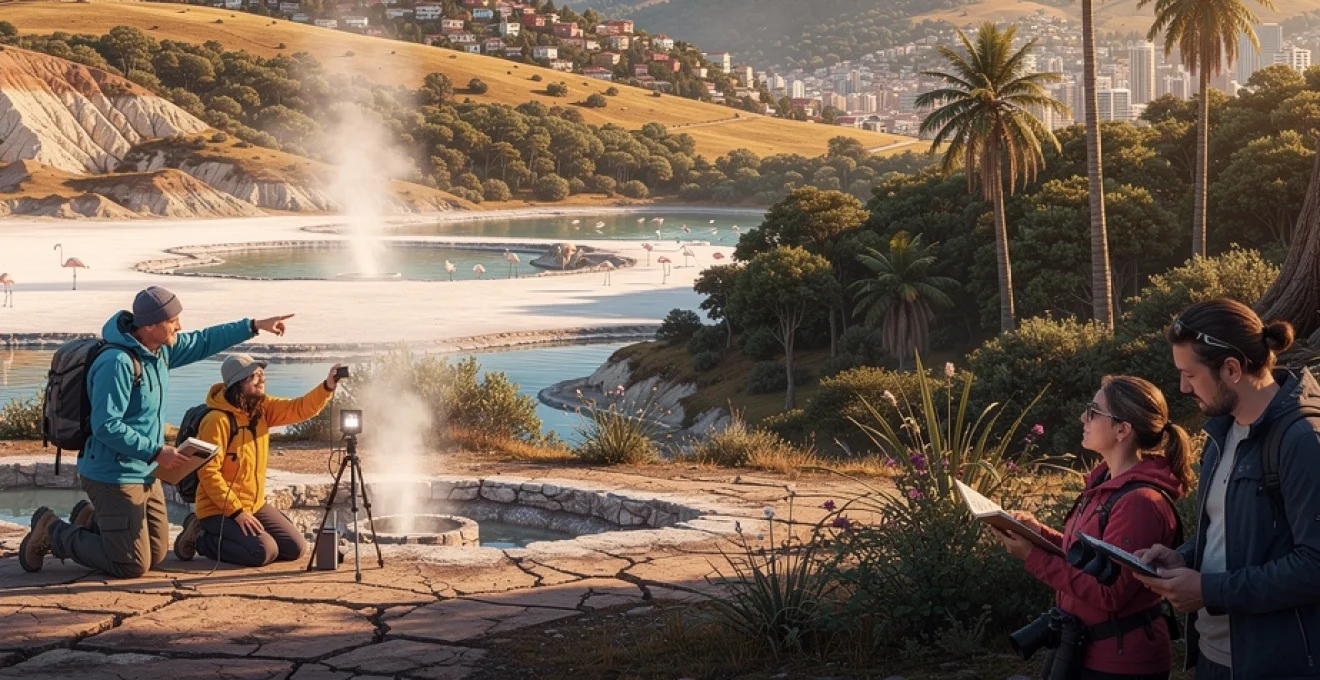
Rising before dawn to visit the El Tatio geyser field means venturing into one of the highest-altitude geothermal systems accessible to non-specialists anywhere in the world. Located at approximately 4,320 metres above sea level, El Tatio comprises more than 80 active geysers, hundreds of fumaroles, and numerous hot springs spread across a broad Andean plateau. The combination of frigid early-morning air and superheated groundwater creates towering steam columns that can reach up to 10 metres, especially visible at sunrise when temperature contrasts are greatest. This setting provides a living laboratory for studying how groundwater circulates through fractured volcanic rocks and interacts with magmatic heat sources.
Geochemists analyse the mineral-rich waters of El Tatio to understand the transport of elements such as silica, arsenic, and lithium in geothermal systems—data that have applications ranging from renewable energy development to planetary exploration. The terraces and sinter deposits surrounding the geysers record long-term patterns of flow and precipitation, much like tree rings record climate history. For travellers, acclimatisation is crucial due to the extreme altitude; pacing yourself, staying hydrated, and following local guidance help you enjoy the spectacle safely. The journey to El Tatio also offers opportunities to observe high-Andean fauna such as vicuñas, vizcachas, and Andean flamingos along the way, underscoring how life adapts even in such harsh thermal and atmospheric conditions.
Atacama salt flats: evaporitic mineral deposits and flamingo ecosystems
The Atacama’s salt flats, or salars, are among the most striking expressions of long-term evaporation and closed-basin hydrology anywhere on the planet. Over millions of years, intermittent inflows of mineral-laden waters from surrounding mountains have accumulated in endorheic basins where evaporation far exceeds precipitation. The result is thick crusts of halite, gypsum, and other evaporites that form polygonal patterns and jagged ridges across the desert floor. Salar de Atacama, the largest of these basins, covers roughly 3,000 square kilometres and hosts some of the world’s richest lithium brine deposits, making it central to global debates about sustainable resource extraction and climate-transition minerals.
Despite the apparent barrenness, these saline environments support productive wetlands and lagoons along their margins. In places such as Laguna Chaxa and other sectors of the Los Flamencos National Reserve, shallow, hypersaline waters host dense populations of brine shrimp and microalgae, which in turn sustain three flamingo species: the Andean, Chilean, and James’s flamingos. These birds rely on specific water depths and salinity ranges, making them sensitive indicators of hydrological change. For visitors, designated observation platforms and boardwalks ensure minimal disturbance while offering close views of feeding and courtship behaviour. Understanding these salt flats means appreciating how geology, hydrology, and biology intertwine in one of the driest environments on Earth.
Alma observatory: astronomical research in zero-humidity conditions
High above the Atacama’s already elevated plateau, the Atacama Large Millimeter/submillimeter Array (ALMA) sits at about 5,000 metres on the Chajnantor plateau—one of the best locations on Earth for observing the cold universe. At these wavelengths, even trace amounts of atmospheric water vapour can distort signals, so the Atacama’s near-zero humidity and high altitude are critical. ALMA comprises 66 high-precision antennas that can be configured over distances of up to 16 kilometres, effectively creating a giant virtual telescope capable of resolving structures in distant galaxies, protoplanetary disks, and star-forming regions. This facility has already contributed to landmark discoveries, including detailed images of planet formation and measurements of complex organic molecules in space.
For Chile, ALMA symbolises how the country’s extreme geography can be leveraged for cutting-edge science. More than 70% of the world’s large telescopes are projected to be operating in Chile by 2030, consolidating its status as the “international capital of astronomy.” While access to the high site is restricted to scientists and support staff due to safety and health concerns, public visitors can tour the operations support facility at lower altitude near San Pedro de Atacama. For anyone interested in how Earth’s most extreme deserts enable us to understand the universe, ALMA encapsulates the link between local conditions and global scientific insight.
Central mediterranean climate and biodiversity hotspots
Moving south from the Atacama, Chile transitions into a central zone dominated by a Mediterranean climate—mild, wet winters and hot, dry summers—that ranks among the world’s key biodiversity hotspots. This band, centred roughly between 30° and 37° south, includes major urban centres such as Santiago and Valparaíso, as well as the country’s principal agricultural valleys. Mediterranean-climate regions cover less than 5% of Earth’s land surface yet harbour a disproportionate share of endemic plant species, and central Chile is no exception. Here, high levels of endemism coexist with intense human land use, making conservation planning particularly challenging and urgent.
For travellers, this region often provides their first impression of Chile: rolling vineyard-covered hills, coastal scrublands, and foothill forests that turn green with winter rains. For scientists, it offers a natural laboratory to study how vegetation adapts to pronounced seasonal water stress and how fire regimes shape ecosystem structure. If you have ever wondered how such a relatively narrow strip of land can support both world-class wine production and unique native forests, the answer lies in this Mediterranean climate and its complex interaction with topography and ocean currents.
Chilean matorral: endemic sclerophyll vegetation ecosystems
The dominant natural vegetation of central Chile’s lowlands and foothills is the Chilean matorral, a dense shrubland characterised by sclerophyll (hard-leaved) evergreen species. Much like the maquis of the Mediterranean Basin or California’s chaparral, the matorral has evolved to cope with hot, dry summers and nutrient-poor soils. Species such as Quillaja saponaria (soapbark tree), Peumus boldus (boldo), and various Lithraea and Cryptocarya species exhibit thick, waxy leaves that reduce water loss and deep root systems that tap into scarce moisture. These physiological adaptations illustrate how plants “engineer” their own survival in seasonal drought, much like well-designed buildings manage heat and ventilation in extreme climates.
Ecologists regard the Chilean matorral as one of the world’s priority conservation ecosystems because of its high endemism and the intense pressure it faces from urban expansion, agriculture, and exotic tree plantations. Less than 10% of original matorral communities remain in relatively intact condition, and many of the remaining fragments are isolated. For visitors driving between Santiago and coastal cities or wine regions, patches of dark green, scrubby vegetation often represent these last vestiges. Engaging with local conservation initiatives—whether through guided walks, visits to protected areas, or supporting land trusts—offers a practical way to help safeguard this uniquely Chilean ecosystem while gaining insight into how plants and animals adapt to Mediterranean climate stress.
Valparaíso and santiago microclimates: coastal versus andean influences
Although Santiago and Valparaíso lie barely 100 kilometres apart, their climates feel strikingly different thanks to the interplay of altitude, distance from the sea, and cold ocean currents. Valparaíso, perched on steep hills above the Pacific, experiences cooler, more humid conditions moderated by the Humboldt Current. Coastal fog and low clouds frequently blanket the city in the mornings, burning off by afternoon to reveal bright skies and ocean views. Temperatures remain relatively stable year-round, rarely reaching the extremes observed inland. This maritime influence creates microclimates that support coastal scrub, dune ecosystems, and even small pockets of native forest on protected slopes.
Santiago, by contrast, sits in an inland basin at roughly 500 metres above sea level, encircled by the Andes and coastal ranges. This topographic enclosure amplifies temperature extremes: summer afternoons can exceed 30°C, while winter nights occasionally bring frost. Air inversions can trap pollution, creating air quality challenges for the metropolitan area, especially during the dry season. Yet even within Santiago, microclimates abound—riverside corridors, urban parks, and hilltops such as Cerro San Cristóbal exhibit different temperature and humidity profiles. For travellers planning a central Chile itinerary, understanding these microclimates can help you pack and plan effectively: layering clothing and being prepared for significant day–night temperature swings is wise.
La campana national park: conservation of chilean palm forests
La Campana National Park, located between Santiago and Valparaíso, embodies the conservation challenges and opportunities of central Chile’s Mediterranean landscapes. Designated a UNESCO Biosphere Reserve, the park protects some of the last significant stands of the endemic Chilean wine palm (Jubaea chilensis), a species once common along the central coast but heavily exploited for sap and cleared for agriculture. Today, these towering palms—some more than 1,000 years old—form evocative groves in valleys and on lower slopes, creating a landscape that early European explorers would still recognise. Their slow growth and sensitivity to disturbance make them a powerful symbol of long-term ecological time scales in a region undergoing rapid change.
Beyond its palm forests, La Campana conserves a mosaic of matorral, sclerophyll woodland, and high-elevation shrublands that host diverse birdlife and endemic plants. The park’s network of trails, including the historic route to the summit of Cerro La Campana (which Charles Darwin climbed in 1834), offers opportunities to observe altitudinal changes in vegetation over relatively short distances. For anyone interested in why Chile’s central zone ranks among global biodiversity hotspots, a day spent walking from dry foothill scrub into cooler, more humid upper-slope communities provides a tangible, ground-level perspective.
Temperate rainforests and valdivian ecoregion characteristics
Continuing south into what Chileans call the “green south,” the Mediterranean climate gradually yields to the cool, wet conditions of the Valdivian temperate rainforest. This ecoregion, stretching roughly from 37° to 48° south, is one of only a handful of temperate rainforest systems on Earth, alongside those of the Pacific Northwest and parts of New Zealand and Tasmania. Annual rainfall in some areas exceeds 4,000 millimetres, and mild temperatures support luxuriant evergreen forests draped in mosses, ferns, and epiphytes. The combination of long geographical isolation and varied topography has produced high levels of endemism, including iconic tree species such as Nothofagus beeches, Araucaria araucana (monkey puzzle tree), and Fitzroya cupressoides (alerce).
From a global perspective, the Valdivian rainforest plays a crucial role in carbon storage and hydrological regulation, acting as a vast sponge that moderates stream flow and supports downstream agriculture and hydroelectric systems. For visitors, it offers a dramatic contrast to the open landscapes of the north: here, trails wind through shadowy, dripping forests where every surface seems alive with plant life. If you have ever compared a tropical rainforest to a crowded marketplace, the Valdivian equivalent feels more like an ancient library—quieter, cooler, but equally rich in stories told through rings, bark, and leaf patterns.
Alerce trees in pumalín park: ancient fitzroya cupressoides specimens
Pumalín Douglas Tompkins National Park, in Chile’s northern Patagonia, protects some of the most extraordinary stands of alerce trees, one of the longest-lived tree species on Earth. Individual Fitzroya cupressoides specimens have been dated at more than 3,000 years old, placing them among the planet’s oldest known living organisms. These conifers once covered extensive areas of southern Chile and Argentina, but centuries of logging for high-quality timber reduced their range dramatically. In Pumalín, strict protection and ecological restoration efforts have allowed remaining groves to persist and regenerate, offering a rare glimpse into pre-Columbian forest structure.
Walking among alerces, visitors experience a sense of temporal dislocation: trunks several metres in diameter rise from thick layers of moss and leaf litter, while the forest canopy filters light into a green-gold glow. For scientists, these trees provide invaluable dendrochronological records of past climate variability, volcanic eruptions, and fire regimes. For Chile, Pumalín represents a landmark in public–private conservation partnerships, where large tracts of land originally purchased for protection have been donated back to the state as national parks. In a country defined by rapid environmental gradients, such long-lived trees remind us how slowly truly mature ecosystems develop.
Chiloé archipelago: oceanic climate and endemic wildlife species
Off the coast of the Lake District, the Chiloé Archipelago introduces another dimension to Chile’s climatic and ecological diversity. Here, an oceanic climate dominated by frequent rain, overcast skies, and relatively small annual temperature ranges shapes both human culture and natural ecosystems. Traditional wooden architecture, including UNESCO-listed churches and stilted palafito houses, reflects centuries of adaptation to a damp, maritime environment. Surrounding these settlements, patchworks of pasture, secondary forest, and remnant native woodland harbour a distinct assemblage of flora and fauna, including several species found nowhere else.
Among Chiloé’s notable endemics are the Darwin’s fox (Lycalopex fulvipes), a small, critically endangered canid, and the pudú (Pudu puda), the world’s smallest deer. Offshore, the islets of Puñihuil host colonies of both Humboldt and Magellanic penguins—the only location where the breeding ranges of these two species overlap. Migratory and resident seabirds, along with occasional visits by blue whales and dolphins, make the surrounding waters a prime destination for wildlife observation. For travellers, Chiloé’s combination of myth-laden folklore, distinctive cuisine, and rich biodiversity illustrates how oceanic climates forge unique cultural and ecological identities within Chile’s larger environmental mosaic.
Puyehue-cordillera caulle: volcanic influence on forest regeneration
The Puyehue-Cordillera Caulle volcanic complex, straddling the Andes near the city of Osorno, demonstrates how active geology and temperate rainforest dynamics are interwoven. Eruptions in 1960 and 2011 deposited thick layers of ash over vast areas, temporarily smothering vegetation and altering river systems. Yet within a few years, pioneering species—mosses, grasses, and hardy shrubs—began to colonise the fresh substrates, followed by more complex plant communities. This succession process offers ecologists a rare opportunity to observe forest regeneration almost from scratch, tracking how soil development, mycorrhizal networks, and seed dispersal interact over time.
For visitors, the juxtaposition of grey ash fields, steaming fumaroles, and lush, recovering forests creates a powerful visual narrative about disturbance and resilience. Trails in Puyehue National Park lead through hot spring areas and regenerating stands of Nothofagus beech, where fallen trunks and standing snags remind you of the landscape’s recent upheaval. If you think of ecosystems as living tapestries, volcanic events like those at Cordillera Caulle act as sudden unravellings—moments when the threads are scattered, only to be rewoven in new patterns over subsequent decades.
Annual precipitation gradients: 2,000-7,000mm rainfall distribution
One of the defining features of the Valdivian ecoregion is its extraordinary rainfall gradient, which can vary from around 2,000 millimetres per year in inland valleys to more than 7,000 millimetres along exposed coastal ranges. This gradient is driven by moist westerly winds from the Pacific that rise over successive mountain chains, cooling and releasing their moisture as they ascend. On windward slopes, persistent orographic rainfall nourishes dense evergreen forests and peat-forming bogs; on leeward slopes, a rain shadow effect creates drier conditions that favour different vegetation types. In some places, this shift happens over just tens of kilometres, making it possible to drive from “perpetual drizzle” to relatively sunny farmland in a single afternoon.
For land managers and scientists, understanding these precipitation patterns is essential for predicting river flows, landslide risks, and the impacts of climate change on both natural and agricultural systems. For travellers, the gradient translates into practical considerations: waterproof clothing and flexible plans are advisable if you’re exploring coastal parks such as Alerce Costero or Chiloé, where sudden downpours are common. Appreciating how much water falls on southern Chile each year also helps explain why its temperate rainforests, glacier-fed rivers, and fjords form such a striking counterpoint to the Atacama’s absolute dryness.
Patagonian steppe and subpolar climate transitions
South of the Valdivian forests, Chile’s landscape opens once more into broad, windswept expanses as it enters Patagonia proper. Here, the climate trends cooler and drier again on the eastern side of the Andes, producing the Patagonian steppe—vast grasslands and shrublands that extend into neighbouring Argentina. Persistent westerly winds, often exceeding 80 kilometres per hour, shape vegetation into low, compact forms and create a sense of perpetual motion across the plains. To the west, closer to the Pacific and the Andean spine, increased precipitation supports patches of forest, glaciers, and fjords, marking the transition toward subpolar climatic conditions near the southern tip of the continent.
This region embodies some of Chile’s most iconic imagery: jagged peaks, turquoise lakes, and dramatic skies that change by the minute. For ecologists and climatologists, Patagonia offers a unique setting to study how steppe, forest, and ice-dominated systems meet and interact along sharp environmental gradients. For travellers seeking to understand Chile’s full latitudinal diversity, experiencing the Patagonian steppe alongside its adjacent mountains and fjords reveals how subpolar transitions unfold not just in temperature, but also in wind, light, and ecological structure.
Torres del paine: granite massif formation and glacial erosion
Torres del Paine National Park, arguably Chile’s most famous protected area, centres on a spectacular granite massif carved by millions of years of glacial erosion. The park’s namesake “towers” and the neighbouring Cuernos del Paine are the exposed remnants of intrusive igneous bodies—magma that solidified beneath the Earth’s surface and was later revealed as softer surrounding rocks were stripped away. During successive glacial periods, moving ice sculpted deep U-shaped valleys, over-deepened basins now occupied by lakes, and polished bedrock surfaces that bear scratch marks, or striations, pointing in the direction of past ice flow. The result is a landscape where geological storylines are written large across every vista.
For geomorphologists, Torres del Paine provides textbook examples of glacial landforms, from hanging valleys and moraines to roches moutonnées (asymmetrical bedrock bumps shaped by ice). For visitors hiking the famous “W” or “O” circuits, each day’s trail reveals a different facet of this glacial legacy—whether it’s the green waters of Lake Nordenskjöld, the iceberg-dotted surface of Lake Grey, or the cirque basin holding the Base Torres lagoon. Standing beneath the sheer granite walls, it’s hard not to imagine the ice sheets that once filled these valleys, grinding and sculpting the landscape into the dramatic forms we see today.
Southern beech forests: nothofagus species adaptation mechanisms
Amid Patagonia’s open steppe and glacial landforms, pockets and corridors of southern beech forest (Nothofagus spp.) trace out wetter microclimates and sheltered slopes. These deciduous and evergreen trees—often referred to collectively as lenga, coigüe, and ñire—have evolved a suite of adaptations to cope with strong winds, cold temperatures, and nutrient-poor, often shallow soils. Many exhibit flexible stems and branches that bend rather than break under snow and wind load, while their root systems anchor them in rocky substrates. On exposed ridges, you may notice “flag trees” whose crowns are permanently sculpted into windstream shapes, stark visual evidence of prevailing westerlies.
From an ecological perspective, southern beech forests act as crucial refugia for a wide range of species, including pumas, huemul deer, and diverse understory plants and fungi. They also stabilise soils and regulate runoff, reducing erosion in steep catchments. For hikers, entering a lenga forest after hours of trekking across open steppe feels like stepping into a natural windbreak and climatic buffer: temperatures moderate, wind noise drops, and the underfoot layer of leaves and roots contrasts sharply with the sparse grasses outside. Observing how tree form changes from valley bottom to ridge crest can be a simple yet powerful way to grasp how subpolar climates shape vegetation at fine scales.
Magellanic moorland: peat bog ecosystems and carbon sequestration
In Chile’s far south, particularly in the Magallanes and Tierra del Fuego regions, forests give way in many places to Magellanic moorland—extensive peat-forming bogs and heathlands dominated by cushion plants, mosses, and low shrubs. These ecosystems develop where cool temperatures, high rainfall, and poor drainage combine to keep soils waterlogged for much of the year, slowing decomposition and allowing organic matter to accumulate as peat. Over millennia, layers of partially decomposed plant material can reach several metres thick, effectively locking away large quantities of carbon. Globally, peatlands store more carbon than all of the world’s forests combined, and Magellanic bogs form a significant part of South America’s peat inventory.
For climate scientists, these moorlands are critical natural carbon sinks whose stability under changing temperature and precipitation regimes remains an open question. Disturbance—from drainage, fire, or infrastructure projects—can rapidly release stored carbon back to the atmosphere, turning a sink into a source. For travellers exploring areas like the Brunswick Peninsula or Tierra del Fuego, the boggy ground, scattered pools, and hummocky vegetation may seem challenging to traverse, but they represent a vital component of Chile’s subpolar landscapes. Boardwalks and carefully planned trails help minimise impact while allowing you to experience these surreal, sponge-like terrains firsthand.
Glacial systems: southern patagonian ice field and glacier dynamics
At the southern end of Chile, the landscape is dominated by the Southern Patagonian Ice Field, the largest expanse of ice in the Southern Hemisphere outside Antarctica and Greenland. Covering roughly 12,000 square kilometres, this ice field feeds dozens of major outlet glaciers that flow west into Pacific fjords and east into Argentinian lakes. The combination of high snowfall in the Andean accumulation zones and relatively mild temperatures at lower elevations creates a dynamic system where ice is constantly being replenished and discharged. This region acts as both a climatic barometer and a freshwater reservoir, with glacier behaviour closely linked to broader patterns of temperature and precipitation.
For glaciologists, the Southern Patagonian Ice Field offers the opportunity to study processes such as ice flow, calving dynamics, and surface melt in a relatively accessible setting compared with polar ice sheets. For travellers, boat trips and trekking routes that approach glacier fronts provide visceral encounters with ice cliffs tens of metres high, the deep blue of compressed ice, and the thunderous crack of calving events. If you have ever wondered how Earth’s cryosphere responds to a warming climate, observing Patagonian glaciers over time offers some of the clearest, if sobering, answers.
Grey glacier and perito moreno: calving events and terminus behaviour
Grey Glacier, within Torres del Paine National Park, and Perito Moreno Glacier, across the border in Argentina’s Los Glaciares National Park, exemplify different modes of glacier terminus behaviour under contemporary climate conditions. Grey Glacier has experienced notable retreat in recent decades, with its calving front fragmenting into separate lobes and the proglacial lake expanding as ice margins recede. Satellite imagery and on-the-ground measurements document thinning ice, increased calving rates, and changes in the glacier’s flow regime—patterns consistent with atmospheric and oceanic warming in the region. Visitors approaching Grey Glacier by boat or from nearby viewpoints can often see floating icebergs of varying sizes, visible evidence of ongoing mass loss.
Perito Moreno, by contrast, has displayed relatively stable or even slightly advancing behaviour over the same period, making it a fascinating outlier in a world of generally retreating mountain glaciers. This stability is thought to be linked to the glacier’s unique bed topography and the way its terminus interacts with the proglacial lake’s depth and circulation patterns. Perito Moreno periodically advances to block the narrow channel connecting two arms of Lake Argentino, forming an ice dam that eventually ruptures in dramatic fashion. Together, Grey and Perito Moreno demonstrate that glacier responses to climate change are not uniform; local factors such as bed geometry, precipitation patterns, and lake dynamics can modulate or temporarily mask broader warming trends.
Bernardo o’higgins national park: largest protected ice mass in chile
Bernardo O’Higgins National Park encompasses much of Chile’s portion of the Southern Patagonian Ice Field, making it the country’s largest protected area and home to its most extensive ice masses. Many of the park’s glaciers, including Pío XI (Brüggen Glacier), flow directly into narrow fjords, calving icebergs into tidal waters bordered by steep, forested slopes. Pío XI stands out as one of the few major glaciers worldwide that has exhibited periods of advance in recent decades, again underscoring the complex interplay between climate forcing and local conditions. The remoteness of Bernardo O’Higgins means that access is largely by boat, with limited infrastructure and a strong sense of wilderness.
From a conservation standpoint, the park safeguards not only ice and rock but also the surrounding temperate rainforests, marine ecosystems, and cultural sites linked to Indigenous Kawésqar populations. The protection of such a large, relatively undisturbed area allows scientists to monitor glacier dynamics, fjord circulation, and ecosystem responses with minimal direct human interference. For those fortunate enough to visit, the experience of navigating among icebergs under towering icefalls and waterfalls highlights just how much of Chile’s identity is tied to its southern cryosphere.
Glacial retreat measurements: climate change impact on ice volume
Over the past several decades, a combination of satellite observations, aerial surveys, and ground-based measurements has provided increasingly detailed records of glacial change in Chilean Patagonia. Studies indicate that the Southern Patagonian Ice Field has been losing mass at rates comparable, in relative terms, to some of the fastest-changing ice masses on Earth. Between the 1970s and the 2010s, many outlet glaciers thinned by tens of metres and retreated by kilometres, contributing measurably to global sea-level rise. Surface melt, calving into warming lakes and fjords, and changes in snowfall patterns all play roles in this mass balance shift.
For climate scientists and policy-makers, these data serve as both warning and guide: the pace and pattern of Patagonian glacial retreat help refine models of future sea-level change and regional hydrology. For travellers returning to the same glacier viewpoints over a span of years, the visual evidence of retreat—newly exposed rock walls, expanding lakes, and receding ice fronts—can be striking. If you view glaciers as frozen reservoirs of climate memory, their current behaviour is akin to an archive being rapidly erased, underscoring the urgency of mitigating global warming and adapting to inevitable changes.
Fjord formation: tectonic activity and glacial carving processes
The intricate fjord systems along southern Chile’s coast are the result of a long partnership between tectonic uplift and glacial erosion. The country sits along a convergent plate boundary where the Nazca Plate subducts beneath the South American Plate, creating the Andean orogeny and elevating coastal ranges over millions of years. During repeated glaciations, valley glaciers and ice streams flowed from the growing Andes toward the Pacific, deepening and widening pre-existing river valleys through abrasion and plucking. Many of these troughs were carved below present-day sea level; when the ice retreated and sea levels rose, seawater flooded the over-deepened basins, forming the steep-walled, deep fjords we see today.
Modern fjords such as those found in the Aysén and Magallanes regions continue to evolve as glaciers retreat, sediments accumulate, and isostatic rebound slowly lifts the land once weighed down by ice. Oceanographers study these fjords to understand how freshwater inputs from melting glaciers influence circulation, nutrient dynamics, and marine ecosystems, including rich kelp forests and cetacean populations. For travellers navigating these waterways by boat, the sense of moving through a landscape sculpted from both above and below is palpable: towering cliffs rise from dark waters, waterfalls plunge from hanging valleys, and remnants of tidewater glaciers gleam at the heads of side arms. In Chile, perhaps more than anywhere else, fjords embody the meeting point of deserts, forests, mountains, and ice that makes the country such an extraordinary natural continuum from north to south.