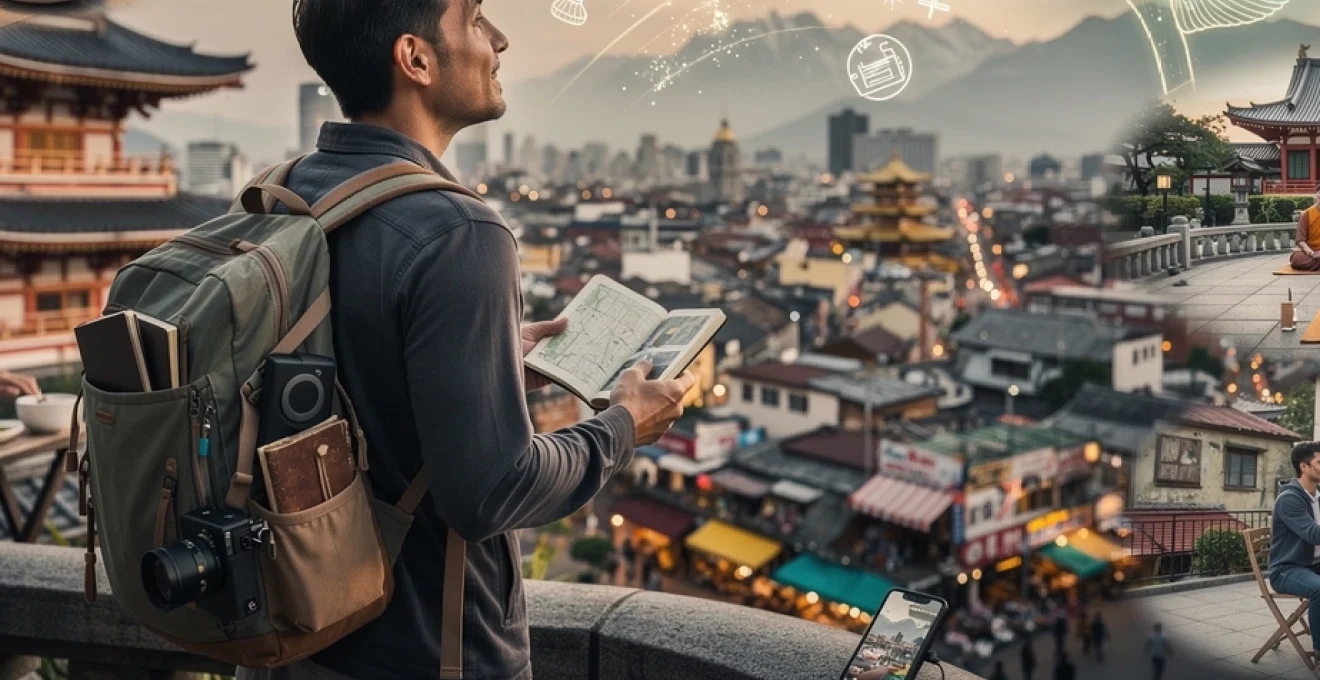
Travel has evolved far beyond the traditional paradigm of ticking destinations off a bucket list or collecting passport stamps. The most transformative journeys emerge when travellers embrace curiosity as their guiding principle, allowing wonder and inquiry to shape their experiences. This approach fundamentally alters how we perceive, engage with, and remember our travels, creating profound connections that extend far beyond the physical journey itself.
Research consistently demonstrates that curiosity-driven travel experiences generate more vivid memories, deeper cultural understanding, and lasting personal transformation. When travellers approach destinations with genuine inquisitiveness rather than predetermined expectations, they unlock layers of meaning that would otherwise remain hidden. The neurological and psychological mechanisms underlying these experiences reveal why curiosity serves as such a powerful catalyst for memorable travel encounters.
Psychological foundations of Curiosity-Driven travel behaviour
The psychological underpinnings of curiosity-driven travel stem from fundamental human motivational systems that have evolved over millennia. Understanding these mechanisms provides insight into why some travel experiences resonate deeply while others fade from memory within weeks of returning home.
Intrinsic motivation theory applied to destination selection
Self-determination theory reveals that intrinsically motivated behaviours produce more satisfying and memorable outcomes than those driven by external pressures or social expectations. When travellers select destinations based on genuine personal interest rather than social media trends or peer recommendations, they engage more deeply with the experience. This intrinsic motivation manifests as sustained attention, enhanced learning capacity, and greater emotional investment in cultural discoveries.
Research indicates that travellers who choose destinations based on personal curiosity spend 73% more time engaging with local communities compared to those following popular itineraries. The psychological reward systems activated by intrinsic motivation create positive feedback loops that enhance both immediate enjoyment and long-term memory formation.
Cognitive dissonance resolution through cultural immersion
Cultural encounters often challenge preconceived notions, creating cognitive dissonance that curious travellers actively seek to resolve. This psychological tension becomes a powerful learning catalyst when approached with openness rather than defensive resistance. The process of reconciling conflicting information or unexpected cultural practices strengthens neural pathways associated with memory and understanding.
Travellers who embrace cognitive dissonance report significantly higher satisfaction levels and demonstrate improved cross-cultural competency upon returning home. The discomfort of unfamiliar situations becomes a growth opportunity rather than a source of stress when filtered through a curiosity lens.
Dopamine pathways activated by novel environmental stimuli
Neuroscientific research reveals that novel experiences trigger dopamine release in the brain’s reward pathways, creating natural high states that enhance memory consolidation. Curious travellers actively seek these novel stimuli, creating multiple dopamine-triggering moments throughout their journeys. This biological reward system explains why spontaneous discoveries often become the most cherished travel memories.
Studies show that travellers who deliberately expose themselves to unexpected experiences report 45% higher levels of travel satisfaction and demonstrate enhanced creativity for months after their return. The dopamine-driven pleasure response associated with discovery creates powerful associative memories that remain vivid decades later.
Flow state achievement during spontaneous travel encounters
Flow states occur when individuals become completely absorbed in activities that balance challenge with skill level. Curious travellers frequently achieve these optimal experience states when navigating unfamiliar environments or engaging in impromptu cultural exchanges. The psychological characteristics of flow—including loss of self-consciousness, altered time perception, and intrinsic motivation—align perfectly with curiosity-driven exploration.
Travel experiences that generate flow states become anchored in memory through multiple sensory channels and emotional associations. These encounters often serve as transformative moments that reshape personal identity and worldview long after the journey concludes.
Neurocognitive mechanisms behind memorable travel experiences
The brain’s response to novel environments and culturally diverse encounters involves complex neural networks that process, encode, and retrieve experiential memories. Understanding these mechanisms illuminates why curiosity-driven travel creates such lasting impact.
Hippocampal memory consolidation in unfamiliar environments
The hippocampus
plays a central role in forming long-term memories, particularly those tied to place and context. When you enter a new city or landscape, the hippocampus becomes highly active, mapping streets, landmarks, and spatial relationships. Curiosity amplifies this process by encouraging you to explore side alleys, local markets, and unfamiliar neighbourhoods instead of staying within predictable tourist zones.
Studies using fMRI imaging show that hippocampal activation increases when individuals actively explore rather than passively observe. In practical terms, this means that when you wander with intent—asking questions, taking detours, and engaging with your surroundings—your brain encodes richer, more detailed memories. This is one reason why curiosity-driven itineraries, even if loosely planned, often feel more unforgettable than highly scripted tours.
For travellers seeking more memorable experiences, simple behaviours like sketching a street scene, noting directions without a map, or mentally “narrating” your walk can further stimulate hippocampal consolidation. These techniques transform a generic stroll into a deeply embedded memory trace you can recall years later with surprising clarity.
Amygdala response to positive cultural novelty
The amygdala, often associated with fear and threat detection, also responds strongly to emotionally significant positive experiences. When you encounter cultural novelty—such as your first flamenco performance in Seville or a shared meal with a host family in Hanoi—the amygdala flags these as emotionally relevant events. Curiosity helps tilt this response toward fascination rather than fear.
From a psychological perspective, this matters because emotionally charged events are prioritised for memory storage. If you approach unfamiliar customs with suspicion, your amygdala may code them as threats, leading to anxiety and avoidance. Approach the same scene with curiosity, and the emotional tag becomes one of excitement, awe, or warmth. The core event may be identical; your mindset radically alters how your brain files it away.
You can support positive amygdala responses by deliberately reframing discomfort as discovery: instead of thinking, “This street market is overwhelming,” you might ask, “What can I learn from how people shop and socialise here?” Over time, this habit trains your brain to interpret cultural surprises as invitations rather than dangers.
Prefrontal cortex engagement during problem-solving travel scenarios
The prefrontal cortex (PFC) is responsible for higher-order thinking—planning, decision-making, and regulating emotions. Travel inevitably presents small and large problems: missed trains, language barriers, or last-minute changes in accommodation. Curiosity transforms these stressors into cognitive puzzles, prompting the PFC to engage creatively rather than react defensively.
Research on resilience suggests that people who frame challenges as opportunities for learning show stronger PFC activity when solving problems. On the road, this might look like treating a delayed flight as a chance to observe airport culture, or using a wrong turn as an experiment in your sense of direction. Instead of defaulting to frustration, you lean into experimentation: trying basic phrases, decoding signage, or negotiating solutions with locals.
Practically, you can harness this mechanism by asking yourself three questions whenever something goes “wrong”: “What is this teaching me?”, “What are my options?” and “Who here might know more than I do?” These micro-reflections activate the PFC, helping you stay calm, flexible, and solution-focused—and turning logistical hiccups into some of your most memorable travel stories.
Mirror neuron activation through cross-cultural interaction
Mirror neurons are brain cells that fire both when you perform an action and when you observe someone else performing it. They are fundamental to empathy, social learning, and nonverbal communication. When you travel with curiosity, you naturally watch how locals greet one another, share meals, or navigate public spaces—and your mirror neuron system quietly rehearses these behaviours.
This neural mirroring helps you “feel into” another culture from the inside out. By observing body language in a Moroccan souk or etiquette in a Japanese onsen, you start to intuit what feels respectful, joyful, or solemn in that context. Over time, you may find yourself adopting local gestures, speech rhythms, or rituals, creating a deeper sense of connection.
If you want to accelerate this process, consciously notice subtle nonverbal cues: how far apart people stand when they talk, how loudly they speak, or how they express gratitude. Then, gently experiment with mirroring these patterns. Done respectfully, this not only builds rapport but also strengthens your brain’s ability to empathise across cultural boundaries.
Ethnographic research methodologies for curious travellers
Ethnography—the systematic study of people and cultures—offers powerful tools for travellers who want to move beyond surface-level sightseeing. You don’t need to be an academic researcher to borrow its methods; you simply need a willingness to observe, listen, and document with care. Approaching travel like an ethnographer transforms each journey into a living field study of human experience.
One foundational ethnographic technique is participant observation: instead of standing on the sidelines, you join in everyday activities. That might mean taking a local bus rather than a tour coach, eating in worker canteens instead of hotel restaurants, or attending a neighbourhood festival rather than a major event marketed to tourists. As you participate, you watch how others behave, noting small details that reveal values, norms, and unspoken rules.
Field notes are another critical tool. Carry a small notebook or use a digital app to jot down sensory impressions, snippets of dialogue, and your own reflections. What surprised you at the morning market? How did people interact on the tram? What assumptions of yours were challenged today? Over time, these notes form a rich qualitative record of your curiosity-driven travel experiences.
Informal interviewing adds further depth. Simple, open-ended questions—“What do you like most about living here?”, “How has this neighbourhood changed?”, “What dish reminds you of home?”—can unlock stories that no guidebook contains. When you ask with genuine interest and listen more than you speak, you step into the role of respectful guest researcher rather than consumer of experiences.
- Adopt a “research question” for each trip, such as “How do people here balance work and leisure?” or “What role does food play in family life?” This gives your curiosity a gentle framework without rigid expectations.
- Set aside at least one “fieldwork day” where you prioritise observation over sightseeing. Choose a single neighbourhood, park, or café and stay put, watching the rhythms of local life unfold.
By integrating these ethnographic methodologies, you not only create more unforgettable travel experiences—you also cultivate a more nuanced, respectful understanding of the places and people who host you.
Digital ethnography tools for pre-travel cultural investigation
Curiosity-driven travel often begins long before you step on a plane. Digital ethnography—studying cultures through online spaces—allows you to explore how people represent their lives, debates, and identities on the internet. When used thoughtfully, these tools help you arrive better prepared, more sensitive, and more attuned to local conversations.
Social media platforms, forums, and local news sites are invaluable. Instead of relying solely on generic “top 10 things to do” lists, you might browse city-specific subreddits, follow local photographers on Instagram, or read opinion pieces from regional newspapers. These sources reveal what residents actually care about: proposed developments, cultural events, social tensions, or environmental concerns that may not appear in tourist brochures.
Digital maps with user-generated content, such as custom Google Maps lists or community-created layers, can also guide curiosity. Look for clusters of independent bookstores, small galleries, or community centres; these often signal vibrant, locally rooted culture. Language-learning apps with community forums offer another window into humour, slang, and everyday phrases you’re unlikely to learn in formal courses.
To avoid falling into the trap of digital tourism—where you feel you know a place before you arrive—it helps to treat online research as hypothesis-building rather than conclusion-drawing. Ask yourself: “What assumptions am I forming based on what I see online?” Then, once on the ground, use real-world experiences to confirm, complicate, or overturn those assumptions.
One practical approach is to create a short “digital field guide” before you travel. Include a few saved local articles, a list of cultural questions you’d like to explore, and a handful of neighbourhoods or venues discovered through local voices, not global lists. This guide becomes a springboard for on-the-ground curiosity rather than a rigid schedule.
Case studies: transformative journeys through systematic curiosity
Some of the most respected travel writers and storytellers exemplify curiosity as a disciplined practice rather than a vague personality trait. By examining their methods, we can borrow concrete strategies for making our own trips more intentional, reflective, and unforgettable. Each of the following case studies highlights a different facet of curiosity-driven travel—from meticulous documentation to contemplative observation and scientific inquiry.
Paul theroux’s methodical documentation techniques in patagonia express
Paul Theroux is known for his immersive train journeys and his habit of meticulously recording details that other travellers overlook. In works like The Old Patagonian Express, he demonstrates how systematic note-taking and close observation can turn a long, uncomfortable journey into a dense tapestry of human stories. Rather than focusing on destinations alone, he documents conversations, minor incidents, and even his own irritations.
Theroux’s method shows that unforgettable travel writing—and unforgettable travel itself—often hinges on documenting the “in-between” moments: a crowded carriage, a shared thermos of maté, the shifting mood of passengers as landscapes change. His curiosity is not random; it is structured through routines of daily writing, character sketches, and environmental descriptions.
You can apply elements of this approach by treating each travel day as a chapter in an ongoing field report. What patterns did you notice on public transport today? Who caught your attention in a café, and why? What did you learn about a place simply by watching how people queue, argue, or greet one another? Over time, this disciplined curiosity yields a rich archive of experiences far beyond photos alone.
Pico iyer’s contemplative observation methods in kyoto temples
Pico Iyer’s work, particularly his reflections on Japan and Kyoto, highlights another dimension of curiosity: stillness. While many associate curiosity with constant movement, Iyer embodies a slower, more contemplative approach. Sitting in Kyoto temples, he pays close attention to the play of light on tatami mats, the sound of distant bells, and the spaces between actions—the pauses in conversation, the intervals between footsteps.
This style of observation demonstrates that curiosity is as much about depth as breadth. Instead of rushing from one “must-see” temple to another, Iyer lingers. In doing so, he perceives layers of meaning—seasonal rituals, patterns of devotion, subtle architectural symbolism—that hurried visitors might miss. His travel experiences become unforgettable not because of quantity, but because of the quality of attention he brings.
To experiment with this contemplative curiosity, you might designate certain hours of your trip as “slow time.” Sit in the same spot for an entire afternoon: a temple garden, a plaza, or a riverside path. Notice how your perception changes as you resist the urge to move on. What do you see in hour three that you missed in minute five? This shift from scanning to dwelling can turn a single location into one of your most profound travel memories.
Anthony bourdain’s culinary anthropology approach in southeast asia
Anthony Bourdain approached food as an entry point into complex cultural, historical, and political realities. In his journeys through Southeast Asia, he treated each meal as an ethnographic text: Who eats this dish? When and where is it served? What stories, migrations, or power dynamics are embedded in its ingredients and techniques? His curiosity extended well beyond taste into context.
By sitting on plastic stools at street stalls, drinking with market vendors, and visiting family kitchens, Bourdain demonstrated how culinary curiosity can humanise abstract concepts. Issues like colonial history, class division, or rapid urbanisation become tangible when you hear them discussed over bowls of pho or plates of nasi goreng. Food, in his hands, became a bridge between outsider and local, tourist and resident.
Adopting a culinary anthropology mindset doesn’t require television cameras—just attentive questions and a willingness to eat beyond your comfort zone. Next time you try a regional speciality, ask the cook or server: “When do people usually eat this?”, “Is this dish linked to a particular celebration?”, or “Has it changed over time?” These small inquiries can transform a simple meal into an unforgettable lesson in living culture.
Mary roach’s scientific inquiry framework in remote research stations
Mary Roach, known for her accessible science writing, often embeds herself in research environments—from NASA facilities to remote field stations—to explore big questions through quirky, specific details. Her curiosity is systematic: she prepares extensively, asks precise questions, and is unafraid to probe awkward or overlooked topics. In doing so, she reveals the hidden mechanics of how people work, adapt, and survive in extreme settings.
Translating this approach to travel means seeing each destination as a living laboratory. Instead of only asking, “What is there to see?”, you might ask, “What is being studied, tested, or debated here?” Perhaps there is a marine biology station tracking coral health, a mountain observatory monitoring climate change, or a community organisation experimenting with new education models. Visiting these spaces—when appropriate and open to the public—can provide a radically different perspective on a place.
You can also borrow Roach’s habit of following your questions down rabbit holes. If you become intrigued by something seemingly minor—a local superstition about wind, a regional obsession with a particular plant, or the engineering of hillside houses—let that curiosity guide a day of exploration. Track down a museum curator, guide, or researcher, and ask them to explain. Like Roach, you may find that the most specific questions yield the most unforgettable insights.
Across these diverse examples, a common thread emerges: curiosity is not just a feeling but a practice. Whether you are documenting like Theroux, lingering like Iyer, tasting like Bourdain, or investigating like Roach, the key to unforgettable travel experiences lies in how you direct your attention—and how bravely you follow your questions into the heart of a place.