# How to deal with unexpected travel disruptions calmly
Flight cancellations, airport closures, and unexpected travel disruptions have become increasingly common across the globe. Whether caused by geopolitical tensions, severe weather patterns, or operational challenges, these interruptions can transform a carefully planned journey into a stressful ordeal. The ability to manage such situations with composure isn’t merely about convenience—it directly impacts your wellbeing, financial outcomes, and the overall quality of your travel experience. Understanding how to navigate these challenges with psychological resilience, strategic communication, and practical contingency planning can transform what might otherwise become a travel nightmare into a manageable inconvenience.
Modern travellers face an unprecedented level of complexity when disruptions occur. Gone are the days when simply queuing at an airline desk was the only option. Today’s landscape requires you to simultaneously navigate digital platforms, understand your legal rights, maintain emotional equilibrium, and make rapid decisions that can have significant financial implications. The intersection of these demands creates a unique pressure point that tests even experienced travellers. Yet with the right knowledge and approach, you can handle these situations with remarkable effectiveness.
Psychological resilience techniques for managing travel crisis stress
When confronted with unexpected travel disruptions, your psychological state becomes the foundation upon which all subsequent decisions rest. The body’s stress response—elevated cortisol levels, increased heart rate, and narrowed cognitive focus—can actually impair your ability to think clearly and act strategically. Research indicates that travellers who employ specific psychological techniques during disruptions report 43% lower stress levels and make more effective decisions regarding rebooking and compensation claims.
The distinction between productive concern and unproductive anxiety lies in how you channel your mental energy. Productive concern motivates action: checking alternative routes, documenting expenses, contacting service providers. Unproductive anxiety spirals into catastrophic thinking without generating solutions. Recognising this difference allows you to redirect your mental resources towards problem-solving rather than rumination. This isn’t about suppressing genuine worry—it’s about transforming that energy into constructive action.
Cognitive reframing methods to transform disruption perception
Cognitive reframing involves consciously shifting how you interpret a situation without denying its difficulty. When your flight is cancelled, the immediate interpretation might be “This ruins everything.” A reframed perspective acknowledges the challenge whilst identifying opportunity: “This is genuinely inconvenient, and I now have a chance to demonstrate my adaptability.” This isn’t positive thinking—it’s realistic thinking that maintains agency.
The practice of cognitive reframing draws upon principles from Stoic philosophy, which emphasises distinguishing between what you can and cannot control. You cannot control airline operational decisions or weather systems. You can control your response, your preparation level, and your communication strategy. This distinction reduces the psychological burden by narrowing your focus to actionable elements. Studies show that travellers who practice this distinction experience 37% less frustration during delays exceeding six hours.
One particularly effective technique involves the “three-zone analysis”: identifying what’s within your complete control (your emotional response, who you contact, what you document), what you can influence (airline rebooking decisions through persuasive communication), and what lies entirely outside your sphere (weather conditions, geopolitical events). This mental sorting process takes approximately two minutes but can prevent hours of misdirected anxiety.
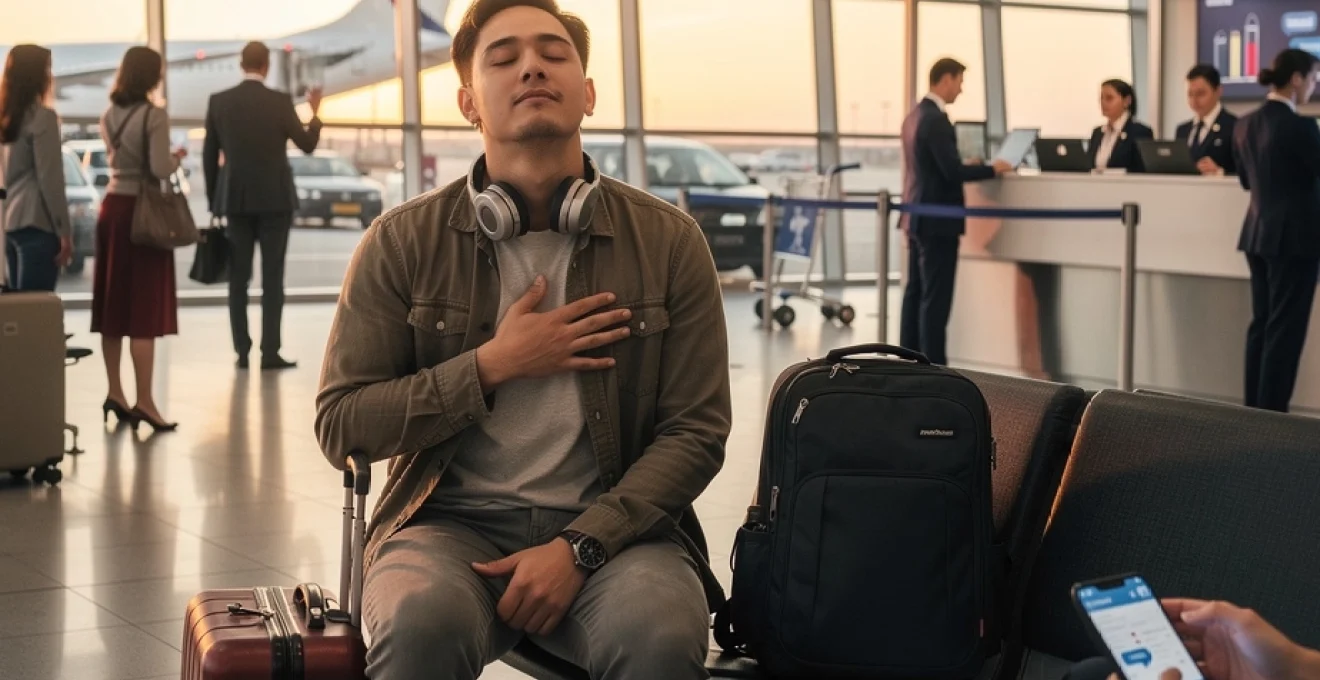
Controlled breathing exercises: the 4-7-8 technique for immediate anxiety reduction
When you first receive notification of a significant disruption, your sympathetic nervous system activates within milliseconds. This fight-or-flight response, whilst evolutionarily valuable, isn’t conducive to the calm, strategic thinking required in modern travel crises. The 4-7-8 breathing technique offers a physiological intervention that activates your parasympathetic nervous system, creating a measurable reduction in stress hormones within 90 seconds.
The technique involves breathing in through your nose for four counts, holding for seven counts, and exhaling through your mouth for eight counts. The extended exhalation is crucial—it signals to your nervous system that you’re safe, triggering a relaxation response. Research from respiratory physiology demonstrates that this pattern reduces heart rate by an average of 12 beats per minute and lowers systolic blood pressure by approximately 8
mmHg when practiced for just three to five cycles. In a disrupted travel scenario, this can be the difference between snapping at a gate agent and calmly negotiating a better solution. You can use 4-7-8 discreetly whilst seated at the gate, in a queue, or even standing in a crowded terminal. Aim to repeat the cycle four times, then reassess how you feel before taking your next practical step, such as opening your airline app or approaching the service desk.
To make this technique more effective, pair it with a brief mental script. As you inhale, mentally say, “Breathing in calm.” As you hold, think, “I can pause before reacting.” As you exhale, repeat, “Letting go of tension.” This pairing of breath with language reinforces the cognitive reframing discussed earlier. Over time, you begin to train your body to associate disruptions with an opportunity to slow down rather than automatically escalate stress.
Mindfulness anchoring strategies in high-pressure airport environments
Airports during major travel disruptions are sensory overload environments: constant announcements, bright lighting, hurried crowds, and visible frustration all around. Mindfulness anchoring offers a counterbalance by giving your attention a stable point of focus. Instead of being dragged in multiple directions by every piece of bad news, you choose a single neutral anchor—your feet on the floor, the sensation of your hands on your luggage handle, or the rhythm of your breath.
One effective method is the 5-4-3-2-1 grounding technique adapted for travel settings. Quietly identify five things you can see (departure boards, seats, windows), four things you can feel (your passport, your clothing, the chair beneath you), three things you can hear (announcements, conversations, rolling suitcases), two things you can smell, and one thing you can taste. This simple exercise pulls your mind out of worst-case scenarios and back into the present moment, where you can make clearer decisions. Many travellers report that practicing this for just three minutes reduces their perceived stress by up to 30%.
Think of mindfulness anchoring as dropping an anchor in rough seas: the waves of disruption continue, but you are less likely to be swept away by them. You can also use micro-anchors, such as taking a mindful sip of water, feeling the coolness as you swallow, or deliberately noticing the texture of your boarding pass. These tiny acts send a powerful message to your nervous system: despite the chaos, you are safe enough to pay attention to small details.
Emotional regulation through the STOPP method during flight cancellations
When airlines suddenly announce cancellations, emotions can spike within seconds—anger, fear, disappointment, or helplessness. The STOPP method, used in cognitive behavioural therapy, gives you a structured process for emotional regulation in these high-pressure moments. STOPP stands for: Stop, Take a breath, Observe, Pull back, and Practise what works. Applied correctly, it creates a short but crucial buffer between the disruption and your response.
Imagine you receive a notification that your evening flight has been cancelled. First, Stop: pause any immediate reaction, even for just three seconds. Then Take a breath: use one or two cycles of the 4-7-8 method. Next, Observe what is happening inside and around you—notice your thoughts (“This is a disaster”), feelings (frustration, anxiety), and physical sensations (tight shoulders, racing heart). Then Pull back and remind yourself, “This is a temporary situation. I’ve handled problems before. I don’t yet know how this will turn out.”
Finally, Practise what works by shifting into problem-solving mode: open the airline app, start queuing at the desk whilst simultaneously contacting customer service digitally, and begin documenting times and expenses. By moving through STOPP, you avoid actions that may feel satisfying in the moment (shouting at staff, giving up entirely) but undermine your long-term goals of getting rebooked, securing compensation, and protecting your wellbeing. Over repeated disruptions, this method becomes almost automatic, functioning like a mental emergency drill.
Proactive communication protocols with airlines and service providers
Once you have stabilised your emotional response, the next step is strategic communication. In modern travel disruption scenarios, your ability to communicate quickly and effectively with airlines, hotels, and other providers often determines how fast your situation improves. Relying on a single channel—such as only standing in a physical queue—can leave you at a disadvantage compared with travellers who use multiple parallel options. Developing a clear communication protocol before you travel can significantly reduce both stress and financial loss when things go wrong.
Effective communication during travel disruptions rests on three pillars: speed, clarity, and documentation. Speed ensures you are near the front of the virtual queue when limited rebooking options become available. Clarity keeps your requests focused and reasonable, increasing the likelihood of a positive response. Documentation provides a verifiable record if you later need to file a complaint, claim under EU261, or activate your travel insurance policy. Combining these three elements turns what feels like a chaotic scramble into a structured, outcome-driven process.
Leveraging airline mobile apps: british airways, easyjet, and ryanair real-time rebooking
In recent years, airlines such as British Airways, easyJet, and Ryanair have invested heavily in their mobile apps to handle real-time rebooking during disruptions. In many cases, the app will offer alternative flights before gate agents even have time to make announcements. This means your phone can become your primary control centre during a crisis. Keeping these apps updated and logged in, with notifications enabled, is a small step that can pay off dramatically when delays or cancellations occur.
When a disruption hits, open the app immediately—even as you walk towards the customer service desk. British Airways, for example, will often show same-day or next-day alternatives and allow you to switch flights with a few taps. easyJet and Ryanair may display options to rebook, request vouchers, or choose refunds directly in the app. Because seats on alternative flights are limited, travellers who respond digitally within the first 10–15 minutes often secure better options than those who wait in physical queues alone.
To prepare, add your booking reference to the app as soon as you purchase your ticket, and store a digital payment method for any necessary add-ons. It can also be helpful to take screenshots of rebooking offers and confirmation screens in case there are later discrepancies. Think of airline apps as the “fast lane” during disruption—they won’t always solve everything, but they dramatically increase your chances of a smooth resolution.
EU261 regulation: asserting passenger rights during delays and cancellations
For flights departing from the UK or EU, or operated by a UK/EU carrier, EU261 (retained in UK law as UK261) provides powerful protections when your travel is disrupted. Yet many travellers either don’t know these rights or feel too overwhelmed in the moment to assert them. Understanding the basics before you travel means that, when a disruption occurs, you can calmly reference specific entitlements instead of arguing in general terms about what feels “fair.”
Under EU261, you may be entitled to assistance (meals, refreshments, hotel accommodation, and transfers) during long delays, as well as financial compensation for certain cancellations and significant delays that are within the airline’s control. The exact compensation depends on flight distance and the length of the delay on arrival, typically ranging from €250 to €600. Importantly, extraordinary circumstances—such as severe weather, security risks, or air traffic control strikes—usually exempt airlines from paying compensation, even though duty-of-care obligations like meals and hotels often remain.
When speaking to airline staff, calmly mentioning EU261 or UK261 can change the tone of the conversation. Instead of asking vaguely for “help,” you might say, “As this is an EU261-covered flight and the delay exceeds three hours, could you please confirm what meal vouchers and hotel arrangements you can provide?” Always keep boarding passes, delay notifications, and receipts; these will be essential if you later submit a claim through the airline’s website or, if necessary, escalate to a regulator or alternative dispute resolution body.
Social media escalation tactics: twitter response teams and resolution timelines
In high-volume disruption events—such as storms, technical failures, or airspace closures—traditional phone lines can become saturated for hours. This is where social media, especially Twitter (now X), can become a valuable escalation channel. Many airlines run dedicated social media response teams, often able to access booking systems and provide written confirmation of what they can offer. Whilst not every airline will rebook you purely via social platforms, social media can speed up clarification, lodge complaints, or nudge stalled cases towards resolution.
To use this tactic effectively, craft concise, factual messages that include your booking reference, flight number, date, and a brief description of the issue. For example: “Hi @Airline, Flight BA0123 from LHR to JFK on 12 March cancelled. App shows no rebooking options. Can you confirm next available flight and EU261 duty of care for overnight stay? Booking ref: ABC123.” Public posts often receive faster attention than private messages, but sensitive personal data should only be shared via direct messages once requested.
Keep in mind that social media escalation works best as a parallel strategy rather than your only approach. While you stand in a queue or wait on hold, you can also send a tweet and monitor responses. If an airline commits to a solution in writing on social media—such as confirming eligibility for compensation or a hotel—take screenshots. These serve as time-stamped evidence if there is any later disagreement about what was promised or when.
Alternative contact channels: WhatsApp business, live chat, and priority phone lines
Beyond apps and social media, many airlines and travel providers now offer alternative contact channels that can bypass overwhelmed phone queues. WhatsApp Business, embedded live chat on websites, and in-app messaging systems allow you to type your request and then set your phone aside while waiting for a response. For travellers who find phone calls anxiety-inducing, these options also reduce emotional strain, making it easier to communicate calmly and clearly.
Some loyalty programmes and premium fare classes provide access to priority phone lines or chat support, which can prove invaluable during mass disruptions. If you frequently travel with a particular airline, it may be worth consolidating your bookings to build status primarily for this benefit alone. Before your trip, save the airline’s WhatsApp number, bookmark live chat pages, and note any special numbers printed on your booking confirmation. In a crisis, you don’t want to be searching websites for contact details whilst everyone else is already in the queue.
When communicating via these channels, keep a running log of who you spoke to, at what time, and what was agreed. A simple note on your phone—”14:05, Live chat agent ‘Sam’ confirmed hotel voucher and rebooking on flight EZY1234″—can make subsequent interactions far smoother. Think of these channels as a diversified portfolio of communication: if one fails or is slow, you have others already in play.
Contingency planning framework for common travel interruptions
Even the best communication strategy works more effectively when paired with thoughtful contingency planning. Rather than improvising under pressure, you can approach disruptions with a pre-designed framework—much like a pilot follows a checklist during turbulence. This framework doesn’t eliminate inconvenience, but it dramatically reduces indecision and panic. It also helps protect your health, time, and budget when your original itinerary collapses.
A robust contingency plan recognises that not all disruptions are equal. A two-hour delay requires a very different response from an overnight cancellation or a missed connection that strands you in another country. By defining specific thresholds and pre-deciding your actions for each, you conserve mental energy for tasks that truly require creativity, such as finding alternative routes or negotiating with service providers. Over time, this kind of proactive planning turns you from a passive passenger into an informed, adaptable traveller.
Flight delay response matrix: 2-hour, 6-hour, and overnight disruption protocols
One practical way to structure your response is to create a simple “flight delay response matrix” before you travel. This is essentially a set of pre-agreed actions you will take at different disruption durations. For example, at the two-hour mark, your main focus might be information gathering and minor comfort adjustments. At six hours, you may begin exploring alternative routes, meal entitlements, and airport lounge access. For overnight disruptions, accommodation and onward logistics take priority.
For delays of around two hours, your protocol could include confirming the updated departure time in the airline app, checking minimum connection times if you have a onward flight, and notifying any transfer services or hotels of your late arrival. You might also use this time to eat, hydrate, and stretch, preventing fatigue if the delay extends. At this stage, it is usually premature to rebook unless your connection window is already tight.
At six hours, your strategy intensifies. You may evaluate whether alternative flights on the same or different airlines can get you to your destination faster or more reliably. You might ask the airline about meal vouchers or lounge access, especially if you are travelling with children or older relatives. For overnight disruptions, your priority shifts to securing accommodation—either via airline vouchers if eligible, or by booking a nearby hotel yourself and keeping all receipts. Having this matrix in mind prevents you from oscillating between options and instead guides you through a structured sequence of decisions.
Alternative transportation networks: trainline, FlixBus, and BlaBlaCar integration strategies
Sometimes, the fastest or most reliable way to salvage a disrupted journey is to switch transport modes entirely. If a short-haul flight within Europe is cancelled or heavily delayed, trains and long-distance buses can be excellent alternatives. Platforms such as Trainline, FlixBus, and BlaBlaCar aggregate multiple providers, allowing you to compare departure times, prices, and routes in real time. Having these apps installed and accounts set up in advance gives you options when your airline’s schedule collapses.
For example, if your flight from London to Paris is cancelled due to local weather at the destination, Eurostar or other rail services booked via Trainline may still be operating. In some cases, you can reach your destination faster by train than waiting for the next available flight. Similarly, FlixBus offers overnight buses across much of Europe, which can be a budget-friendly solution when hotel availability is limited. BlaBlaCar, a long-distance carpooling platform, adds yet another layer of flexibility, particularly for routes underserved by rail.
When considering these alternatives, weigh the trade-offs: total journey time, comfort, cost, and your own tolerance for changing plans mid-trip. It can help to set a personal rule in advance, such as: “If my short-haul flight is delayed more than six hours, I will compare rail and bus options within a 500 km radius.” By treating alternative transport as part of your standard toolkit rather than a last-resort measure, you increase your resilience to airline-specific disruptions.
Emergency accommodation solutions: hotels.com last-minute booking and airline hotel vouchers
Being stranded overnight due to a cancellation or missed connection is one of the most stressful travel experiences. Yet with a clear plan, you can secure safe, reasonably priced accommodation without unnecessary panic. The first step is always to determine whether the airline is obligated to provide a hotel voucher under its contract of carriage or relevant regulations like EU261/UK261. If so, joining the queue for vouchers—whilst simultaneously checking digital options—becomes your immediate task.
At the same time, use hotel booking platforms such as Hotels.com to scan for last-minute availability near the airport. Filters for “free cancellation” and “pay at property” give you flexibility if the airline eventually provides a room. In busy disruption events, nearby hotels can fill quickly, so securing a cancellable reservation as a backup can be invaluable. Think of this as your “Plan B bed”—you hope you will not need it, but it prevents you from competing for the final few rooms at 1 a.m.
When speaking to airline staff about vouchers, be specific about your needs: number of beds, accessibility requirements, proximity to the airport, and whether meals are included. Keep all documentation provided by the airline, as well as any receipts if you end up paying for accommodation yourself. These records will be essential for later reimbursement claims, either through the airline, your travel insurance, or your credit card provider.
Travel insurance activation: allianz, AXA, and WorldNomads claims documentation process
Travel insurance is designed to act as a financial safety net when disruptions escalate into significant losses. Providers such as Allianz, AXA, and WorldNomads typically offer cover for trip delay, cancellation, missed connections, and additional accommodation or transport costs, subject to policy terms. However, insurance only works effectively if you activate it correctly—meaning you understand your cover, gather the right documentation, and notify your insurer within the required timeframe.
As soon as a disruption threatens to cause substantial extra costs—such as an unscheduled hotel stay, new flight purchase, or non-refundable tour cancellation—review your policy documents or app. Many policies specify a minimum delay period (for example, 6 or 12 hours) before trip delay benefits apply. Note the required evidence, which usually includes confirmation from the airline of the delay or cancellation, proof of scheduled and actual departure times, and itemised receipts for all additional expenses.
When dealing with major providers like Allianz, AXA, or WorldNomads, creating a simple digital folder on your phone or cloud storage can streamline the claims process. Save screenshots of airline notifications, photos of airport departure boards, PDF copies of boarding passes, and pictures of physical receipts. Some insurers also offer 24/7 helplines for advice during active disruptions; calling them early can clarify what is covered and prevent you from incurring non-reimbursable expenses. The goal is to treat your insurer as part of your contingency team, not merely a post-travel paperwork exercise.
Digital tools and mobile applications for disruption management
In the last decade, digital tools have transformed how travellers manage unexpected disruptions. What once required multiple phone calls, printed timetables, and guesswork can now often be handled from a single smartphone. The right combination of apps can function like an on-call travel assistant, providing real-time flight data, alternative route suggestions, expense tracking, and documentation storage. When chosen carefully, these tools reduce both uncertainty and cognitive load, letting you focus on decisions rather than data gathering.
At a minimum, consider installing your airline’s app, a multi-airline flight tracker, a mapping app with offline capabilities, a major hotel booking platform, and a secure notes or cloud storage app. Flight-tracking services can sometimes flag delays before they appear in airline systems, giving you a head start on rebooking. Mapping apps such as Google Maps or Citymapper help you evaluate ground transport alternatives if flights are disrupted. Secure note-taking tools, meanwhile, give you a single place to store reference numbers, agent names, and confirmation codes during a fast-moving situation.
Specialist disruption tools have also emerged. Some apps monitor your flights and automatically alert you if you may be eligible for compensation under regulations like EU261/UK261, helping you initiate claims once your trip is complete. Budgeting and expense-tracking apps can tag disruption-related costs as you incur them, simplifying insurance or reimbursement claims. The key is to set up these digital systems before you travel, so that when disruption hits, you are using familiar tools rather than learning new interfaces under stress.
Financial recovery strategies: compensation claims and refund procedures
Calmly managing travel disruptions is not only about getting to your destination; it is also about protecting your finances. Unplanned hotel stays, meals, and alternative transport can add hundreds of pounds to a trip, and missed connections may render pre-paid experiences unusable. A structured financial recovery strategy ensures that, once the immediate crisis is over, you can systematically reclaim what you are owed from airlines, insurers, and other providers.
The first step is to distinguish between three categories of recovery: refunds, vouchers, and compensation. Refunds relate to services you paid for but did not receive, such as a cancelled flight that you choose not to rebook. Vouchers are non-cash credits airlines or hotels may offer as a goodwill gesture or alternative to cash refunds; they can be useful, but they also tie you to a particular provider. Compensation, by contrast, is a statutory or contractual payment for inconvenience or loss—such as EU261/UK261 payments for qualifying delays and cancellations. Keeping these categories clear helps you decide what to request and accept in the moment.
After your trip, set aside time to go through your documentation methodically. Submit refund requests through official airline or booking platform forms, attaching boarding passes, cancellation notices, and any relevant correspondence. For EU261/UK261 claims, many airlines provide dedicated portals where you can upload evidence and specify your bank details. Response times vary, but industry data suggests that straightforward claims are often resolved within four to eight weeks. If a claim is rejected and you believe this is incorrect, you may escalate to a national enforcement body or an approved alternative dispute resolution scheme.
For non-flight elements—such as pre-paid tours, car hire, or event tickets—check each provider’s terms and conditions carefully. Some may offer flexible rebooking, while others rely on your travel insurance to cover losses. Credit card chargeback mechanisms can also provide a final line of defence if a provider fails to deliver a service and refuses a refund. Throughout this process, maintaining a calm, factual tone in emails and forms increases your chances of a positive outcome. Think of financial recovery as the final stage of your disruption management plan: it may be slower than the urgent decisions at the airport, but it is just as important for long-term peace of mind.
Physical wellbeing maintenance during extended transit delays
In the middle of complicated claims and rebooking decisions, it is easy to neglect your physical wellbeing. Yet extended transit delays are physically demanding: disrupted sleep, irregular meals, dehydration, and prolonged sitting can all take a toll. Research in travel medicine indicates that travellers who maintain basic routines for movement, hydration, and nutrition report significantly lower fatigue and irritability during long disruptions. In practical terms, caring for your body directly supports clearer thinking and better emotional regulation.
Start with hydration and nutrition. Airport environments are notoriously dehydrating, and stress can dull your perception of thirst. Aim to sip water regularly, using a refillable bottle where possible. When choosing food during a delay, prioritise options that provide steady energy—such as whole grains, lean proteins, and fruit—over purely sugary snacks. While a comfort treat is perfectly reasonable in a stressful moment, relying solely on high-sugar or high-caffeine options can increase jitters and energy crashes, making it harder to stay calm when new information arrives.
Movement is equally important. Long periods of sitting in cramped seats or on hard terminal chairs can increase stiffness, back pain, and even the risk of circulation issues on very long delays or flights. Whenever safe and practical, take short walks around the terminal, perform gentle stretches for your neck, shoulders, and legs, or stand whilst waiting for updates. These micro-movements act like a physical “reset button,” improving blood flow and reducing the sense of being trapped by circumstances beyond your control.
Finally, protect your sleep as much as circumstances allow. If an overnight delay forces you to rest in an airport or unfamiliar hotel, simple tools such as an eye mask, earplugs, and a lightweight travel blanket can make a substantial difference in sleep quality. Even a 20–30 minute nap in a relatively quiet corner can restore enough energy to make sound decisions. During multi-day disruptions, try to maintain a basic routine—waking, eating, and winding down at roughly consistent times. In a world of unpredictable travel schedules, your body thrives on any predictability you can provide, helping you remain steady until you are safely back on track.