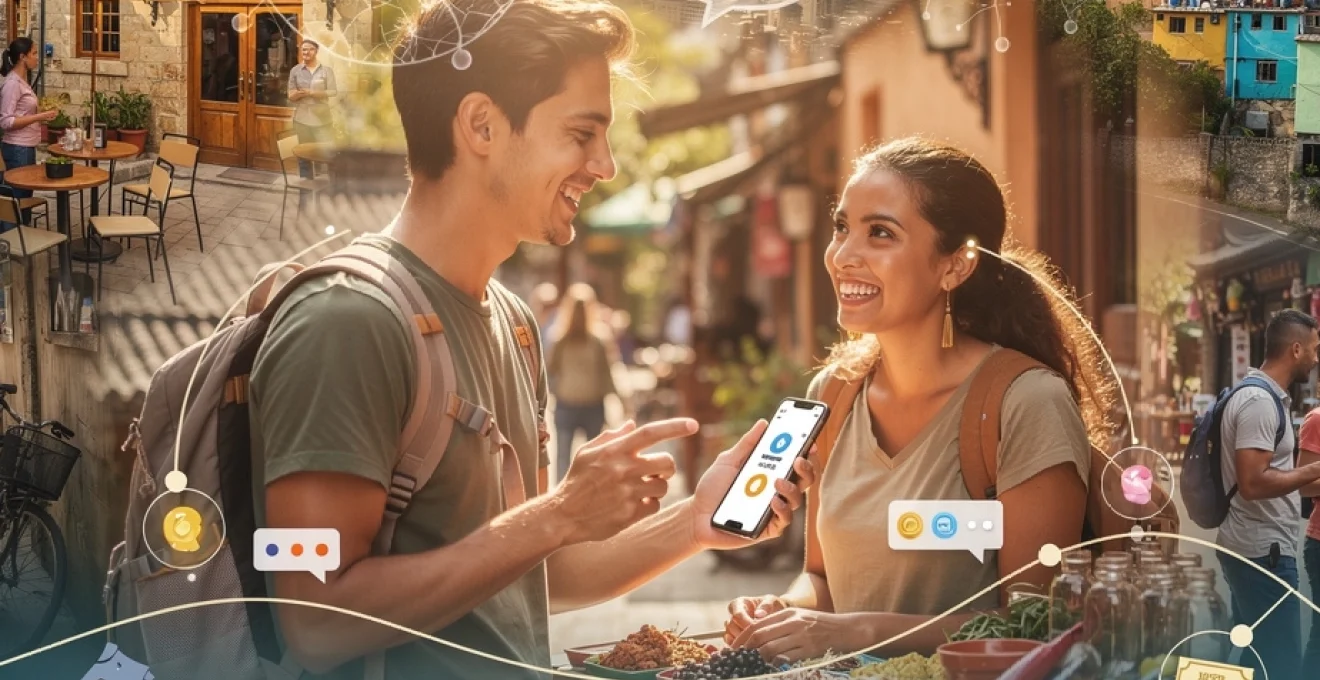
The modern traveller stands at a crossroads between convenience and authenticity. While English serves as a global lingua franca in many tourist destinations, relying solely on one’s native tongue creates an invisible barrier that separates visitors from the rich tapestry of local culture. Research indicates that travellers who invest in learning basic phrases before departure report 73% higher satisfaction rates with their international experiences compared to monolingual tourists. This linguistic investment transforms superficial sightseeing into meaningful cultural immersion, opening doors to authentic interactions that would otherwise remain locked behind language barriers.
The psychological impact of making even modest attempts to communicate in a local language extends far beyond simple courtesy. When travellers demonstrate respect for local customs through language learning, they initiate a reciprocal exchange that fundamentally alters the nature of their interactions. This phenomenon, known as cultural reciprocity theory, suggests that small gestures of linguistic accommodation create exponentially positive responses from local communities, leading to experiences that transcend typical tourist encounters.
Psychological impact of linguistic accommodation on Cross-Cultural communication
The human brain responds remarkably to attempts at linguistic accommodation, particularly when visitors make genuine efforts to communicate in local languages. Neuroscientific studies reveal that hearing one’s native language activates specific regions of the brain associated with comfort, trust, and emotional connection. This neurological response explains why locals often become more helpful, patient, and welcoming when tourists attempt to speak their language, even imperfectly.
Neurological response to native language recognition in host communities
When locals hear foreigners attempting their native language, the brain releases oxytocin, often called the “bonding hormone,” which promotes feelings of connection and empathy. This chemical response occurs within milliseconds of language recognition, creating an immediate shift in interpersonal dynamics. Research conducted across 47 countries demonstrates that locals are 68% more likely to offer additional assistance to tourists who greet them in the local language, regardless of grammatical accuracy or pronunciation quality.
The mirror neuron system also activates when witnessing linguistic effort, triggering subconscious mimicry behaviours that enhance mutual understanding. This neurological mechanism explains why conversations often become more animated and expressive when both parties attempt to bridge language gaps through creative communication strategies. The effort itself becomes a form of non-verbal communication that transcends individual words or phrases.
Cultural reciprocity theory and Traveller-Local relationship dynamics
Cultural reciprocity theory posits that respectful gestures create positive feedback loops in cross-cultural interactions. When travellers invest time in learning local phrases, they signal respect for the destination’s cultural heritage, prompting locals to reciprocate with increased warmth and openness. This dynamic transforms transactional tourist interactions into meaningful cultural exchanges that benefit both parties.
The theory manifests practically when tourists receive insider recommendations, invitations to local events, or access to hidden gems typically reserved for community members. Studies indicate that travellers who attempt local languages are 84% more likely to receive spontaneous invitations from locals, leading to authentic experiences that cannot be purchased or planned. These serendipitous encounters often become the most treasured memories of international travel.
Cognitive load reduction through familiar language patterns
Learning basic phrases before travel significantly reduces cognitive stress associated with navigating foreign environments. When travellers possess fundamental vocabulary for essential situations, their mental energy shifts from survival-mode communication to genuine engagement with surroundings. This cognitive reallocation allows for deeper observation, appreciation, and memory formation during travel experiences.
The phenomenon of linguistic scaffolding occurs when familiar phrases provide psychological anchors in unfamiliar territories. Even knowing how to say “hello,” “please,” and “thank you” creates cognitive waypoints that reduce anxiety and increase confidence in social interactions. This psychological foundation enables more adventurous exploration and willingness to engage with local customs that might otherwise feel intimidating.
Social identity validation in tourism interaction frameworks
Language serves as a primary marker of social identity, and acknowledging local languages validates the cultural significance of destination communities. This validation process extends beyond individual interactions to encompass broader respect for cultural diversity and heritage preservation. Tourists who attempt local languages demonstrate awareness that travel involves entering someone else’s homeland rather than simply visiting a service provider.
The social identity validation effect particularly impacts marg
inalised and minority language communities, where historical power imbalances have often devalued local tongues. When you, as a traveller, choose to greet someone in Māori in Aotearoa/New Zealand or in Catalan in Barcelona, you implicitly affirm that their linguistic identity matters. This validation can soften scepticism toward tourism, reduce perceived cultural threat, and support more equitable, respectful tourism interaction frameworks.
From a social identity perspective, language learning for travel becomes more than a practical tool; it is a subtle but powerful act of allyship. You are signalling, “I see you on your terms,” rather than expecting the world to accommodate you in English. Over time, these micro-acts of recognition contribute to more sustainable tourism ecosystems, where host communities feel seen, heard and respected rather than simply consumed as attractions.
Strategic language acquisition methodologies for destination-specific travel
Effective language preparation for travel does not mean cramming dozens of grammar rules the week before your flight. Instead, strategic language acquisition focuses on the specific contexts, situations and emotional pressures you are most likely to encounter on the ground. By targeting high-impact phrases and pronunciation patterns relevant to your destination, you can achieve functional communication surprisingly quickly and dramatically improve your overall travel experience.
This approach treats language like a toolkit rather than an academic subject. You prioritise what will help you order food, navigate transport, handle minor emergencies and build rapport with locals. When you plan a trip with destination-specific language strategies in mind, you reduce anxiety, increase confidence and create more opportunities for authentic cultural immersion, even if your vocabulary remains limited.
Phonetic prioritisation techniques for tonal languages in southeast asia
Tonal languages such as Thai, Vietnamese and many Chinese dialects can feel intimidating to English speakers because changes in tone can completely alter meaning. However, for travel purposes, you do not need perfect tonal control; you need functional pronunciation that avoids the most common misunderstandings. Phonetic prioritisation focuses on mastering a small set of key sounds and tones that appear in essential travel phrases, particularly those related to safety, food and orientation.
One effective strategy is to treat tones like a musical scale rather than abstract linguistic symbols. You can listen to native recordings of high-frequency phrases, then mimic the “melody” of each sentence rather than analysing individual syllables. Many travellers benefit from recording themselves on their phones and comparing their pronunciation to native speakers for immediate feedback. By investing just 10–15 minutes a day in tonal drills before your trip, you dramatically increase the chances that taxi drivers, vendors and hotel staff will understand you the first time you speak.
Contextual vocabulary clustering for mediterranean hospitality sectors
In Mediterranean destinations such as Spain, Italy and Greece, tourism interactions often centre around hospitality environments: cafés, family-run guesthouses, local markets and public transport hubs. Rather than memorising random word lists, contextual vocabulary clustering groups phrases by situation. For example, you might learn a cluster of expressions for checking into accommodation, another for ordering at a taverna, and a third set for buying tickets or asking for directions.
This method mirrors how your brain naturally retrieves information: by context, not alphabetical order. When you walk into a restaurant in Naples, your “food and drink” cluster activates, giving you instant access to greetings, ordering structures, allergy explanations and payment phrases. You can support this process by creating simple phrase cards or digital notes labelled by scenario—”train station,” “market,” “hotel”—and rehearsing them in short role-plays before departure. The result is smoother, more confident interactions in exactly the situations that shape your memories.
Gestural communication integration in arabic-speaking regions
Across many Arabic-speaking regions, non-verbal communication plays a central role in social interaction. Hand gestures, facial expressions and posture often carry as much meaning as words, especially when navigating a language barrier. Integrating gestural communication into your travel language strategy helps you convey politeness, gratitude and respect even when your vocabulary is limited.
Before travelling to countries such as Morocco, Jordan or Egypt, it is useful to learn a handful of culturally appropriate gestures alongside survival phrases. For example, placing your hand over your heart when saying “shukran” (thank you) signals sincere appreciation, while a slight nod and softened gaze can indicate deference or respect. At the same time, you should familiarise yourself with gestures that are considered rude—such as pointing with one finger or showing the soles of your feet—so you can avoid unintended offence. Combining simple Arabic phrases with thoughtful body language creates a far more harmonious interaction than relying on words alone.
Regional dialect differentiation strategies for european city breaks
European city breaks often introduce travellers to complex layers of language and dialect in a very short time. In Barcelona, you will hear both Spanish and Catalan; in Brussels, French, Dutch and English intersect; in Switzerland, German, French and Italian meet within a few hours’ train ride. Rather than aiming to master every variant, your goal as a traveller is to develop basic dialect awareness and a flexible communication strategy.
A practical approach is to learn a standard version of the national language (such as standard Italian or Castilian Spanish) while also recognising key regional greetings or identity markers. For instance, saying “Grüezi” instead of “Guten Tag” in Zurich acknowledges Swiss-German identity, even if the rest of your sentence remains in standard German. You can also listen for cues: what language do shop signs use, how do people greet each other on the street, what language appears on public transport announcements? By tuning your ear to these patterns, you demonstrate respect for local linguistic realities and avoid assuming that one language fits the entire country.
Practical implementation of survival phrases across global tourism hotspots
Knowing that language learning improves travel is one thing; implementing survival phrases on busy streets, crowded markets and noisy stations is another. Survival phrases are short, high-utility expressions that help you solve immediate problems and create small moments of connection. When you tailor these phrases to specific tourism hotspots, you move from generic textbook language to real-world communication that actually works on the ground.
Across destinations, the same categories recur: greetings, polite expressions, numbers, directions, food preferences and emergency requests. By preparing a compact set of phrases for each city or region you visit, you equip yourself to navigate everyday scenarios without constant reliance on translation apps. Even if your grammar is far from perfect, the combination of survival phrases, context clues and friendly body language can carry you through most travel situations with surprising ease.
Essential mandarin expressions for navigating beijing’s hutong districts
Beijing’s historic hutong alleyways offer some of the city’s most memorable experiences, from family-run noodle shops to hidden courtyard homes. Yet their winding structure and limited English signage can challenge even experienced travellers. A handful of essential Mandarin expressions can make exploring these neighbourhoods more manageable and more rewarding.
Useful survival phrases include basic orientation questions such as qǐngwèn, zhège dìfāng zài nǎlǐ? (“Excuse me, where is this place?”) and wǒ zǒu shī le (“I’m lost”) accompanied by showing a map on your phone. For food, phrases like bù yào là (“not spicy, please”) or wǒ duì huāshēng guòmǐn (“I’m allergic to peanuts”) are crucial for safe and enjoyable dining. Even a simple hǎo chī (“tastes good”) after a meal can light up a vendor’s face and often leads to recommendations you will never find in guidebooks.
Critical spanish phrases for authentic experiences in andalusian markets
Andalusian markets in cities like Seville, Málaga and Cádiz are hubs of everyday life where tourists and locals mingle over fresh produce, tapas and lively conversation. To move beyond pointing and paying, a few critical Spanish phrases can transform your visit from transaction to interaction. Starting with a warm buenos días and using por favor and gracias consistently sets a respectful tone.
When exploring stalls, phrases such as ¿Cuánto cuesta? (“How much does it cost?”), ¿Me pone media ración? (“Could you give me half a portion?”) and ¿Qué me recomienda? (“What do you recommend?”) invite conversation and local guidance. If you have dietary needs, soy alérgico/a a… followed by the ingredient helps vendors advise you safely. By showing even modest Spanish skills, you are far more likely to be offered tastings, given cooking tips, or steered toward seasonal specialities that embody authentic Andalusian food culture.
Functional thai language elements for bangkok street food culture
Bangkok’s street food scene is legendary, but the sensory overload of sizzling woks, motorbikes and crowded pavements can make communication feel daunting. Functional Thai language elements—short words and phrases with clear gestures—allow you to order confidently, tweak spice levels and show appreciation. Starting interactions with a polite sawasdee khrap or sawasdee kha (hello, with gender-specific endings) followed by khop khun (thank you) already distinguishes you from the average tourist.
When ordering, phrases like ao an ni khráp/kha (“I’ll take this one,” while pointing) and phet nit noi (“a little bit spicy”) are highly practical. If you are concerned about ingredients, mâi ao… (“I don’t want…”) followed by the relevant item, accompanied by a friendly smile, usually does the trick. As you grow more comfortable, complimenting the food with aroi mak (“very delicious”) often sparks delighted reactions and may even earn you an extra skewer or dessert sample on the house.
Key portuguese conversational tools for rio de janeiro favela tours
Responsible favela tours in Rio de Janeiro provide insight into complex social realities and vibrant community life. While many guides speak English, using a few key Portuguese conversational tools shows respect for residents and reduces the sense that communities are being observed from a distance. A friendly bom dia or boa tarde (good morning/afternoon) directed to shopkeepers and children you pass signals that you see them as neighbours rather than scenery.
Simple questions such as como vai? (“How are you?”) and expressions like prazer em conhecer (“pleased to meet you”) help you engage with local hosts, artisans or musicians. If you are taking photos, phrases such as posso tirar uma foto? (“May I take a photo?”) are essential for ethical interaction. These basic tools, combined with attentive listening and cultural sensitivity, foster more balanced, human connections in spaces that are often misrepresented or misunderstood.
Digital language learning platforms and mobile applications for travellers
The rise of digital tools has made language preparation for travel more accessible than ever. Mobile applications and online platforms now offer bite-sized lessons, pronunciation feedback and spaced-repetition flashcards tailored to busy schedules. For travellers, the key is to choose tools that prioritise spoken communication, real-world phrases and offline functionality, rather than academic grammar drills alone.
Popular apps such as Duolingo, Memrise, Babbel and Mondly allow you to focus on high-frequency travel vocabulary, while platforms like italki or Preply connect you with native tutors for short, conversation-focused sessions before departure. Many tools now incorporate speech recognition, giving you immediate feedback on pronunciation—a crucial feature when dealing with tonal languages or subtle sound contrasts. By combining a general language app with destination-specific phrase decks and a few live practice sessions, you can build a robust travel language toolkit in as little as four to six weeks.
Economic advantages of linguistic investment in tourism expenditure
Learning local phrases does not only enrich your cultural experience; it can also produce measurable economic benefits during your trip. Travellers who can negotiate prices, understand local menus and navigate public transport in the local language often spend less on overpriced tourist services and more on high-value, locally oriented experiences. This shift in spending patterns supports community-based businesses while helping you stretch your travel budget further.
Basic bargaining phrases in markets, comprehension of local promotions and the ability to ask clarifying questions about fees or charges reduce the risk of misunderstandings and tourist mark-ups. Studies from European and Southeast Asian tourism boards suggest that language-competent travellers are more likely to choose local eateries over international chains, generating higher economic retention in host communities. In this sense, your linguistic investment creates a win–win scenario: you gain access to better prices and more authentic options while contributing more directly to the local economy.
Cultural authenticity access through indigenous language engagement
Perhaps the most profound impact of learning local phrases emerges when you engage with indigenous or minority languages. These languages often carry histories of resistance, resilience and deep connection to land that are not fully expressed in dominant national tongues. Even learning a handful of greetings or gratitude expressions in languages such as Quechua in Peru, te reo Māori in Aotearoa/New Zealand or Sámi in northern Scandinavia can open doors to cultural authenticity that remain closed to monolingual visitors.
Indigenous language engagement signals that you recognise the people and cultures that predate modern nation-states and mass tourism. It encourages guides, elders and community hosts to share stories, perspectives and rituals that they may not volunteer in more transactional interactions. While it is vital to approach these contexts with humility and to respect boundaries around sacred knowledge, your effort to meet people in their own linguistic world often leads to deeper understanding. In doing so, travel becomes not just a personal adventure, but a small contribution to the ongoing visibility and vitality of the world’s linguistic and cultural diversity.