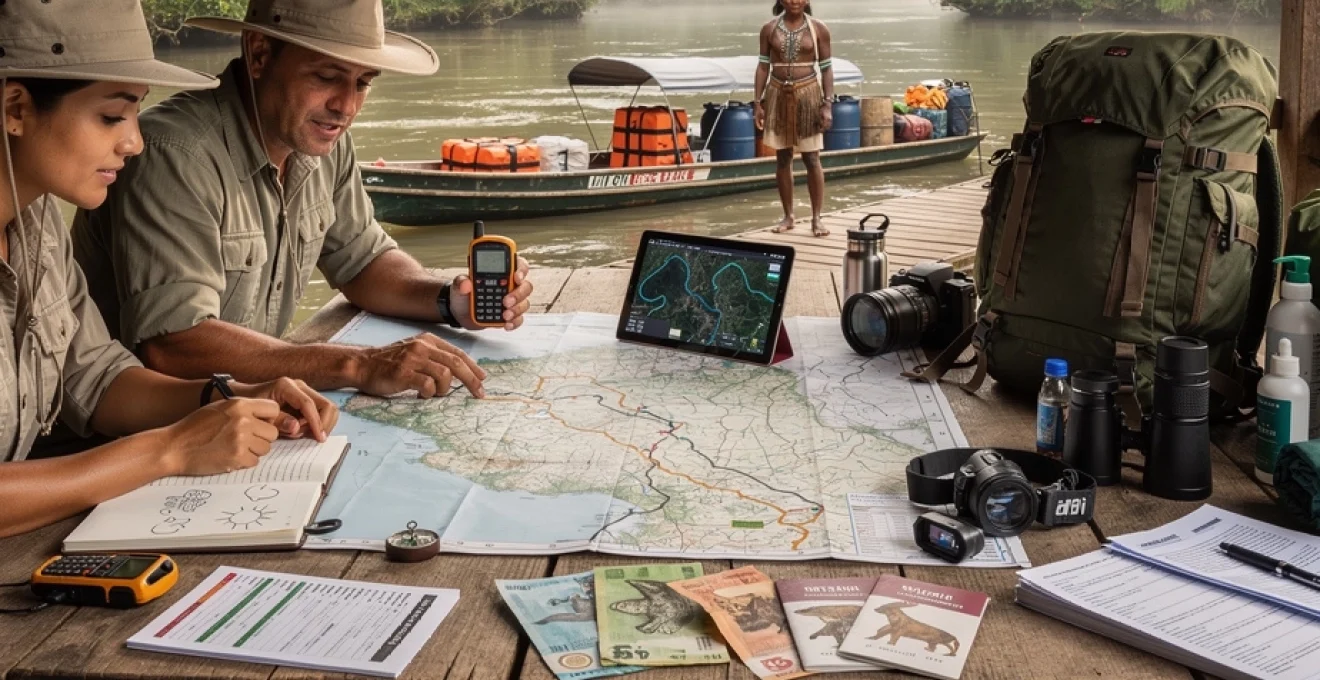
The Amazon rainforest represents one of Earth’s last great wilderness frontiers, spanning over 6.7 million square kilometres across nine South American countries. This vast ecosystem harbours more than half of the world’s biodiversity, with millions of species calling its dense canopy home. Planning a successful Amazon expedition requires meticulous preparation, from understanding seasonal weather patterns to securing proper permits for accessing protected territories. Whether you’re seeking to document rare wildlife, study indigenous cultures, or simply experience the world’s largest tropical rainforest, proper planning determines the difference between a transformative adventure and a challenging ordeal.
Essential Pre-Expedition planning for amazon basin exploration
Successful Amazon expeditions begin months before departure, requiring comprehensive planning that addresses health requirements, documentation, and financial preparations. The complexity of Amazon logistics demands attention to multiple variables that can significantly impact your expedition’s success and safety.
Wet season vs dry season logistics in peru’s manu national park
Seasonal variations dramatically affect accessibility and wildlife viewing opportunities in Peru’s Manu National Park. During the wet season (December through May), water levels rise significantly, allowing boats to penetrate deeper into remote tributaries and providing access to previously unreachable areas. However, increased rainfall creates muddy trail conditions and limits terrestrial wildlife spotting opportunities.
The dry season (June through November) offers optimal conditions for hiking and terrestrial wildlife observation, with clearer skies providing better photographic opportunities. Wildlife congregates around remaining water sources, creating exceptional viewing chances for jaguars, tapirs, and various primate species. Trail conditions become significantly more manageable, though river access may be limited in certain areas due to lower water levels.
Temperature variations during the dry season can be extreme, with cold fronts called friajes dropping temperatures to 10°C for several days. These weather patterns, originating from Patagonian air masses, require appropriate thermal clothing and flexible itinerary planning to accommodate sudden temperature changes.
Vaccination protocols for yellow fever and hepatitis A prevention
Health preparations for Amazon expeditions require specific vaccination protocols administered well before departure. Yellow fever vaccination remains mandatory for most Amazon regions, requiring administration at least ten days prior to travel to ensure immunity development. Many countries require proof of yellow fever vaccination for entry, making this documentation essential for international travellers.
Hepatitis A vaccination provides crucial protection against contamination from food and water sources that may not meet international standards. The vaccination series requires multiple doses over several months, necessitating early medical consultation. Typhoid fever vaccination also provides valuable protection against bacterial infections common in tropical environments.
Malaria prevention requires ongoing medication regimens that begin before travel and continue after return. Consultation with tropical medicine specialists ensures appropriate medication selection based on specific regional resistance patterns and individual health considerations.
Obtaining special use permits for indigenous territory access
Many Amazon regions require special permits for accessing indigenous territories and protected areas. Brazil’s FUNAI (National Indigenous Foundation) issues permits for indigenous territory access, requiring detailed expedition plans and proof of legitimate research or educational purposes. Permit processing can take several months, making early application essential for expedition success.
Peru’s SERNANP (National Service of Protected Natural Areas) manages permits for national parks and reserves, with specific requirements for group size, duration, and planned activities. Colombia’s park system requires similar documentation, with additional considerations for security clearances in certain border regions.
Research permits often require academic or institutional sponsorship, with detailed proposals outlining research objectives, methodologies, and potential environmental impacts. Community agreements may be necessary for accessing traditionally managed territories, requiring respectful engagement with local leadership structures.
Multi-tiered insurance coverage for remote wilderness activities
Amazon expeditions require comprehensive insurance coverage addressing medical evacuation, equipment protection, and trip cancellation scenarios. Medical evacuation insurance becomes particularly critical given the remote nature of many Amazon locations, where helicopter evacuation may represent the only viable emergency transport option.
Equipment insurance protects valuable scientific instruments, photography gear, and specialised outdoor equipment against theft, damage, or loss during expedition activities. Coverage should specifically address water damage and tropical climate conditions that can quickly destroy electronic equipment.
<p
Trip cancellation and interruption insurance should explicitly cover delays due to weather, river level fluctuations, and regional airline disruptions, all of which are common in the Amazon Basin. Carefully review policy exclusions related to “adventure activities” such as canopy walks, river kayaking, and backcountry trekking. When in doubt, speak directly with the insurer and obtain written confirmation that your specific jungle adventure in the Amazon rainforest is covered under the chosen plan.
Currency exchange strategies for brazilian real and peruvian sol
Financial planning for an Amazon expedition involves managing at least one, and often two, local currencies. In Brazil, the BRL (Brazilian real) predominates, while in Peru you will use the PEN (Peruvian sol). Major gateway cities such as Manaus, Lima, and Cusco offer competitive exchange rates and ATMs, but cash access becomes increasingly limited as you move deeper into the rainforest. It is wise to withdraw or exchange sufficient local currency before heading into remote regions where electronic payments are unreliable.
For most jungle adventures, a hybrid strategy works best: carry a modest reserve of USD or EUR as backup, use ATMs in larger cities for day-to-day expenses, and reserve cash payments for remote lodges, community fees, and tipping local guides. Avoid exchanging currency at airports where rates are typically unfavorable, and instead use reputable banks or official exchange houses. In truly remote areas, some indigenous communities may accept small USD bills, but relying on this as a primary payment method can create unnecessary friction and confusion.
Digital payments are slowly expanding across the Amazon Basin, but patchy internet and power cuts mean you cannot depend solely on cards or mobile wallets. Keep cash stored in waterproof pouches and split between different bags for security, particularly on river transfers and long overland segments. Remember that respectful bargaining in local markets is acceptable, but pushing for aggressive discounts in small communities undermines the sustainable tourism model that keeps jungle travel viable.
Strategic route selection through primary rainforest corridors
Designing an efficient route through the Amazon involves more than tracing a line on a map; it means understanding river dynamics, protected area boundaries, and cross-border regulations. Primary rainforest corridors often follow major tributaries, connecting national parks, indigenous territories, and remote research stations. The best jungle adventures balance time on the water, periods in terra firme forests, and strategic overnight stops at established lodges or research centers that serve as logistical hubs.
When planning your jungle adventure in the Amazon rainforest, think of rivers as highways and protected reserves as key intersections. Access points such as Manaus, Iquitos, Puerto Maldonado, and Leticia serve as primary gateways into this network. From each hub, you can branch out along specific corridors like the Rio Negro, Rio Solimões, Madre de Dios, or Napo River, each offering distinct ecosystems and cultural encounters. Your final route should reflect your priorities: intensive wildlife photography, indigenous community visits, scientific research, or multi-country exploration.
Upper amazon basin navigation via rio solimões and rio negro
The confluence of the Rio Solimões and Rio Negro near Manaus forms one of the most strategic navigation hubs in the entire Amazon Basin. The Rio Solimões, carrying nutrient-rich “white water” from the Andes, supports high fish biomass and riverine communities along its banks. In contrast, the Rio Negro’s dark, tannin-stained waters host fewer mosquitoes and a different assemblage of aquatic species, making it a favored corridor for multi-day river cruises and kayaking expeditions.
When plotting a route in the upper Amazon Basin, many travelers choose to begin in Manaus and then head either upriver along the Negro toward Jaú National Park and the Anavilhanas Archipelago, or down the Solimões toward more remote communities. River levels fluctuate by up to 10–15 meters annually, influencing which creeks and igarapés (small channels) are navigable at any given time. Working with a local operator ensures that your jungle adventure in the Amazon rainforest aligns with current hydrological conditions.
Boat selection becomes a critical logistical factor: shallow-draft vessels and motorized canoes allow deeper penetration into flooded forests, while larger expedition boats provide greater comfort but less flexibility. Consider combining a larger cruise vessel for long stretches with smaller day boats for intimate wildlife excursions into side channels. As always, route plans should include contingency options for low-water bottlenecks or sudden storms, which can temporarily close certain passages.
Pacaya-samiria national reserve waterway systems
In northern Peru, Pacaya-Samiria National Reserve forms a vast mosaic of rivers, lakes, and flooded forests often referred to as the “jungle of mirrors” because of the way still water reflects the canopy. Access typically begins in Iquitos, followed by overland and river transfers to entry points along the Marañón and Ucayali rivers. Within the reserve, transportation relies almost entirely on motorized canoes and small skiffs, allowing you to navigate narrow channels where pink river dolphins, giant river otters, and macaws are frequently seen.
Effective route planning in Pacaya-Samiria hinges on understanding seasonal hydrology. During high-water season, between December and May, boats can reach far into the interior via inundated varzea forests, offering excellent opportunities for canopy-level wildlife observation from the water. In low-water season, navigation shifts toward deeper channels and oxbow lakes, while mudflats and emerging riverbanks become hotspots for wading birds and caimans. Adjust your itinerary length and daily distances to reflect these conditions, as travel times can double when water levels drop.
Most structured jungle adventures in this reserve follow loop routes that depart from a base lodge or cruise vessel and return via a different arm of the same river system. This minimizes backtracking and maximizes ecosystem variety. Given Pacaya-Samiria’s protected status and stringent rules on camping and research activities, it is essential to coordinate routes through accredited operators who hold current permits and maintain active relationships with local communities and park authorities.
Tambopata research center access points and trail networks
In southern Peru, the Tambopata Research Center (TRC) sits deep within Tambopata National Reserve, accessible primarily from the jungle city of Puerto Maldonado. From there, a combination of overland transfers and riverboats along the Madre de Dios and Tambopata rivers brings you into one of the most studied and biodiverse corners of the Amazon rainforest. The journey itself, often 6–8 hours by boat depending on river conditions, is an integral part of the adventure, passing sandbars alive with capybaras, herons, and black caimans.
Once at TRC, visitors gain access to an established network of forest trails radiating from the lodge like spokes from a hub. These trails traverse terra firme forest, palm swamps, and riverine habitats, providing structured routes for morning birdwatching, nocturnal amphibian surveys, and multi-hour mammal tracking. Because the system is well-mapped and regularly maintained, it offers one of the safest environments for in-depth jungle exploration without sacrificing the sense of remoteness.
Planning a stay here requires aligning your international flights with fixed transfer schedules operated by partner lodges, as boats rarely run after dark for safety reasons. If your flight arrives late in the day, plan an overnight in Puerto Maldonado before continuing upriver. For researchers and serious wildlife enthusiasts, longer stays of 4–7 nights allow for targeted visits to macaw clay licks, canopy platforms, and more distant satellite trails, all of which can be strategically integrated into your Amazon rainforest itinerary.
Cross-border expedition routes between colombia and brazil
The tri-border region around Leticia (Colombia), Tabatinga (Brazil), and Santa Rosa (Peru) offers a unique opportunity to experience multiple Amazonian cultures and jurisdictions within a compact area. Flights typically connect from Bogotá into Leticia, where travelers can then cross into Brazil or Peru via short boat rides or even on foot, depending on current immigration protocols. For jungle adventures seeking a multi-country perspective, this area serves as a flexible launchpad into both Colombian and Brazilian stretches of the Amazon River.
Cross-border routes often follow the main Amazon channel downstream from Leticia–Tabatinga toward more isolated communities, or upstream into protected areas and indigenous territories. Because each country enforces its own permit systems and conservation regulations, itineraries must be carefully coordinated to ensure that all documentation—entry stamps, park permits, and research approvals—is valid on both sides of the border. Working with a binational operator simplifies these complexities and reduces the risk of administrative delays.
Given the strategic importance of this region, security protocols and navigation rules can change more quickly than in interior parks like Manu or Tambopata. Before finalizing your route, verify current advisories from local authorities and update your emergency contact list with consular information for each country you will enter. By treating the tri-border area as both a cultural crossroads and a logistical gateway, you can plan a jungle adventure in the Amazon rainforest that seamlessly crosses political boundaries without compromising safety or compliance.
Professional guide selection and indigenous community partnerships
The quality of your professional guide often determines whether your Amazon experience feels like a superficial tour or a deeply immersive expedition. Certified naturalist guides bring years of field experience, advanced wildlife identification skills, and an understanding of microhabitats that casual visitors simply cannot replicate. In many regions, regulations now require accredited guides for entry into national parks and indigenous territories, particularly when groups are conducting research or filming.
When evaluating guide services for a jungle adventure in the Amazon rainforest, ask about language proficiency, first-aid certification, and specific experience in your destination park or river system. A guide who has worked for years along the Tambopata River, for example, will know where jaguars most frequently cross, how to time clay lick visits, and which trails provide the best chances for rare bird sightings. Conversely, a generalist guide without deep local roots may rely on standard routes that are more crowded and less rewarding.
Equally important is building respectful partnerships with indigenous communities who act as custodians of large tracts of primary forest. Many of the most rewarding jungle experiences—traditional fishing demonstrations, storytelling sessions, medicinal plant walks—are led by community members operating as co-guides. These collaborations not only enrich your understanding of the forest but also direct tourism revenue to local families and conservation initiatives, reinforcing the economic value of intact rainforest.
Before visiting any community, ensure that your operator has formal agreements in place and that visits are scheduled at appropriate times, avoiding sensitive cultural events or subsistence activities. Simple gestures, such as asking before taking photographs and purchasing locally made handicrafts at fair prices, demonstrate respect and help maintain positive relationships. In a region where mistrust of outsiders is sometimes justified by past exploitation, transparent and ethical partnerships are the foundation of sustainable Amazon travel.
Specialised gear configuration for tropical rainforest conditions
Tropical rainforest conditions subject equipment to relentless heat, humidity, and abrasion, making gear selection a critical part of planning a jungle adventure in the Amazon rainforest. Cotton clothing quickly becomes waterlogged and slow to dry, while non-breathable rain layers trap sweat and lead to rapid overheating. Instead, prioritize lightweight, synthetic or merino fabrics that wick moisture and dry quickly, paired with a breathable, packable rain jacket that can handle sudden downpours.
Footwear should match your route: mid-height, quick-drying hiking boots with robust tread are ideal for muddy trails in Manu or Tambopata, while amphibious sandals or river shoes excel on canoe-based itineraries with frequent wet landings. Regardless of style, pair footwear with high-quality, insect-repellent socks if possible, and consider gaiters to keep mud and leeches at bay. Think of your gear system like an ecosystem: each component—clothing, pack, footwear, rain protection—must function together, or the whole system begins to break down under stress.
Electronics such as cameras, GPS units, and satellite communicators demand extra protection in the Amazon. Use dry bags and desiccant packets to combat humidity, and pack redundant storage media for high-volume photography or video work. Many travelers underestimate how quickly lenses fog when moving from air-conditioned spaces to humid forest air; ant-fog wipes and gradual acclimatization routines can mitigate this. A small, solar-compatible power bank or compact folding solar panel provides added security on longer expeditions where power outlets are scarce or unreliable.
Finally, do not overlook “micro-gear” that has outsized impact in the field. A compact headlamp with a red-light mode preserves your night vision on nocturnal wildlife walks. A basic field notebook and pencil—far more reliable than a phone in the rain—allow you to record sightings and GPS coordinates. And a lightweight hammock with integrated mosquito netting can serve as both emergency shelter and an ultra-relaxing way to experience the forest sounds at night. The more you tailor your gear to the realities of the Amazon, the more freedom you’ll have to focus on the adventure itself.
Wildlife encounter protocols and biodiversity documentation techniques
Wildlife encounters are often the highlight of any jungle adventure in the Amazon rainforest, but they must be managed with strict ethical and safety protocols. Animals in protected reserves are increasingly habituated to human presence, making it tempting to approach too closely for photographs. Maintaining a respectful distance—typically at least 5–10 meters for most mammals and birds—reduces stress on wildlife and minimizes the risk of defensive behavior. Your guide should set and enforce these boundaries, especially when large predators or territorial species are nearby.
Noise discipline is equally important. Whispered conversations, slow movements, and careful placement of feet on forest trails enable closer, more natural observations than loud, hurried groups. Flash photography should be used sparingly, if at all, particularly with nocturnal animals whose eyes are adapted to low light. Think of yourself as a guest in someone else’s home: your goal is to witness daily life, not to disrupt it. This mindset not only yields better wildlife moments, it also aligns your personal expedition with broader conservation ethics.
For travelers documenting biodiversity—whether casually for personal records or systematically for citizen science projects—simple methods can greatly enhance the scientific value of your observations. Record the date, time, GPS location, habitat type, and behavior for each notable sighting, using a notebook or a dedicated app that syncs when back online. Platforms like iNaturalist and eBird, for example, allow you to contribute data that researchers use to track species distributions, migration patterns, and population changes over time.
High humidity and low light conditions present significant challenges for wildlife photography. Fast lenses (with wide apertures), image stabilization, and higher ISO settings help compensate for dim forest understories, while rain covers and lens hoods protect against sudden showers. Instead of chasing every animal, consider focusing on a few target species or behaviors—such as macaws at a clay lick or river dolphins at dawn—and designing your daily schedule around these peak activity windows. By combining ethical encounter protocols with thoughtful documentation, you transform your jungle adventure into a small but meaningful contribution to Amazon conservation knowledge.
Emergency evacuation procedures and medical response planning
Even with meticulous preparation, remote jungle travel carries inherent risks, making clear emergency evacuation procedures non-negotiable. Many Amazon lodges and river vessels maintain basic first-aid kits and radio contact with regional hubs, but serious incidents often require multi-stage evacuations. This might involve boat transfer to the nearest town, followed by a small-plane or helicopter flight to a larger city such as Manaus, Iquitos, or Cusco for definitive care. Before departure, confirm exactly how evacuation would work from each leg of your itinerary and how long it is likely to take.
Travelers with pre-existing medical conditions should obtain written summaries from their physicians, translated into Spanish or Portuguese when possible, and carry sufficient medications for the entire journey plus a buffer supply. A personal medical kit tailored to tropical conditions—oral rehydration salts, broad-spectrum antibiotics as prescribed, antihistamines, and treatments for gastrointestinal distress—can prevent minor issues from escalating into serious problems. Think of this kit as your first line of defense in an environment where pharmacies and clinics may be days away.
Communication protocols form another pillar of emergency planning. Satellite messengers and PLBs (personal locator beacons) offer reliable alternatives to mobile networks, which are often nonexistent once you leave major river towns. Discuss with your operator who is responsible for carrying such devices, who receives emergency alerts, and what chain of decisions follows an activation. Ideally, at least one member of your group should hold current wilderness first-aid or wilderness first responder certification, especially on custom or exploratory itineraries that push beyond standard tourist routes.
Finally, rehearse your response to likely scenarios before you encounter them: a severe allergic reaction, a broken limb on a slippery trail, a capsized canoe during a sudden storm. Walking through these possibilities may feel uncomfortable, but it transforms abstract risk into concrete procedures that your team can execute under pressure. When combined with robust insurance, competent guides, and conservative decision-making in the field, a clear emergency framework allows you to embrace the intensity of the Amazon with confidence rather than apprehension.